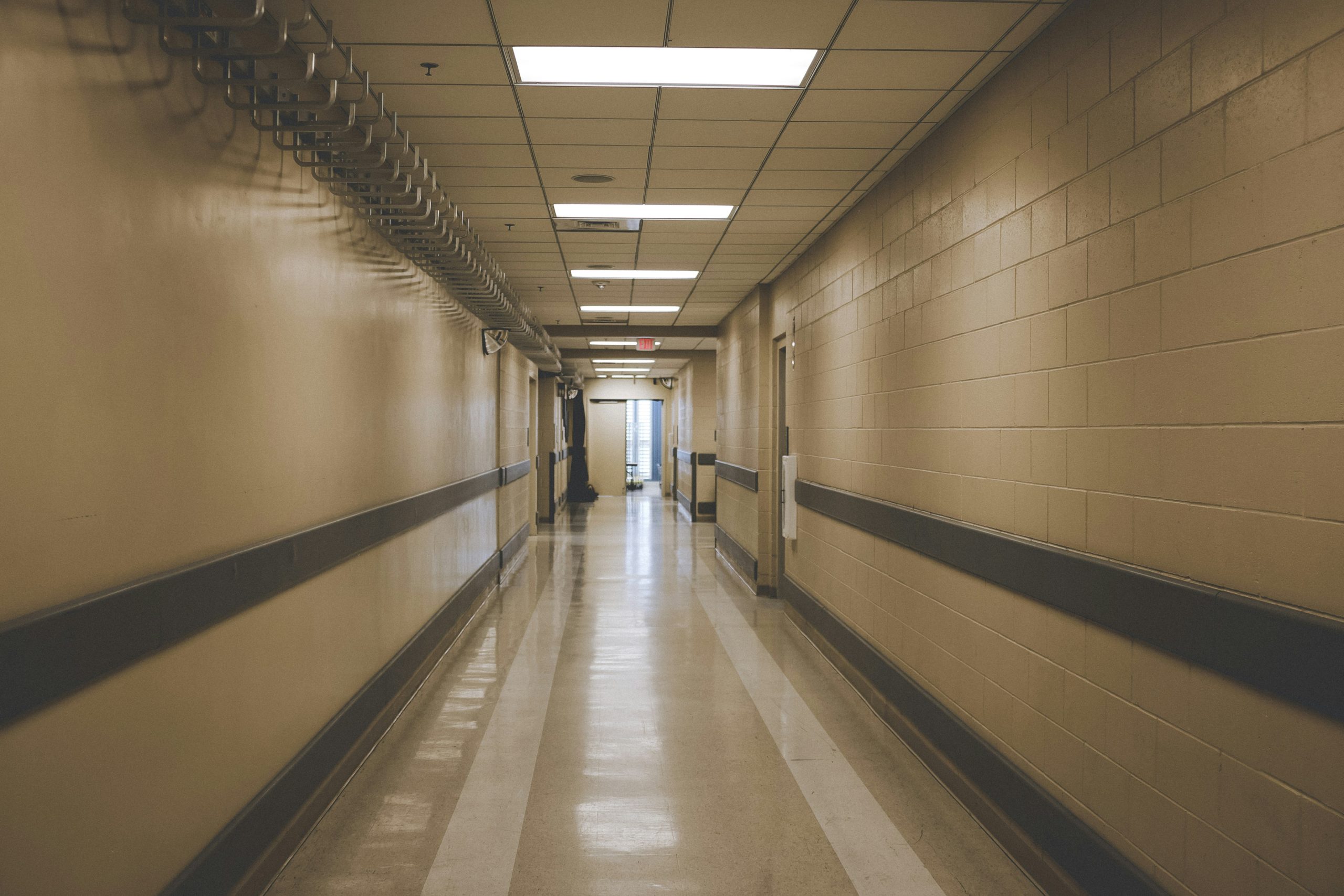
The nurse teaches us like this: you rub and rub and rub ‘til it seeps into your palmar lines and settles in that corridor for the week. Purell atoms; if you aren’t smelling a college night, she says, you haven’t rubbed enough. She demonstrates with dry apricot hands, chafed into 100-grit sandpaper. Fist raised, she wheezes: knuckles aren’t an afterthought. See how I go over, under, around. Bones for eyebrows. You have to sniff oatmeal bars through her face mask to hear her. I pack them for my partner too, she tells us, in case he gets hungry after Shepherds’ pie leftovers. It can make you camel-thirsty, though, all that Worcestershire. Ye shall drink like diseased camels raging with thirst! Her colleague from Chandler taught her that one. Now, watch as I tie the gown at the back, just like this. Hands never touch eyes or mouths. If you touch your eyes or your mouth, you might as well tongue kiss our residents. And your knuckles, she says. Watch those knuckles.
*
Caroline on the third floor says she’s Polish. She’s never been to Poland, and I can tell she had to exaggerate the lilt until her accent stuck. I believe her not because it’s true but because disputing feels cruel. She failed a spy screening for the government once, too many tattoos – faded cerithium and coiled boughs. Every morning she panics about a school bus that isn’t coming. Help me tie my hair, she says. The bus has already left, Caroline. Help me tie my hair. A lift assist looms over her bed – a steel insect, the structure moving on locking casters. It hooks into a nylon sling that cradles Caroline’s body. I was taught to gently roll her to the side, tuck the sling beneath, skin liquid under my gloves. I clip loops onto the spreader bar: two at the shoulder, two at the legs. The T-shaped handle goes up and down. Caroline’s eyes close on the ascent, hydraulic pump whirring when fluid is forced through the valves. I always look away. I’m not sure why. A netted fish, she sways in the center of the room for a second too long.
*
They brought in nine of us as service aides because the nurses had stopped showing up. They were falling sick and taking their children down with them. Nurses always had three kids at home, never two, never one, which made for an exponential spread. Your grandparents are neglected in their retirement homes, the job description read, they cough blood on mildewed sheets and talk to the wall, right beneath where your wedding pictures hang. Would you like to save your grandparents and pocket twenty-eight Canadian dollars an hour before tax? At the time I was talking to walls myself. The apartment had started smelling like the inside of a fridge, all that soured dairy and sealed plastic. I was sleeping when I wasn’t eating and hovering when I wasn’t sleeping. The job had a heroic narrative appeal. I could already hear myself sighing to my mother on the phone: the mouths I’d fed, backs I’d scrubbed. She’d ask what would happen if I caught it – if my lungs burst with fluid. The possibility didn’t trouble me much. I didn’t say so.
*
That morning Caroline doesn’t ask about the bus. She lays still under the covers, hands crossed. I catch the faint mix of citrus perfume and urine. We all look the same to them, faces fogged behind plastic. If she knows me, it’s only by my eyes. She looks up, nods. Can you lift me? There’s a stillness about her, slack jaw and steady breath. The light from the blinds catches her tattoos, sidewalk chalk after a night of rain. My hands reach for the nylon above. She shakes her head, grunts: Can you lift me?
*
We work in pairs. Beds, laundry, bleach-wipe surfaces in frantic circles. I asked for the third floor, where residents can still hold a conversation. Laurie, my partner, is round-cheeked and sharp-eyed. She never laughs unless she means it and she never means it. Her septum piercing snags on the mask almost daily, and she makes a ritual of turning away, shaking it loose as if to remind me it was there. We move from room to room with sacks of linen. We peel off soiled sheets and pads and dump them into a plastic bag. Laurie chews gum and talks the air dry. She’s always talking. She can’t stand the quiet. We fit the bottom sheet tightly over the mattress corner on the cleaned side, tuck the draw sheet. My uncle died on the bus, she’s saying. Just didn’t get off. She smoothes the sheet with the flat of her palm. Laurie moves like the girls who’ve lived many lives, who can braid their own hair and clean bathroom vents. Driver walked back to him, told him sir, we’re here. Tapped his knee a little. Nothing. Laurie tears the pillowcase clean in one go. He looked like he was sleeping, that’s what they told us. Just his head back and his arms all tucked. A pause to chew: They pulled him out quiet. In some rooms, Laurie would throw the end of the sheet with unnecessary force, or would get to both pillows before I even started. I couldn’t tell if she was rushing or trying to win. We drop the linen in the bin, close the door. My mom got the call while she was frying eggs, Laurie says. Told us he was always a quiet guy. Said it tracked.
*
It takes longer than I would like to admit to realize an old man is still a man. His walls are bare: no sepia-toned graduation photos or Structube-bought paintings of flower pots. No ornamented pillowcases to make his being here feel more like a choice. His family is back in the Middle East. That kind of bareness triggers something maternal in nurses. He enjoys leaving loaded diapers for us to find in different corners of the room, tucked behind chairs and under radiators, with varying degrees of heaviness. The stink clings to the wallpaper, his clothes, the parquet. It hugs my socks when I take them off at home, wafts from my sleeves when I toast bagels in the kitchen. He spoke in grunts and dismissive waves until I asked if he wanted milk with his breakfast in Arabic, once. The nurses caught him giggling. They gave him to me: Bingo, lunch, bedroom, steer him like a stroller, wheel the smell of shit along with us. Laurie can’t speak Arabic. Your dimples, he says. What about them?
*
There is no one in the hall outside Caroline’s room. The head nurse went upstairs – a spill, maybe vomit – and Laurie is waking up the others. The furniture seems to hover an inch above the ground. Caroline lays in bed like a bundle of sticks coming loose in a sack. Go on, she says. Her hands claw the cotton, their tremor almost impersonal. Her eyes are fixed on me. We’re not allowed, Caroline – but the wails start. I slide one arm beneath her back, the other grips her calf. An animal sound from the bottom of her throat. Sweat runs into my eyes. A butchering. I switch to her knee instead. My gloves slide against her spine and each ridge shifts as if breaking loose. I rock her to the center. A whale blue stare, unblinking. I cannot remember what they said about lifting, besides to avoid it. Through thighs or through arms. Laurie would have known where to pull, where to brace, what to whisper. My arms around her: please, let’s use the lift assist, I say. She screams. I lift; the weight isn’t heavy the way a rock is, it shifts around. Her head presses against my chest, slack and hot. My knuckles wipe at the sweat on my forehead and eyes and I realize I’m shaking.
*
After, I stay outside her room. My gloves are still on. I’m not sure if I’m waiting for someone to call out or need to know she’s breathing. It feels like leaving a baby face-down in a tub, like I’ve done something not quite human. Later that day Laurie’s talking about a cat her neighbor ran over. My hands can’t remember the order of the sheets. I tuck a draw pad before the bottom layer, rip it all back out. Laurie doesn’t say anything.
*
We gather by the elevator for afternoon tea in the garden. The usual clatter of brakes and squeak of rubber wheels. Each of us has someone in tow, their heads slumped. Someone balances IGA-bought lemon cookies on their lap. Him and I get looks; a few sharp noses wrinkled. The smell walks ahead of us now. Sun looks strong today, someone says, shielding her eyes with manicured hands. He laughs, loud and sudden, and it echoes down the corridor like a bark. He turns in his chair and looks up at me, perched like a boy at a bus stop. In Arabic, kind like a compliment: you’d look good chained in my basement. The elevator dings. Sunlight waits down there, tables with paper napkins. I wheel him in. They watch us like we are in on something.
*
It takes seven days for the virus to crawl into Caroline’s lungs and kill her. Her grandson comes to the window and presses his palm against the glass. The fever climbs and does not come back down. I can hear her wails from the hallway when Laurie and I make our way through the linen rotation, as if I am still pulling at her limbs. They move the lift-assist away from her bed. No reason to move her around anymore. She’s zipped into a bag that shakes on the gurney. It must be dark and quiet in there. I walk with a cough rising dry up my throat, almost clawing. Her skin was so thin it almost invited it.
*
On my walk home I call my mother, kick stones off the path. What’s the building look like? A building. Then, because she’s still waiting: A hospital, if it were an apartment. Beige bricks. Long windows. Lots of signs. What do you do there? I switch the phone to my other hand. Make beds, I say. Open milk cartons. Help with socks. Stuff like that. The air smells like Lysol; I pass a tree, tear off a leaf, press it to my nose. They like you? Some of them. Mostly they just want the lights turned on and off. The leaf starts to melt in my palm after a while, lines breaking down into mush. They like things a certain way, I say.