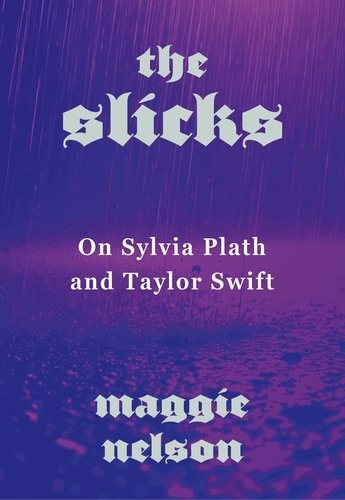
Maggie Nelson’s book-length essay The Slicks, about cultural icons Sylvia Plath and Taylor Swift arrived on November 25th from Graywolf Press, hot on the heels of Taylor Swift’s twelfth studio album, The Life of a Showgirl. Originally published by Dopamine Books as a limited run zine, The Slicks is Nelson’s thirteenth book. I was drawn to this little volume for its gorgeous cover design—a torrent of purple rain falling behind gothic letters—and its slim profile. Plus, I was dying to get my hands on the latest Maggie Nelson.
Reading Maggie Nelson is like drinking from a well. It refreshes and brings clarity to the mind. In The Slicks, her sensitivity to complicated dialogues about Taylor Swift and Sylvia Plath is well considered, measured, and researched, but she does not simply rely on facts to do the talking. Rather, Nelson is notably lucid in her construction of this unlikely comparison, the pairing of two famous artists across time—one alive and one dead—each, as she ascertains, criticized for similar faults despite their shared significance as modern heroines. She makes this parallelism both lifeblood and major object of contemplation in this essay—a jumping-off place to say: not much has changed. Fans celebrate as Plath’s and Swift’s stars grow brighter while critics rue the reign of these female artists, as if their contributions to literature and song have not been enough. This splitting of favor and judgment twists these artists’ reputations into a mess of controversy that most unopinionated bystanders would not dare oppose. Nelson dares.
***
The salient points of interest for Nelson lie in the ancient and upheld cultural practice of silencing women for their “sonic outpouring[s].” One of her recurring motifs in the essay is the Greek virtue of sophrosyne, or orderly temperance and male self-control, defined in contradiction to female expression. Spill or abundance, Nelson reminds us, has more fans than critics, yet it continues to be derided as lowbrow art. She also points out that such rational-passing analysis is often accompanied by a barely-suppressed attempt to sound more worldly or superior. She quotes Anne Carson’s essay, “The Gender of Sound,” published in Glass, Irony and God (New Directions, 1995):
I wonder if there might not be another idea of human order than repression, another notion of human virtue than self-control.
This timeworn preference for sophrosyne sees its revival in the well documented Gen Z distaste for oversharing or the popularized label “cringe,” which deems sonic outpouring as “trying too hard.” The Life of a Showgirl is “full of cringey sexual innuendo,” Amanda Petrusich opines in the New Yorker. I, too, a zillennial born on the cusp of cringe culture, winced the first time I heard the song “Wood” (and every time that followed). I have learned that however fashionable, cringe is a personal reaction, not an aesthetic or particularly artful analysis rooted in theory. If we are interested in aesthetic interpretations, Nelson avoids them in her essay, choosing to comment instead on the meanings behind Plath’s poems and Swift’s lyrics and what the two artists symbolize in the regulatory system of sophrosyne vs. spill.
Perhaps like many of us who encounter Swift’s music in grocery stores and skating rinks and wherever pop music is played, Maggie Nelson genuinely feels neutral about it. It can be difficult to resist the thrall of Swiftdom when each new year brings a potential new album, and with each album the risk of artist reevaluation. However, Nelson avoids making any statement that would indicate a preference for or against Swift’s music. She does celebrate Swift’s “genius for pop” as well as the “transmutation of [Swift’s] emotional life into epic, public journey”—appraisals that eschew personal opinion. She also calls Swift’s music “perfectly orderly” and states that “no one has to like it or listen to it” to place value on it. Her musical taste, however welcome, stays off the page.
Rather than fight Swift’s critics with music theory and craft, Nelson makes a more obvious claim: Their criticism is flawed. Her clapback to these critics of self-indulgence is keen and penetrating as she charts their collective derision (one that “arrives dressed up in new clothes every decade or so”) from the ’50s until now and summarizes the clichéd script shaming the making of the personal public: Commonly the denigrator considers the personal to be a “rotten source of art” and presumes that “work with a disclosing first-person speaker is uncooked confessionalism concerning only a single self.” Nelson reminds us that in the words of Nietzsche, every great philosophy comprises “the confession of its originator, and a species of involuntary and unconscious autobiography.” In spite of decades of uncoolness, readers and listeners remain drawn to deeply personal work. Maggie Nelson included.
It’s surreal to write literary criticism about literary criticism, especially of a writer like Maggie Nelson, whose literary panache has earned renewed attention and admiration from readers, thinkers, and theorists for the last two decades. Her cult-favorite books The Argonauts (Graywolf Press, 2016) and Bluets (Wave Books, 2009) captured my attention early on because no one was attempting what she so confidently did in these genre-defying titles. One is a memoir interlaced with citations and told in vignettes while the other is an assemblage of prose poems meditating on the color blue.
Maggie Nelson’s impressive oeuvre holds both restraint and spill in equal measure. Though she writes about subjects ranging from queerness to violence, her works are deftly balanced. They betray no sign of artifice. She makes her arguments out of complete, sound reason, yet beneath the surface readers discern her personality and emotions. They sparkle undeniably. Nelson is a master at this. Her approach feels authentic, her essays clearly ring of the personal. I wonder if there is great irony in the brilliance of Nelson’s work: even a poet and scholar of her caliber cannot pour too much of herself into her writing—or at least she has taken great care not to be considered “emotional.” This is why she makes a strong advocate for Plath’s and Swift’s work.
Every artist’s star eventually winks out, even one marking the storied career of a “hyperproductive, globe-trotting, serial-dater” who once achieved global domination. In that sense, poetry and songwriting are similar. Though one occupies a “degraded and exalted position in capitalist culture”1 as the other enjoys widespread digital attention and circulation, both artistic pursuits are bound by the rise and fall of public opinion. Participants in the “project of fame,” Plath and Swift can be considered both victim and beneficiary of patriarchal valuation (though Plath didn’t live to see her work celebrated). As Nelson puts it, the famous person comes to “signify a phenomenon that exceeds her . . . and over which she has little control.” Her original self must die so the performer can live. When fame deserts, what remains?
It is wise to remember that criticism occupies the same temporal relevance as the artist it evaluates. Fans and critics of Taylor Swift, Sylvia Plath, and Maggie Nelson rejoice—the bottomless wells from which they draw power show no sign of drying up.
1 a paradox Ocean Vuong also once cited during a cameo appearance in my poetry class