
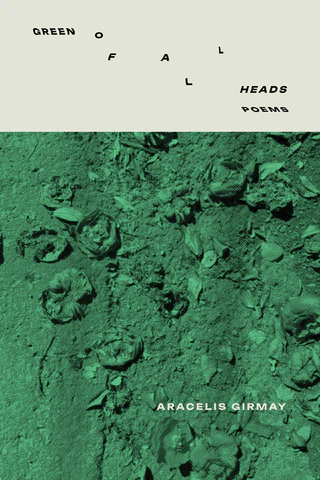
Aracelis Girmay’s searing new collection Green of All Heads is a sumptuous gift of love and grief for family, place, and community. The book continues Girmay’s exploration of evergreen themes in her body of work, such as death, immigration, and colonization. In Green of All Heads, however, Girmay looks at these issues through the prism of her father’s death, which results in a collection that is shimmeringly surreal and existential. The individual becomes the collective and the collective is distilled through an individual, revealing the shared reality between us, and the fluidity between place, identity, and memory. The elasticity of the mind and the perspectives within people are reflected in the following verse,
Right after Dad’s stroke
I could not keep
A fact or
Sentence straight…

And it goes on,

...For ‘him’ I said
“They,” or said
My brother’s name,
& then my son’s,
& also sometimes
Instead of “Dad”
I said “I”...

In these stanzas, we can see that the subject matter of the poem mirrors the poem itself. Girmay is describing how after her father’s stroke, it is she, rather than her father, who struggles with memory and language. This is a typical aftereffect of a stroke for the patient, but not for a stroke victim’s daughter. Girmay is taking on her father’s pain. It is a collective pain, with roots in a communal reality shaped by  shared history, language, cultural traditions, and religious practice. With a change of perspective in these lines, the idea of the “individual” begins to disintegrate as we can’t tell throughout the rest of the book who “I” is, who “he” is, and so on. These are the themes that dominate the first third of the book, as if Girmay is grounding us before the vertigo to come, signaling that we are about to question reality itself..
In the beginning, as Girmay rips the floor out from under our feet, the themes of colonization open up slowly like morning blossoms. For instance, in the poem GLASS VOICE,
The music teacher from seventh grade.
Not her name, but her hair.
Oak-colored. European, half-austere.
And how she had us all take turns going into her classroom
to sing
And she told us, like a reverend with her wooden voice, what we
were. Alto, soprano.
In another poem, TRANSMISSION, we also see the rumblings of colonization in one striking line at the end of the poem,
We are all of us here because of war.
Colonization is central in the web of elements that shape the book toward a mournful tone. Girmay sets us up knowing we are situated in an unstable reality. Point of view and even personhood are interchangeable. Identity is lost. Through the opening, Girmay places readers directly in the position of the colonized. The deepest existential questions immediately gather around the text like clouds, “Who am I without that which I know myself to be?” “Where is home if nowhere is my home?” When these poems appear in the book around page 50, our sense of being lost in a desert begins to fade as the author illuminates the path before us. This recalls Palestinian philosopher Edward Said, the founder of post-colonial studies and the theory of the “other.” As Said describes it, “othering” occurs when the colonizer centers themselves in all things, thereby leaving anyone who is not a member of the dominant culture (in this case, white Europeans) as “othered,” pushed to the margins. Girmay is placing readers in the position of colonized peoples; displaced, robbed of home and identity. Colonization is not an immediately clear theme of the book, however, the author draws readers to experience colonization through the unstable grounding of the book’s tone and structure.
Another subterranean theme of the book comes in the form of an anaphora, presented in the poem:
YOU ARE WHO I LOVE
1/2017-1/2025
You dancing in the kitchen, on the sidewalk, in the subway
Waiting for the train because Stevie Wonder, Hector Lavoe,
La Lupe
You stirring the pot of beans, you washing your father’s feet
You are who I love, you
reciting Darwish, then June
The identity of “you” is ambiguous , which is in keeping with the book’s fluidity of perspective . When this poem appears over three-quarters into the collection, it immediately feels different than the rest. The poem is written as an anaphora, wherein the first line of the poem is repeated throughout. In this case, every stanza begins with “you.” Anaphora is typically used to invoke something lost. It is reminiscent of an incantation, much like the spell-casting refrains of the witches in old cartoons stirring their cauldron. In this case, Girmay appears to summon not just her deceased father, but her collective ancestors. The ancestors we all have form our own individual collective, part of what many spiritual traditions refer to as “spiritual team.”
Another device apparent in this collection is the use of negative space. Girmay achieves this in several ways; firstly, through her use of surreal imagery, Girmay leaves us floating in the ether. By sheer lack of placement and specificity, we inhabit negative space for the entirety of the book. A kind of open field of creative utopia, where anything is possible because nothing is certain. You are in another reality, different from your own. The other way Girmay uses negative space is through literal blank space within the text,
ANSWERS TO YOUR DISAPPEARING QUESTION
Yes, we will – – we have been trying – – for as long as you – – have been – – where, – – in the air?- –
These are fragmented thoughts, depriving readers the ability to easily decipher a linear story. This is a commentary on time, place, as well as an implicit question as to where stories go and who gets to tell them. Who has possession of the stories of the colonized? Where do those stories go when people die and become ancestors and there’s no one left to tell them? Girmay distills the book in a few poignant lines,
FOR A.
I wrote: “I cannot recall.” Then waited
three days. I think I see
Her eyes now. Wet, dark petals.
Her eyebrows are barely there.
On her forehead is the green, fading cross.
It is the green of tears, the green of flies.
They pollinate me with memory.