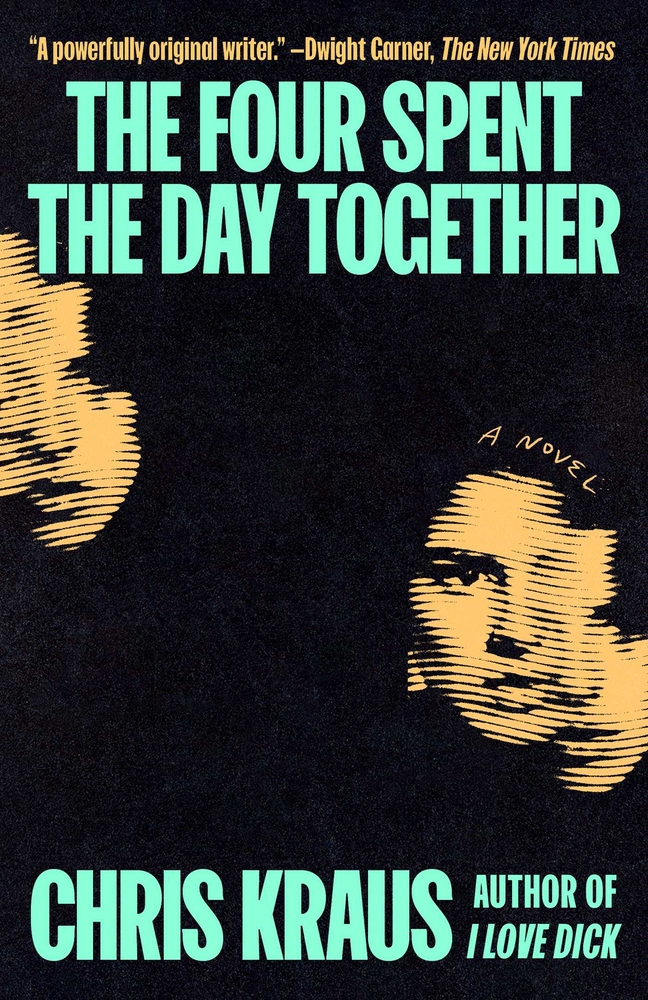
It is beyond ironic for a feminist writer who cut her teeth publishing a work of feminist disclosure, which names and publicly shames misogynist men and institutions, to sour on such modes in a post-MeToo political climate. Worse still, perhaps, to boast unapologetically about land-lording during a housing crisis. Does that make Chris Kraus’ new novel, The Four Spent the Day Together, daring in the tradition of her earlier works? According to its early reviewers, it falls short when compared to her previous writing… but it’s Chris Kraus of I Love Dick fame! Radical, right? The iconicity around that 1997 book and the mythologization of its beloved author enabled a permissiveness toward what is neither great writing nor politics.
Devoted readers recognize the familiar thrust of Kraus’ corpus— like her earlier books, she brands her newest a “nonfiction novel” which centers serious girls and women, considers fraught and unequal interpersonal relationships, and is disloyal to form. In other words, it’s a fictionalized memoir testing the limits of facticity and falsity while dabbling (this time) with the conventions of crime writing and the inclusion of direct messaging transcripts. Written in third person and in three parts (plus an appendix), The Four Spent the Day Together dully glistens with the crisp details of small town living and the patinated gilding of suburban homeownership.
Beginning with an eerie story set in a Suburban Bardo, the narration details the archetypal minutia of family life ad nauseum: uncomplicated pregnancies, the PTA, “new ways to get three meals out of a chicken,” and so on. A vivid first part of the triptych, “Milford” opens with a modernist stream of consciousness exposé of the Greenes: Emma is a cheap, bored housewife who longs for culture and worries over her children; Jasper, the family patriarch, is a pretentious, self-taught book snob with delusions of grandeur and a faux British accent; Charlotte (Kraus’ avatar) is a precocious daddy’s girl enticed by culture and art but eventually sucked into a young adult life of drugs, hitchhiking, and playing hooky; Carla, the youngest child, is a manipulative “late bloomer” suspected to be autistic or living with some personality disorder. In this section, the prose is grounded and less cerebral than in other parts of the book, focusing on the stuff of everyday life. At times tongue-in-cheek, it portrays the impossibility of culture in rural townships, as Emma, Jasper, and Charlotte, each in their own way, long for a little slice of class and culture they never quite attain while in Milford. Charlotte “hated the way her mother repeated popular phrases from Father Luke’s sermons, TV, and Newsweek. It was so middlebrow.” What could be worse! As she matures, Catherine grows into herself as Catt and sees this striving as shameful. Bored, bullied, and longing for New York, Catt huffs Liquid Paper and hitches rides out of suburbia to associate with radicals, hippies, bikers, or drug dealers. The section concludes with the news the Greene’s are moving to New Zealand, escaping the limbo of Americana.
The pivot between “Milford” and “Balsam,” the book’s part two, jars. The reader is teleported from Catt’s anxious coming-of-age in the ’60s to a tech-referential 2010s. Speeding through her formative years, sidestepping New Zealand altogether, and jumping over a marriage, an education, and the start of a career, this section delivers readers from Catt’s rough-and-tumble young-adulthood into a period of relative comfort and renown back in America. Catt’s written a cult classic book called I Love Dick. What follows is a repetitive catalogue of her days between Balsam and California, and a look at the obsessive logics of addiction via Catt’s spouse, Paul Garcia (a recurring character from Kraus’ Summer of Hate, modelled on her partner Philip Valdez), as he recovers and relapses. The plot mutates into both critique and defense of property and gentrification. This section drones on in an uneasy hum, detailing Catt and Paul’s lives as functional addict and successful artist, trapped in the locked groove of unhappy liberal domesticity, buying, selling, fixing, and renting out properties. During the ensuing Trump years, they weather tumult of strange politics and an entropic world: “The invisible mesh of surveillance and data control that surrounded the world was tightening. Time sped up, a continual stream of cascading events that meant less and moved faster.” There’s little hope for the utopic potential of the web, little faith in how so-called radicals are mobilizing against an authoritarian state. The narration plods along in a tedious rhythm of pessimism, entropy, and addiction: “the only conclusion they reached was to keep going.” Eventually, though, the repetition culminates in the dissolution of Catt’s second marriage as she finally leaves Paul. Their interpersonal conflict coupled with Paul’s abusiveness are accompanied by a curious post-feminist arc in which Catt rides the wave of her successes after writing I Love Dick, defending her motives as a landlord to her critical readers (just as a decade ago Kraus had done when I Love Dick resurfaced in cultural discourse and she was criticized for incoherent politics).
The third part of the narrative triptych describes Catt’s amateur sleuthing and efforts to commune with neighbours in the Iron Belt. In classic Kraus fashion, obsession drives the plot and its third part, “Harding: The Four Spent the Day Together,” describes how Catt’s preoccupation with the senselessness of a meth-fuelled murder leads her to investigate the facts of a young man’s killing. She commiserates with other landlords over the depravity of the young people leasing their properties, the degeneration wrought by technocapitalism and drugs, the supposed opacity of violent human action. At first blush, this section appears as non-sequitur to Catt’s childhood and adulthood which preceded it. But Catt’s life as preface to the crime invites the reader to draw parallels and to question good and bad rebellion. There are obvious connections between Catt in part one and Brittney in part three—Brittney is the moody and reckless young woman who links up with lonely Brandon online, invites him over, accuses him of rape, and encourages her boyfriend to kill him thereafter. Catt too had been a troubled and eclectic child, experimenting with drugs and longing for connection and change. But Catt’s childhood was edgy, not destitute, because she outgrew it. Brittney, who never outgrew her defiant streak and never transmuted her rebellion into an appropriate outlet, (like writing or house-flipping), is a lost cause. The difference between Catt and Brittney evinces the vulgar degeneration wrought by these last decades.
Throughout the book, there is an undercurrent of gendered sexual violence, implied but left largely unrepresented by the narrator. Emma is an unspoken victim of incest, Catt is targetted and drugged by older men as a minor. The vague description of instances of sexual assault seem at first a calibrated choice to preserve the integrity of the victim (refusing to spectacularize sexual violence). Then, in the book’s third part, an alleged sexual assault is cited as the motivation for Brandon’s murder, and the dearth of evidence of sexual violence throws into relief assumptions about witness testimony. Whom do we believe? Children, housewives, addicts? The narrative hints that Brittney falsely claimed (to her boyfriend) that Brandon raped her, which motivated Brittney’s boyfriend to orchestrate Brandon’s slaying. In part two, “Balsam,” we also learn about Catt’s sympathy for Avital Ronell, an acclaimed critical theorist renounced for sexually harassing Nimrod Reitman, a gay male graduate student. Catt/Kraus defended Ronell in the court of public opinion and undermined Reitman’s allegations against Ronell, coloring them as “opportunistic,” in a 2018 blogpost. As if women cannot exert authority over subordinates of whatever gender and sexuality. As if sexual harassment is about sex and not power. As if Kraus doesn’t know this, hasn’t written about it. In contrasting Brittney and Reitman with Emma and Catt, the difference seems to be that real cases of sexual violence are unrepresented or unrepresentable, and victims bear the weight of assault without harming others in sharing their testimony. Taking jabs at MeToo and dedicating ink justifying Ronell’s behavior when Kraus’ rise to fame relied on such testimony undermines her own legacy. Have we begun to listen to too many women? or the wrong women? Through The Four Spent the Day, Kraus disavows what she herself has come to represent and what she opined, decades ago, as politics. Politics for me but not for thee.
The dominant reading of Kraus’ work has held that, for her, the form has been the story: the way women can use art to create themselves is of great importance in her writing. But this new novel relies too heavily on the groundwork of previous publications, while undermining their ethos, such that what once vibrated with formal radicalism now stagnates. Perhaps ironically, the turn to more conventional prose, as in the first section of this book, seems Kraus’ greatest departure—it’s an irksome domestic drama fixed in aspic. But the navel-gazing middle section regurgitates well-trod autobiographical ground and is disappointingly interspersed with defensive conservative content lacking style. Like Catt, Kraus has trended on Twitter and was lambasted for her landlordism. To her credit, she never concealed the house flipping, detailing homeownership in most of her autofiction. Kraus’ protagonists are anti-heroes; it’s no surprise she is a complex, somewhat problematic figure. I love her for this.
In a similar vein, The Four Spent the Day is wickedly successful in discomfiting the reader—perhaps particularly by unsettling the newest generation of Kraus readers, young women coming to her during the resurgence of I Love Dick in the 2010s (a revival referenced in this book). But she does so by assuming that half her new readership is nothing beyond spunky pop-feminists reading I Love Dick on the subway for shock value–then she is surprised to find some acolytes repudiate her politics! I can sympathize with the way that Kraus uses this book to vent her anxieties about being misinterpreted in the thralls of her fame by a neoliberal hoard; she’s often spoken about how I Love Dick lives a cultural life of its own, separate from the book about Guatemalan civil war and class struggle she believed herself to have written. It makes sense that she has fretted over her representation: questioning who she is, what role she plays in the artistic ecosystem, how she simultaneously represents culture and counter culture. But perhaps the indictable offence is using one’s art to defend the exploitative practice of proprietorship when one ostensibly engages in that proprietorship in order to sustain one’s art.
Yes, a feminist writer who famously penned a tract cancelling the institutions of men writing in rebuke of cancel culture is an exciting premise. Left leaning politics are fractured, purity politics within progressive ranks have made mobilizing difficult. Yet the hypocrisy of disavowing the form of disclosure, which allowed one to purchase nice houses to rent out to poor people, makes it such that the ethics of this book fail to hold water. Who is all this for?
It’s very meta: One cannot discuss the merit of The Four Spent the Day without recourse to I Love Dick because the former incorporates the latter. Reviews for this book all begin with reference to that book,in praise and admiration of that which cushions reception of this. The character of Dick in I Love Dick was a figure representing the cruelty of one man, while metonymizing the attitudes and behaviors of all sexist intellectuals within the art scene at that time. I Love Dick was, after its tepid initial reception, eventually hailed as a subversive book, so we expect Kraus’ subsequent work to follow suit. And yet, we must move on from I Love Dick at a certain point to recognize that Kraus is Dick for many people: she represents a standard, a template for how (wealthy, white) women’s radical literature is supposed to be written. In Beyond Feminist Aesthetics: Feminist Literature and Social Change, Rita Felski writes that “the significance of particular communicative practices needs to be located in the contexts of their use, in the functions they serve for particular social groups at specific historical conjunctures.” What once was an active subversive style has automated for Kraus, cashing in on old checks and depending on readers’ familiarity rather than pushing the discourse forward to a new critical terrain. So much about the world, of The Four Spent the Day Together and its inspiration, moves on quickly. Some things haven’t changed as much as we might like, though. Too often, things move in slow circles.