
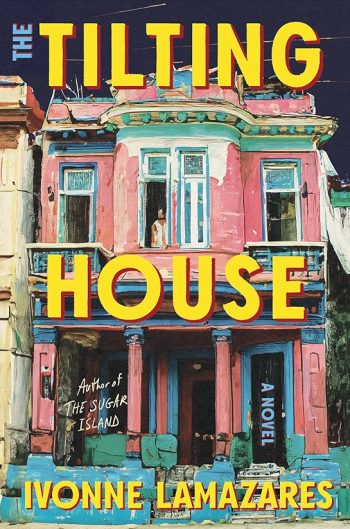
Familial conflict and political strife converge in The Tilting House by Ivonne Lamazares.
We meetYuri, a teenager growing up in 1990s Cuba with her Jehovah’s Witness and strict aunt, Ruth. Yuri and Ruth’s lives are disrupted when Mariela, Yuri’s half-sister, arrives from the United States, hellbent on wanting to reconnect with her lost Cuban identity. Mariela, an artist and idealist shaped by her American upbringing, changes the course of Yuri and Ruth’s lives. This humorous, poignant, and voice-driven novel, delivers a compelling and refreshing coming-of-age story about grief, acceptance, and self-discovery.
I spoke to Lamazares via email about her work characterizing the headstrong and magnetic women of The Tilting House and her experience writing about 1990s Cuba.
The Rumpus: What inspired you to write The Tilting House?
Ivonne Lamazares: I came across a short piece by a Cuban American writer who spoke of returning to Havana to live there permanently. This was an unusual reverse migration journey, especially in the case of Cuba, an island suffering from economic scarcity, political repression, and outright censorship of writers and artists. And something about this decision to reverse-migrate to Cuba raised for me a number of questions. I kept asking myself, “What moves an immigrant, particularly a Cuban American, to go back permanently to their (troubled) country of origin?” Behind the decision to reverse-migrate, I imagined feelings of longing, displacement, even estrangement from the adoptive country, perhaps a desire to recover something essential we may feel we lost by migrating.
As I let myself imagine return journeys, the character of Mariela, one of the two half-sisters in the novel, appeared—a 34-year-old Cuban American artist who had been sent as an unaccompanied four-year-old to the US during Operation Pedro Pan (which brought 14,000 unaccompanied Cuban children to the US between 1960-1962). Unlike many Pedro Pan children, Mariela never reunites with her family in the US, and she’s raised in a Nebraska orphanage and briefly in a foster home. Then in 1993, Mariela returns to the island to recover her Cuban origins, to make art in her homeland, and to become part of a home and a family that she felt she was denied.
And as I wrote about Mariela, I asked myself whether any of us can ultimately recover our origins. And what will Mariela’s attempt to recover those origins do to the family receiving her in Havana? What disruptions will her arrival cause, what unintended consequences?
Rumpus: Can you discuss the role of family dynamics in the story?
Lamazares: In The Tilting House, I wanted to begin with a shaky, precarious family situation in Havana, prior to the disruptive arrival of Mariela from the US Yuri, the narrator, is 16 years old at the beginning of the novel and lives with her strict, religious Aunt Ruth in the fictional suburb of Paladero. Yuri’s mother, Mamá, has died recently, and Yuri rejects Ruth’s conservative values, which are diametrically opposed to Mamá’s socialist, revolutionary beliefs. Mariela’s arrival causes a further disruption for Yuri. Once it’s revealed that Mariela (a rich, American stranger to Yuri), is actually Yuri’s half-sister, Yuri experiences profound disorientation.
Many of us go through similar experiences, where the foundations of our lives and family dynamics collapse. These situations force us to come face to face with the instability of self-narratives, family structures, and personal identities. I’m enormously curious about the ways in which people creatively pick up the pieces of such experiences and integrate them into a narrative that allows them to survive and even thrive. This is what the two sisters in the novel struggle to do in very different ways.
Rumpus: I was impressed by the immediacy of the novel. How do you approach beginnings?
Lamazares: I’m so glad you’re asking about this. I re-wrote the beginning of The Tilting House so many times I’m embarrassed to say. I feel that if a novel’s beginning isn’t working, the foundations of the story and the characters will be shaky, and I can’t go on with energy or confidence. Beginnings for me are like airplane takeoffs; the energy and burst of the story has to be there, full throttle from the first sentence; it has to grab the reader’s attention and lift her and the story off the ground, high up in the air.
I debated for a long time whether to start The Tilting House with Mariela’s arrival to the family in Havana, as in the familiar plot of “a stranger comes to town,” but I ultimately decided to begin with Yuri’s reminiscent voice in the desperate 1990s in Cuba, a “Special Period” of terrible scarcity after the fall of the Soviet Union and the end of Soviet subsidies to the island. It seemed to me that the country’s precarious situation mirrored and increased the precariousness of the family, so that when Mariela unexpectedly appears a few pages later, the reader can see her as a possible solution to the family’s economic struggles, while at the same time the tension rises, as Mariela proves in many ways to be the opposite.
Rumpus: Yuri, the novel’s narrator, has such a compelling voice. What’s your approach to voice?
Lamazares: I think of Walter Benjamin’s famous assertion that the order of composition in a novel is music, architecture, weaving. Benjamin’s quote has helped me understand a great deal about novel writing, or about how I specifically write novels. At first there is music, the music of the voice, a unique tone or rhythm or diction, and the experience of this for me is mainly aural. I have to hear it. If it sounds wrong, the novel feels wrong.
Yuri “sounds” a certain way—skeptical, defiant, allergic to bullshit, from others and from herself. To develop her voice I thought of her as a kind of homegrown detective, constantly looking for clues to understand her world and to arrive at “rock-bottom” truths as she calls them. She’s constantly asking the big questions about Cuban and American societies, colonialism, socialism, global capitalism.
As I wrote I found that Yuri’s voice “grows up” as she becomes an adult and migrates to NYC and becomes a journalist later in Miami. The voice becomes a bit more “academic” then, more philosophical.
Rumpus: There were moments in the novel that had me laughing: Yuri is a hilarious narrator. What’s your approach to humor?
Lamazares: I’m so glad that you found Yuri funny! What a relief! I desperately didn’t want Yuri to sound solemn or self-pitying, even as she faces quite difficult physical and emotional circumstances. I’m guessing her humor comes from her observant, skeptical teenage mind, constantly calling out the ironies and hypocrisy of the adults around her. She brings a certain irreverence to situations, possibly from growing up in an impoverished society where so many have to “invent,” as Cubans call it, ways to survive. The Cuban culture in general favors “relajo,” meaning the mocking of solemnity or seriousness, a constant wry humor that knocks down our importance as humans and allows for a kind of fatalistic acceptance of absurdity.
Rumpus: While reading The Tilting House, I found myself struck by the novel’s sense of place. You render life in Cuba during the 1990s with so much authenticity that it seems effortless. What was your approach to writing about place?
Lamazares: Because I migrated from Cuba at the age of 13, I’m lucky enough to have vivid memories of the place, the people, the language and culture and an entire way of life that no longer exists. I grew up in Havana during the period of Soviet Cuba, when Cuba was the USSR’s satellite state 90 miles from the U.S. mainland, and in exchange for this strategic access to the U.S., the Soviet Union supplied Cuba’s economic needs. Cuban society was very closed then, and most of the visitors from abroad came from Soviet bloc countries.
But The Tilting House takes place in the 1990s, around the time of the demise of the USSR and the Soviet empire, when Cuba is left adrift, without resources or currency to trade in the global markets. The economic crisis was extreme, and Cubans lost an average of 20 lbs. per person during these difficult years. I didn’t live through the “Special Period” of the 1990s in Cuba, but I set the novel in this era because it was a time not only of instability and extreme need on the island, but also of hope. For the first time the Cuban government allowed more visitors from abroad, particularly Cuban Americans, and encounters between the Cuban diaspora and Cubans living on the island began to happen more frequently. I was fascinated by some of the consequences. For one, the economic power of the “traitors” who’d left the revolution became real to those still living on the island. Special shops opened up where goods unavailable to the general population were sold only in US dollars, and suddenly a revolution that had billed itself as an anti-colonialist, socialist, egalitarian movement, was restructuring itself around the power of money and acquisition.
Rumpus: The novel does a great job of illustrating how a place influences and shapes an individual. Yuri, who begins her journey in Cuba, is pragmatic. While Mariela is a fervent idealist, embodying American values and attitudes. How do you approach the relationship between person and place? How does it unfold in the novel?
Lamazares: It was interesting for me to explore the power dynamics between Mariela, the visiting Cuban American, and the rest of the characters living in Cuba. Having dollars, a coveted resource that could buy someone precious food and supplies in special shops in Havana, grants Mariela immediate power in Ruth’s household and neighborhood. While Mariela proudly declares that she has returned to Cuba to “fight for the revolution” and to stay on the island “for good,” the irony is that Mariela can only move events and people in Ruth’s neighborhood and obtain permission for her art projects because of her American dollars. And despite her commitment to “third world peoples” as she calls them, Mariela often behaves in privileged ways that reflect her upbringing in the US. She has little sense of the limitations on self-expression and behavior that the Cuban government enforces, for example.
And yet, while Mariela exhibits privileged American behavior in Cuba, it’s also true that she was initially sent to the US as an unaccompanied minor and was abandoned and raised in orphanages in Nebraska. She grew up as a Latina girl in the margins of American society, without family or resources, and with tremendous material and emotional deficits.
Once Mariela returns to NYC (she ultimately doesn’t stay to help the revolution), the “queenly coolness” by which she moved events and people on the island vanishes. She’s desperate and powerless and dependent. She is an immigrant artist with little money, struggling to be noticed in the art world of the US which she calls “closed minded,” perhaps unfriendly to minority women artists. Her apparent power is gone. I was very interested in exploring these shifts in power relations based on place and positionality and societal context.
Rumpus: Early and throughout the novel, Yuri displays a level of emotional intelligence and understanding that is often beyond her years. She is dimensional. This passage left me speechless: “That Mamá had never aimed the rifle at herself during those painful months seems less strange, looking back, than that I never emptied the weapon or put it away… I had the absurd certainty that as long as the rifle remained within her reach, Mamá would find it a help in bearing what was to come… the loaded weapon turned into a strangely calming presence—a familiar monster under the bed, that, in its way, was also there to protect us.” What were your goals for crafting this character?
Thank you! It was definitely my goal to center multidimensional, complex immigrant characters in the novel. And I’m so glad that you pointed out this particular passage. It expresses Yuri’s capacity for empathy (her unusual understanding that her mother might find the loaded gun as a possible out for herself and thus, paradoxically, a help in bearing her painful illness). One of the major challenges I faced in rendering Yuri, her voice and character, was that, partly because of her brooding teenage ways, she was often reticent to express emotions directly. The initial novel drafts were a bit subdued because Yuri, in a sense, is “stuck” for much of the book and unable to express the core fact of her emotional life, which is her intense grief over her mother’s death. She calls it “impacted” grief. So I had to find concrete or metaphorical ways to represent that grief as in the passage you quote here.
My goal for Yuri as a character was to render her emotional life intelligible and to convey to the reader, at the same time, her reticence, her need to remain loyal to that dying mother with a loaded gun under the bed, and for this to ultimately move the reader.
Rumpus: Mariela is an artist, a photographer. Her work, as described in your novel, is genuinely fascinating and beautiful. Are you an artist or photographer? How did you prepare to write this character?
Lamazares: I wish I were an artist or a photographer. The novelist Ana Menéndez claims that writers need an additional art “to fail at.” I have to confess that so far I haven’t heeded her advice. Maybe I will someday.
I worked at making Mariela’s art projects as interesting and authentic as I could. I knew in earlier drafts that Mariela would be a performance artist. She needed a way to physically express her wrenching from her homeland, and her orphanhood, her trauma and losses. So I was inspired by the work of several performance artists to imagine Mariela’s art projects, which are all fictional. Ana Mendieta’s art, especially her amazing works in Cuba, was an inspiration to me, as was Cuban artist Tania Bruguera’s. But Mendieta, as far as I know, didn’t shoot at her creations, and this was something that I felt Mariela would be compelled to do. For the Nadies figures that Mariela creates and then shoots at and partially destroys (“Nobodies,” or as Mariela calls them, “Forgottens”), I was particularly inspired by Niki de Saint Phalle’s shooting paintings. I was also inspired by the Chinese artist Cai Guo-Qiang, who uses gunpowder and creates explosions to explore themes of destruction and transformation.
Rumpus: Mariela is the victim of displacement. She yearns for a connection to a land and a people that she isn’t entirely familiar with. Her need for belonging often informs her naive perception of daily life in Cuba. Can you share about what drives her desire to belong in Cuba and specifically the revolution?
Lamazares: Mariela has a great hunger to belong and to connect to a land that she feels she should have been a part of. She had a “right to it,” she says. It wasn’t her choice to migrate; she was four years old, and Ruth lied to her by pretending to be her mother and by sending Mariela letters over the years promising to reunite with Mariela in the US. These were difficult circumstances in which to grow up, and Mariela not only wants to recover her stolen past and the family she should have had, in her view, but she also wants to destroy that past and that family unit that existed without her and recreate it, and this desire has dire consequences for Ruth and for Yuri.
Mariela also has, as you say, little understanding of Cuba or its history. So her view of the Cuban revolution is somewhat romantic, probably acquired in progressive artistic circles in the US where the Cuban revolution might have been perceived positively as an anti-imperialist movement.
Rumpus: I’m always fascinated by what pieces of ourselves make it into our fiction. How did your upbringing influence The Tilting House?
Lamazares: The events in the story are not autobiographical, but parts of the emotional trajectory of the two sisters echo my own. Yuri begins narrating when she’s about the same age I was when I migrated to the US, and I found that I ultimately had to write from that moment of migration, a time in my life of great vulnerability and disorientation and possibility.
When I migrated to the US with my father’s parents, I experienced, like Yuri, a radical rewriting of my family’s narrative. My mother died when I was three, and I had been told that in migrating to the US, I would reunite with my biological father. He had left Cuba when I was six. My grandparents, too, would reunite with their only son. We would become a family, and I would live with my surviving parent. I longed to have a father, naturally. But my biological father abandoned both me and his parents once we arrived in Miami, and when he resurfaced sometime later, he was abusive and our relationship ended.
As in Yuri’s case, it took me years to process the collapse of the family narrative I’d grown up with. I’ve been lucky to gradually move, with the support of many, from surviving to emotionally thriving.
Rumpus: Is there a particular scene in the book that you found especially difficult or rewarding to write? Why?
Lamazares: It was very difficult emotionally for me to write the scenes after Yuri migrates to NYC and decides to stop writing to Ruth and Ruth’s caretaker, Sara, in Havana. Yuri doesn’t send food packages or money or aid of any sort. Yuri’s decision seemed harsh to me, self-involved, almost entirely out of character. And yet I couldn’t make myself write anything different, and I had to dig deep to understand her reasons. Ultimately, I discovered them in myself. Sometimes the way to survive significant trauma, especially when one is young, is to run away from the people involved, to try to forget and start anew. But this is not easy, or even possible. And Yuri finds it incredibly difficult to live with the guilt of having left for the US and therefore of finding herself better off materially than those she left behind. Later Yuri sees her abandonment of Ruth and Sara as a selfish decision, an immature decision, and regrets it a great deal. But I understood that at the time she had to make that choice and that it wasn’t entirely out of character.
15. What can you share about the title The Tilting House?
The novel begins in 1989, when the Berlin Wall falls and the Soviet Union collapses. This event has global consequences, and for Cuba, it triggers a huge economic crisis on the island. Therefore, the characters’ lives and the entire world in the novel are in constant motion; political and economic relations shift in this period of global history, which to some degree cause the family relationships in the novel to reverse and collapse. The tilting house of the title also represents for me, the unstable, constructed nature of reality and identity. Immigrants experience firsthand this tilting or shaking or sometimes outright destruction of the foundations of who we thought we were. I’m often in awe of the creative ways through which people integrate and reconstruct their narratives after major losses. But it also strikes me that the opposite belief, that our identities, personal and national, are fixed and immovable can lead us to some pretty malignant actions that can dehumanize any “other” that dares to cross our border.