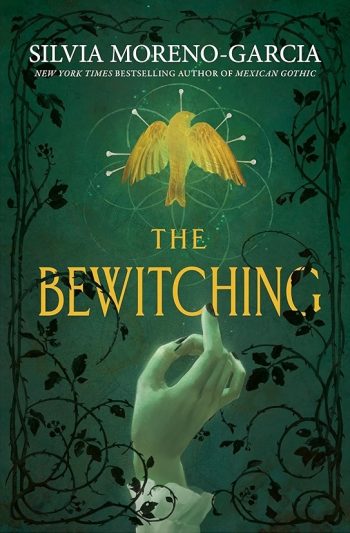
A Mexican rancher goes missing in Hidalgo in 1908, a beautiful co-ed disappears from her college campus in 1934, and in 1998 a young man suddenly vanishes from the same college campus, leaving three boxes of his stuff and a lot of unanswered questions. What happened to these unlucky three is only one of the mysteries explored by Silvia Moreno-Garcia in her latest supernatural horror novel, The Bewitching.
In this tightly paced, multi-strand story, we focus mainly on Minerva, a graduate student at the fictional Stoneridge College in Temperance Landing, Massachusetts. The location is important—Temperance Landing is close to the witchy mecca that is Salem, and not too far from Providence, Rhode Island, home of horror granddaddy, H.P. Lovecraft. Minerva is there to study the life and works of Beatrice Tremblay, an alumna of Stoneridge, whose only novel, The Vanishing, was inspired by her time there, when her friend and roommate, Virginia Somerset, disappeared without a trace one winter night.
We also hear from Minerva’s great-grandmother, Alba, who grew up on an isolated ranch in Hidalgo, Mexico on the eve of the Revolution. Her own brother goes missing around the same time her mysterious and alluring uncle, Arturo, shows up for a visit.
As Minerva digs deeper to uncover what happened to Virginia, she begins to piece together a series of unexplained disappearances around campus, at the same time she feels a malevolent presence beginning to creep closer to her own front door.
Told in alternating perspectives that keep readers turning pages until the very end, The Bewitching is another gripping horror story from a writer who seems to never run out of ways to terrorize her readers.
I had the pleasure of speaking with Silvia Moreno-Garcia over Google Docs about the history of horror in New England, what frightens her, and where magic truly comes from.
The Rumpus: I’d like to begin by asking how the idea for The Bewitching came about. In the Afterword you mention that you attended school in Beverly, Massachusetts and used the location as the inspiration for Temperance Landing. Was this novel something you’d wanted to write for a long time?
Silvia Moreno-Garcia: I wanted to write something inspired by the witchcraft folklore I learned about from my family growing up back in Mexico. But I also lived in Massachusetts for a little while and wanted something related to that locale, which is right next to Salem, famous for its witch trials. After a while I figured out that both Mexican folklore and the New England backdrop could speak to each other in interesting ways.
Rumpus: You open the novel with a quote from Minerva’s great-grandmother, Alba: “Back then, when I was a young woman, there were still witches.” Some of us—or, maybe, just me—cling to the belief that witches did exist, and to a lesser extent still do, though we often can’t perceive them or any other supernatural phenomena because we lack the words or the attention to see it. A type of muscle atrophy, if you will. Do you think this is true? Were there witches in the past?
Moreno-Garcia: I don’t believe in the supernatural. But witches did exist, and do exist in the sense that there have been magic practitioners of many types through the ages. In recent times, you’ve had New Age witches with healing crystals and horoscopes and the like, but you had alchemists in Europe a few centuries ago. In Mexico, there were many types of magic practitioners pre-Conquest. Witches who could summon storms and hail, witches who could transform into animals, but also healers, people who might interpret portents, et cetera. This happens in most societies. The Romans had the augurs; Mayans had daykeepers. All these kinds of supernatural and magic practitioners were flattened into a single term once the Spaniards arrived in Latin America: brujo or bruja, equivalent to witch. But there was a greater variety and careful differentiation of types of witches before that. The roles of witches in society of course change and vary depending on the time and place we’re talking about.
Rumpus: I read that your Master’s thesis focused on H.P. Lovecraft and his depictions of women in his fiction. I know that you edited two anthologies of stories inspired by his work (Historical Lovecraft, 2011, and Future Lovecraft, 2012), but beyond that, have you been dying to feature him in one of your novels?
Moreno-Garcia: Not really. I enjoyed The Night Ocean, by Paul La Farge, which partially employs a fictionalized Lovecraft as a protagonist. Some people thought La Farge took too many liberties in his book—Lovecraft is a closeted gay man in his novel—but I thought it worked as a whole. The book is also as much about Lovecraft as it is about Robert Barlow, a fan of Lovecraft, who was an anthropologist in Mexico City in the 1950s and a gay man at a time in which this was more unspeakable than any Lovecraftian horror. I think some people expected a scary novel and it’s a poignant, sad drama, not horror at all.
Rumpus: Minerva’s digging eventually leads her to Carolyn Yates, a wealthy arts patron who was a friend of Virginia’s at the time of her disappearance, and her screw-up grandson Noah Yates, who seems to have a lot more going on than his blazer and boat shoes would have one believe. At one point, in The Bewitching, Noah says, “Monsters don’t age. They live forever.” What does he mean by that?
Moreno-Garcia: Magicians don’t reveal their tricks, so I won’t explain it.
Rumpus: Minerva says that New England, and Massachusetts in particular, is prone to ghost stories and spooky happenings. (As a recent transplant to Massachusetts, I’m quite disappointed that I haven’t yet seen a ghost!) What about New England lends itself well to horror?
Moreno-Garcia: A lot of the popular elements that we consider iconic to horror—a spooky house and crumbling cemeteries, for example—can be found in New England and not so much in other parts of the United States. You don’t think “that’s spooky” when you imagine strip malls and parking lots, even though those are much more common and part of the American landscape than quaint Rhode Island towns. We’ve basically built the language of horror inspired by many things that are found in England, which originated Gothic fiction, and I think New England is just closer to that kind of landscape than, say, Los Angeles. I find it interesting therefore when you stumble across horror that doesn’t employ those signifiers. For example, many Japanese horror movies I’ve watched take place in large cities, in apartment buildings, with a bevy of modern technological items around.
Rumpus: I heard Paul Tremblay and Victor LaValle say in a podcast that they’re both absolute fraidy cats. I think LaValle said in particular he’s afraid of walking into a bathroom and seeing the shower curtain fully drawn, so that anything might be in there hiding. What frightens you?
Moreno-Garcia: Many things. Death is the big one.
Rumpus: The always studious Minerva says, “Words keep terror at bay.” Was she being literal? And do you agree with her?
Moreno-Garcia: I think so. When I gave birth to my first child I didn’t take any pain killers and I got through the pain partially by repeating lines from a book. It transformed the pain, in a way.
Rumpus: When Minerva begins reading Beatrice Tremblay’s undiscovered manuscript, she has a moment where she muses about the collective unconscious and shared elements of different traditions. “Stories of werewolves in Canada had been imported by French colonists and mixed with local folklore, creating the loup-garou.” I grew up on the Rio Grande and heard stories of La Llorona stalking the banks and trying to drown children. So imagine my surprise when I learned many years later that nearly every body of water in North America has some sort of La Llorona-type legend attached to it! In your research on this topic, what was the most surprising example you found of this synchronicity?
Moreno-Garcia: The loup-garou and the rougarou and the Llorona, yeah. They’re widely shared monsters. I don’t find it surprising when something is similar, I actually am more surprised when there is a folk story that is completely different. I’ve found, again, that Japanese folk creatures are very different from what I’m familiar with. We have a lot of crosspollination in Latin America and the Caribbean and into the United States, so I’m not surprised when something similar pops up in Texas and then you see it further south. One of the most interesting phenomena is sleep paralysis, which happens across the world, and there are different creatures that are associated with it, though they can have similarities. I went to a talk about Irish folk creatures and sleep paralysis, for example, and we have an explanation for it in Mexico, too. Obviously this is a common physiological response so it makes sense we find explanations for it worldwide.
Rumpus: In one particularly intense scene between Arturo and Alba, Arturo tells her, “Magic is desire.” I love this. Can you say a little bit about what you meant?
Moreno-Garcia: With neo-pagans you get a lot of talk of intent and will. It’s common with ceremonial magic, which you see with people like Aleister Crowley. Intent plus will plus action equals a spell and such. But I thought back to the folk magic I learned about and decided desire is the engine of magic.
Rumpus: Many recent horror novels have addressed very real terrors. I’m thinking, for instance, of Mariana Enriquez spotlighting Argentina’s Dirty War in Our Share of Night, and Samanta Schweblin tackling chemical pollution in Fever Dream. Do you feel that, at a time when the real world is plenty dark and full of terrors, horror stories should address the multitude of frightening things in the real world?
Moreno-Garcia: I don’t think literature should do anything in particular. There are stories that are intended as escapism and are there to provide pleasure. Much of pulp fiction had this function: pay 30 cents, read Tales from the Crypt and witness the story of the cursed diamond that doomed the conniving nephew who stole it from his uncle, et cetera. But some horror stories do address real world issues more explicitly instead of engaging entirely in escapism. Much of Stephen Graham Jones’s fiction, for example, is both a loving ode to horror fiction but also an exploration of Indigenous identity and issues.
Rumpus: I’ve heard you speak on the concept of genre, how it was invented in the early twentieth-century to categorize fiction books as they suddenly became a popular pastime. Do you find the concept of genre limiting to your writing? Or do you not think of it at all?
Moreno-Garcia: I like genres and sub-genres because they impose limits but also facilitate exploration. For example, I mentioned that we associate horror with certain imagery such as the old, dark house and the ancient cemetery in New England. But what if you have a haunted house that is brand new? Can you do that? Grady Hendrix had terrific fun with a haunted IKEA store in the novel, Horrorstor, for example.
Rumpus: Can you share a little about your writing process? Do you have routines? What have you found most helps you to work?
Moreno-Garcia: I don’t have routines. I try to write a little every day but sometimes the writing is not fiction. It might be replying to emails, doing interviews, et cetera.
Rumpus: You’re a very prolific writer. I’m quite envious! Do you ever experience writer’s block?
Moreno-Garcia: I know someone, Nick Mamatas, who said something that has stuck with me for years: We don’t talk about plumber’s block. There are many reasons why someone may not be as productive at a certain point in time (anything from depression to having numerous house chores to being unable to solve a plot issue), but you won’t solve the problem by calling it writer’s block because it obscures the root of the problem and makes it into a mythological condition. Essentially, you can’t treat writer’s block, but you can treat depression and you can find ways to delegate chores or brainstorm to solve a gnarly plot problem.
Rumpus: I believe one of the reasons your novels are so enjoyable to read is that they’re always so artfully paced. You are the master of the slow burn. Can you speak a little bit about how you make sure your writing is suspenseful?
Moreno-Garcia: A lot of people don’t like slow burn! But I believe M.R. James had it right and I quote: “Two ingredients most valuable in the concocting of a ghost story are, to me, the atmosphere and the nicely managed crescendo… Let us, then, be introduced to the actors in a placid way; let us see them going about their ordinary business, undisturbed by forebodings, pleased with their surroundings; and into this calm environment let the ominous thing put out its head, unobtrusively at first, and then more insistently, until it holds the stage.”
Rumpus: What advice would you give to an aspiring horror writer?
Moreno-Garcia: Read widely, both old horror works, newer ones, and books that are not horror at all.