
In Jailbreak of Sparrows, Martín Espada writes poems that read as portraits, framing each subject with dignity, beauty and compassion. Inspired by the figure of his father, Frank Espada—civil rights activist and photographer—these poems weave memory and anecdote into a reckoning with personal inheritance and collective witness. They trace the early years of Espada’s family’s story alongside his later work as a tenant lawyer, confronting immigrant struggles and institutional indifference. Yet, this collection also delights with a chorus of love songs voiced by surprising speakers: a bat with vertigo, a disembodied head in a jar. In Jailbreak, grief is met with humor, resistance with tenderness. Espada’s varied portraits ask us to look with the eyes of love.
I sat down with Espada over Zoom, where we discussed the illusion of a balanced writing life, the role of a poet within society, how portraiture humanizes its subjects and how to identify surprising entrances into a poem.
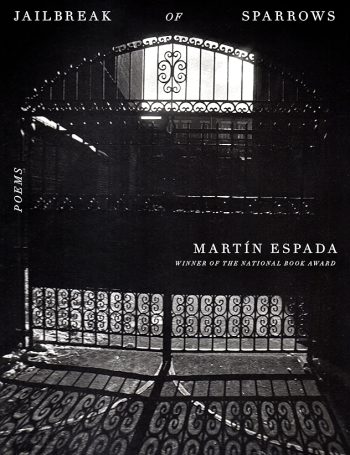
The Rumpus: You have published over 20 books! Before we dive into the content of Jailbreak of Sparrows, can you talk a bit about your writing practice? How do you organize your time to balance writing with the demands of life?
Martín Espada: Your question implies that I’m pulling off the balancing act. There is no balancing act. There’s no pulling it off. It’s always going to be chaotic to integrate writing into the rest of life. Part of having a consistent writing practice is not waiting around for perfect conditions. People often make that mistake—I’ve made it myself. We wait for the ideal set of circumstances, and we all have them in mind. For some people, it’s candles. For others, it’s a cabin in the woods.
But the world doesn’t stop spinning because we’re poets. It’s not going to accommodate me, no matter how many honors I accumulate. Most people don’t care, and the world itself doesn’t care. It spins on. That’s part of what we’re writing about—what it means to be alive on a planet that never stops moving. We must integrate writing into the pandemonium of life. For me, that means I don’t write every day. I don’t write at the same time or in the same place. I let ideas slip away. I let images and narratives escape because life intervenes.
So why am I prolific? First, because I’ve been doing this for a long time. Second, I’ve developed a way of holding on to narratives, images, and diction in my head. I don’t mean that in a linear way. The end of a poem might come to me first. Sometimes the last line arrives, and that line creates the urgency to write the rest. Other times, a stanza appears fully formed. I can visualize words as if they’re on a screen. I had that ability long before we used screens, so when computers came along it felt natural. It’s the result of repetition—years of practice—and trusting myself to do it. I don’t wait for the perfect conditions to write.
Rumpus: Your work asks us to read with immense empathy, often with a social justice and community-oriented focus. How would you articulate the poet’s role in society?
Espada: Here’s one example: If you consider yourself a public poet, part of your charge is ceremonial. You write and speak poems for meaningful occasions. In today’s increasingly secular society, poets may be asked to take on the role traditionally held by preachers: delivering an elegy at a memorial.
The last poem I wrote was an elegy for Everett Hoagland, an African American poet based in New Bedford, Massachusetts, the Poet Laureate of the city, and a longtime teacher at UMass Dartmouth. Everett died in July.
It was a three-hour drive to read a three-minute poem. But that’s what it means to write the ceremonial poem, for a memorial service, a wedding, an anniversary. It’s the idea of the poem as gift.
Rumpus: Thinking about the poem as a gift is a beautiful segue into some of the thematic content of your book. In the book’s opening, portraiture, and the work of your father, plays a large role. And the poems about your father read like portraits in language. What role does portraiture play in your work?
Espada: Portraiture humanizes. Poets should be engaged in society, in an ongoing struggle. We are part of the larger tension between humanity and dehumanization, everywhere—politically, personally, in the atmosphere we breathe. Portraiture demands our attention as poets. It relies on the senses for detail. I ground the portrait in the image.
Of course, by “image,” I mean more than the visual sense; I include all five senses. Still, the visual predominates, and that’s no coincidence: I was raised by a documentary photographer—not only a documentary photographer, but the creator of the Puerto Rican Diaspora Documentary Project, a photo documentary of Puerto Rican migration. He was also a community organizer and activist long before he was known for his photography.
All this, through my father, Frank Espada, had an enormous impact. It gave me a sense of purpose, shaped my craft and my commitment. I grew up with his unshakable faith in the connection between art and activism. His photographs hung on the walls of our apartment in Brooklyn, and therefore on the walls of my imagination from earliest memory.
His purpose was to photograph his community. Even before documenting the Puerto Rican community, he photographed the people around us in East New York, Brooklyn, where I grew up. He photographed the Civil Rights Movement, of which he was a part. That connection between art and activism was so essential to my upbringing that I assumed that’s simply how it worked. It never occurred to me that if you wanted to be a poet or a photographer that you’d do anything else. I learned later that wasn’t always the case, and in fact, that such a belief might put you in the minority.
Once my father got rolling on the Puerto Rican Diaspora Documentary Project, thanks to a grant from the National Endowment for the Humanities, he needed an assistant, someone to hand him film, carry the camera bag, fish out lenses, hang shows, travel with him, listen to him talk, catalog the photographs or answer phones at his Galería Boricua. Oftentimes, that was me in the early 1980s.
There’s a poem in Jailbreak of Sparrows called “My Father’s Practice Book.” I recreate a scene: my father in the street taking photographs, me standing right behind him with the camera bag. When he wanted a roll of film, he’d snap or roll his fingers—no words, just a gesture. That was my cue to put the film in his hand. He’d load it, and then the camera would click, click, click.
That made me part of the process. Even more important was my perspective—standing there, looking over his right shoulder, seeing how he composed the shot in real time. I may have been just the kid with the camera bag and the first wisps of a beard, but I was also observing what he was observing. He was framing a shot, and I was watching him frame it.
Rumpus: Has writing about your father changed for you since his passing?
Espada: My father’s been gone for eleven years, so he recedes. He’s eleven years in the past. At the same time, I’m getting older. I’m getting closer to my father’s age. I’ve already blown past the age he was when he did his documentary project. My father lived to be 83, so I’m not nearly there yet, but I’m getting closer every day. I am moving away from my father but also coming closer. This shift in perspectives enables me to look at him differently in this collection of poems.
There was a time when I could only write about my father in a heroic mode. Even right after he died, it was hard to do anything else. Here we are, eleven years later, in 2025. I’m able to explore his vulnerabilities now, to look at him as fragile, contradictory. I’m able to look at him as an artist and activist who believed he had failed. I heard him say it: He had failed to change the material conditions in his community. He devoted his life to doing that. He felt he had failed financially. By the end of his life, he had taken to sitting on his deck and photographing sunsets, trying to sell the prints and make a few bucks. He hung many of his expectations, his dreams on the self-publication of a book called The Puerto Rican Diaspora: Themes in the Survival of a People, subsidized by a friend who gave him the funds. But he only printed 1,000 copies and they ran out. The money ran out too. “My Father’s Practice Book” addresses that. How is it that a photographer ends up in the Smithsonian but also ends up trying to raise the rent? That’s a deep contradiction I couldn’t have explored during his lifetime.
Rumpus: Can poetry restore dignity from where it has either been taken or lost? Or perhaps, what do you think poetry can or cannot do in terms of restoration?
Espada: It sounds grandiose to proclaim that poetry can restore the dignity stripped away from people left without dignity. Then again, poetry is not doing what it does in isolation. I don’t expect my poems to magically accomplish anything. I see my poems as part of a movement: That movement is political. It is artistic. It transcends poetry. It transcends politics. If we believe in human dignity, and each of us works towards the restoration of human dignity in one way or another, whatever that might be, then it’s easier to visualize poetry as a part of something greater than itself.
Political poetry is often held to an unreasonably high standard. Protest is held to an unreasonably high standard. The inevitable cynical response to the political poem, the protest, is: What did it accomplish? How come this social condition you’re addressing with such passion has not been resolved? Why did your protest not triumph? Of course, that’s not how protest works. That’s not how progress works. Progress is not linear. It zigs and zags. It moves in figures of eight. We move forward; then we move back again. Then we move forward again over years, over decades, over centuries. The poets are part of that somehow. The impact of the poem you write, the political poem, the protest poem, cannot be weighed, labeled, measured, or boxed. I put the poem into the collective atmosphere, where we all breathe it in.
However, if you’re closely connected as a poet to a community, there are those precious times when you can see instantaneously that it makes a difference to the people in the room.
Rumpus:We’ve been talking about the themes, and this book balances suffering with humor through many modes: personification, simile, and metaphor, all grounded in the image. Can you talk a bit about how you craft your poems?
Espada: Well, without craft, there’s nothing. We’ve been talking mostly about subject, point of view, experience. But without craft, none of it matters. Without craft, it’s not poetry. Without craft, it’s only good intentions.
Occasionally, I’m asked to give a craft talk. Invariably, I’ll talk about metaphor and simile, the construction of images. That’s the leap that makes it poetry, that moves it beyond anecdote. I’m using metaphor and simile to construct the image, which in turn undergirds the narrative in the poem. I’m building bridges. I’m trying to make the poem as vivid as humanly possible with whatever I have at my disposal. I see metaphor and simile as spices—I don’t want to use too much or too little. You want the right balance.
How do you know the right balance? The same way you know in any poem: revise the hell out of it. I’m a big believer in revision. I may revise repeatedly because the metaphor or simile isn’t striking enough to render what I want to say. I can’t make a poem without images, and I can’t make images without metaphor and simile. Regardless of trends that make such forms of comparison unfashionable, they remain essential to me.
I’m also constructing poems with music, anaphora, epistrophe, even the occasional pararhyme. Ultimately, I’m striving for an aesthetic of clarity. Keep in mind that I’m writing from a position where most readers don’t share my experience. There may be empathy, but it’s not their world.
Rumpus: In this book, humor brings humanity and levity to difficult situations—human suffering and indignity—and allows us to hold the complexity of the situation. Can you talk a bit about the role of humor in your work, both in terms of lighter and more difficult subject matter?
Espada: There are satirical poems where I laugh at the world, and poems where I laugh at myself. There’s one about my days as a bouncer, “A Dream of Drunks Outsmarting Me”—guarding two doors at opposite ends of the bar. It struck me as akin to Sisyphus pushing the rock uphill. Then there are persona poems. How do you write a love poem and circumvent the sentimentality of which we are all allegedly terrified? You write love poems like the “Love Song of the Disembodied Head in a Jar.” It’s based on a prompt from my wife, Lauren Marie Schmidt. She said, “You want to be a disembodied head in a jar? Write a poem with singing, bubbles coming out of your mouth, X, Y, and Z . . .” Good prompts guide you without dictating too much. I wrote it as a gift to her. Others, like the “Love Song of the Bat with Vertigo,” came from experiences in our lives.
We had an enormous bat in the house one day, dive-bombing my wife’s head. Turns out she’s afraid of bats. I managed, foolishly, to trap the bat against the wall with a bucket. You could hear it flapping around inside the bucket. You could write that poem—”Oh, I caught a bat”—but it’s not terribly interesting. But what was the bat thinking? The bat had fallen in love with my wife’s hair, or so it seemed. He was just trying to get closer. After I caught the bat, I flung it out into the night. The bat flew away upside down, and it occurred to me that the bat must be dizzy—thus, vertigo.
We have been talking about universal experiences and poetic devices, but there are some poems in this collection that are very Puerto Rican, requiring cultural or historical translation like, “The Iguanas Skitter Through the Cemetery by the Sea.” Some reader out there might come upon that poem, and say, “Wow, those Latin American types really love that magical realism.” Magical realism? There really were iguanas in the cemetery. One of them was squatting on the tomb of Pedro Albizu Campos, the revolutionary leader of the independence movement in 20th century Puerto Rico. In that same cemetery, there was another iguana staring up at the bust of a great poet and pro-independence advocate by the name of José de Diego. I had my metaphor: “Aha! Iguanas… equals colonialism.” Thank you, iguanas.
We’ve been talking about the diversity of subject matter, point of view, and poetic devices in this book, and this is where the book lands. It leaves us with this: colonialism, as represented by iguanas skittering through a cemetery.