

Equal parts story and song, Mickie Kennedy’s striking debut Worth Burning is a visceral and tender reckoning with inheritance, sexuality, and grief. A queer-coming-of-age told across poems that traverse multiple timelines in the speaker’s life, this poignant collection transforms the act of dedicated self-witness into devotional self-creation. Worth Burning never resists naming the conditions that challenge queer survival—family secrets, abuse, bullying—and expertly cleaves these registers to humor, sensuality, and a palpable aliveness that propelled me from poem to poem.
It was a joy to speak with Kennedy on Zoom in January, a month before the collection was released, and we discussed, among other things, using musicality to reach towards the subconscious, tending to burn barrels, the complexity of writing about family, and the joys of poetry community.
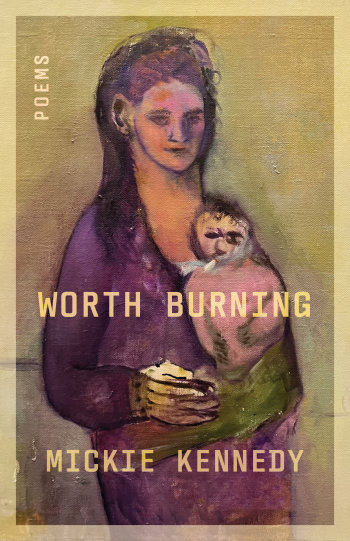
The Rumpus: There are many instances in Worth Burning where we encounter a young speaker in the process of defining himself. Young people are just so observant—this is what I was left thinking. I’m wondering, where did you get your entry point into poetry? Who or what were your early influences?
Mickie Kennedy: I had a very late entry into the literary world. I was all about science when I was in high school. At East Carolina University, I took a huge Introduction to Biology lecture class. Early on, we had to write an essay. Apparently my essay was no good, because the professor spoke to me afterwards, urging me to take a bunch of English and writing classes, so I could really learn to write, before I took any more science classes. Thank god for that. Up to that point, I’d read science fiction—bad science fiction. I did occasionally read Jules Verne and a couple of the classics, but those were generally accidental. From there I just fell in love with writing and reading and learning how to communicate better. After graduating, I ended up going to George Mason for my MFA, studying under Carolyn Forché, Peter Klappert, and Susan Tichy.
Rumpus: People often associate Carolyn Forché with “poetry of witness” and your own poetry is so keenly observed. How did working with her shape your writing?
Kennedy: I didn’t get a lot of one-on-one time with Carolyn. Surprisingly though, I ended up living with her family for a little over six months. I was a displaced gay person with no place to stay and she took me under her wing. Her husband, the photographer Harry Mattison, was an amazing and astute reader of my work. He was so sympathetic, and as a photographer, had such an eye for the visual. I learned a lot during that time.
Rumpus: That’s fascinating to hear how Mattison, as a photographer, shaped your writing. The images in Worth Burning often depict bodies, such as the speaker’s in a moment of desire or danger, or the aging and injured bodies of his parents. Your images evoke a range of emotions: pleasure, fear, embarrassment, pride, tenderness. What informs your approach to building imagery?
Kennedy: When I freewrite, rhythm and music tend to take the lead. As I’m writing, I’m open to my past and my emotions. Eventually, the music sends me back to a particular memory, and that memory floods the freewrite with imagery, and then I just roll with it. I end up with a lot of writing that points me to the poem, and often, I tend to overwrite beyond what should be the end of the poem. Then I go back and I edit, trying to preserve the music and rhythm, because I don’t want to lose too much of that initial intensity.
Rumpus: What helps you stay open in those moments? What allows you to get to the most potent and wild stuff?
Kennedy: I try not to self-censor during those beginning stages. It’s a freewrite. I’m just having fun. I’m riffing. Generally, when it stops being fun, I know I need to go back and assess where the poem is, what it wants to be. Sometimes I’ll discover the possibility for three distinct poems within my initial draft. Chaos is part of the process. Over there, something about my grandmother; over there, something about one of my children; and over there, something more physical, more intimate, about the body. I invite everything, foregrounding play and surprise.
Rumpus: Since you shared that musicality and image are so connected for you, I wonder if we can talk about rhyme. It was really exciting to see that Diane Seuss blurbed your book. Recently, for the Poetry Society, she gave a lecture where she described her inclination towards rhyme as coming from the experience of “making do with what you have.” Do you resonate with Seuss on this?
Kennedy: I do resonate with Seuss. I mean, how could you not? She’s incredible. Rhyme and musicality, particularly through song, were always there for me. I grew up in a household where my mother drank, and she’d often play music in the evenings. She’d dance while drinking. Music has always felt like an engine in the background of even the most difficult moments.
In my poem, “Small Bother,” there are hints of end-rhyme, smeared and buried, to evoke the musicality of a children’s song or lullaby. But in the context of the poem, which is about abuse, that musicality feels quite ominous, unsettling. Musicality is a vessel for a poem’s thought. A vessel for surprise and emotion. When you channel it and bend it and incorporate it in a poem, it gives the poem more power—it helps us sink beneath the surface of the lines.
Rumpus: Throughout the collection, your treatment of the speaker’s mother was so nuanced. The title poem, “Worth Burning,” shows her using “a long, metal pipe” to “stir” and “prod,” “push [trash] down” towards flames, until it transforms into cinder and ash, leaving everything, including the speaker, “[reeking] of smoke.” The actions of this poem–gathering, observing, prodding, stirring, burning, transforming–served as a synecdoche for the work of the collection as a whole. How did you settle on the title of the collection?
Kennedy: I identified “Worth Burning” as the title long before this book was written. I’ve always had a sense of humor, and I liked the idea of a title that could be low-hanging fruit for hungry critics. I could just hear a critic saying: “This book indeed lives up to its name: burn it!” It almost made me work harder, to prove that imaginary critic wrong. But as I was writing the book, the name became much more than a fun idea. It fit the project organically.
I kept returning to the image of a burn barrel. Back when I was growing up in rural North Carolina, everybody had their own burn barrel because it was cheaper to burn your trash, and money was always tight. I can still see my mother standing over the burn barrel in our backyard, stirring. That’s where the title poem, “Worth Burning,” comes from. You couldn’t burn everything, though. Some rugged, stubborn piece of trash always stuck around, which is what the mother says at the end of the title poem: “a goddam piece / that just won’t burn.” Of course that line is about the trash, but it felt more massive than that, too. A rugged resilience that felt true to the manuscript as a whole.
Rumpus: The title also rewards rereading. It made me relate to each of those words, “worth” and “burning” differently—this idea of worth and feeling worth something was another way that it engaged the themes of the book.
Kennedy: Yes, absolutely. I loved how versatile both words were. For example, the duality of burning as both violent and destructive, but also something that could be passionate and full of longing. We see this in the title poem, too, when the contained violence of the burn barrel collides with the adolescent speaker’s queer fantasy. I love these sorts of collisions.
Rumpus: In a collection that is so much about self-becoming, what are your thoughts on the costs of transformation? Even in just what you were describing there—I hear how seemingly divergent experiences are actually two sides of the same coin.
Kennedy: I do feel like transformation comes with a cost, though it’s often a necessary cost. When we transform, there’s always something left behind: a residue, a past self, a place, maybe even the place we first called home. I’m thinking of the burn barrel again, the persistence of things.
I also think there are times in our lives where it’s unsafe or impossible to transform. For example, growing up in the house that I did, I was forced inside the closet. Even so, I found little elements of queerness to cling to: the record I bought, not because I loved the music, but because the musician on the cover was cute; borrowing my mother’s magazines, not to look at the women, but the occasional man with his arm wrapped around a woman.
I feel like secrets, sometimes, are seeds of transformation, waiting to be watered. For example, in “Open Secret,” the speaker has a black eye that goes mostly unaddressed by the mother, until they interact with a woman working at Dairy Queen: “I bet she thinks I gave it to you, Mom said, / dragging a tater tot through ketchup.” Ironic, coming from my incredibly violent mother. Another example: in “Violent Games,” we see the speaker watching older boys play video games, as if he wants to play the game, but really he’s just watching them, watching their beautiful arms move. There’s the surface, and beneath the surface, all that passion and longing searching for a seam.
Rumpus: As you’re talking about those two poems, I’m reminded of many other instances in the collection of seeing, hiding, refusing to see, choosing to be seen. The book reveals how these are some of the most powerful contracts that exist between people. For example, in “Sheraton by the Airport,” the speaker is blindfolded in an encounter with a lover. In “The Pecan Tree Leaning Away from my Childhood Home,” the tree becomes a place from which the speaker “could see everything,” while remaining hidden. In “Important Things,” he lets himself be seen holding the hand of his male lover. What kind of seeing and being seen did the act of writing make possible for you?
Kennedy: For me, the process of writing helped me reframe my relationship to the past. Mickie, the poet, the maker, was no longer the passive child in an abusive home. My role was active: I could choose what was said, what was seen. Throughout the book, many forces act upon (and act against) the speaker. Writing was a way to reclaim some control over the past, creating the diorama of my life.
Rumpus: Are there particular things you wanted to make visible to readers?
Kennedy: I didn’t want my mother to just be a villain. Frankly, the book is more generous to her than I sometimes feel. That generosity felt necessary for readers, to highlight the complexities of the situation. I recognize that my mother was broken by my father’s death, and she turned to alcoholism. She did terrible things, but she also had to move through tremendous grief. It’s very complicated. In the book, we see the mother much later in life, declawed by time, but she’s still herself. There are still some jagged bits, those idiosyncratic sparks, that make her the character that she is.
Rumpus: Do you share your work with your mom or other members of your family?
Kennedy: When I wrote about Cindy, who’s still my best friend, it was suggested that we change her name, for anonymity. I ran the idea by her, but she said no. She didn’t want to be erased in that way; the poems recount how it was, and she wanted to be there. I haven’t really shared my work with my mother. There’s part of her that knows that she was drunk for many years, that she did many unspeakable things. She doesn’t want to invite conversations about the past. I don’t think she would be understanding if I tried. She’s fixed in her ways.
Somewhat recently, I went home to visit, and the only thing in her fridge: thirty or forty candy bars. When I asked her about it, she said, “I’m 70-some years old—if I want to eat candy bars for every meal for the next 2 or 3 days, I’m going to do it.” I said, “Okay” [laughs]. She’s always been stubbornly herself. Outside of that, much of my family aren’t readers. I haven’t hid it from them, but I don’t see them seeking out my books and really reading them.
Rumpus: Since you mentioned Cindy—the character of Cindy features in the first poem in the book, “The Pact,” where we see the speaker at the beginning of his marriage to his wife. In the final poem of the collection, “Aubade Where Nobody Leaves,” we see the speaker with his husband: “A grown man walking back inside / to nudge another man awake.” In a book that travels in time so much, how did you decide on where to start and end?
Kennedy: I got help. I’d entered a lot of book competitions, as a poet does, and I wasn’t getting much attention. I was working with someone at the time, and they gave me great advice. At that point, the manuscript was more or less following a strict chronological progression. But the person I was working with felt that a lot of the strongest poems were in the second half of the book, and readers weren’t going to make it that far, especially if they were skimming. Trust your readers, they reminded me. Trust that the reader is intelligent enough to hop through time: moving back and forth between child and adult speakers. Freed of chronology, I immediately felt like “The Pact” would be a great opening for the book: intense, aggressive, grounding the manuscript in its own domestic mythology. I started paying more attention to the emotional trajectory. That’s one of the reasons I decided to incorporate the highly lyric “Mouth of Many Endings” poems.
Rumpus: How did the “Mouth of Many Endings” series come to be? There’s two poems with that title, and they each appear as an interlude between the three sections.
Kennedy: “Mouth of Many Endings” began over 25 years ago. When I went to graduate school for my MFA program, it was the first time I was away from North Carolina, away from home. I felt like I could finally just breathe. I was carrying a lot of trauma, and I started going to therapy. My therapist suggested that I write down what I was going through. I wrote it out, typed it up—close to twenty-four pages of raw material, just disjointed phrases and images. More recently, when I was looking for a lyric interlude to punch space between the longer sections, I went back to that language and I wondered if I could resurrect something from those pages. And it worked.
Rumpus: Another aspect of “Mouth of Many Endings” that stood out to me was the fact that it’s in sections. A few other poems in the collection also used that quality in their form. For example, “Accidental Wren,” is split by asterisks, or “Breach, A Play in Three Parts,” which proceeds in numbered acts and scenes. That segmented structure reminded me of the line from “Violent Games,” that goes “I wanted / a body like that–battered / smaller, each piece of me // alive, complete, my city / of selves.” What did these forms of division offer you?
Kennedy: A lot of the sectioned poems felt like they needed an organizing principle. In “Breach,” for example, I was trying to mimic something like a play or a drama—part of the poem was an email, part of the poem was a phone conversation. In order to contain everything, the poem needed section breaks. I feel like sections are particularly useful when your subject isn’t tidy, and the poem wants to make bigger leaps. Breaking the poem up allows the sections to be autonomous units—autonomous units that harmonize together.
Rumpus: Are there other aspects of your revision process that you could speak to?
Kennedy: I’ve really only been prioritizing revision in the last three years. For a long time, I used to write experimental, musically driven poems that I’d send out for publication. At some point I realized that people weren’t really understanding the poems. The aboutness was too intentionally obscure. That’s when I turned back to narrative free verse. I read Sharon Olds and Marie Howe. I liked the way their poems contained transparent narratives without sacrificing rigorous craft. I felt like I needed to go back and revise my work in that direction. I hadn’t really written much about the abuse I endured, at least not explicitly. When I read Split by Cathy Linh Che, which tackles abuse, I was stunned. It dipped me in fire. I thought: “Wow, you can actually write about this!” I was really excited, really motivated, so much so that I sent Cathy an email. To my surprise, she wrote me back. I was thrilled, and moved. I’ve felt so welcomed by the poetry world. Other poets are so generous with their time. I’ve encountered so much community, so many supportive people as I’ve taken myself on this journey. I’m incredibly thankful for it.
Click here to subscribe today and leave your comment, or log in if you’re already a paid subscriber.