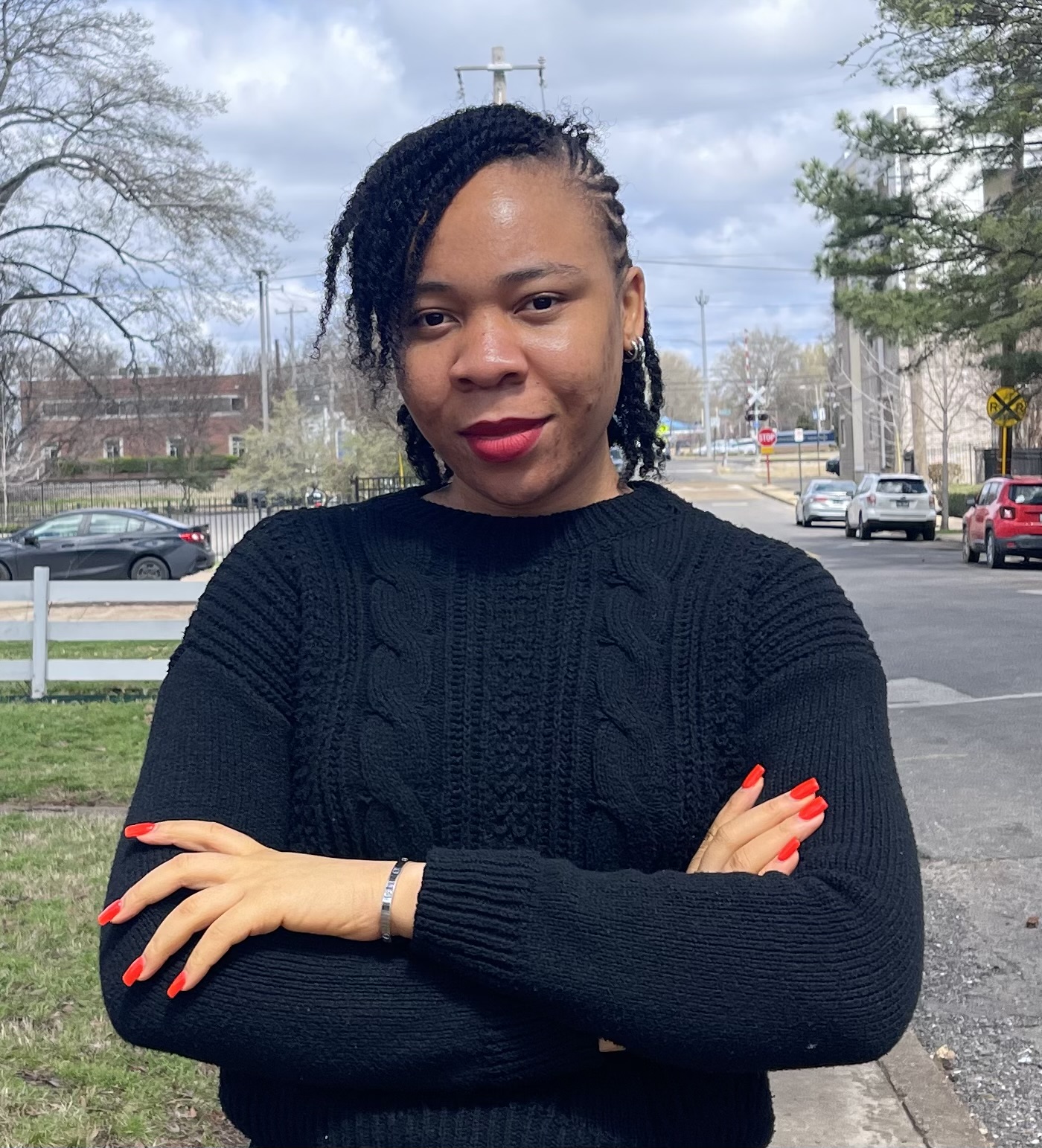
Every once in a while you read something that makes you feel both more attuned to yourself and freshly activated in the world. Kelsey L. Smoot’s debut full-length poetry collection, SOULMATE AS A VERB, does just that. It strikes notes both familiar and invigorating, like looking out across a crowded room, and spotting a soulmate.
I met Smoot two years ago at Atlanta’s City Hall. A mutual friend introduced us as we waited to be let into council chambers, where we would speak out against the development of Cop City, the $100 million militarized police training facility opposed by environmental and racial justice activists alike. This would be one of the last organized actions at City Hall, and the last one I would attend. It was exhausting to take time off work and writing to wait in line and come up with ever-new ways to beg, only to be met with bored stares by our elected leaders.
As Smoot and I became friends, we joked and griped together about the world, and I looked forward to saying something that would earn their warm laugh and a “for sure.” This kinship is also what it feels like to read their poems. Many people will feel seen by the following line from “The Revolution Might Not Be Televised:” “too bad we only got two parties in this country, / and neither of them are lit.”
Smoot and I met in person on New Year’s Day at a coffee shop that readers smarter than us will have predicted was closed. Our mistake was serendipitous: the door to the building’s lobby was unlocked, and though we didn’t have coffee, we had something even better: a quiet, warm space in which to talk about poetry and SOULMATE AS A VERB.

The Rumpus: Knowing you arrived at poetry via a nontraditional path, I was surprised to see so many traditional forms here. You use the quatern, kwansaba, sonnet, landay, and others.
Kelsey L. Smoot: I’m naturally kind of ungovernable; I like to break rules. But I at least need to know what the rules are. So when I started writing poetry, I Googled how to write a sestina, how to write a sonnet, how to write a Golden Shovel. A lot of poets shy away from form because we convince ourselves it’s too hard or that our creativity will be constrained, but learning more traditional forms challenges you to be really thoughtful about every word you’re selecting, and also how to innovate form and make it your own.
There are a lot of forms that come out of literary traditions that are not white or Western. The kwansaba is a Black-ass form, which is super cool. At Tin House, I learned how to write a ghazal, which is an Arabic form. They challenge this idea that writing in form is going to make your poetry turn into Shakespeare—no shade to Shakespeare—shout out to Shakespeare.
Rumpus: When you started writing poetry, you were getting your PhD in race, gender, and sexuality. How did what you were studying influence your poems?
Smoot: I was constantly thinking about the process of identity formation. Blackness and queerness and masculinity are cultural artifacts that we teach each other and that evolve over time. They’re incredibly hard to pin down. Poetry allows you to blow language open and think in terms that are so much less concrete.
I was resistant to the inaccessible format for displaying and conveying knowledge that’s common in academia. I wanted my writing to be alive and actionable and resonant with people outside of academia. Poetry was how I felt I could bridge that gap, and to celebrate the joy in Blackness and queerness and boihood that wasn’t represented in the media I was seeing.
Rumpus: Can you explain what boihood means for those who are unfamiliar?
Smoot: What I mean is a Black, queer, gender-nonconforming relationship to masculine identity and experience. I think boihood is intimately tied to girlhood. Most of the bois I know have experienced some format of a gender-nonconforming childhood that included a lot of re-imagining what is possible with regard to gender and identity. There’s a bit of a youthful way that even adult Black queer masculinity has some space in it for more imaginative, playful aspects of gender. You go through this very specific form of socialization, and we’re always looking for each other.
Rumpus: You reference a lot of literary ancestors in this book: June Jordan, Toni Morrison, Audre Lorde, and others. I’d love to hear more about their importance to your work.
Smoot: When I first started writing poetry, I told Dr. Hermine Pinson, this talented Black poet who happened to be on my dissertation committee, “I’m writing these poems and I want to introduce them into my academic work.” She asked me, “What poets have you read? Who have you studied?” And I had that smug-ass response where I was like, “No one, really.” And she said to me, “As a Black poet, you’re writing in a lineage. It would behoove you to learn about that lineage.” I’m so grateful she did.
I remember reading authors like James Baldwin and Octavia Butler and bursting into tears and having this moment where I was like, “All these thoughts and feelings and anxieties and fears that I’m having—they already had. And now I get to read about them and write about them.” That’s when I started taking seriously that craft is a huge part of poetics, specifically Black poetics.
I have three portraits over my bed now, which I refer to as the Holy Trinity: It’s Audre Lorde, Octavia Butler, and Toni Morrison. Those are my moms. Those are my literary soulmates, if I can be so bold.
Rumpus: A lot of people might think of “soulmate” as referring to a singular romantic love. But you use it here to mean a variety of loves, including friendship. When did you know that SOULMATE AS A VERB was going to be the title?
Smoot: I always knew. “Soulmate as a verb” was something that was said to me by my brother, Spencer, who is the first person who ever read my poems. I’d had a series of dating misadventures in my 20s, and I was griping to him, like, “Where is she at, bro? Where is my soulmate?” And he goes, “I hate to break it to you, but I don’t think she exists. There’s just the choice that you make with someone to create a soulmate connection.” When he said that to me, it was transformative. And he was also like, “I think that we’re soulmates. That’s the work that we’ve done in our relationship.” I think it would greatly benefit us all to broaden our definition of soulmates to include non-romantic connections, familial connections, political connections, and even people we’ll never meet in person but who we’re in some way tied to.
Rumpus: That expansiveness of the word soulmate is even in your dedication. You dedicate the book to Spencer but also to Refaat Alareer and Palestine, Tortuguita (a Stop Cop City activist who was killed by police) and the Weelaunee Forest (the site of Cop City).
Smoot: Yeah, all my soulmates.
Rumpus: Can you talk a bit about your poem “Cousins,” which directly references both Cop City and Gaza? In it, you write, “I’m not an activist / I’m just Black and tired, / so I act like this.”
Smoot: I wanted “Cousins” to speak to other Black people who are like, “Why the fuck am I gonna care about what’s happening in Palestine right now? I’m dealing with state-sanctioned violence over here.” I wanted that poem to say, “Here are the ways in which, if we understand histories and how colonialism ties us together with other oppressed peoples, this is how we can think of art and social justice as tools to get us collectively free.”
Rumpus: One of the lines is, “we got the same short end of the stick / but we can hold them together.”
Smoot: Yeah, man. I love when a poem behaves.
Rumpus: It’s written in a way that people who don’t read much poetry can enter into and participate. It’s the kind of poem that wants to be read aloud.
Smoot: I started going to an open mic night called The Space in 2023, and I realized that my little academic stream-of-consciousness poems weren’t really going to pop at The Space. I wanted people to resonate with my writing in a way that required I attend to an audible quality. That’s when rhythm really started to take shape in my work.
As a page poet, I have a fidelity to the context of written word. But at the same time, there are poems like “Cousins,” like “Bricks,” like “The Revolution Might Not Be Televised,” that I wrote knowing I was going to share them out loud.
Rumpus: “Bricks” is about how you’d love for your books to be banned because that would mean you were saying something significant. That’s the last poem of the collection. And then the first is “Black Idioms and Euphemisms.” Euphemisms are a form of silencing too. A theme here that feels universal is that idea of saying the thing out loud that nobody is saying.
Smoot: There’s the idea of revealing certain things that have happened to me that are painful. But then there’s the greater political implication of what it is to stand on certain values in an increasingly authoritarian political context. I just feel like that’s what I’m supposed to do. That’s how I get to use the privileges that I have. My role is to say, “Genocide is bad, and I don’t stand for it. I’m a proud trans person, and I don’t give a fuck if the government wants to erase that or limit my access to medical interventions or gender-affirming care.” You can’t stop the reality that I am who I am. And I’m not going to let the fear of what saying those things could do [to] stop me from using whatever little slice of a platform that I have to say it with my whole chest. I’ve always been somewhat belligerently myself.
Rumpus: Silencing shows up in your forms, too; there’s the blackout poem that uses an automated voicemail transcription as its source text.
Smoot: I think Black writers and artists gravitate towards silence, whether it’s a blackout or a caesura (a pause in a poem) or just the white space on a page—all of those things can tell a story.
The transcription from the voicemail was particularly interesting to me because transcriptions often make mistakes. They’re already queering a text or interpreting it. And so then blacking that out is this double interpretation. Blackouts are the perfect example of how silences are their own language. There is so much that is said when things are intentionally not said.
Rumpus: One of my favorite parts of the whole book is when you write, “i’ll insert a little genocide into your light-hearted brunch conversation.” That’s in “If I Must Live,” after Refaat Alareer.
Smoot: My growing understanding of what’s happening in Gaza has meant tapping into a level of empathy that was greater than what I’d had before. I’ve always cared about the experiences of others, but to wake up with fear in my heart and to be actively heartbroken has awakened me to a level of radical thought and conviction that feels like such a tragic gift.
Rumpus: That empathy feels core to the soulmate definition that you put forth in this book.
Smoot: For sure. Dehumanization is just one of the go-to tools of white supremacy. And at the core of SOULMATE AS A VERB is my urging towards humanizing other people, even the people that we don’t necessarily have a direct connection to in our daily lives.
Rumpus: That empathy is diametrically opposed to the American ideal of individual striving and upward social mobility. One of the poems that really struck me was “Glory Days,” which describes your parents’ dreams for you, and how you have rejected them in a lot of ways.
Smoot: “Glory Days” is one of the more vulnerable poems in this collection. It’s about my growing up feeling ugly, which was connected to my inability to conform to certain ideals that I was assigned as a kid. I was supposed to be, first and foremost, a girl. And my failure to perform girlhood in a way that was legible in my family resulted in a lot of pain.
My parents also viewed financial ascension in America to be a mark of success. I don’t aspire to grow up and get rich and live in a McMansion. And my disdain for some of those things started to be read as a lack of gratitude or even naivete about the importance of money. Like, no, I want safety and security. I like nice things. But what that looks like for me is knowing that my community is safe. I was never going to base my worth off of what I could produce or acquire in capitalism.
My dad—despite the fact that we’re very different in how we approach our work—has grown a deep respect for the fact that I am so strongly convicted about the things I care about. He sees that I’m a very passionate person, and that is a reflection of some of the values I learned from him. The apple doesn’t fall far from the tree; it’s just a different type of apple.
Rumpus: Why did you decide to structure the book the way you did? Each section is named for a part of the body: chest, ribs, lungs, and heart.
Smoot: The torso is the most vulnerable part of us. It’s our core. The chest allusions in this work bear witness to the fact that I had top surgery while writing it. My chest has become a site of radical vulnerability, but it also feels like my armor. I’ve worked out and built muscle. It’s this protective outer layer, but also, having had top surgery, I feel, literally, so much closer to the world.
I wanted these groupings to convey a moving inward. The ribs are the skeletal portion of our body that protects our more delicate organs. And then once you get into the lungs, those are the poems that are moving towards seeing ourselves as more intimately connected. Obviously the heart is the deepest depth, the most vulnerable organ. It’s also where the soulmates live.
Rumpus: I can’t help but think of “Transitory,” the poem that references Brandon Teena, where you call your body a contested site.
Smoot: It is so astounding to me that other people want to lay claim to something that is so intrinsically yours. There’s certainly a very strong parallel to these contested sites like Palestine and the Weelanuee Forest and others. We now have the contemporary technologies to see intimately what colonization does to bodies. Having lived through the murder of George Floyd and its aftermath, I saw how many people loved lying about how they were going to be different and how their institutions were going to be different and how the world was going to be different after that. And now it’s more fucked up than ever.
Rumpus: It’s pretty bleak out there. Considering today is New Year’s Day, do you have any hopes for 2026? How does it feel to be here?
Smoot: The courage to call myself a poet and not have an MFA and not have a formal background in poetics and to teach myself this thing that I’ve fallen completely and totally in love with is something that I’m really proud of. My first full-length book gets to live in the world and be in conversation with all of these other super brilliant writers and thinkers. I just hope that I can continue to say my truth and have fun doing it. I’m also working on my next manuscript, which is tentatively titled, Hope Is the Next Best Thing to Certainty. It’s my attempt at contributing to a way forward—a roadmap of sorts for how to see beyond the current constraints of our material conditions. So, what happens after capitalism, after the fall of the empire? Who could we be? What is possible? That’s the direction I’m writing towards. I want poems in 2026 that say, “Yeah, we can do this.”