

In Aimee Nezhukumatathil’s Night Owl, divine darkness, graceful lyric, and a bounty of poetic forms retrain and finetune our senses to attend to the joys and lessons of the natural world. Crystalline images buttress deep reflections on motherhood, the porous boundary between the human and natural world, and love as our antidote for climate crisis, across nocturnes, zuihitsu, invectives, summer songs, and more.
At once a monument to raising her children and to an ecopoetics centered on care, Nezhukumatathil’s poetry invokes the terrestrial and the celestial, the brief and the enduring, to defend the lushness at the center of our everyday lives: “That first day with our final baby / it might as well have been—it felt like I held / the rest of an entire, glorious summer: / sunflower & stone fruit & mulberries & bees.” Generosity, attention, and tenderness towards the other-than-human is Nezhukumatathil’s radical intervention and the taproot for her stunning portraits of adolescence, animal phenomena, and first-generation American experience in the South. She asserts, “I was born a snapdragon—from a burst of seeds knocked clean by a rabbit escaping a fox.” In Night Owl, we bask in that magic.
Aimee Nezhukumatathil is an award-winning and bestselling poet, essayist, editor, and professor living in Oxford, Mississippi. Her expansive body of work, which includes multiple collections of poetry and illustrated essays, celebrates the awe, wonder, and joy of the natural world and how it illuminates our sense of self, family, and community.
Over email correspondence, we spoke about the humility of poetry and parenting, the poetic possibilities of caregiving, motherhood, deep noticing, Japanese poetic forms, and praise for not hurrying along.
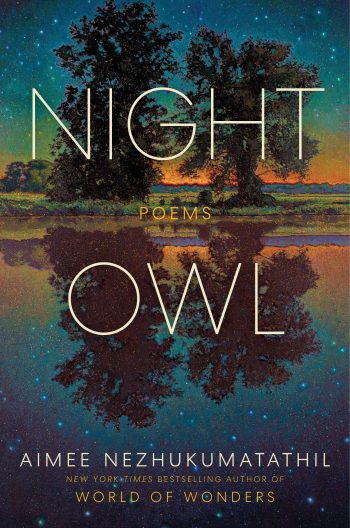
The Rumpus: The first stanza in Night Owl begins: “I do my finest listening in the dark. / My best friend has always been ink / and she lets me talk so much at night.” A central poetic feature of this collection is the nocturne, which you define in your author notes as “a poem of the night.” Even the book’s overarching movement is organized by the stages of night, like “crepuscule” and “midnight.” How has night served you as an emotional or poetic framework and is it part of your poetic methodology or process?
Aimee Nezhukumatathil: Night has always felt like a soft loosening of the world’s grip on me. During the day, everything asks to be fixed quickly, answered quickly. When I became a mom the asks of my children meant it all pretty much doubled (and it should be said, much of this is what I had deeply wanted and hoped for–and still do). At night the demands fade and I can hear things I miss when the sun is up: my own breath, birdsong when they are migrating, memories, and possibilities for writing. The dark feels like permission. As a poetic framework, night gives me a way to move through emotional registers that might feel too bold or bright in full daylight. Grief, wonder, longing, tenderness, worry, yearning—they all glow differently in the dark. I’ve been drawn to the nocturne for years because it’s a container for vulnerability without spectacle. I don’t feel interrogated at night; I feel my most honest, my most vulnerable.
Structurally, the stages of night helped me think about time as something cyclical and alive rather than linear with an end point. I feel like each phase of the night carries a different emotional register. It mirrors how feelings actually move through us: not in neat chapters or stanzas, but in genre-blurring waves. I hope readers feel like the book follows the body’s own clock—what Edward Hirsch calls the “night mind”—when we are the most honest, most porous, most likely to whisper truths we can’t manage at, say, noon. Night has always been part of my creative process! Even when my sons were toddlers, I loved to write at night when the rest of the world quiets down.
Rumpus: There is incredible formal diversity in this collection. We encounter familiar forms like the “ode,” but also less familiar forms that might surprise readers like the tondo or carmina figurata in poems like, “Punctuation,” and “Big Night.” These forms are especially surprising in how intricate they are and how they draw attention to their materiality and the labor that made them possible. In a way you’ve created a garden of forms for the reader that leave their impression on us. In part because of how they demand a very embodied and physical response to how we engage with the book and move our bodies around the page in order to read their swirls, grids, shapes, and pictographic representation of animals. Can you share with us your process of building these poems and then placing them throughout the collection?
Nezhukumatathil: Oh, thank you so much. The short answer is I was writing these poems while I was deep into writing essays [what would eventually become World of Wonders (Milkweed, 2024) and Bite by Bite (Ecco, 2024)] and truthfully, I was getting tired of the conventional stanza. I mean little or large rectangles were sometimes leaving me bored, so I started experimenting with the line, with the shapes of poems, and more. It was great fun and exhilarating to challenge myself with difficult shapes like the sharp and thin silhouette of a Magnificent frigatebird for example.
The longer answer is that I hope every poem I include in my books is interactive, that is, the speaker of these poems very much wants to interact with you (as opposed to lecturing or shouting into a void). I love finding different ways to engage the reader: I consider the way I lay the poem on the page, if they have to hold the book up to their face real close or far, or how to get the reader to maybe even spin the book when they read! As for placing the poems that don’t have traditionally shaped stanzas throughout the book, I put them where I thought they may fit tonally.
Rumpus: Traditionally we associate the haiku with nature. In this collection, you invoke the haiku through the haibun alongside other Japanese forms like the zuihitsu, which you describe as a compilation “of seemingly random observations and juxtapositions that capture a specific mood.” What is it about these Japanese forms specifically that allows you to engage with nature?
Nezhukumatathil: Maybe it’s uncool to say, but I very much have a favorite form to write in poetry and that form is the haibun. I started writing them as a way to nudge myself back into writing after I became a mom, and maybe I have a sentimental feeling about this form that exhilarates me and got me writing on days when I thought I didn’t have it in me. I think what I love most about the haibun and zuihitsu is that these forms trust smallness. This scale feels honest to how I experience the outdoors. Nature doesn’t really have a thesis or explanation that I can fit into stanzas. I feel like the outdoors offers up textures, shifts in light, and rewards us with incredible imagery if we slow down and notice. The haibun, especially, lets me braid the interior by describing the exterior. I’m never just describing a place, for example, because I’m also pinning a mood or tone to it too.
Rumpus: In the heartbreaking persona poem, “For Elephant Poachers: An Invective,” you lend a human voice to a poached elephant. So much of this collection is a radical act of empathy where your lyric blurs the line that separates the human from the more-than-human. In writing so close to the natural world and lending your voice to animal experience, what tensions, opportunities, or surprises did you encounter during the creation of this book?
Nezhukumatathil: Oh, that’s so lovely to hear about my poems. I’m so glad you’re seeing the “radical act(s) of empathy.” This isn’t something I consciously set out to do, but rather, is how I’ve tried my best to continue on this planet after my best teachers of the outdoors (my immigrant parents) modeled a way for me to be. That is, back when I was a kid in the 70s and 80s in the suburbs, they were already demonstrating to me that ideally there isn’t separation between us and say, plants and animals. They showed me that we were all connected and if we didn’t take care and notice the inhabitants of the outdoors, that would end up harming us, even though we lived indoors.
In other words, my poetics—and who I am as a person—are about holding onto the belief that we are all connected, and it is our responsibility (and joy!) to care for each other. Noticing is the ultimate act of love, right? I love your question because it reminds me that the tensions, opportunities, and surprises are always inspiring, are always a happy challenge to get it all down, as much as one can in a lifetime. Writing about the outdoors affords me surprise and delight in the kabillion possibilities of making poems and essays. It’s more a question of how can I snag pockets of time to write, rather than drumming my fingers at my desk and wondering what to write about.
Rumpus: The book is also a beautiful argument for how the natural world offers us language and ways of knowing and being that exist beyond the human. For example, in “Green Love Poem,” the tweeblaarkanniedood, a plant that never dies, becomes the material embodiment of eternal love, or how in “First Lockdown, with Toucans,” the tropical chick becomes the articulation of the awe inspiring—yet vulnerable—potential of school children in an era of gun violence. Can you share with us the experience of finding those connections and how the natural world can help us better understand life and ourselves?
Nezhukumatathil: I love this question because it gets at a misunderstanding I think people sometimes have about nature writing. Some might think poets go out “looking for metaphors,” like the world is a giant writer’s prop closet. I don’t start with metaphor. I start with observation, an image. I’m not asking, “What does this bird stand for?” I’m asking, “Who is this bird when I’m not around?” That shift matters to me. Poems feel different when they grow out of relationship instead of assignment.
Often the connection happens later, almost sideways. I’ll be watching a plant or an animal, trying to get the details right—how it moves, how it survives, what it needs—and only after that deep noticing do I realize, “Oh, this is brushing up against something in my own life.” The poem isn’t built from “this equals that.” It’s built from “this lives alongside that.”
If I stay long enough with a creature or a landscape, I start to see patterns of existence that aren’t just human: fragility, adaptation, and interdependence, and so much more. Those patterns help me understand my own life, but I try not to hurry it along. Ideally, I want the plant to remain a plant—the bird to remain a bird. As I tell my nature writing students again and again: “Let the natural world be itself before it helps you be yourself.”
Rumpus: You also present motherhood as a precious thing that grounds us within nature, especially in poems about breastfeeding like, “When Milk is A Memory,” and raising growing boys like in “Animals in Fall.” The voice in these poems and across the book are so sensitive and tender but also wise and sagacious. How might motherhood prepare someone to be a poet? Did the process of writing this book illuminate something about motherhood for you?
Nezhukumatathil: I always feel a little shy talking about motherhood as if it’s some grand credential. Mostly because parenting has humbled me more than anything else. I’m wrong a lot. I’m tired a lot. I forget things constantly. My teens will vouch for me on all of that, haha! Motherhood didn’t teach me how to write so much as it changed how I pay attention. Your awareness sharpens in strange ways. You notice the small shifts like a new word, a longer stride, the day you realize your arms no longer fit around someone the way they once did. Mostly it has made me more interruptible, more porous—which turns out to be very good for poems. And yet I think that also: attention is the daily practice both poetry and caregiving share.
I also love how motherhood keeps me in the physical world. There’s nothing abstract about feeding someone, lifting them, staying up when they have a fever, or watching them become independent. Writing Night Owl, I kept returning to that feeling, how quickly something daily and essential can become a memory, and how astonishing it is that it ever existed at all.
I hope the poems don’t feel closed off to people who aren’t parents. You don’t have to be a parent to understand care, or awe, or exhaustion, or the ache of loving something you can’t hold still. Motherhood just happens to be the way those forces arrive most vividly in my own life. It’s my favorite role, yes—but it’s also just one way of figuring out how to love fiercely and temporarily at the same time. If Night Owl illuminated anything for me, it’s how much poetry and parenting share a humility: You don’t get to control the outcome. You show up, you pay attention, you offer what you can, and you let the rest unfold. That feels like a pretty good way to live—on and off the page.
And maybe that’s the real overlap: a poem and a child both ask you to pay attention while they are here, knowing you don’t get to keep them exactly as they are.
Rumpus: This book also wrestles with questions of being a woman of color in the US, but also more specifically a mother, homeowner, writer, student, and even waitress, living and working in places like the South. Your poem “American Tenderness” takes the shape of a letter to America. How do you envision nature, Americanness, and race converging in the space of this poem? How do you hope it resonates with readers living—and surviving—in America today?
Nezhukumatathil: In that poem, I’m trying to hold America the way I hold a garden I didn’t plant but still tend. I recognize that it’s complicated, wounded, yet still capable of beauty. My family and I are on a mission to visit all of America’s National Parks—we try to go to at least a couple a year. Gardens, forests, beaches, deserts, mountains all remind me that notions of belonging and land ownership reveal the complex relationships at the center of the (violent) origins of this country. Even the word “belonging” is complicated. Sometimes that word comes from attention, from learning the names of things that live beside you.
As a woman of color, I’ve often felt both visible and invisible, and the natural world gives me another way to claim space. Not through argument, but through care, witness, attention and knowing the names of the creatures and plants that live on this planet, in this country in particular. I hope readers feel less alone in their mixed and complicated feelings about the outdoors and remember that tenderness is not weakness but a way of staying human inside a place that can be harsh. If we can keep noticing, keep tending, there’s still room to grow something gentler, together.

Click here to subscribe today and leave your comment, or log in if you’re already a paid subscriber.