
The odds of picking a perfect March Madness bracket are frequently given as one in 9.2 quintillion. How likely is that? You’re far more likely to be eaten by a grizzly bear, or to win the Powerball, or probably to win the Powerball while being eaten by a grizzly. According to the NCAA, the odds are so vanishingly small as to be laughable:
“A group of researchers at the University of Hawaii estimated that there are 7.5 quintillion grains of sand on Earth. If we were to pick one of those at random, and then give you one chance to guess which of the 7.5 quintillion grains of sand on the entire planet we had chosen, your odds of getting it correct would be 23 percent better than picking a perfect bracket by coin flip.”
For this reason no one has ever picked a perfect bracket, and no one is expected to do so anytime soon. But in fiction, unlike in statistics, all things are possible.
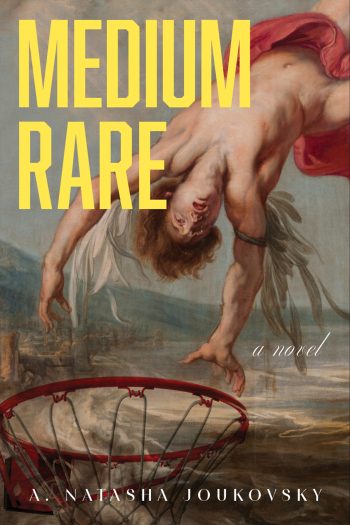
In Medium Rare, the second novel from A. Natasha Joukovsky, Phil Fayeton is a Washington lobbyist for the American Association of Stone, Sand, and Shale, a decidedly unsexy organization, and enjoys a very middling life as a fairly middling person. That is until his bracket picks for the 2019 Men’s Basketball Tournament start coming true, and Phil realizes he may be able to win the billion-dollar prize. Phil rises like Icarus, along with his alma mater’s seemingly unstoppable team, the University of Virginia’s Cavaliers. And watching all of this is the novel’s narrator, Cassandra, a political fundraiser and seer who moves in the same social circle as Phil. She befriends his wife, Raleigh, and becomes increasingly more entwined with her life as Phil is swept into the maelstrom of sudden fame.
Joukovsky has been compared to Edith Wharton, as she steers directly into American taboos like class and status with unflinching honesty, humor, and sympathy and scorn in equal measure. She describes Medium Rare as “a feminine novel inside a masculine one,” and I concur, with appeal for lit girls, Ovid stans, basketball bros and everyone in between.
I was delighted to speak with Joukovsky over Google Docs about statistics, social status, and the difficulty of getting people to listen when a prophetess speaks.
The Rumpus: I want to begin by asking how your interest in college basketball began. The way you write about the University of Virginia’s 2018-2019 team is positively rhapsodic. “Their vicious pack-line defense had the texture of a coloratura soprano’s staccatos… their long, drawn-out offensive possessions unspooled like paragraphs of Proust.” I know you’re a UVA alum. Was your interest piqued during their historic championship season, or were you always a fan?
A. Natasha Joukovsky: My interest in college basketball was pretty limited to bracketological statistics before I started writing Medium Rare. I never attended a game in college; my most salient basketball memory from that period is winning second place in my debate society’s March Madness pool one year. Sure I was casually pleased when UVA won the championship in 2019, but I didn’t fall in love with that particular team until Cassandra did, in real time as I was researching and writing the novel. My going-in perspective was much like hers as well. (“You can’t teach height, as they say—and what on earth, at five-foot-six, was there to gain from pursuing something one could not learn?”) The lines you quote above were added in edits, after the book was fully drafted, in the afterglow of so closely studying the games.
Rumpus: And what is it about specifically about the March Madness bracket process that drew your attention? Can you explain to readers what the odds are of picking a perfect bracket?
Joukovsky: The high concept was actually my husband’s idea—he’s a much bigger (Duke) fan than I am—but it immediately grabbed me and wouldn’t let go because it so clearly divorced two things almost pathologically lumped together: rarity and value. Filling out a perfect March Madness bracket is a vanishingly rare feat utterly devoid of value. Who cares! But of course, people would. I wanted to explore all of the ways our society would overreact to this sort of fools gold in a Fool’s Gold Administration. In fairness, the math is mesmerizing. The odds of picking a perfect March Madness bracket are often cited as one in ~9.2 quintillion, or 263—but this is wrong. It treats each game as a fair coin flip when the tournament seeding is asymmetrical. As I relay in the book, the first one-seed ever to lose—UVA, the year before we won it all—only did so after 135 consecutive one-seed wins. There are statisticians who study this stuff (e.g., professors, Nate Silver) and create models that build in these asymmetries, underlying team metrics, et cetera. The most optimistic I found in my research was, coincidentally, for 2019, and put the estimate around one in two billion.
Rumpus: Status and rank play a big role in the novel. You have the college teams all ranked against one another and vying for the top position, but at one point you also have your characters jockeying for space in an elevator according to their relative professional status. Then there are the usual American insecurities about money and parentage and class, et cetera always bubbling in the background. Can you speak a little about your perspective of status in the United States and how it functions in the novel?
Joukovsky: Yeah, I am really, really, really interested in this. America has been ever at the forefront of what Alain de Botton calls “the great aspiration of modern societies” to shift from hereditary to mutable status dynamics. But gaining the opportunity to rise comes alongside the possibility of falling (cue Icarus!) and the anxiety of this uncertainty. This anxiety is so unpleasant that we’d prefer not to think about it, and we Americans specifically have a neat palliative queued up in the bootstrappy delusion that by eschewing hereditary nobility, we’ve conquered status itself (and relatedly, as Phil illustrates, luck). Not so—and ironically American squeamishness about status, especially positional status and our human tendency to prioritize relative over absolute outcomes, precludes its consideration—the consideration of reality—in policy development. So we end up with arms-race inefficiencies that suck for everyone instead of, like, progressive consumption taxation. I hope Medium Rare never crosses the line from moral inquiry to moralism about this stuff—my foremost artistic objective is to delight—but this reader is admittedly delighted by Rawlsian distributive justice, so it’s in there.
Rumpus: Your characters have a healthy sense of irony, especially Cassandra. “I had made all the traditional choices of the unenlightened women I looked down on; my only distinction was having made them more elegantly.” Can you speak a little bit about how you cultivate this ironic voice? I have to imagine it begins with observation. Are you an observant person? What kind of things catch your attention?
Joukovsky: This question made my husband laugh out loud. If I am unusually observant, I am also unusually blind. Yes, I can clock a basted coat vent from two blocks away, and I do think this sort of observation—“sight,” the novel might prefer—is particularly suited to penning ironic psychosocial novels. I’m deeply attuned to status and class signifiers. But I also frequently miss things others consider extremely obvious. I did not realize “Joe Rogan” was the Fear Factor guy until last week. The “absent-minded professor” gene runs in my family, and I unquestionably inherited it.
Rumpus: It’s interesting to read a play-by-play of a basketball game in narrative form. As you were writing, did you have difficulty blocking the games in your mind? How do you keep the narrative of a game interesting to readers?
Joukovsky: Oh, no, the blocking came so naturally. Grounding all of the basketball in reality made writing the games feel more like adaptation than genesis, allowing me to save my creative energy for what I was superimposing onto them. And the arc of UVA’s championship run the year after such a humiliating loss is itself so compelling! It was a pleasure to build around. Having not previously been much of a basketball fan, I was able to use my own interest as a gauge—as well as that of pretty much everyone else involved in publishing the book.
Rumpus: Cassandra’s voice is so fun to read. She’s a little bit Lady Whistledown of Bridgerton, a little bit Dan Humphrey of Gossip Girl, but with the sharp edge of William Makepeace Thackeray. How did you find her voice?
Joukovsky: On the voice front, all roads lead to Jane Austen. I originally thought this novel would be in the third person—Cassandra’s “omniscient” narration was a later development—and was simply writing in my own authorial voice (a toned-down version of my debut’s where I was being extra-extravagant with Narcissian prose “in love with itself”). Cassandra didn’t change the voice much; Austen herself occasionally slips into first person, and I was going for a more detached first, the kind that often feels more like third.
Rumpus: There’s an incredible line halfway through the novel. “If you want the world to pay attention to an extraordinary woman, you have to tell the story of an ordinary man.” Wow. Can you say a little more?
Joukovsky: Thank you. I envisioned this novel as a series of Trojan Horses on the topic of identity: a feminine novel inside a masculine one, but then a human one inside that. I wanted the novel to work on all three levels: on a basketball 30-for-30-type level, on a literary, character-driven level, and on a unifying philosophical level. To get the dudes who come for March Madness invested in literary female friendship—and the lit girls who come ready to dunk on average white guys invested in men’s basketball—to expose the smallness of seemingly insurmountable differences. There’s a snippet of the Indigo Girls’ song “Virginia Woolf” that was top of mind: “We’re all the same / The men of anger / And the women of the page.”
Rumpus: Writers, of course, live all over. But I’d like to hear about what it’s like being a fiction writer living in Washington, D.C. How does being in the capital, so close to power, inform your work?
Joukovsky: The power I actually live close to is Georgetown University—my neighborhood feels more like Nantucket than Washington. I work from home, and if anything I feel more insulated from politics here than I did in New York. Occasionally there have been explicit literary benefits to being in D.C. A mom-friend who works in the Senate got us tickets to tour the East Wing (RIP) during the Biden administration, and I was able to pepper the staff with questions like, “Where were the Shiklers hanging in 2019?” The more general benefit is that it’s simply a nice, bougie place to live and raise a kid with less expense and stress than in Manhattan. (I do still miss New York.)
Rumpus: Your first novel relied on Ovid’s Metamorphoses and the myth of Narcissus as sort of foundational or inspirational texts for the story, and this novel loosely follows the Icarus myth. “There are some gods,” you write, “like some stories, so culturally existential they bear not only imitation but iteration.” What is it about the ancient myths and texts that you find so personally captivating, and why do you think they endure culturally in general?
Joukovsky: My mythic approach is heavily inspired by the Joycean model in Ulysses. The way it merges timeless and temporal considerations, literary innovation with established staying power. I love Ovid’s Metamorphoses specifically for its wit and leggerezza, well aligned with the tone I am looking to set; for its ekphrastic proximity to visual art; for its intense recursivity. The nested, mirrored, echoed, and interwoven stories in Ovid’s text are further enveloped and translated and iterated across the history of Western art. I think this sort of recursivity, the structural isomorphism between Ovidian narrative and Godëlian mathematics, is central to these stories’ endurance. They are structured like the human brain itself! And we are mimetic creatures, ever enamored of our own reflections.

Click here to subscribe today and leave your comment, or log in if you’re already a paid subscriber.