
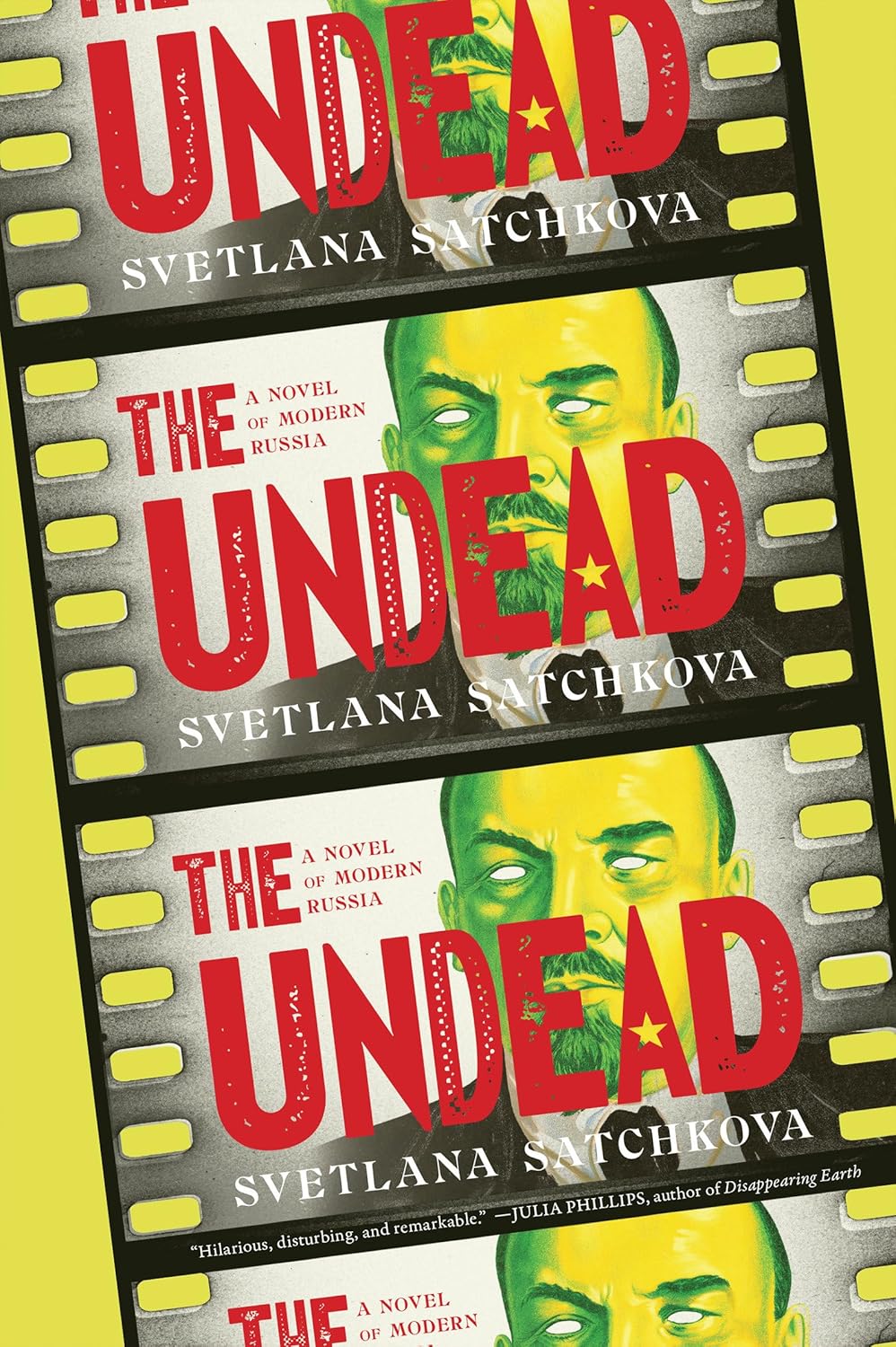
It’s been two weeks since I finished reading Svetlana Satchkova’s The Undead, and the novel continues to haunt me. Not just because of its supernatural element—though the supernatural sits at its core in the form of a horror film about Lenin, the dead Soviet leader, coming back to life to lead an army of ghouls—but because the pages capture the terrifying reality of living in an increasingly totalitarian state.
On any given day, I spend a lot of time thinking about Russia. I think about it more now because I don’t feel I can travel to my birthplace, given the regime’s knack for arresting even those who have donated $51 to Ukraine, never mind publicized their opposition. So I imagine. I imagine going to the theater, which is what we always do there, because for generations, my family has worked in theater in Moscow. I imagine going to cafes that serve the kind of food my Ukrainian great-grandmother used to make. And above all, I imagine conversations: honest ones that I cannot have with my Russian relatives and friends over WhatsApp or Telegram about the state of affairs in a country looming from afar as a war-mongering, censorship-ridden, humanity-despising disaster, (but that I know is also filled with terrified people hoping to experience something better in their lifetimes.) Russia is a country full of criminals, yes—but also home to creative spirits who are drawn to the stage, page, or canvas to tell a story—and who want to continue to make art even as the path they tread narrows by the minute.
So it meant a great deal to visit modern Moscow through the window Svetlana Satchkova cracks open in The Undead. Billed as a modern novel of Russia, it is precisely that: A portal into the current reality that headlines don’t capture. It is a way to explore, without fear of being caught on a recorded line, what it’s like to make art while attempting the impossible feat of staying away from politics.
If at times reading The Undead made me uncomfortable, it is because the novel’s dark turn is so devastatingly true-to-life. And that is precisely what makes it essential reading: because at any given moment, any act of ours, creative or otherwise, can be misconstrued by those in power as a political statement. At any given moment, someone in power can choose to make an example out of us.
Maya, the novel’s heroine, is in her thirties. She finished film school later in life than she would have preferred. And she receives her dream opportunity—to make a film she’s written—equally later in life. A producer, Belov, accepts her project, telling the disbelieving Maya, “This is just great. It’s an art-house horror, and how many of these are out there. I don’t remember seeing any in the last few years.”
For those who haven’t followed the disturbing funereal fate of Vladimir Ilyich Lenin, the Soviet Union’s first head of government, (who led the overthrow of Russia’s imperial government in 1917 and then ruled the Soviet Union until his death in 1924), Lenin was laid to “rest,” against his wishes, in a grotesquely voyeuristic open casket in a mausoleum in Red Square, outside the Kremlin.
Two years ago, at the centennial of Lenin’s death, I wrote about a legend I learned while growing up in Moscow: that a curse will continue to grip Russia until Lenin is finally buried underground. We’re still waiting for that day. Instead, a team of scientists continues to perfect the fine art of embalming what’s left of Lenin’s body.
In The Undead, we see what happens when instead of burying the dead—and letting dark history be history—we resurrect it. Intuition tells us that nothing good can come of this, and in fact, nothing good does. A revolutionary elixir invented by the medics who keep Lenin looking vivacious brings him back to life. He proceeds to seek control of Moscow, a zombie army following in his wake. Tellingly, the Kremlin authorities alerted to the production of the film will see themselves in the ghouls, and this confrontation with reality—with their likeness as bloodthirsty, murderous non-humans—will not sit well with them.
In her sometimes surprising innocence and naivete, Maya has not intended to make a metaphor of her film. Not at all. Her lack of political messaging in fact causes her quite a bit of distress: She feels that an artist should know exactly what it is they want to say, but Maya can’t yet articulate a lofty message, and the Lenin horror plot really seems like experimental theater. Maya is new to this stage of the artistic journey,and wants to play and innovate before settling into any sort of aesthetic or intellectual credo.
Maya is still basking in the fading glow of recent Russian history—from the 1990s until the early 2000s—when Russia seemingly moved toward democracy, despite evident instability and corruption. She fails to sense the increasingly statecontrolled environment, where playing, innovating, or asking “What If?” is out of the question. What ifs are the kryptonite of authoritarian rule, even when questions are posed on an artistic playground, and even when the low-budget horror film stands little chance of starting a revolution against the all-powerful state.
More than once, I found myself wishing that I could read Maya’s actual script alongside the novel, but that’s beside the point. Because in The Undead, the script, compelling as it is, is also beside the point. The point is that Maya, who wrote it wishing to do something bold and different—to surprise her audiences—receives the ultimate surprise.
One day, someone writes a denunciation accusing her of antigovernment sentiment. And in Putin’s Russia and its FSB (the domestic intelligence and security agency), just as in Soviet Russia and its KGB, there is little that’s worse. Maya gets a knock on her apartment door, and two agents barge into her apartment. They tell Maya that, “A concerned individual submitted a statement to us, reporting a perceived crime,” accusing Maya of making a film inciting extremist activity, using the undead Lenin as a stand-in for Putin.
Maya’s project is halted and her life begins falling apart. She faces arrest, a horrible, staged trial, and the disorienting limbo accompanying her acknowledgement that she is merely a helpless marionette whose strings are held by people she can neither see nor influence. Having finally ascended to the fabled rank of director, Maya can no longer direct her own life.
Ironically, Maya is the least politically aware of all her friends,yet it is Maya who falls hardest, becoming an example in order to scare others. Maya’s friends—particularly a semi-friend/semi-nemesis named Ksenia—seem simultaneously able to keep their finger on the political pulse and strategize their career growth accordingly.
When Maya finds herself feeling like an idiot for not imagining that this could happen to her, her lawyer, Lilia, offers these words of comfort:
“Don’t beat yourself up,” Lilia advised. “If it makes you feel any better, most people think like this. It’s normal in a situation where you can’t control anything—your brain is just trying to protect you. You ignore reality because it’s too awful to contemplate. If you face it, it can destroy you.”
And if you don’t, Maya thought as she sat in the car on her way home, it still comes for you and destroys you. Suddenly, it occurred to her why the horror genre hadn’t really caught on in Russia. The reality was so horrifying that viewers didn’t need to be scared. They already had too much of that.
Maya’s fiasco of a trial will be familiar to those who have followed Russian politics in recent years. Among Russia’s current political prisoners are poet and theater director Evgenia Berkovich and playwright Svetlana Petriychuk, arrested on absurd charges of “justifying terrorism” in Petriychuk’s play about women marrying jihadists in Syria. Satchkova acknowledges them in her book, using their trial as the foundation for Maya’s experience in the courtroom.
The Undead takes place in the years Aleksei Navalny (another victim of Putin’s Kremlin) is alive, making his anti-Kremlin documentaries, and leading rallies for what he called The Beautiful Russia of the Future: democratic, prosperous, and free of corruption. Maya’s love interest, Mark, gets involved in Navalny’s demonstrations, and Mark and many other friends criticize Maya for her blindness and unwillingness to join the cause. And the question Satchkova poses indirectly, with great care and without judgement is: how willing are we to judge Maya’s character? What would we do? Would we get the hell out, or find a way to navigate the home we love (and also hate) like Maya? It is a poignant litmus test, especially for American readers increasingly contemplating similar questions.
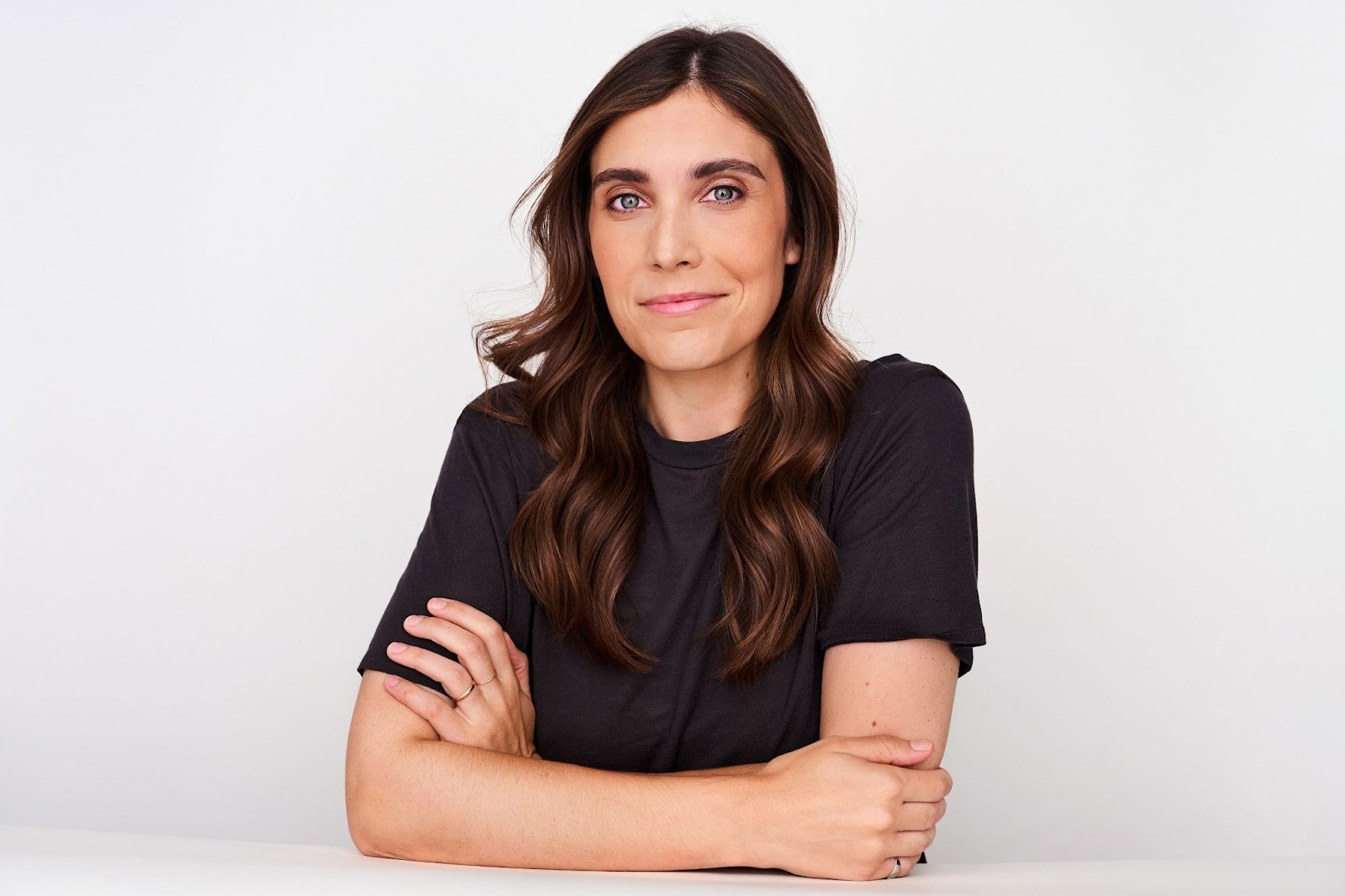
It’s clear throughout the novel—from the quintessentially Russian conversations and thought processes to the references (sometimes veiled, sometimes not) to real Russian players and the political backdrop—that Satchkova is writing from deeply personal experience. An émigré from Putin’s Russia now living in New York, Satchkova was a journalist and writer with a long-standing career at Condé Nast in Russia, first as Deputy Editor in Chief at Allure and then Features Director at Glamour. She reported in Cannes, Venice, London and Buenos Aires, interviewing Hollywood stars like Alicia Keys, Antonio Banderas, Gwyneth Paltrow, as well as politicians and criminals, and writing three novels in Russian.
Satchkova has spoken about her own conscious choice to steer clear of politics while living in Russia because of its dangers: As a single mother with no relatives in Russia, she prioritized safety. Satchkova’s journey and sensibility find echoes in Maya’s best friend, Lena, who supports Maya’s film and then trial—until Lena herself opts to depart to the US with her son. For Satchkova, the idea for the novel came from watching friends who didn’t follow politics and seemed unwilling or unable to acknowledge they lived in a repressive regime.
If a reader of The Undead doubts Maya’s attempts at apoliticism amidst creative undertakings, here’s an anecdote. My aunt—an educated, kind woman who lives in Moscow—recently called from Morocco. On vacation, she was able to speak more freely. And what she said when asked about what’s happening in Russia was that she doesn’t even know what’s happening. She simply no longer watches any news at all. Not state-funded propaganda, nor information she could find over VPN. “Because if I did, I would go insane,” she said. Instead, she’s set up her art studio, where she makes flower arrangements and pottery. In a world of misery and lies, she has chosen to make beautiful objects while closing the curtain of the politics. My aunt tries not to think about her sons being drafted to fight on Ukrainian land where her father grew up. She doesn’t protest—Russians know how that ends.
In The Undead, Maya travels the world and is deeply engaged in Moscow’s creative scene—but turns a blind eye to politics even as she pulls a decomposing politician into her film. As the novel progresses, we see how psychological walls create a semblance of self-protection.
We see Maya’s emotional state devolve as she awaits and then experiences her trial. We see her weigh her options and choose to stay, even as she is offered an opportunity to leave Russia. Here, I couldn’t help thinking about my great-great-grandmother, who was offered a similar opportunity in the early 1900s but decided to stay in Russia, only to watch Stalin’s men take her husband.
Satchkova could have written the novel with Lena as the central character. Lena—a successful journalist like Satchkova herself—decides to leave Russia behind with her son and embark on a new life in America. But I deeply appreciate that this is not the novel Satchkova wrote. Instead of penning a Hollywood ending, Satchkova kept the story firmly in a gray zone, asking us to reckon with the murky reality faced by so many, worldwide. Despite her complicated relationship with her family, Maya still has family in Moscow, and she loves them in her own, complicated way. Despite watching her professional life crumble and her social circle shrink, we get the feeling that Maya still hopes that a messy but passionate love story might one day turn into something more enduring. And despite her complex views on Moscow, she still loves the city. I know current residents who say Moscow today is more glamorous and thrilling than ever, (hard as that is to digest). Maya observes that,
“Side by side with the loveliness—the glorious architecture, the immaculately clean streets, the trendy cafes and new cultural spaces—there were bulky, flat-faced men everywhere, looking at you as if you were a second-class human. […] When you were constantly surrounded by intelligent and sophisticated people, you tended not to notice all this, and it was easy to pretend that it had nothing to do with you—until, suddenly and shockingly, it did.”
The Undead excels in maintaining this deeply unsettling tension between everyday life and totalitarian terror. The novel is thrilling, but it is not a thriller. It is willing to decelerate and remain past the point of comfort in quotidian human existence, with its romantic entanglements, disappointing family gatherings, professional ambitions and disappointment, and battles with emotional upheaval and depression. While a thriller might demand the heroine make a dramatic statement to prove her point and affect meaningful change, we see instead an ordinary woman attempting to subvert the government’s agenda in subtle ways, only to come up short.
We see, too, how a love of homeland, a passion for art, a fear of the unknown, and the unlikelihood of success abroad influence a choice to remain and hope the tides turn.
Given the dark realms The Undead explores, the novel is surprisingly light and easy to read. Because, as in real life, daily matters take up a great deal of the heroine’s headspace. A relatable, flawed woman attempts to live her life, pursue a path critiqued by her parents and sister, find a functional and fulfilling romantic liaison, and get rid of a creepy ex. All this occurs while politics slowly encroach until, seemingly out of nowhere, the sky opens up and the protagonist is pummeled into a barely recognizable version of herself.
How can a person find a new normal under such conditions? This is the answer we seek when faced with the impossible and unbearable, and the question The Undead strives to uncover, with modern Russia as its testing ground.
Click here to subscribe today and leave your comment, or log in if you’re already a paid subscriber.