
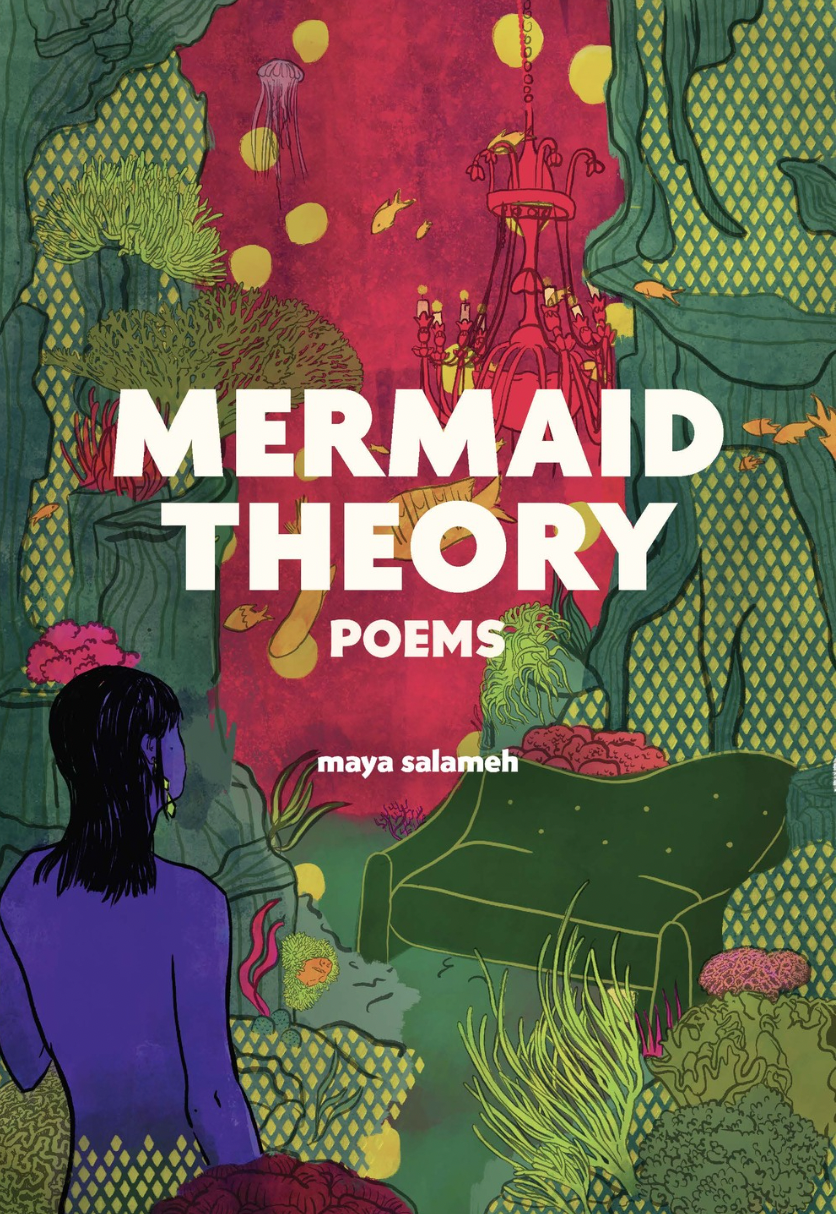
“Long ago we crawled out of the water. We can’t go back.”
from “Haggling the Shami Way,” Mermaid Theory
On the seafloor, a menagerie of sunken human artifacts. Tattered remains of history of a not-so-distant past: skeletons, ironworks, pottery, family heirlooms, are often corroded, encrusted with marine life, but some piece of it endures. In fact, items that are found buried in the sediment can be extremely well preserved,as long as they remain submerged. While the ocean’s saline water may preserve shards of shop, bone, and organic matter, retrieval introduces an immediate environmental change from water to dry land that can shock these objects into rapid disintegration. Such objects require intentional caretaking to preserve their integrity.
“if I slipped over the seafloor like a duvet
thumbed its creases
I’d find plastic & kinfolk & anglerfish
 I’d find proof of my doomedness”  Notes on Methodology
It is this “shock,” this consistent disintegration, and the techniques necessary to stall it, that Maya Salameh so tenderly and precisely metabolizes on the page. Water is our earliest teacher, and Salameh shapes language like it. Salameh’s lyric feels familiar: speaking in lineages of water bearers, spirits and communities, everything we experience is part of a larger watershed and this author is always connecting us to the Source. Life and knowledge emerged from water, and without it we are impossible. Yet through imperialism, militarization, alienation and surveillance, our engagements with our most abundant resource are ruptured. For this writer, the intensity is not just in the rupture, but in what precedes it and what follows. Water connects, removes, and, in the words of Tao Leigh Goffe, “ferments” many of our diasporas. Fluid, textured, sensual and at times humorous, Salameh’s writing is simultaneously a flood as it is a perfect row of clear cups resting on the altar.
Salameh’s second collection, Mermaid Theory (Haymarket Books, 2026), is as a tribute to water that caresses womanhood, enduring ancestry, friendship, queerness, and the lands (and tributaries) capable of holding such depth. Mermaid Theory is an archive and an invocation, a case study that meets folklore, a tough nut to crack, and an uncle sharing sunflower seeds with a casual spring Wednesday. Readers unfamiliar with Salameh’s evocative style should anticipate layered engagements with self and culture, a glittering tone tinged with nostalgia and righteous displeasure, an opportunity to be both delighted and informed, which, I believe Salameh would agree, is the entire point anyways.
Mermaid Theory is a collection preoccupied with the fallacy of separation. Mermaids, as beings of land and sea, are ideal figures through which Salameh interrogates grief patterns, loss, and the search for meaning, especially as a result of orientalism, dehumanisation, and the othering that justifies ongoing terror. When horrific destruction becomes diurnal, what other forms of relief are available beyond prayer, beyond a mythology that explains what data fails to capture? A mermaid can survive in the in between.
Following the prefatory poem “Pleasure is Data,” Mermaid Theory opens with the sunrise. There is a recurring dawning, an awakening that permeates the entire collection. The opening aubade grounds the reader in a future to be pursued, one of course, influenced by the past, but not beholden to it. Structure is one of Salameh’s most notable strengths. Mermaid Theory is organised into three parts: “The Legend Goes That,” “Estuary/Girl,” and “Common Maronite Hymns,” all tracing narrative threads between Syria and the United States, forcibly tethered through militarism, extraction, and religious persecution. This attention to framing gives way to Salameh’s secondary strength: her ability to be in conversation with numerous writers, mythological elements, and narrative arcs. Mermaid Theory navigates the tricky boundary between heritage and homemaking while asking who is a trustworthy narrator in an era of ceaseless violence carried out in the name of intervention. Salameh’s poetry is filled with song; it reverberates even after the words have been spoken and all that is left is their vibrations. iIt challenges hegemony, dissects sound, celebrates the cacophony, the multiplicity of our existence. Above all else, Salameh’s work elevates the messy vibrancy of life, not casting judgment but honoring the capaciousness of our successes, and our wounds. It is her ability to immerse the reader in such sensorial richness that allows for us to take the lead in our own exploration of her linguistic profundity. Salameh inherently trusts her audience, which encourages readers to step up to the challenge.
“is my gender chlorophyll? air left alone from soldiers?” from “Pelvic Ultrasound in July”
As a writer who also contends with both the empirical and mythological, I take pleasure in how effortlessly Mermaid Theory stretches language to recover what migration has rendered lost. While much other writing focuses on the destructive event itself, Salameh turns a critical eye towards the aftermath (which is perpetual), simmering on casual moments shared between siblings, the permeable barrier of the television screen, moments where womanhood and youth collide. Incorporating academic tools like methodology, archive, ethnography, and annotated bibliography, Mermaid Theory’s reaches its most profound moments when Salameh experiments with form and repetition through this terminology, as in the poems “Excerpts from September’s Psychosomatic Effects on Arab Am. Girls IRB Protocol #654781,” “Estuary Ghazal (American)” and “Estuary Ghazal (Arab).”
Salameh cheekily dissects rigid systems that seek to diagnose and pathologize rather than understand. And even understanding has it limitation: what Salameh words do is allow us to feel. Like being submerged in an entity greater than our small humanness, Mermaid Theory is filled with underwater acoustics, siren song… motivating us to sit with discomfort and our own preconceptions. The lyric challenges the chauvinistic pathologization of female rage – how it might be one of the clearest ways we see through the American Propaganda machine. It doesn’t make that critical attention any less alienating…or maddening. One of the most apparent through lines in the collection is the notion of Arab female “hysteria;” though not explicitly named, Salameh balks at the personal and political encounters which attempt to hold grief hostage. But like water, pain must flow somewhere. Vacillating between Syria and the United States, Mermaid Theory asks complicated questions about the nature of separation — and whose narratives gets centered among persecuted communities. At times self deprecating, others honorific or stoic in the face of intense grief, Salameh illustrates the difficult absurdity that is diaspora:
“…I write here in the crevice across pandemics where an unprecedented amount of us recognize our country as the massive peach it is rupturing at the skin with rot I am so full of salt so wined & well-fed so American.” From “The First Mermaid Ever Climbs Out the Sea & Tells You She Won’t Take You Back”
Mermaid Theory is as self-aware as it is incisive; there is beauty in unease, and vice versa. Acts of self discipline are nothing without moments of worship, of divinity, of celebration with loved ones who are also clear-sighted in their visions for a better world. In order to midwife this next one, we must return to the original portal: the ocean. The First Mermaid predates U.S. imperialism, the so-called Wars on Terror, perhaps opened her mouth to birth land as we know it today. Can we, as readers, as witnesses of history, perform in such a way that honors knowledge beyond our contemporary enclosures? Whether on the porch, in Walmart, in the grocery store parking lot, at the ridge of an unnamed river, Salameh retrieves holiness in the most mundane activities, challenges us to live and think and act with purpose. Amongst Mermaid Theory’s pages, we are presented with a collapsed past-present-future, where fig trees are as much kin as estranged relatives, where beauty for the sake of beauty is something worth celebrating, where our eyes and ears are filled with the sound of someone(s) trying to speak while drowning.
Perhaps the most important phrase in the entire collection is Salameh’s insistence: “I refuse to be brief.” It is as much an assertion as it is an invitation to not only speak, but to waste the empire’s time as much as it has wasted ours. Naming our rage, our joys, our desires, our shortcomings is only the first step in resurfacing. A theory is only an invitation for further inquiry – and further action. We may never be able to resurrect those lost to the sea, those who cannot return home, but we can honor long histories of survival while wearing away at imperialism’s mountain…because water will always find a way to cut through stone. For Mermaid Theory would not exist without a lineage of voices: Etel Adan, Safia Elhillo, Donna Haraway, Mohammed El-Kurd and Aracelis Girmay, among others, and it is this harmonious insurrection that reinforces sacred counternarratives against despair. Yes, pleasure is in data, but it is also in poetry that stretches the tongue, wide and divine as the waters that ensure our existence.
Mermaid Theory does not offer an ending, but a constant unfolding, like rivers, lakes, ocean. In the final pages of the collection, Salameh centers song, good water, hymnals that envelop and cleanse. Beginning at the sea and its ancient motion, and ending at the dance floor, another estuary. Mermaid Theory honors the aches of modern diaspora while refusing to succumb to abstraction. Let the lyric, however drenched, flow.

Click here to subscribe today and leave your comment, or log in if you’re already a paid subscriber.