
When we first started dating, my partner told me, “I don’t really like horror.” Still, that didn’t stop him from sitting next to me on the couch to watch Ethan Hawke prowl his child-ghost-infested house in Sinister, or jointly analyze how the demon haunting is all the bad boyfriend’s fault in Paranormal Activity, or marvel over how Nosferatu captures Gothic eroticism. His foray into fear is motivated by his love for me and nothing else. He knows that I will venture into these haunted houses and abandoned asylums regardless, and he wants to keep me company.
Horror is a genre of solitude. Its protagonists are routinely isolated to some degree: in rural cabins or estates with no neighbors for miles, in hotels snowed in for the winter, in the murder-basement of a serial killer, in space, where no one can hear you scream. Fear, I find, is also a feeling most potent in isolation, most intensely experienced at home alone at two in the morning when the silence is broken by a suspicious thump, or walking alone at night in an unfamiliar place, or in the dark movie theater where the world narrows to just you and the screen. But there is something so intimate about grasping a hand in the dark, that physical reassurance of: I am here, too. Another body is a comfort in so many ways. The fear may be perforated, but that connection forged in its crucible is given depth from this emotional contrast.
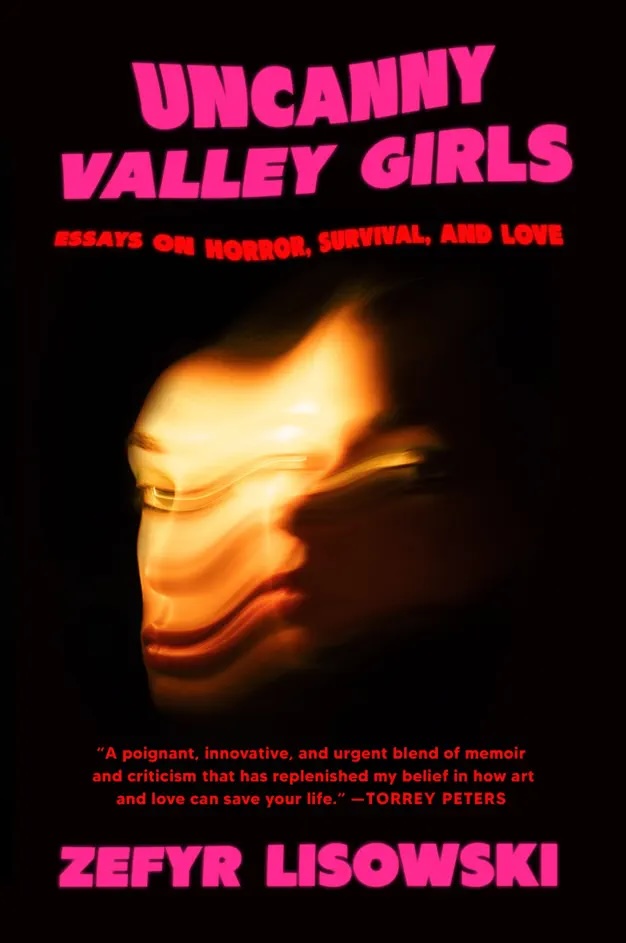
This twinning of fear and connection is the backbone of Zefyr Lisowski’s essay collection, Uncanny Valley Girls: Essays on Horror, Survival, and Love (Harper Perennial, 2025). As Liswoski writes in the book’s opening page, “This is a book about horror, real and filmic, which means it must also be a book about love. […] you have to love to begin with in order to fear it being taken away.”
The book is organized into three sections themed around othering, violence, and sisterhood, with each individual essay centered on a specific horror text or series of related works placed within a larger political context. Intermixed with this criticism is personal narrative of Lisowski’s life, notably focusing on her Southern childhood in a segregated town in North Carolina, her romantic and sexual relationships, her gender identity as a trans woman, grief over her father and older sister, and her mental health struggles. Bookending these sections are a Prelude and a Postlude offering broader holistic reflections on the horror genre as Lisowski contemplates an experience of institutionalization.
As bestselling horror author Paul Tremblay notes in a 2015 essay in Nightmare magazine, “From Freud’s uncanny to the gender politics of the final girl, perhaps no other genre is as fraught with such political anxiety [as horror].” Lisowski deftly examines the biases and often conservative messaging of her chosen horror movies: the ableism underlying The Ring, the classism and racism of Scream, and the stigmatizing of mentally ill women in Black Swan, to name a few. However, Lisowski doesn’t dismiss these stories, even as she critiques their poor politics, but instead finds space for reflection through the connection she feels to each work, a connection brought on by her identification with the work’s characters.
In the first major essay in the collection, “The Girl, The Well, The Ring,” Lisowski skewers The Ring’s depiction of Samara through the lens of disability at the same time as she finds herself within it, muddying the distinctions between monster and protagonist: “In these sickened villains I saw a commitment to shared endurance, and that scared me. In them I saw, but didn’t want to see, myself, surrounded by those like me—girls marked by their illness.” Lisowski excavates alternative paths out of the horror, despite what some of these texts might indicate, by acknowledging that she, like the maligned monsters at their core, is a subject deserving of care. In this way, her criticism is a form of love towards both her chosen art objects and herself. And while, as Lisowski writes, “loving yourself isn’t a panacea for a world that doesn’t love you,” there is still a powerful alchemy in this reconfiguration.
This is made perhaps most apparent in the essay, “Preliminary Materials for a Theory of the Werewolf Girl,” which examines the creature through the idea of trans womanhood. Lisowski is aware of the precarious nature of this identification given how trans women are too often smeared as dangerous predators, “But regardless of how much I want to trouble this concept,” she writes, “it still doesn’t change the force of [my] identification with werewolves.” Instead, Lisowski considers werewolves as powerful agents of change, how they “transform in surprising ways,” reconfiguring the “were” of their name to move beyond masculinity and instead hold humanity’s “capacity to hurt and hold alike.” Lisowski handles these topics with nuance and rigor, exploring her transition and how she changed due to violence inflicted upon her, including by other trans women. Lisowski never shies away from the complexities of her experience, no matter the horror it holds, but instead writes from a place of tenderness and accountability (and if that doesn’t culminate into care, I don’t know what does.) In another essay, Lisowski writes, “Horror movies […] are close enough to unnerve, and like a mirror they reflect us back—distorted into something strange and new. But isn’t that love, too? Doesn’t everything worth doing change you?”
Lisowski doesn’t just find connection with these various media as individual pieces of art, but with the people she experiences them with, as well as the artists themselves. Lisowski tracks various relationships—platonic, familial, romantic, and sexual—across these essays, some more fraught than others. In “Crazy in Love,” she examines her relationship as a mentally ill trans woman dating another mentally ill trans woman as the two watch Lars von Trier’s Antichrist, writing, “This is why I’m devoted to growing through crazy for crazy relationships: Regardless of what else happens, part of them remain and reflect back onto you.” The essay, “War on Terror,” juxtaposes criticism of the Iraq War and the American military industrial complex with a tumultuous childhood friendship in which Lisowski and her militarily-inclined friend watched torture porn movies popular in the 2000s: “His arm almost brushed mine. When I watched [the friend’s favorite movie, Final Destination 3], just a few months ago, it felt surprisingly like a comfort, even though I hated it at the time.” And in the final essay in the collection, “Uncanny Valley Dolls,” Lisowski writes of her affinity for the trans artist Greer Lankton, who created life-sized dolls as equally beautiful as they were uncanny. “It’s perhaps hackneyed to say,” Lisowski writes, “but what saved me was the love of others like me, embracing the messiness and care present in our lives and work. And this complex negotiation echoes what I see in Greer, too.” If there is not already a sense of familiarity to be found within the works themselves, one is forged in the experience of witnessing it beside another. “That is what was beautiful about it—life, the movies, art, whatever—the fact that it could be shared, endured, and held with others,” Lisowski writes.
There are many other hybrid nonfiction books that explore horror through a personal lens. There’s the lyrical fluidity of Gina Nutt’s Night Rooms (Two Dollar Radio, 2021), the opaque abstractions of Justin Phillip Reed’s With Bloom Upon Them and Also With Blood (Coffee House Press, 2023), and the consideration of hauntings and the supernatural as supposed realities in Claire Cronin’s Blue Light of the Screen (Repeater Books, 2020). But none of these books consider what it means to share in a communal experience of horror as Uncanny Valley Girls does, of how we together face fear. Even though many of the relationships Lisowski documents are turbulent, they shape her in profound ways. Love can be complicated, but its imprint remains even after a person is no longer a presence in one’s life. “If grief is an act of love,” Lisowski writes, “then leaving a ghost of yourself behind is as well. Sharing an experience with someone who isn’t there anymore, I have to believe, is a way of communicating with them, too.”
There is love to be found within the horrors, Lisowski argues, and it is love that allows us to live as richly as possible despite the fear and pain, to survive long past the credits.



Click here to subscribe today and leave your comment, or log in if you’re already a paid subscriber.