Ramona Ausubel thinks writers have weird, gorgeous brains and hearts, and wants to help their work to be more and more itself. She is also willing to make a bet: if she asked every writer in the world whether they felt stuck in their work at any given moment, she is confident she would get a lot of show of hands. Maybe it’s writer’s block, imposter syndrome, or the juggling act of having a full-time job and being a new parent. Or perhaps it has to do with the idea of permission, as one of Ausubel’s undergraduates once confessed, as a first-generation student trying to write a book she didn’t think she was “one of the people who gets to do that kind of thing.”
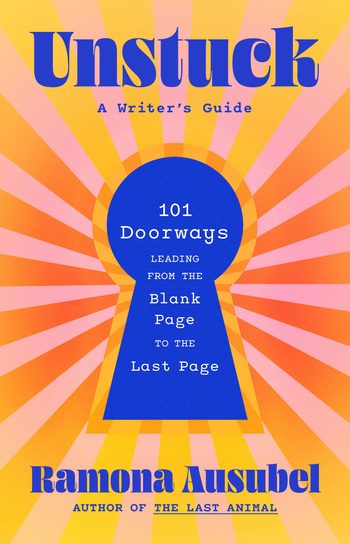
In her twenty years of teaching and writing, Ausubel understands the particular challenges of navigating the long haul of creative practice. “I have written three novels and two collections of short stories. Another way to say this is that I have spent a large part of the last two decades in one state or another of failure and confusion. Stuck,” she writes in her new book on craft, Unstuck: 101 Doorways Leading from the Blank Page to the Last Page. “I have been stuck and afraid when the world outside begins to look prickly and dangerous for my art-baby. In every case it feels as if I am surrounded by walls. Sound familiar?”
Unstuck is much more than a how-to writer’s manual. Ausubel is the wise and inquisitive literary fairy godmother whose creative exercises and un-intimidating experiments—what she calls “doorways”—help writers conquer those seemingly impervious walls. She generously guides us through these doorways (one hundred and one of them!) to get us back inside or closer to our work, and to make us excited and curious again.
I had the pleasure of speaking with Ausubel over Zoom in January, following a record-breaking snowstorm in New York. We discussed the concept of writer physics, why killing your darlings is terrible advice, and compared notes on who accumulated more snow thus far in 2026—New York City or Colorado, where Ausubel has lived for over ten years. (New York City won.)
The Rumpus: There is so much energy in this book. From the warmth and approachability in your voice to the powerful reminder that writing fiction is joyful and you dared to say it—fun!
Ramona Ausubel: Thank you for that. Yes, fun! What a concept! As writers, we know that working on a long project is hard, like pushing a boulder up a hill. But there’s also so much energetic possibility around that. It’s not another day of drudgery, but rather, “What is the story that I need to tell? How have I been fed by another piece of literature or art that has mattered to me? How do I want to connect with somebody on the other side?” It’s not just about pushing the metaphorical boulders, but you get to be a part of this big churning movement of words and magic and feeling.
Rumpus: There’s a question on the first page where you ask, “What if you could think of writing as a continual process of discovery?” Can you tell us more about that?
Ausubel: One of the great delights of being a writer is being in that state of openness. You have this idea, this character, this situation, maybe even a title. Wherever it is you’re starting, all you have in the beginning is this little square where you’re standing and everything else is possibility. It can be daunting and overwhelming but it’s also like, “Whoa, that’s so cool! This is my job today, to go and see what I discover in that little square of unknown. What do I know so far about this character? What have I noticed from my own life that I can pull in?”
The magic in being a writer is having a job where you have to pay attention: being open to the weird and wonderful little details of the world. And those details never fail to present themselves if I watch, listen, notice. I don’t think it’s some kind of fate if someone has placed this lady in a weird fur coat and rain boots in front of me because it’s just the kind of detail that I needed for that story. The details include the heartbreaking parts, too. Being attentive to everything that is happening and taking responsibility for putting that down is a part of our work.
Rumpus: Why do you think we get stuck?
Ausubel: We get stuck because we are scared we’re going to make the wrong choices—that at the beginning and well into a piece, we still might not know all the answers. Saying to ourselves, “I don’t know what’s going to happen in the plot. I don’t know who everybody is yet. I don’t know if what I’ve started is going to pan out or if it’s going to fizzle.” And it’s scary to be the only person who has to keep making those decisions and keep pushing whatever it is forward to say, “Yes, this character is going to be a retired auto mechanic and he’s building a giant dollhouse in his garage. Yes, I’m going to trust that and I’m going to go with it.” But then you ask, “Is that interesting? What’s going to happen? So he builds a giant dollhouse: is that the story?”
At some point along the way, I’m sure all writers have this experience of saying, “I don’t know what to do next, so I’ll stop.” And I think that’s really what “stuck” is. You kind of let that chute close. Part of my argument in the book is that that’s okay to say, “I’m going to pause. I’m going to take some breaths and then look around the story and see what I’m excited about.”
Rumpus: What you call “writer physics:” Follow the energy, follow the momentum.
Ausubel: Exactly. Move forward with what you’re excited about and trusting the next decision will come, and the next decision will come from that. And that all decisions are temporary and can be undone. You can go back later and revise anything, any point of view, any character. Maybe the situation is that your character is not a mechanic after all but a florist, because that’s got more friction and interest for you!
I think we also get stuck because we’re scared of judgement from other people. That our idea is not that good. That the joke is not actually funny. That the ending is too grand and ridiculous. That somebody is going to read it and say, “Please, this is so dumb.” And between the self-doubt and the projected doubt coming at you from the world, it feels like a lot of good reasons to be like, “This is too much, I’m going to go for a walk instead.”
Rumpus: Speaking of going for a walk, this is one example of an exercise, or “key,” you suggest for getting unstuck. There are so many creative and practical keys: lie on your back on the floor without a pillow for at least ten minutes. Have your work read back to you using a text-to-voice AI reader. Set up an email account for your inner critic and write a quick note telling them to buzz off. Create a playlist for your character. How did you come up with these keys?
Ausubel: The very first iteration of this book came when I was asked to give a craft talk at a low residency MFA program at the Institute of American Indian Arts years ago. I was like, “I don’t know anything, I’m not a person to give a craft talk. They’re going to find out I’m a total fraud!” Then I was like, “Okay, what could I talk about that would be honest, even if it’s not what I think of as a craft talk.” So I wrote a talk called, “Revision? Revision. Revision!” It was about the way I revise as I go along and the different approaches I take in the process of writing. A few years after that, I was at another residency and thought, “I actually have so much more to say!” So I built out that talk and realized that it wasn’t just drafts that I was moving through, but each one was like an opening. And that’s when I started to think of them as doorways.
This isn’t a technical to-do list. I’m giving myself, and I’m giving these writers that I’m talking to, doorways that they enter. It’s not about trying to make someone write more like me, or more like anyone else, but more like themselves. That’s why I liked the image of the doorway. We stay ourselves as we move through the doorway.
When I was working on the proposal for this book, I wanted to hand it over at the end of each chapter, each “doorway,” and for the writer to have their own key. A way of saying, “Here’s what you can do right now.” This is the key in your hand and where you go with it is totally your own.
Rumpus: In Unstuck you reframe how writers traditionally think about writing fiction, offering more generative perspectives, born from a place of curiosity and wonder. There are many re-framings like, “Inciting incident versus What is being born here?,” “Plot versus Movement,” “Who would read this? versus Who is this to?,” and “Kill Your Darlings versus Write the Shit Out of Your Darlings.” Is there one in particular you would like to talk about?
Ausubel: I remember hearing the phrase, “Kill your darlings,” when I was in graduate school. I had been a poet in college, then I worked and had done other things. I had written enough prose to get into an MFA program, but I hadn’t written in a community at all. So I missed all the sort of fiction truisms. So when somebody said that—kill your darlings—I was like, “Why are we doing this in the first place? What’s the point?”
I understand the advice, that if something isn’t working for the story then you have to let it go. But I think it depends on where you are in the process of writing. If that advice plops onto a writer in her first draft, it’s only going to be destructive. If you’re telling her what she finds interesting is probably bad, that feels fundamentally problematic and dangerous. So I have been trying to write the shit out of my darlings ever since. What am I here for? What do I care about and how big can I make that on the page? And then what happens as a result of putting that love or curiosity or heartbreak or whatever it is at its maximum form?
Writing the shit out of your darlings feels like a way of saying to any writer that your voice, your idea, and your questions are important even if you don’t understand how it’s going to work on the page yet. You need to start there and go all the way with it. And then in some later draft way down the line—when you’ve worked on it and worked on it, there may be places where you pull back and say, “I actually think a quieter iteration of this is more powerful.” You never kill your darlings. You put them in a saved document for later. Give them a snack and put them in a nice cozy place.
Rumpus: Tuck them in and they can take a nap.
Ausubel: Exactly!
Rumpus: Let’s talk about drafting. You describe novel writing as “inside out and upside down” and use these great images like “primordial slush,” “swamp monster,” and “The Black Hole to Which All Other Matter is Drawn,” which writer Brad Wilson said in a workshop you attended many years ago. Because writing a whole draft of a book is a long, slow, and messy process, there is something you call the “Half Draft.” Rather than trying to write every scene and moment, you suggest writing rougher, shorter scenes and skip over the small parts for later. Why does the concept of a half draft feel so much less intimidating than what we traditionally think of as a first draft?
Ausubel: It’s like a honeymoon, those first seventy-five, eighty pages where you’re like, “Oh my god this is going to be so fun! I’m writing every day and this is great!” And then you’re like, “Wait, what’s going to happen though?” You’ve done the tourist version, you’ve seen the main sites, met everybody, and you just can’t go to another cocktail party. You need to start moving this story into a direction where things really start to happen and that decision fatigue and fear gets heavier because you’re like, “Alright, is this guy going to kill the bus driver so that he can steal the coins and feed his dog?” All of it just becomes scary because you’re in it and no one is going to tell you what to do. You have to do it yourself and you have so much more to go.
Rumpus: You’re committed.
Ausubel: Yes, exactly! When I was working on my third novel [The Last Animal (Riverhead Books, 2024)] I didn’t have the time the way I had with my first two. I had a full-time job. I had two kids. There was no way I could write ten pages a day like I did with my first novel, or five pages a day with my second. So I was like, “Do I even need a first draft to be the length of a full book?” Instead of aiming for two-hundred plus pages, I’m aiming for a hundred and something pages. It doesn’t have to be this huge, full-length piece. Instead of trying to build the entire road—We are writers! We are magical beings! We can do anything we want, go anywhere we want!—you can jump over that ravine and you don’t have to build a road over it because you don’t know what it is yet. You’re going to go to the other side and write something you do understand or have a sense of right now.
The half draft is freeing you from the sense that you have to connect every piece to another piece. You don’t have to write in full scenes and you don’t have to know why chapter two is connected to chapter three. This is information you get later in the process, so you don’t have to take responsibility for all that. Go in humble, playful, and without expecting it to look like a book from the first time you sit down. It’s less intimidating and more fun when you’re in that mode of discovery, where you’re like, “Oooh, what’s that about?”
Rumpus: There’s a theme woven throughout the book—this idea of giving oneself permission: Permission to write toward joy. Permission to take pleasure in falling down rabbit holes. Permission to take the easy way because the piece will not be better because you suffered the most. You encourage the writer to be the “anti-hall monitor” to that negative voice in our head.
Ausubel: As a teacher, I’m always giving my students permission. I feel like my entire pedagogy is to go into the classroom and say, “Guess what you can do? Anything! Well, anything except use AI to write your story. You can’t do that. But all the other things? Yes! Try that! Do it!” Writing fiction is a sphere where you don’t need permission from anybody else. That’s why I put that doorway in the book, to write yourself a permission slip.
Rumpus: I think the permission slip went something like, “To Whom It May Concern, Ramona Ausubel has permission to put a woolly mammoth in her novel. Thank you for supporting this decision! Sincerely, Ramona.” I love how you say it’s a bit bratty and bossy but sometimes it’s exactly what we need.
Ausubel: That negative voice says, “You should probably not do this.” But you’re like, “Oh I am though!”
Rumpus: Ha, love that spirit of defiance! There is also all this great outdoorsy imagery as it pertains to writing—river canyon as narrative structure, connecting archipelagos of prose, writing volcanoes and islands, taking the switchbacks and not the cliff. This must be inspired by living in Colorado and being surrounded by nature?
Ausubel: Yeah, it definitely is. As a person whose job it is to pay attention, that’s what I’m paying attention to because it’s right in front of me. I also feel that the natural world has billions of years of wisdom that we can learn from. Thinking about the way a river moves while thinking about plot is really helpful, for example. It’s not a straight line. The same way an early draft doesn’t go from page one effortlessly and straightforwardly to page two-hundred and fifty. You’re going to follow the current. You’re going to follow that energy and it might not lead you directly to where you thought you were going, but you will discover so much more than you would have if you limited yourself to that straight line.
Rumpus: Writing a book means opening oneself up to a vast array of possibilities, and after the long journey is over you are not the same person as when you first started. How do you feel like you were changed after writing this book?
Ausubel: Well, I’m writing a new novel right now and I still use these keys. I will get stuck and be like, “Hey, remember you wrote a book about this?!” I will take a breath and let go of whatever is it that I’m not allowing myself to do, and give myself the permission slip.
The best thing has been getting to work with other writers, being in rooms with people who are trying something daring and who are excited about it. It is the biggest privilege to be in conversation with writers in the midst of their own projects and learning about the doorways they have used, and the ways all of these wise and incredible people are moving through a project. I feel like I’ve been changed by being in these rooms and being a part of those conversations.
Rumpus: In the book, there is this lovely emphasis on literary citizenship and the importance of building literary community. You give shout-outs to other writers and how their work or their friendship have inspired you. From Marie-Helene Bertino and Alexander Chee to Joyce Carol Oates, Eula Biss, Eileen Myles, and others. It’s wonderful that you highlight the literary citizen aspect of this whole ecosystem of writing a book.
Ausubel: Oh, it’s so important! It’s life-giving and beautiful to be in conversation with the work, or to get into those deep discussions about how they got that scene to work, why we loved that sentence, to just nerd out and go deep into the total ridiculous love of this little world that we’re in.
Rumpus: And that we share this vast inheritance of literature. All of it belongs to us. You wrote in the book that we are literature billionaires. That one stuck with me. I loved that so much!
Ausubel: We are!
Rumpus: You close the book on such a beautiful note. The writer is done drafting, reworking, revising, and they have finally finished. After they have released their work into the world, after the querying and publishing and celebrating, there’s this lovely, quiet moment where you remind us that we get to begin again.
Ausubel: Yes, there’s the achievement part of it—the stories, the novel, the essay collection, whatever it is, there’s the full circle moment. You get to celebrate, you have the party! But it’s not actually the end. The very next step is to go back to the beginning. You’re following that energetic movement. What can I take from that last thing I made? How does that carry me into the beginning of something else? The best case scenario for every writer is that we get to begin something, follow it through the long, twisty middle, find ourselves at a point of completion, and then begin again, and again and again.