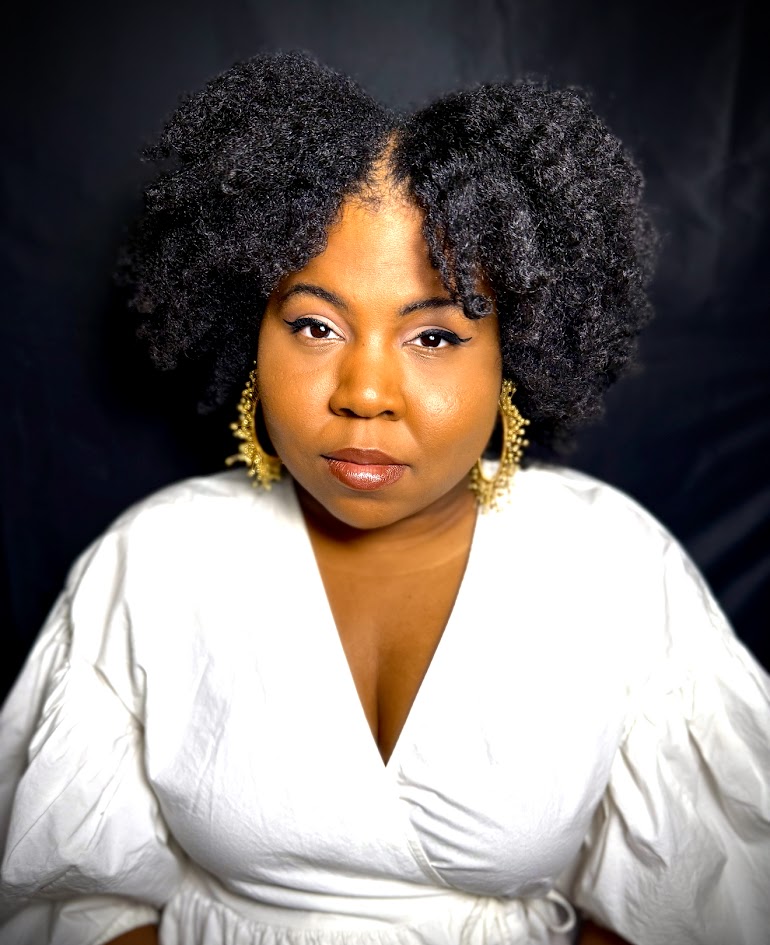
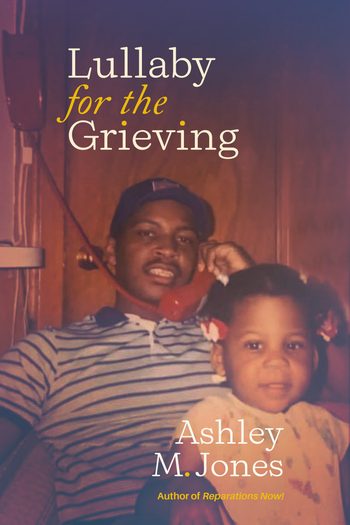
Ashley M. Jones is no stranger to grief. Her newest collection, Lullaby for the Grieving seems to be especially poignant in this moment of collective grief and tumult. In 2021, at a conference in Birmingham, I heard her read a poem about her father and his garden, not long after he had passed away. I tucked that poem away those years ago waiting for its re-emergence. It plucked something inside of me, playing me like a guitar. Some poems become mirrors in which we can see ourselves and this was one. I had ached in the wake of my own fathers’ passing and in her work, I found a kindred spirit.
At AWP, earlier this year, she read “Snow Poem” by way of Zoom, her voice punctuating how form can be a hand to hold as you’re walking through a difficult time, as she referenced how her father had once ribbed her about writing a poem about snow, resulting in such a different poem than he might have ever expected.
Jones’ poems suck readers in as they often contend with race, Alabama and the South, spirituality, and in the case of her newest collection Lullaby for the Grieving, grief. But also, food, and playfulness with form as in her contrapuntal poem, “A Meat and Three,” her perfect plate of food that gives each dish its own poem, like “Hoppin’ John: A Blues,” told sideways on the page.
Grieving follows What Things Cost: An Anthology for the People (University of Press, 2023) edited by Jones and Rebecca Gayle Howell, and past collections, Reparations Now!, longlisted for the 2022 PEN/Voelcker Award for Poetry, dark // thing (Pleiades Press, 2018) which won the Lena-Miles Wever Todd Prize for Poetry, and her debut, Magic City Gospel (Hub City Press, 2017), which garnered a silver medal in poetry in the 2017 Independent Publishers Book Awards. She is the youngest and first Black Poet Laureate of Alabama.
We met earlier this spring by Zoom to talk about speaking poems aloud, having fun with form, and how reprimand can be done with love. This interview has been edited for length and clarity.
The Rumpus: The “Grief Interludes,” elegies to your father, pop up at unexpected intervals throughout the book, much like grief itself. Over what period did you write them and did the shape of them emerge in revision or right from the outset?
Ashley M. Jones: I remember distinctly writing a few of these poems while I was at residency at Converse. I am on the MFA faculty there, kind of on a hiatus, because I’m doing my PhD now. But at the time, I was still regularly attending. And one of the poems—actually, two of the early poems, came from Denise Duhamel, my mentor.
The first one was a golden shovel sort of game poem where we passed around these cards which had Lucille Clifton quotes on them. That’s how “On Entering the New Year Without My Father” came and that was one of the first things I wrote that became these grief poems. And then the “Grief Pantoum” was the first one that had a title with the word grief. That one was also written after Denise’s lecture on the pantoum.
And of course, that pantoum is in a prose block, because I’m weird like that. That poem began all of the other grief poems. I don’t remember when I knew I would need several grief interludes but these poems that became the grief interludes just kept coming. It became very clear that this needed to be represented in the book in this way, because although there are poems about everything, the grief is the throughline. I felt like that made sense because in my life, so far, with this huge grief and other times I’ve grieved someone’s loss, it always comes randomly.
You just can’t predict where this stuff is coming from. You can’t predict how it’s going to impact you. Some of the grief interludes are just sad. Some of them have a little hope. Some of them are just purely observational. And that has been how my grief has manifested. I think most of us have this multifaceted grief process, and to have it juxtaposed with poems that are about falling in love or poems that are about social justice—that really mirrors the way my mind has worked throughout the grief.
Rumpus: Golden shovels, pantoum, sonnets, visual poetry—do you find a different kind of freedom in the constraints of form? Can you also walk me through your crown sonnet, “Snow Poem” that you read at AWP.
Jones: Yikes, “Snow Poem” is a lot, so I will definitely save that for last.
But form, I really am so surprised at how much I enjoy using form, because I’ve said this before: As a young person, when I was in art school in middle and high school, I hated form. Really, up until graduate school, I was like, “What is the point of form? It’s just archaic. We don’t have to use these constraints.”
That was really because I had never read enough women and people of color who—and alive people, for that matter, living poets—who are using form. It’s really hard to relate to someone who’s been dead for centuries. That’s just true. I mean, “Yay, Shakespeare!” He did great things, but I cannot always relate to those poems in the way that I need to, to understand how I can fit into them.
And so now that I’ve read Gwendolyn Brooks, Patricia Smith, all these other contemporary poets, Tyehimba Jess, who are doing cool stuff with form and who are reminding me how to see myself in a poem—that’s the other thing some people might say, “Well, none of us can relate to Shakespeare.” But—how do I want to say this—it’s important for me not to always struggle to see myself in the work that I read. It means something to me to actually feel something from the poem because it’s speaking to me directly.
Anyway, I do love using form because it allows me to distract myself from the grief. I’ve always used form. In all of my books, I’ve been using form, and it’s been helpful just to provide a container or to create a starting point or to constrain myself away from expected language. But in this book, I found that form actually helped me to make it through the writing process. So, for example, there’s a poem that’s not in this book that was maybe the very beginning of the grief writing process.
It’s in my previous book, Reparations Now!, the first poem in the book, which is written for my dad, and I wrote it a couple of days after he passed as we were preparing for the funeral. I knew I was going to have to—I wanted to read something at his funeral. So, I had to think back to a conversation that I had with the poet Faisal Mohyuddin about the acrostic form, which is a form that he uses a lot. And he has this beautiful poem called “The Faces of the Holy,” which is an acrostic to his mentor. And I thought back to that. Faisal has also lost his father, so we talked about that, too. I thought back to that, and I knew this was the way for me to make the poem happen, because the blank page was just not working. So, the acrostic allowed me to literally put his name on the page so that he was there with me as I wrote the poem.
That concept held true for a lot of these pieces as well. For example, “Snow Poem” was the last poem that I wrote, and it was on my back. It’s been on my back for a long time, because the story of the poem, which I say in the epigraph, is, this is an idea my dad always wanted me to write. This is not really the poem he was expecting, but it’s something that has existed in our family for so long—this idea. Also, the thought that I wanted to do a heroic crown of sonnets to try to encapsulate the bigness of his life, but also the bigness of his loss. That was a lot to deal with. So, knowing that I at least could focus on, “Okay, where are my syllable counts? What rhyme am I doing?” That helped me to navigate, because the places that that poem took me, it was really difficult. I mean, I’m usually a pretty quick writer, but I had to stop for days on end because I would just start crying trying to write a poem.
And even with that, knowing that I had a form to follow still helped me to make it through those moments. Because, okay, yes, I hate the line, or I’m crying because I’m reading a line about his body—having to identify him with my mom. But I know there’s a rhyme I need to get to. So, okay, I’m crying here, but let’s think about that rhyme instead, so that poem was very hard to write and I feel very proud of it. And it’s also very hard to read because it’s long, but also because I’m kind of reliving it all the time.
And I do find that people, when I’ve read this at readings—and you tell me, you heard some of it at the AWP session—but I find that people relate because there’s something in this long poem that maybe mirrors how they felt.
Rumpus: I can relate. When you’re writing or revising, do you read your poems aloud? You hide your litanies deep in your lines—they aren’t as noticeable on-the-page and lead to clever sound work.
Jones: I have to read them aloud. That is the number one thing I tell anyone who’s like, “How do I know the poem’s done?” You’ve got to read it out loud because it’s going to tell you. The poem will tell you what it needs, what it doesn’t need. I just did it this morning: I was writing a poem and I was like, “I guess I’ve got to read it out loud.” And that’s what helped me to make it sound a little bit better.
The sound does matter. I think often there’s this divide between “page poets” and “stage poets,” and that’s not a real thing. Yes, the delivery may be different, but we are all using all the same tools and so each of us has to think about both parts. Stage poets also have to think about what the words are doing as they read them on the page. Page poets also have to think about what the sound is doing when it comes out of someone’s mouth, or even if they’re reading it with sound in mind. I just let the language do its thing. I love when I can just make stuff happen, on the page with rhyme that’s unexpected. The ghazal that I have in here, “Home: Variations”—I love doing this poem. I love doing ghazals because they’re just so, I don’t know—warm, because there’s that repeated sound. It’s like a hug in some way. And I just really loved finding new ways to make that “door” sound do something different throughout the piece. So, it’s a ton of fun for me.
Poets who don’t have fun writing poetry, I say get out of it. You really should be having fun when you’re creating art. Even if it’s painful art, there’s still fun to be had.
Rumpus: Interesting repetitions crop up in the collection, like in the poem, “I feel powerful when” with two solid towers of the word “Black” repeated nine times across 46 lines and eight times across two lines. Then, there’s the fuselage of freedomfreedomfreedomfreedomfreedomfreedom repeated three times in “Harriet, The Locomotive,” part two in “A Portrait of Harriet.” Describe your use of repetition and how you build energy on the page to propel the reader forward.
Jones: I do love having fun, but I also love how limitless language can be. I think sometimes as poets, or as serious writers, we’re too concerned with decorum. And I really take inspiration from, for example, Sonia Sanchez and the Black Arts movement. And those poems were not trying to fit into anybody’s box—Nikki Giovanni— they are saying what they are saying loudly. And the words have movement. If you ever heard Sonia Sanchez read, it sounds almost like a jazz piece because she’s repeating words or inflecting her voice. And I love that.
So, in these two poems, for example, in “I feel powerful when,” I can’t tell you exactly why my brain said, “We’ve got to put Black on the page.” But something in me said, “I feel most powerful when I’m Black. And I have to make sure they know.” That’s what it is—not any other thing, but the Blackness, the Blackness, the Blackness, the Blackness. I figured, “Well, maybe I just bombard them with that word so they can’t escape and so that it becomes synonymous with power.” The more you see it, you’re not dwarfed by it, but you feel the power of the words because they’re there, kind of assaulting you.
And the same with the Tubman. When I was writing this poem, these were for an orchestral piece, so I also was thinking about what they might sound like read aloud. When I got the idea about the locomotive, because, of course, the underground railroad; I’m playing with that. The freedom, freedom, freedom, freedom feels like the train, like, chugga, chugga, chugga. But it’s freedom, freedom, freedom. And that’s the thing that’s propelling her. And so, it only made sense that that was the fuel between each stanza.
Rumpus: Considering shape, what kind of attention do you give to how a poem looks on the page, like the line of intersections of writing at the bottom of your poem, “A Map of the Capitol—Montgomery, Alabama, USA.”
Jones: Okay, so that one. Let me just start by saying I like doing weird stuff. I’m very hopefully known for doing weird stuff on the page. And that goes back to we are limitless and we’re making art. We don’t have to be afraid of doing interesting things. We can still have the figurative language, the form—these are all haiku in this poem, but they’re in an interesting shape.
As I thought about writing this poem about my commissioning and about Montgomery and all of the contradictions that I’m seeing—or, some of them, rather—have to do with where things are in the city: like the street named after Rosa Parks, the street named after Jefferson Davis and then renamed for Fred Gray, and even Court Square, where Rosa Parks was arrested, and the Capitol Building, and the first Confederacy—first White House Confederacy—everything’s right there. It’s all right there, which is super weird, but also super USA, that’s what we do. And so, because I wanted to talk about that space, I didn’t want to just say, “Here are these streets; it’s weird they’re here. I wanted to make the streets on the page. And so that’s what that shape is: it’s Rosa Parks Avenue and Jefferson Davis / Fred Gray Avenue. And then the star, of course, is the Capitol; it just seemed to make sense. Also, I wrote this poem as a commission for a visual art opening called Monuments, which is happening later this year. So, since I knew it would be presented with other visual art, I was like, “Well, I’ve got to come up with something; I can’t have a regular poem on the page.” So that gave me the freedom to try something different on the page as well.
Rumpus: Speaking of Alabama and the South, they frequent your poems so often, sometimes with incredible tenderness and other times, with reprimand, especially when considering history, specifically slavery and civil rights. How does love allow a different kind of space and language for reprimand? How do we not forget what has happened, or repeat it without also not letting it impede how we might love the place that we inhabit?
Jones: Something I’ve said for the past few years, because, as poet laureate, people always want to ask me, “How do you view the South? How do you view Alabama?” because they know what I write about. And I’m like, “Well, everything I’m saying is love. Under the umbrella of love, there is critique, there is calling in, calling out. All these things exist in our love relationships with other people already: people who you love, people you’re married to, dating, your family. If something happens, you have to address it because you love that person.
Loving that person doesn’t mean they never do anything wrong or that you never disagree. It just means that you want to address that thing. And although you can’t erase the thing that happened, you want to move forward. And so, I see that the same way with the state of Alabama and the country. It’s a hard moment to feel that, of course, but I think maybe being from Alabama makes me more passionate about expanding our idea of love to include reprimand, to include holding accountable, because it’s easy to say, “Okay, you’re a descendant of African Americans, of enslaved people, how can you ever love a space that did that to you?” Well, I don’t love slavery, obviously, but I do love the people who I’m descended from. I respect them immensely. I owe them my existence. So, I have to be here trying to work to make this place the place that they built, basically.
And it’s not the land’s fault that we were mistreated. It is people’s fault, certainly, and systems, but the land itself is not to blame. And so, of course, I love the beauty of nature. And in some ways, I’m connected to my ancestors through that nature; they were working the land. I am living now on that land and trying to repair that relationship. All that to say, I think we’re a little too reductive sometimes when we say love. And maybe some people are that way in their relationships with humans: They think love just means “Yay!” all the time, but that’s not true at all. Any person who has children—I don’t have them, but I am one—and I know my parents loved me dearly and also told me when I was doing something wrong. It’s the same thing, I think.
Rumpus: Have you made intentional space for faith to speak into your poems, or find it meanders into them on its own? The faith that appears in your poems is neither sentimental nor dreamy.
Jones: That’s a really great question. As I’ve gotten older and written more books, I’m less afraid to show my whole self. And so, of course, that includes my faith. So, yeah, I am making intentional space because now I’m kind of like, “You don’t have to hide yourself; just be who you actually are, because that’s what drew you to the poets you love.” Also, I can’t avoid it because my faith is very important to me and the way I came to faith was really just seeing my parents be good people.
Rumpus: How can hope show up when grieving? It does in your poems so often.
Jones: Gosh, I’m trying to think of the first moment I felt happy thinking about the memory of my dad—there was definitely a moment where it switched, not all the way, but there was a little switch from, every time I think about him, “I’m so sad” to “what a blessing it was” to have him. I can think happily about what I had and what it offers me. I think once I got to a point where I felt proud that I am like him—that I’m carrying on his legacy and that all my siblings are—once I got to that point, it then could show up in the poems a little bit more.
I’m thinking specifically about the poem “Grief Interlude IV,” where I’m recounting how his spirit is still showing up in so many ways and that really came about because literally in my real life, I saw, “Okay, he can still be here. I can still have a relationship with him somehow.” And he left parts of himself here: in me, in my siblings, but also in the house that we shared with him, in the way that we speak, in the jokes that we tell, in the garden, in the garden, my goodness—just all the things that he touched. And that’s where I saw a space for me to feel less just terribly sad about everything. There is hope in knowing that you had good memories and that it wasn’t an awful experience to have my dad. It was amazing to have him, and that’s something to be happy about.
I can pass that on if I ever have a family of my own. Even if I don’t, I can pass on that love that he gave. In my grieving process, there’s been a lot of hope in that, but also in realizing that life still has beauty to offer me, and that doesn’t erase the grief, but it shows me that all of life is a balance and all of us are working on that balance and that there will be a time when, again, I’m really low and something else happens, but there’s always going to be another side.