The history of every historical thing including God but not including all men and women individually, is a violent mess like this ice.—Bernadette Mayer, Midwinter Day (1982)
Life is hopelessly frayed, all loose ends. A pansy suddenly, a web, a trail remarkably’s a snail’s. […] Children are not always inclined to choose such paths. You can tell by the eucalyptus tree, its shaggy branches scatter buttons. In the afternoons, when the shades were pulled for my nap, the light coming through was of a dark yellow, nearly orange, melancholy, as heavy as honey, and it made me thirsty.
—Lyn Hejinian, My Life (1980)
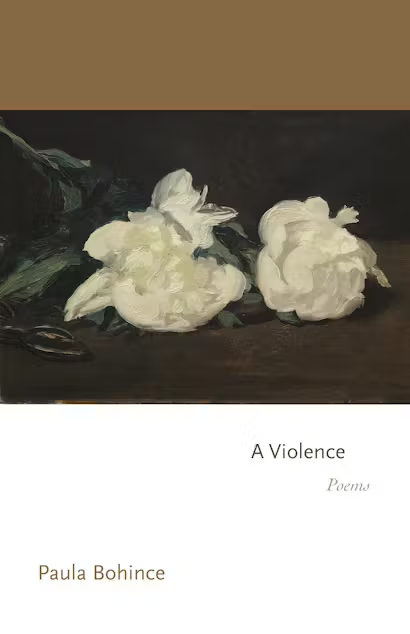
Like silence, violence is not quantifiable. Put the indefinite article “a” in front of it and the monolithic world of violence shutters into a reflective surface of infinite, biodiverse fragments. What counts as violence? What happens to seemingly non-violent events and experiences that spin into different types of violence? How can the relationship between the violence we endure and the violence we enact against others reconfigure the ways in which we are tethered together and to our surroundings? Paula Bohince’s fourth poetry collection, A Violence, moves fluidly through the different forms of violence we create, forget, never quite recover from, witness but not confront, and live in the cold shadow of. In her tapestry of short and philosophically-apt lyrics, violence is a “Mother spun past the playpen, / hands like horse-blinders” or a “phrase to swim through the mind / like an offense,” it occurs in rooms which “give glow-in-the-dark / ambience to hideous kisses” or “in the therapist’s office, quiet / I don’t knows lodged there.” Regardless of the form, a violence that may appear profoundly personal is entangled with a vast social space and an even vaster natural world, cleaving in unruly ways our collective present, future, and past.
Bohince borrows the phrase “A Violence” for her title, as she explains in a note, from Wallace Stevens’s essay “The Noble Rider and the Sound of Words,” delivered as a lecture at Princeton in 1941 and published one year later. In the context of World War II, Stevens makes a stark argument for the necessity of a wildly aggressive imagination, famously referring to it as “a violence from within that protects us from a violence without,” “pressing against the pressure of reality” and proving vital for “self-preservation.” For Stevens, who was contemplating the role of poetry specifically and art generally at a critical moment, imagination does not help us eliminate, ignore, or escape from reality but is and needs to be a kind of internal violence; it has world-building powers, it can preempt, prevent, undo, and reform the violence of intrusive, external reality.
Bohince is writing during equally yet uniquely unprecedented times—as the Bulletin of the Atomic Scientists cite in the 2026 update of The Doomsday Clock, the world is facing intensified nuclear threats, unsettling technologies like artificial intelligence, biological security challenges, and a persistent climate crisis. She, like Stevens, is not interested in imaginatively designing her personal and our collective responsibilities out of this violent reality. In and through her poetry, she locates an intricate ecosystem in which the shards of violence reside, and she doggedly makes a habitat in it, dwelling there in order to explore the very heartbeat of meaningfulness.
This delicate intersection of the personal and the social, which Bohince has practiced throughout her career and further refines here, makes the reading of A Violence often feel like engaging with the best pages of Bernadette Mayer’s Midwinter Day (1982) and Lyn Hejinian’s My Life (1980) simultaneously. Bohince is formally and conceptually different from the New York school poet and the Language poet but—in a book that is deeply concerned about “the tenderness of mothers” and “the mothering quiet”—she occupies a crucial point in which her two often disparate poetic foremothers meet: she thinks critically about “The lobes of autobiography” (as Hejinian writes) and remains committed to the broad entanglements within life writing. Often processing experiences “from the mind’s anthology,” yet moving beyond egocentric thinking, Bohince fractures the historically and violently messy ice that Mayer invokes and lingers in the textured liquid with a kind of thirst that Hejinian associates so powerfully with childhood.
In the title poem, this fracturing is the result of an array of collisions: between child and animal, destruction and renewal, nature and mind. “A Violence” begins with the “performance” of the spring peeper, the chorus frog that produces a loud, high-pitched “peep” by forcing air from the vocal chords into the vocal sac as a mating call, a territorial claim, and most emphatically an environmental diagnostic, loudly indicating the arrival of spring (hence the name) through a kind of an ode to surviving the winter. In Bohince’s poem, we encounter this peeping almost in a state of anguish, as it is suggested through negative verbs such as “rushes,” “hoarsens,” “pulses,” and “hiding.” By tracing the disturbed song of the peeper—aborted not only with urgency but anxiety, perhaps in ecological distress—and thereby inverting the associations of spring with renewal and bountifulness, Bohince conjures a menacing moodscape in which she analogically situates the reaction of a “traumatized / child,” in similarly environmental terms:
   so the traumatized
child’s amygdala reacts, gripped by
permanent panic,

grown weird in the woods
among broke iris, introvert
birches, the cones
of her eyes sorting frond
from danger, repainting the world,
the first memory
From the swamps and marshes of the spring peeper, Bohince follows a child into the metaphorical “woods” of trauma. As in her second collection, titled The Children (2012), Bohince’s latest book is in its own way a powerful meditation on the “spark of childhood,” “the fruit flies / of childhood,” and “the green / of childhood,” replete with “the milk-carton / children,” “estranged children,” and “wolfy children.” The “traumatized / child” in “A Violence” is seen in a layered neurological web, caught “by / permanent panic” and processing her surroundings in a way that reconstitutes the world, similar to the forceful work of the imagination that Stevens discusses. Characteristic of her best poems, Bohince immerses the reader into the wilderness of words by weaving a web of her own, carefully spinning together the textures of words such as “grown,” “broke,” “birches,” and “cones” in order to evoke the sensory experience of the child. She constructs the psychologically complex world the child is “repainting” not through a vertical simile but a set of horizontal connections with the spring peeper (“As the spring peeper […] so the traumatized / child”), connections that allow the two to open-endedly inform each other.
This intricate connectivity—linking the words, environments, and senses—finds a corollary in the bigger picture of the poem’s structure. Written in one long sentence that runs thirty unevenly short lines, broken into seven irregular stanzas, and stitched together with enjambment, different punctuations (commas and colon), and linking words, the poem is temporally and conceptually complex. This form—the bewildering length of the sentence and the diverse components it combines—represents, on the one hand, instability and excess, and, on the other hand, the child’s attempt to “sort,” contain, and narrativize Reading this poem feels like being taken by the force of a wave, engulfed and carried away, without locational awareness, without the vivifying relief of an end-stopped line. The energetic force of this unstoppable stream leads to the final stanzas of the poem, culminating the poem’s temporally significant tensions:
thus the toad becomes
maternal heartbeat, sanity in the hence,
when too much spring
is a violence,

melt overwhelming the brook,
crushing eggy nests, the fawn born
too soon, too weak

amid pinprick midges, sick
hemlock, and somewhere the helpless
one reaches still toward her savior,
urgent in the blurry before.
In the face of excess “spring,” the spring peeper becomes the ultimate guiding pulse for the “traumatized / child.” Spring is rarely what you expect in Bohince’s collection: in “Everything,” for instance, spring is a process of dissolution, it “trembles / like a bomb packed with snowmelts,” while in “Red Lake,” the poetic voice questions the clarity it affords, asking “Was spring, naturally, verve of fugitive colors finding voice, / and seeing subjects as they were.” In “A Violence,” one meaning of the phrase “too much spring” fiercely slips over the next, presenting both the season that bridges winter with summer and a source of water. For Bohince, this interrelated violence of symbolic seasonal dysfunction and water overflow is both implicated in and produces a muddled temporality (“thus,” “hence,” “too soon.”). Forming a cycle in which beginnings are ends and ends are beginnings, violence here is tethered to survival and renewal. The powerful final image vibrates with the persistence of “the helpless / one”—importantly unnamed and abstracted, diluting the isolation of “one”—who “reaches still toward her savior, / urgent in the blurry before.” This movement forward but back, this gesture charged with stillness, this gesture that is also an effort to see clearly, both urgent and in desperate need of urgency, all encompass the complexity of navigating the past.
Poems that think about and problematize “the blurry before” accumulate like graupel in this collection. Bohince approaches the many forms of “the blurry before” unflinchingly, with playful maturity and mischievous sophistication, even in poems that seem simple. “Januaries,” one of the most compact poems here, traces the relationship between the natural world and the world of childhood again, but it is propelled by a more personal mode. The multiplicity in the title pertains to the artificial accretion of memory, time, and artificiality itself in which Bohince is deeply invested. The month of January is in the center of the winter season in the Northern Hemisphere (“A cold most lethal,” as the first line of the poem announces). Yet in the poem the stacked-up Januaries form a lens through which the speaker sees with her “ice vision” a painful past that has been semi-concretized with the passing of time into disconnected memories. This is a fitting instrument since “January” is the contrived temporal marker for the artificial start of the year. Seeing in and through the past is as easy as opening your eyes during a blizzard:
     	When it becomes
unbearable, I’ll describe this in the colors of
a children’s book. Winters with Annie
playing orphans in the woods: foraging, peeling
hours in all those blades beneath a bitter
lemon sun, made sweet by not being alone.
Enter, snow. One dissociation sifts over
another, with decades between, hooves retreating
into the past, whatever that is, the cold
accumulating all its meanings.
What is “it” that will become “unbearable,” and for whom? The cold, the memory, the description itself? For the speaker, for the reader? The speaker promises to overcome this unbearability not by describing “this” from the perspective of a child or in the mode of a coloring book (in which children never confine themselves within the lines) but “in the colors of / a children’s book.” Stuck in a palette that is overdetermined by the past, the speaker seems almost painfully aware of the artificiality of time, how we remember it and describe it supposedly on demand. And just as the speaker begins to unravel this orchestrated process—in a poem written entirely in the present and future tenses even as it looks back to “Januaries”—another performance appears, of children “playing orphans” and “peeling / hours,” undoing the accumulation of time as it passes by.
It seems likely that only children who are orphans pretend to be ones, who relegate a painful reality into the realm of the performative, and embrace—as the poet does, by using the stage direction “Enter snow”—the theatrical dimensions of the environment. Bohince ambitiously explores the theatre of time, the endless stage of the “peeling / hours,” with humble images and language that always retain both wonder and bafflement. The last line of the poem provides a theory of traumatic disconnectedness (“One dissociation sifts over / another”) and puts a profound question mark over “the past”—“whatever that is”—without exercising control or giving the illusion of mastery. Significantly, and crucially in the plural form, the closing word of the poem is “meanings.” To say that a poet pursues meaning is not to say much. But Bohince here—as in poems such as “I Love the Whole World,” which also ends with the word “meant” as an adjective—is so deeply interested in the types of meanings that do not depend on logic or comprehension, on legibility and integrity of form; she is interested in the meanings that proliferate and produce proliferation despite (and because of) the “sifts” of time, the meanings that survive and thrive in the cold, which is to say, all meanings. In fact, Bohince is the poet, as the final image of accumulation paradoxically suggests, that almost stacks up meanings like warmth and insulation against the cold itself.
“Pathway,” one of the last poems and in many ways the soul of this collection, starts like so many of Bohince’s poems with displacement and exposure to the elements; the speaker in the poem “At Thirty,” for instance, shares “I fled from my life / in a hailstorm and firestorm.” In “Pathway,” however, the poetic voice moves both uncontrollably and with determination towards the warmth of new sunlight: “I wiped my mouth clean and went, deranged, / into daylight.” “Deranged,” the word that invokes irrational behaviour in the English language, comes from the early 18th-century French word “déranger,” which means “to move from orderly rows.” Although this psychologically charged movement begins as a personal one—a single pathway, as the title suggests—it quickly intersects with the path of “a duck [that] swam singly as if transformed into a crystal / of exquisite peace, in a cloudless basin.”
Comparable to the title poem and “Januaries,” which touch on the various convergences of people and animals, “Pathway” depicts these intersecting movements as an occasion to explicitly thematize converging roads and explore their life-affirming significance. At the same time, the poem is fittingly located at the end of the book because in just fifteen lines and a single stanza it forms a crossroad of the book’s major preoccupations: time, nature, meaning, trauma, belonging, and relationality. Partly because the loaded intersection here is situated at the “Fontana dell’Acqua Paola,” a 17th-century fountain by the River Tiber in Rome, the poem also epitomizes a key quality of Bohince’s writing in general: an air of timelessness and poetic classicism (not to be confused with problematic elitism) that reaches the reader in an entirely unexpected grammar. A Violence is rife with archetypes of poetry, but they are always defamiliarized: songbirds, lamentations, even the white peonies on the cover of the book. In “Pathway,” it is noteworthy that the speaker runs across “a duck [that] swam singly as if transformed into a crystal” rather than a swan, a more customary presence in classic stories and poems featuring avian transformations:
Feather or flesh, any veined thing
was absorbing the same sunbeam. I felt a neuron
pulse, a pathway changing course. Rain roads
and roads made by people, transient road the duck
made of her stylized blue, converging.
Our sensitivities, our natures, together just once. Healing,
the literature says, is relational. As the wound was.

Under the nascent sunlight, the speaker not only finds a shared space but a space of communality and connectedness, where “veined thing[s]” almost come to share bloodties. Precisely in this symbolic convergence of roads—made by the rain, the people, and the duck—the poem turns to another type of pathway, the speaker’s neural pathway, in which a rearrangement takes place. Yet, the poem does not linger on the neurological state of the speaker—a critical concern in Bohince’s collection—but reverberates the first-person plural “Our” that powerfully consolidates, if only transiently, “sensitivities” and “natures” from all directions.

On a certain level, “Pathway” is a poem about relationality and in defense of the idea that “Healing, / [as] the literature says, is relational.” As the poem pulses with short clauses towards the very surprising final four-word sentence, however, it is clear that it does not want to merely stick to a preached appreciation of relationality but to ambitiously say something more invigorating. While Bohince syntactically separates healing and “the wound,” the word “As” sharply lacerates that separation, undercutting “the literature” or the manual way of processing relationships. A poet who fully realizes the versatility of the word “As,” using it to draw fluid connections and lifelines, Bohince recognizes an intimacy between the healing and the wound, and finds their common ground in relationality itself. Reading this collection feels that you are submerging yourself in a gelid, watery world in which everything coexists beyond separation, where not even a violence or a wound can stand apart from healing, where convergences matter and persist.

In her short, complementary essay on A Violence, which expands the context of her writing, Bohince presses on a personal connection between poetry and swimming:
What I get from swimming, I also get from reading and writing poetry. Entering a different element, making there a different kind of sense. Being moved around by the water, moving differently in it, thinking (or not thinking) differently in it.
In the pool and on the page, Bohince finds an environment that engenders control and freedom as sister forces rather than antithetical ones; both “[b]eing moved around” and “moving,” without associating one with power and the other with powerlessness, feeling—as she writes later on—“a kind of echoing peace and bewilderment” at once. The word “different” punctuates this section almost as frequently as the commas. Its repetition is not a mark of suffocation but of breath. In A Violence, Bohince breathes, sees, colors, speaks, thinks (and does not think) by other means. In the world in which she invites us—which she insists is not only her own, or mine, or yours, or anyone’s, but ours—a difficult difference can be found and made. This difference matters for the spring peeper, the iris, the “lemon sun,” the “transient road the duck / made,” the girl who “held on to / childishness longer than most,” and for all the unnamed and unnameable things. It matters all the way from within to without.