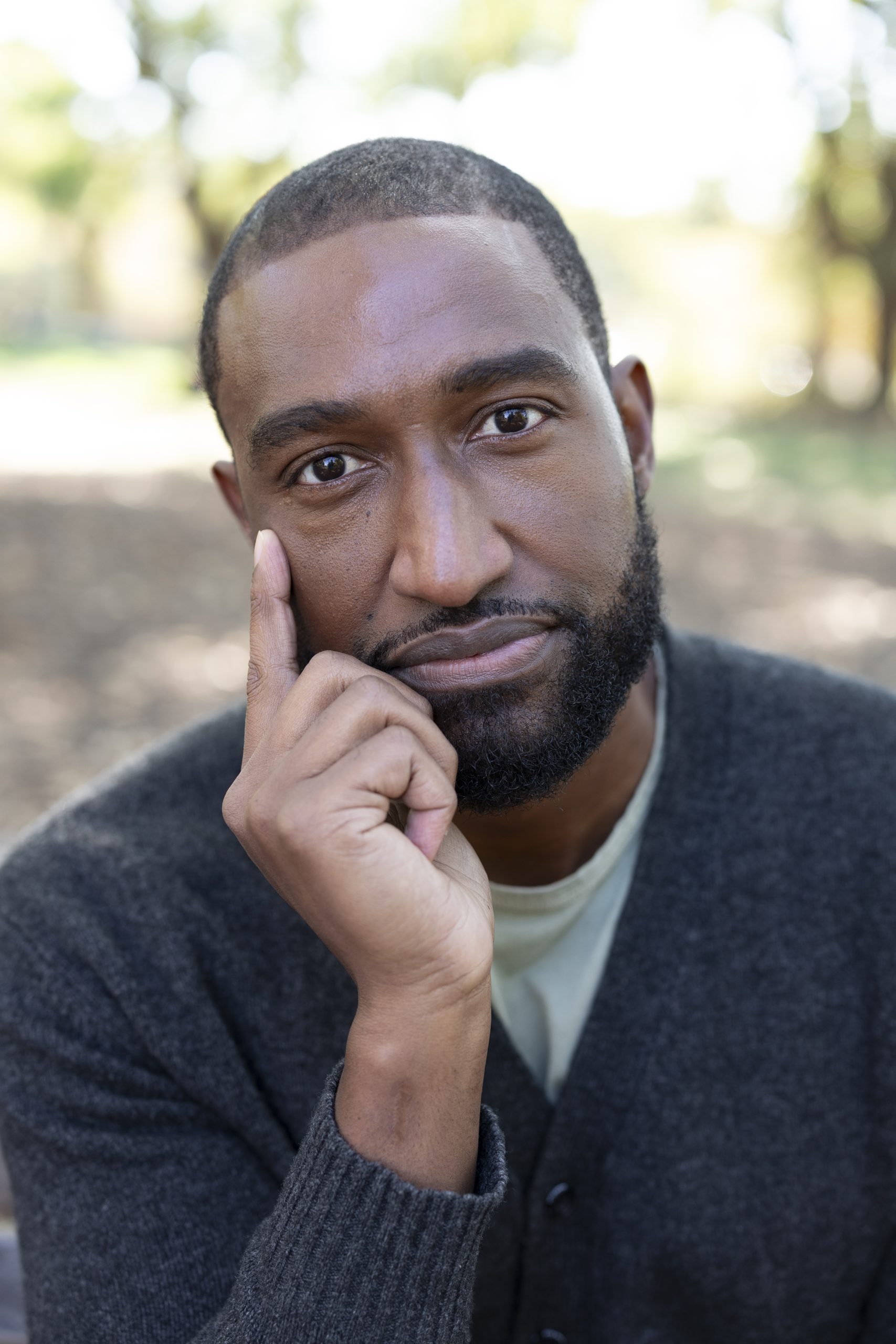
The acknowledgements section of Jeff Boyd’s second novel, Hard Times, out now from Flatiron Books, says he started writing the book during the pandemic while an MFA student at the University of Iowa. As the world seemed to be eating itself alive outside—both from a new, scary, historic disease and protest movements on a scale we hadn’t seen in years—Boyd wrote that he found himself “wondering about the fates of all my former students, praying for their safety, always hoping for our world to get it together.”
From that impetus sprung a novel exploring a large cast of characters living through hard times of their own in a Chicago neighborhood where Boyd once taught high school. The result is equal parts literary fiction and crime thriller—following the ripple effects of a tragic shooting through a community, tracing the lives of an idealistic English teacher, his students, a corrupt cop, and numerous families caught up in between them.
Hard Times follows Boyd’s debut, The Weight (Simon & Schuster, 2023), about a young Black musician navigating a predominantly white Portland, Oregon—where he once lived. Today, Boyd calls Brooklyn, New York home.
It was a joy to speak with him for the first time on Zoom in early March—him calling in from his apartment in Brooklyn, and me from my home in Miami. We chatted about craft, character, and what it means to write with full humanity about communities that are too often flattened into easy-baked headlines.

The Rumpus: Okay, I read your acknowledgements section, but want to know more about the initial kernel of this book. What came first: a character? An image?
Jeff Boyd: I started with the high school teacher, Buddy. His life is closest to the life I lived as a former teacher in Chicago. I kept thinking about teaching in a neighborhood and in a school like I used to teach in, and thinking about the students I taught. Then I started to wonder: What would it look like if someone like Buddy–who had these strong ideals about the world, teaching, and doing good–had a family member who compromised those ideals. How would that force him to have to wrestle with what he actually believed and what it meant to stand up for his family and his community?
Once I had that, ideas started coming–including the idea early on that somebody would get shot. Then I started asking myself: “Well, who is going to get shot? And why?” Eventually I started to explore all those questions and discover answers to them through writing–which is usually how I do it.
Rumpus: Buddy seems to serve as a conduit for the novel’s many voices: his cop brother-in-law, his students, his wife, and even his students’ guardians. Was it hard managing all those voices?
Boyd: That was one of the bigger challenges craft-wise. My first novel was first person, and followed one POV. But with this one, I got in enough pages and all of a sudden I thought to myself: “Wait, how many POVs do I have here?”
Funny enough, having that many voices ended up helping the plot. As I was writing I would eventually get to a point where I could only go so far with one character. I thought: “What if every character got to tell their own version of the story?” I approached things from a journalistic perspective. Okay, this story occurred. These things happened, and I want to get the reaction from all the major players. I want them to tell me, in their own words, what they were doing, what they were thinking and why.
There would be times where I’d stop and say, “Let me ask Zeke what’s happening here. And then go and ask Truth or Chrissy about something else.” I tried to give every character a chance to speak for themselves. Eventually I started to really hear them in their own words and I took all of what they had to say and tried to parse the story out.
Rumpus: Some of my favorite characters were the teenage boys in the book. They sounded like real, complex teens who happened to live in the hood.
Boyd: Some of the kids came easy, like Zeke, who for whatever reason I just understood right away. Other kids, like Dontell and Truth, took a long time. In the beginning, they were too alike. I got a note that said I should get rid of one, and I took that more as a challenge to get to know them better and distinguish them.
What helped me with the kids generally is I interacted with a lot of young Black boys, as a teacher, who were all such different, distinct people. But they also shared some characteristics, too. Like the fact that sometimes they could say things that are so mature and profound, and other times say things that remind you: “Oh, wait, you’re just a damn child.” I tried to use all of what I’ve learned about adolescence as a teacher, and how kids talk, and how kids in certain neighborhoods, like the one I taught in, talk tougher than they actually feel. They’re always aware that they have to present in a certain way, that they can’t look soft or vulnerable.
Rumpus: Were there any voices that gave you a hard time?
Boyd: Janice, the mother of Truth. I never really intended to have her in the book. Then I got to this point where I wanted to know more about the background of this situation and these characters, and the only person who could give it to me was Janice. To get into her POV I wrote her scenes first in first person, because that was the only way I could access her. The third person has more of an authority feel to it. It’s like: “They were thinking this” but then I’m wondering: “How do I know what they’re thinking?” Sometimes I need characters to think things out on the page first in their own words and then I can choose what is most relevant and use it in the third person.
Rumpus: The novel takes place in Chicago’s urban, Black community–a setting, like the Bronx where I’m from, that is often reduced to stereotypes. How did you approach writing a community that’s often represented in such narrow ways?
Boyd: I don’t think you can write about places like the Chicago I’m writing about or the Bronx and not have things like gangs or violence. Those are all real things people experience. But going back to focusing on the interiority of characters, I tried to lean into that interiority as much as possible. Because while things do happen in these communities, why they happen and how they happen and how people feel about it is something we often get wrong. I also tried to keep in mind that there are many days–even whole lives–where things are not terrible. You have your community, your people, and good times. So, I tried to be respectful to the people I was depicting, and also make it clear that there is so much more richness and nuance to a lot of this.
Rumpus: In addition to being an interesting exploration of these characters’ inner lives, this is also a crime novel. There are detectives, shootings, suspense, and twists. Did you set out to write a crime novel?
Boyd: It kind of just emerged. When I first started writing the book, I was just trying to tell a story that was interesting to me. But when it went to my editor at Flatiron, and they were like, “Oh, this is a crime novel.”
Once I realized it was a crime novel, I did start reading more crime books from authors like Dennis Lehane and Richard Price. I also watch a ton of true crime shows. Mostly, my goal while writing was to get these balls up in the air. Okay, if someone gets shot, something has to happen, there has to be an aftermath. I had to have the people and the characters in situations where people were working through it. I would say the second draft is when I really approached it thinking, “Okay, this is a crime novel, these certain things have to happen—I probably should start with some kind of violence.”
Rumpus: How many drafts did it go through?
Jeff: Three or four. The first draft didn’t even have chapters. I was just riffing. It took some time to write the book because I was just trying to figure it out for a while. What is this? I came from playing music and I still think about that when I write—there’s vibes and there’s the feel of a thing and you just kind of have to get with it or you don’t.
Rumpus: What instrument do you play?
Boyd: The bass.
Rumpus: So you’re the one setting that steady tone. Does that translate to writing?
Boyd: I think so. To me, there always has to be a sort of rhythm or pace to it, which is what I was keeping in mind as I was switching POVs in this novel. The train’s always moving, and it’s almost always moving at the same beats per minute, whether you like it or not. I think about that with narrative thread or plot–it’s also kind of dependent on this steady rhythm. And then sometimes I’ll get the feeling characters need to break rhythm for a beat or two. I’ll decide, ”Oh, this character needs a riff now–they’re just going to talk.”
Rumpus: The word “chorus” kept coming to me while I was reading–all these distinct voices moving together. How did you make sure we know who all these people are while also keeping the fall out of the crime and the on-going investigation humming in the background?
Boyd: My first book, like I said, was first person, and I thought it had a strong plot, but it was more about what was happening to that character. Whereas in this book, because of the crime and the story, the plot was more at the forefront–it’s important that I really hit the markers for the plot. I don’t outline or anything, but I do usually try to know what’s going to happen at least a little bit in advance. And then I’d have these epiphanies where I’d be like, ”Oh, that’s why this is important! This is totally going to lead to this!”
I’d have it in the back of my mind: “Okay, in the end, this is what’s happening.” Knowing that was how I worked through those moments where I’d have characters talking or saying something or doing something. I’d ask myself, “Well, why is this important?” And to me, it always had to be justified in the sense that it was advancing the narrative or advancing the plot.
When Truth says this to Dontell, or when Buddy forgets an item at school, that’s important because in the end, he’s going to have to go back and get that item. I don’t know when it’s going to happen, but I know that it’s going to happen and it’s going to be important. And so I just tried to have these markers or these moments that I was working toward. I wouldn’t always know which character was going to get me there or what situation was going to get me there, but I did start having these ideas of what was going to happen later in the book.
As for interiority, when to dive into it–sometimes it just felt natural. In a story, I’d want to know, “Yeah, you’re doing this or this happened, but why?” And sometimes the why seemed as important to me as anything else, and that’s when I would dive into the interiority of the characters or show their home life. I figured that if you can understand what their life is like at home, and what their life is like at school, you can understand why they would listen to an uncle when he asks them to do this thing. It’s all in service. Character is plot and plot is character—they’re all working in conjunction with each other because all that really matters to me is not necessarily what happens, but what it means to the people it happens to.
Rumpus: This is your second novel. Were there things you approached differently this time around? Lessons you feel that you were able to apply?
Boyd: I think this time around I thought more about who my audience would be or how this would be received. With my first book, I was mostly amazed that I could write a book and that it would be published.
Now it’s more like, “Okay, but what is this book? How are people going to receive it?” I’m a lot more confident now. I know I can write a book. I didn’t know that the first time around. This time, when I hit roadblocks and felt like this wasn’t going to come together, I thought, “Well, you already did do this once before. You have proven that you can do this.” I think that confidence definitely helped me stretch myself.
Rumpus: What’s next? Do you see yourself writing another crime novel? Trying something new?
Boyd: I’m not very far into this next thing yet. I’m still contemplating it. I would say it’s more of a historical novel. It takes place in the past, in upstate New York, and concerns these Black homesteaders who are being pushed out of their land. It might have a Western feel to it, too.
I’m not thinking much about genre to be honest. I try to write what I would like to read. And I don’t always want to read the same kind of books all the time. There is a variety. But I try to keep that question in mind: “What would I like? What is something that would make me say, ‘Oh, I want to read that?’”
Story is more important to me than genre. Can I write something that’s going to surprise me? Can I write something I’m going to be proud of? Nowadays, those are my markers.
I figure that if I’m going to string together different jobs: be a father, and a partner, and make the time and sacrifices to sit here at my desk, I might as well write stuff that I feel is worthy of all that.