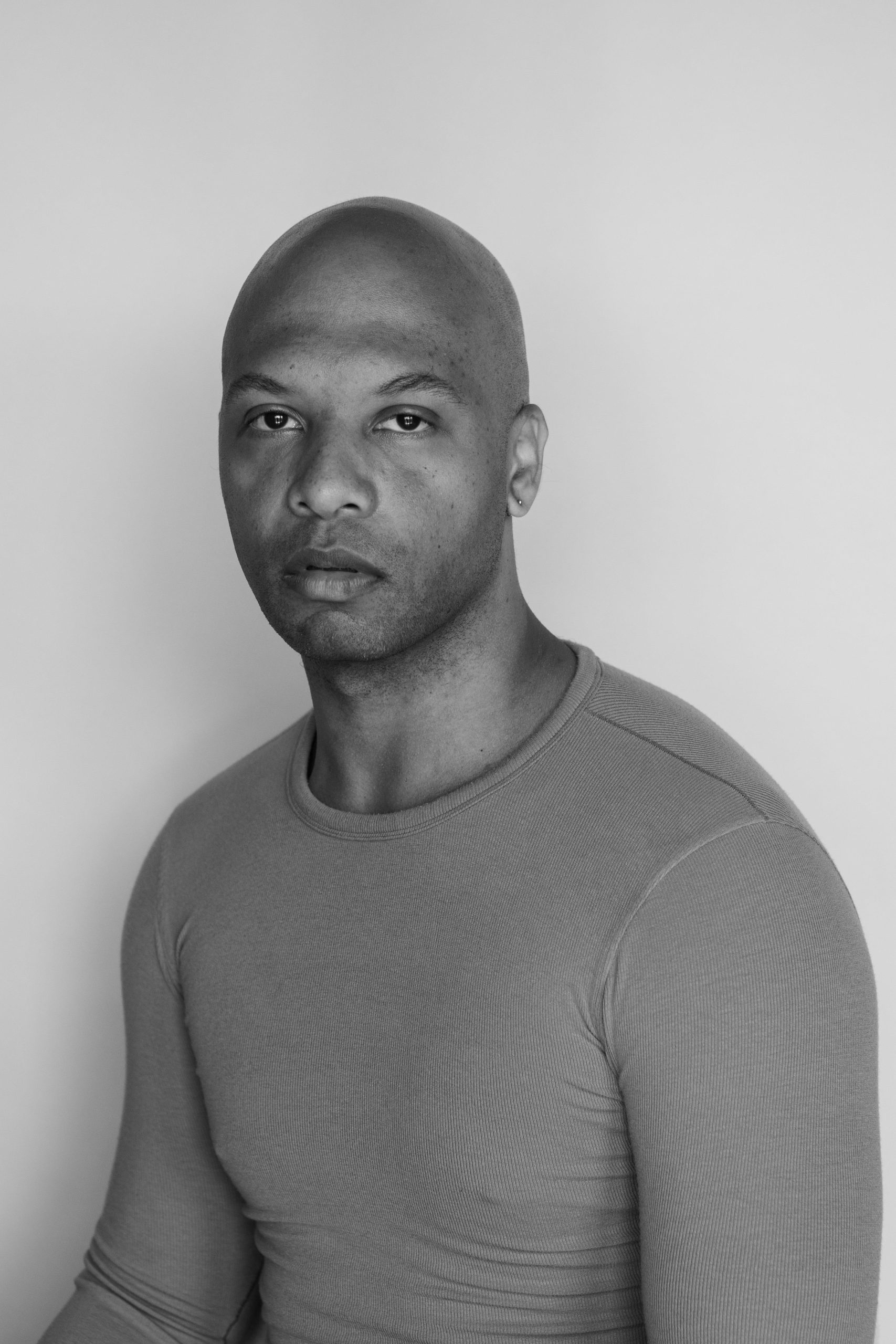
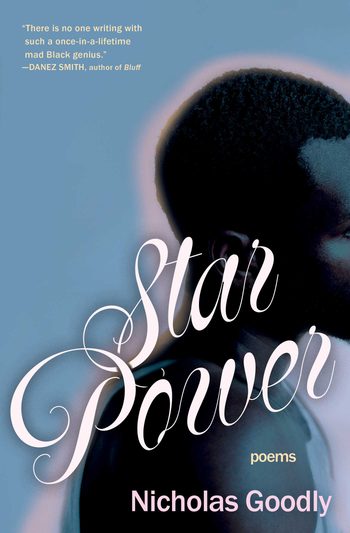
Nicholas Goodly continues to establish themselves as not only a breakthrough voice in the literary community, but a necessary one. Their second poetry collection, Star Power, invites us to be dazzled and mesmerized by all the possibilities of transformation: in language, in images, in the self. Goodly explores what it means to live and hold Black joy in a world that frequently attempts to deny it.
I first encountered Nicholas Goodly through their debut poetry collection, Black Swim, published by Copper Canyon Press in 2022. The precision and emotional depth with which Goodly navigated Blackness, queerness, injustice, and belonging held me in awe in poems that resisted simplicity and asked me to sit with the vulnerability, tenderness, and spellbinding language. Goodly invests in the possibilities of language, not merely as witnessing but as reclamation.
Star Power renders the invisible visible through language and form. Goodly moves seamlessly through lyricism, narrative, fragmentation, and rupture with ease. This allows the poems to embody the tension Goodly sets out to capture throughout the collection. Star Power deeply attends to performance, not only as artists and celebrities appear in and out of the collection, but a performance that is demanded by survival, queerness, identity, and desire.
To read Nicholas Goodly is to encounter poetry that lingers long after the page has been turned. Their writing invites readers into a space of vulnerability while at the same time challenging the boundaries of the way language moves through every breath of each poem. Goodly continues to redefine what poetry can hold, what it can witness, and what it can make possible.
Goodly and I began our conversation through an email exchange. Across our correspondences, Goodly reflects on their debut poetry collection, Black Swim, and the many tools, acts of risks, rituals, and moment of conjuring it took to shape the writing in Star Power. In preparing for this interview, I found myself eager to ask Goodly so many questions–from how their writing balances transformation and survival to the ways in which they experiment with form to communicate the intended experiences. I was particularly interested in how they approach language, voice, and images with their craft, and how poetry itself becomes a site where identity can be questioned, performed, and remade.
What emerged clearly throughout our emails was Goodly’s commitment to giving insightful and honest answers about their craft and thinking. Their reflection reveals a writer deeply aware of poetry’s ability to witness the world around them and at the same time transform it. Whether discussing queerness, Blackness, memory, or the embodiment of experience, Goodly consistently returns to the importance of language as a living force.
The Rumpus: Your new poetry collection, Star Power, leans towards Black joy and those who do not get praised or seen. In your dedication page, you write, “dedicated to the stars that go unseen.” What does Black joy mean to you and how does Star Power redefine what Black joy is, and what it means to be seen? And, how do the speaker(s) of these poems negotiate how they want to be visible?
Nicholas Goodly: Perhaps my version of Black joy is rooted in a sense of pride, for myself, for my community. I imagine Black joy has a lot to do with gratitude for who I am and how I got here. Black joy lives in the moment and honors the past. Black joy is resilient and contagious. It cannot be denied or stifled, and deepens when shared.
Rumpus: Star Power is your second poetry collection. In what ways was the process of writing this collection, from its initial idea to the moment you felt it was a finished manuscript, different from your debut poetry collection Black Swim?
Goodly: The seed of this book started with wanting to make bigger swings and take more risks. This is by writing with a more straightforward tone or being more vulnerable with my personal narrative. I wanted to remove as much second guessing as possible and hide less behind abstraction. If Black Swim is a seduction into my heart and mind, Star Power begins in a place where we can start to actually have some serious fun and play with each other.
Rumpus: What role does the body play in your poems as a site of transformation, memory, or resistance?
Goodly: The first art form I ever attempted was dance. There are hours of home videos with me in a diaper and fedora jiggling in front of the TV imitating Michael Jackson. In dance, the body is where observation becomes feeling and feeling becomes movement. Knowing myself as a dancer first allowed me to approach poetry as an extension of that process. I receive, I observe, I allow the insides to give the experience new shape. Similar to dance, I believe good poetry is not concerned with the end result but rather the process, what happens from the inside out. The thing we can’t see, that’s where beauty comes from.
Rumpus: The poems “HOW TO BE A STAR,” “HOW TO DRESS A STAR,” “HOW TO SPEAK STAR,” “HOW A STAR FADES,” and “HOW TO NAME A STAR” are poems throughout the collection which almost function as section markers. Each of these poems asks their readers to explore different ideas on themes seen throughout, such as what it means to be rewritten, to be revealed, to be hidden, et cetera. What was your intention for the placement of these poems? How do they balance celebration and struggle without minimizing each other?
Goodly: I do think of them as section breaks, the themes of those poems foreshadow the poems that come after them. The poems typically look back on a life experience, or refract a memory into a place of meaning-making. This tension between these poems of personal history and the poems of high energy declarations give the book a sense of direction. I show you where I’ve been and where I’m trying to go, back and forth and outward.
Rumpus: I was captivated by different forms in the collection, such as “Anatomy,” “Ars Poetica,” and “Anime & Disassociating in Locker Room,” to name a few. In an interview with jaamil olawale kosoko, “Intentional Offerings,” published in The Common, you mention the crucial work which goes towards choosing the correct language: “I’ve spent a lot of time in the back of my mind, like sometimes two hours, changing three words in a poem… like, no, you’re here to figure out these three words. That’s your priority… I know that my priority is to be creative.” How do you go about form? Is there a process in which you ask the poem, how does the content want to be seen? Or does the form come first?
Goodly: I have grown to love form. At first, it was a love-hate relationship. It’s become a place where I can play games and challenge myself. I often find that form pushes me to express myself outside my comfort zone. Perhaps my first instinct doesn’t fit whatever form I’m choosing, so I have to imagine new ways to say what I want and fill out the form. These new phrasings often are where I can surprise myself the most. It removes the ego in a way I really enjoy, like I’m collaborating with the poem much more concretely. The more rigid the guardrails, the more flexible I have to make myself.
Rumpus: There are poems that are dedicated to pop culture icons such as Tiffany “New York” Pollard or artists such as Jacolby Satterwhite, which contribute to the themes of power and visibility. What does blending high art, pop culture, and queer history reveal about identity and belonging in this collection?
Goodly: When we reflect on the moments, people, and figures that impact us, we don’t get to choose where they fall in the larger cultural zeitgeist. What means the world [to] one person is a passing [blip] to another. My job as a poet in this collection is to not only highlight the figures who’ve inspired me, and to share those figures with others, but to share how they fit into my life. The poem is my space to figure out what makes a person meaningful to another. Why do people resonate with us the way they do?
Rumpus: How do you balance tenderness and rupture when writing about queer identity?
Goodly: I think a lot of people identify with this pull between tenderness and rupture. We crave vulnerability yet fear getting hurt. It happens all the time to people all around us. When it happens to us, it lives in our memories. Perhaps some of these poems are versions of myself where I am embracing the risk. I am tender and rupturing. I love this broken version of myself, too. When I write, I am wholeheartedly myself. I do my best to come from a place of no fear. Living in unapologetic queerness has made me feel like no one can hurt me, not really. Getting to write from this place of empowerment truly is a blessing. I hope I can help others find this feeling for themselves.
Rumpus: Another theme found in Star Power is the power of transformation. I’m thinking of your poems “How I Make the Money Come to Me,” “Vantablack,” and “How Rhinestones Were Invented.” Why is the idea of transformation an important political or cultural act in marginalized communities? How is transformation portrayed not just as an escape, but as a form of resistance or survival?
Goodly: Adaptability is key to survival, a concept I lean into and because of my persistent interest in octopuses. I learned from them how to change form while essentially maintaining their identity as octopuses. This is similar to the transformation I can make in poems. I can make myself into a different version of myself. In these exaggerated presentations, I actually get to see myself more clearly. I write poetry to achieve a prismatic effect, where light gets refracted, the image of myself gets tossed in all directions, but it is all quintessentially me. A book is me looking at myself through a piece of quartz over and over again.
Rumpus: In your contribution to the features section of Poetry Society of America’s “In Their Own Words,” you shared some insight on your poem, “Evening Prayer,” where you mention that “As poets, we all know the importance of language, how the right combination of words can change a life forever, how words can save a life or break it almost beyond repair. Language is scary in that way, and we as poets are taking a big leap to assume we are the ones capable of wielding this power. Aren’t we full of nerve, to believe we are the ones with the winning alchemic formula of letters to free us from ourselves? And then we believe that those words may free someone else?” Can you share how you challenged conventional uses of language—through fragmentation, repetition, and shifting meanings—to reshape how readers understand identity and experience in Star Power?
Goodly: During the process of this collection, I reflected on my use of language in everyday speech and in poetry. I wanted to reach into my everyday vernacular and bring it into the same elevated place of magic that I associate with poems. I like being quick on my toes in conversation, mak[ing] puns, exaggerat[ing]. I employed those same mechanics on my poems, and I really discovered this world that was much more honest to who I am as a human being, not just as a poet.
Rumpus: Your poem, “The Spirit and Craft,” which is for Lucie Brock-Broido, reads as a meditation prose poem, tackling themes on queerness/identity, surrender, art, and language—specifically what poetry is. Can you expand on the idea of what poetry is to you and how it has been a vehicle for you to name and explore the subjects which perhaps other mediums of writing do not let you do so freely?
Goodly: That poem is a really long explanation of what I thought a poem was at the time, and I still don’t think I got it all right. For now, I’ll just say I make poems and I make art because it’s how I process the world. It gives me a chance to make my life beautiful and meaningful. Through poetry, I have agency about how my story is told. I’ve lived a lot of lives, grown into versions of myself I barely know. Poetry lets their voices be heard; it’s where my true living happens.
Rumpus: I love the poem “Legendary Children” and how it fits so well as the closing poem.. How do you use collective language (“we”) and vivid, unconventional imagery to redefine identity, power, and community? How does the use of religious and biblical imagery, like the references to angels, saints, and Lot’s wife, challenge traditional ideas of holiness and reimagine queer identity as sacred and powerful?
Goodly: The “we” is for all of us to feel as beautiful and complex and holy and dirty and invincible as I did assembling these images. “Legendary Children” is a way for me to put my foot down for the queer community. It’s a direct challenge to the erasure of a lot of queer and trans rights that we are facing. It is a nonviolent poem, but it is also firm. I also wanted to end the book in a moment of queer celebration. Too often our stories end in tragedy or melancholy. I want the queer lives of my book to end on a high note. I want it to be a party that keeps going.
Rumpus: Which influences helped shape Star Power? Who are poets you return to for inspiration and guidance?
Goodly: Several of the poems have their influences listed, but a few of the unnamed inspirations are writers like Harryette Mullen, Maya Angelou, Adrienne Rich, Audre Lorde, Hanif Abdurraqib, Jericho Brown, Danez Smith, Tracy K. Smith, Dorothea Lasky, Bernadette Mayer, as well as artists like Leikeli47, Lady Leshurr, Mykki Blanco, Azealia Banks, cupcaKKe, Kevin Jz Prodigy, Serpentwithfeet. This is still only the fast and nasty list, but enough to get the vibe. Mixing my influences across mediums helped make the collection feel more dynamic. These characters are so varying in styles and energy that the world of the book stays fresh.
Rumpus: In order to write, some writers create a ritual to go into the world or to tap into the speaker’s voice they are creating. Are there any rituals you do before you sit and write? In moments of writer’s block, what do you do to get out of it?
Goodly: The only kind of suggestion I have for writer’s block would be to make sure to not edit as you create your initial draft. In my first drafts, I usually expect to cut at least half, so there’s no expectation as I’m “finding it.” I actually try to overwrite first because I love the chiseling down of a poem so much. One of my favorite poems in the book was initially two, typed, single-space pages, and now it’s twenty-eight words. That feeling of stripping away and letting go is unmatched.