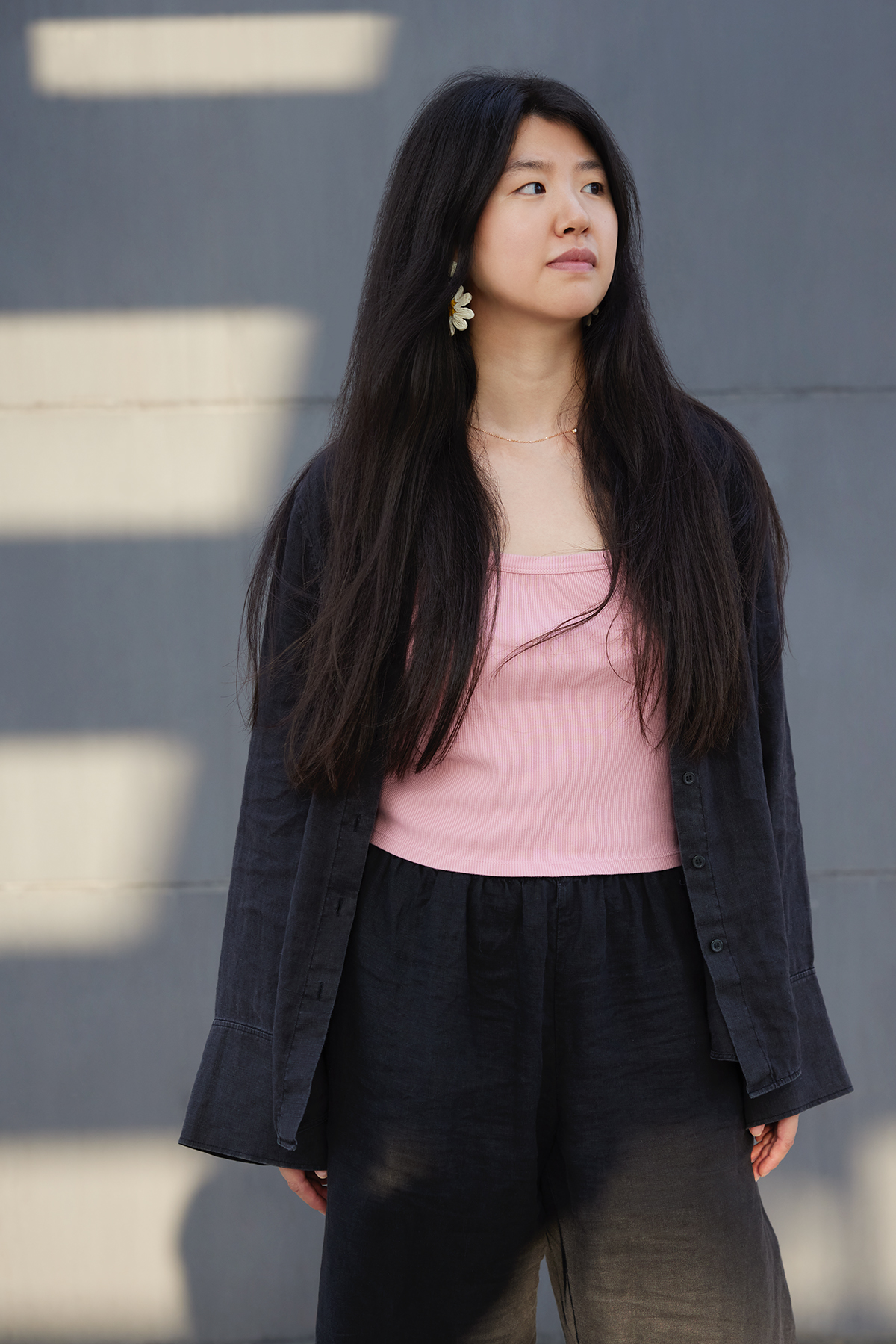
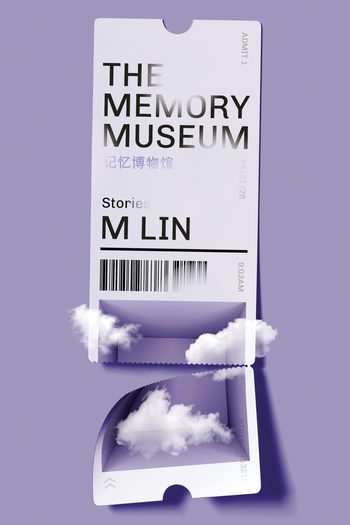
What does it mean to be Chinese? As a mixed Asian writer seeking belonging in the stories diaspora communities tell about themselves, M Lin’s debut, The Memory Museum stirred up questions about my own relationship to Chineseness. The tension in her work holds so well: the desire for continuity alongside the recognition that history does not arrive intact. The past reaches toward us, but it does not always explain us.
The collection of nine stories feels less like a single arc than a constellation—a series of bright, tensile points stretched between China, America, Morocco, and imagined futures. Taken together, the stories form a kind of ballad for China’s One-Child Generation: intimate yet political, playful yet edged with precarity.
Lin’s characters move through layered migrations. They travel across continents and from countryside to city, but they also migrate across memory, across language, across versions of themselves. In one story, an elderly woman in a dystopian future clings to recollections of her grandfather’s village. In another, artists and lovers test the limits of intimacy under censorship and ideological pressure. Even in the collection’s speculative leaps—a future Memory Museum designed to shape collective remembrance—time itself feels unsettled, provisional. From remembered childhood to imagined futures, Lin’s collection refuses a singular answer to what it means to be Chinese today. Instead, it offers something more honest: a resonant chorus of memory, contradiction, and possibility.
Over Zoom and e-mail, Lin and I spoke about the idea of an “ideal reader” (I joked that perhaps I was her ideal reader—someone who feels tethered to a rapidly transforming China not only as a country but as a people), about the adventurous spirit of Sanmao, and about contemporary mainland Chinese writers and artists navigating visibility and risk. We talked about exile versus self-exile, about the overseas Chinese experience, and about literary inheritance—what it means to write in English when it is a second language, or even a “second second” language. Again and again, our conversation returned to agency: who gets to remember, who gets to narrate, and what it costs to do so.
This interview has been condensed and edited for clarity.
Rumpus: What are your thoughts on Chinese artists or Chinese folks in exile?
M Lin: It’s a constantly changing situation and very different these days from when people left during Mao’s time or after Tiananmen Square. Now people choose to live abroad for various reasons—exile, by definition, can be either voluntary or compulsory. But with the internet and other technologies, living away from China no longer means getting cut off from it completely, and artists remain connected to it—the culture, the language, the people, the politics—to various extents.
In my own case, I don’t know if I consider myself in exile. I still visit China very often to spend time with family and friends, and I hope it stays that way. I chose to write in English so I could write truthfully, both personally and politically; whatever the consequences are I’d have to accept. But because censorship, and the government in general, is such an opaque, mercurial system, no one really knows how it works, so no one can predict what will happen. It operates on people’s fear. I try not to let it paralyze me. Maybe I’m slowly writing myself into a self-exile?
The conundrum is, though, if I want to keep writing truthfully about China and Chinese people, I need to keep visiting, to understand what I’m writing about. It’s more and more difficult to parse the information online, so I often see Chinese artists and writers in exile who are no longer able to go to China, gradually lose touch with its reality. I didn’t visit China for over four years because of the pandemic, which made me realize that the longer you are away, the more your idea of the place becomes imagined. So sometimes I feel like in the back of my mind, I’m probably still aware of the long-arm censorship, because I have this basic need of wanting to be able to go home, to see my family. It’s very complicated and everyone navigates it in their own way.
Rumpus: That’s fascinating. Given the long arm of censorship laws, as you pointed out, do you find that you self-censor what you write? How do these laws impact you?
Lin: The problem is that there are no laws, no real rules to follow. What’s allowed today might not be allowed tomorrow, and vice versa. So all I can do is not to think about it when I’m writing and stay true to myself. My intentions and aspirations have always been literary. If they were political, I would have chosen other paths that would make a more meaningful and direct impact, such as activism. But I am a writer, not an activist. My writing has become political at times only because to write about the reality of contemporary China, it’s simply impossible to avoid politics, at least not in ways that I find honest.
But writing and publishing are two different things that require different considerations. I have self-censored in the sense that, once, when I knew a story was to be published, I took out a few overtly explicit name-callings. I believe the story was actually better for it—sometimes leaving something unsaid has a chilling, powerful effect. Another instance was I once turned down an opportunity to be published because I thought the platform was too risky in terms of attracting unwanted attention. For the safety of myself and my family, I will have to keep making these decisions case by case, but none of it happens at the writing stage.
Rumpus: Since you are bilingual, how do you approach writing? Do you first create and write in your mother tongue or do you think immediately in English and proceed from there?
Lin: When I write in English, I think in English, but I know it’s not entirely in English because now and then Chinese phrases would come up and I put them in line with English, as you’ve seen in the book, so Chinese is still in my mind somewhere as I write because these phrases would appear only in Chinese and I don’t think they would have the same effect translated into English. Mandarin being my first language is informing my English in ways that I’m not really conscious of. I’m guessing that this happens because the context of what I write is always Chinese. Some of the stories in the collection are about Chinese people who have left China. Some, like the couple in “Magic, or Something Less Assuring” were once international students and returned to China after school, which is very common these days. There are characters like me who live abroad. Then there are Chinese characters who have never left China and have nothing to do with America or anywhere else—the context of those stories, especially, is 100 percent Chinese, but I am writing them in English. Though I don’t feel that writing in English creates a distance to their reality, sometimes I think it must, just in ways that I’m not able to see as the writer.
Rumpus: When did you start learning English then?
Lin: For people my age in China, most of us started in first grade. But our English teachers never went abroad or spoke to a native English speaker themselves. We were taught very bookish, mechanical English. The first lesson is always, “How are you? Fine, thank you. And you?” I’m not sure if it’s still like this for Chinese children today, but that was the only way we were taught to respond to the question, “How are you?” For me, it got better in middle and high school. My school had American teachers who taught us once a week. I also took extra lessons outside school and learned a lot by watching TV and movies. But I only started living in an English-speaking environment when I came to the US for college at eighteen.
Rumpus: What made you decide to start writing in English, completely changing the trajectory of what you thought you would be doing?
Lin: I started writing fiction in the pandemic around September 2020. Before then, that summer, I had finished a feature-length screenplay and for many reasons, felt more dejected than ever about my future as a screenwriter. I was mostly writing in Chinese and working with the Chinese film industry, and I realized that I could never tell the stories I wanted to tell in such a system.
One of the reasons that I write in English is that I feel like I became an artist in English when I studied film in college. Then there are practical reasons, too—some of the stories in the collection wouldn’t be able to be published in Chinese. I can also feel the parameters of censorship more tangibly in Chinese, what is and is not allowed to be said, and have to try extra hard not to self-censor. I feel much more liberated and clear-headed in English. The only thing I intentionally do is that I retain some of the Chinese grammar in the dialogue so sometimes a line of dialogue might not read idiomatic to a native speaker. Dialogue is the reader’s direct access to characters, and I want to remind the reader that these characters are Chinese, and they are speaking Chinese. But of course, I have to pick my moments.
Rumpus: You have such an interesting point of view. I haven’t really seen that many contemporary points of view of Chinese living right now, not in a dated past.
Lin: I think writers are interested in history because there is so much room to fictionalize. I believe one of the reasons that so much fiction about China has been set in the past is that Chinese American writers often have inherited memories from their family, which are often traumatic—China’s recent past had many traumatic events. It makes sense that they are interested in exploring these histories, and it’s valuable, too, because those wounds are still present in contemporary China. But China has changed so much since then. The China I grew up in is so different from how it is portrayed in most English-language fiction. It’s time to write about it.
And I know there are more and more Chinese writers working in English. I look forward to more stories about contemporary China and Chinese people so I don’t have to bear that burden of representation.
RUMPUS: You mentioned that you were a screenwriter, which brings to mind the story “Tough Egg”—a piece that departed in tone from the rest of the book, and I thought was formally experimental because it combined two genres: prose and a screenplay. How did you arrive at the conclusion to combine them the way you did?
Lin: The screenplay I mentioned earlier that I finished during the summer of 2020 was, indeed, titled “Tough Egg.” It was an entirely different story about an unmarried woman suing a Beijing hospital for refusing to freeze her eggs, which is based on a true story. I showed it to a few Chinese producers and was very frustrated by their responses. For the short story, I wanted to write about this frustration.
Why did I decide to have the screenplay pages? I think I was interested in exploring the relationship between an artist’s work and her life, and there would be no real way to show that without showing the actual work. Though I knew this would be a big risk—when you read about someone being a brilliant artist in fiction, you usually don’t get to directly see their work, you just take the narrator’s word for it. If you show the work, you risk the reader judging the work for themselves. I portrayed the narrator in “Tough Egg” as a good writer, and I can only hope the screenplay in the story lives up to her reputation.
And I love thinking about form in general. The narrator’s screenplay becomes a way to characterize her. Things she says in her work she doesn’t say elsewhere—like we all do. We write fiction because what we say in it is not able to be articulated in any other way. So I thought it was a worthwhile experiment to include the screenplay, playing with form not for the sake of it, but to explore if the mirroring and tension between the two forms—screenplay and prose—would create more meaning.
Rumpus: Do you think your collection differs from other “immigrant” books?
Lin: I’m torn about the idea of an immigrant book, as if it only relates to the experiences of immigrants. It is my hope that these stories are simply human, that Chinese people, immigrants or not, despite living with a different political system, are not “the other,” but share the same joys, hopes, sadness, heartbreaks, and grief as any reader. I’m not saying that I need to prove our humanity—I don’t have to prove something that is true.
But I would say that there is a familiar, more published immigrant narrative that this book is not. The word “immigrant” emphasizes the place a person has immigrated into, and in our context the country is the United States. But The Memory Museum does not center around the US. For one, many characters in the collection, whether they lived in other countries previously, reside in China. And even those who live in the States, like in “Shangri-La” or “Yulan,” the friction in the stories does not concern the characters’ relationship with the American society, but more between each other or with themselves. No story is about assimilation or how hard an immigrant works to stay in this country. In this sense, though I wrote the book in English, I’ve always considered it more in conversation with translated literature. It is more of a Chinese/diaspora book than an American immigrant book.
Rumpus: Do you think you’ll write an American immigrant book somewhere down the line or will you continue with a Chinese/diaspora story? Is there even a difference between the two?
Lin: This is such an interesting question! I don’t think there’s a real difference between the two—and I was making the distinction because I feel like what is considered an “immigrant narrative” in the American context today doesn’t necessarily include my experience or the experience of my characters. But the immigrant narrative can and should be expanded. Or perhaps it will become a “migrant narrative,” as some of my Chinese friends who live in the US now don’t see the US as their final destination, but leave open the possibility of moving somewhere else in the future. This is the state of our world in general, no? A lot of migration and movement. Nothing is fixed as it was before. Less order, more chaos. Less certainty, more instability.
My next project, which is a novel, is not a typical immigrant story, either, though the protagonist has been living in the US and by legal definition is an immigrant. However, the story is not about her experience making a life in the US, but is set in Beijing, her hometown, where she has to deal with the consequences of her emigration, such as her relationship with her aging mother, since in Chinese culture, a child is supposed to take care of her parents when they get old, but in the case of my protagonist, because she and her mother live in different countries, everything becomes significantly more complicated. When you hear of an immigrant narrative, this part of the story probably would not be the first that comes to mind. But it is such an essential part of the immigrant experience—every immigrant is an emigrant who leaves behind people, places, and parts of themselves. It’s a painful process.
Rumpus: What do you hope people learn from your collection whether they’re the ideal reader or not?
Lin: I don’t think I would use the word “learn” because I don’t have anything to teach. While my ideal reader is people like myself, I do hope the book would reach people who, at first glance, might be very different from me. I believe they would be able to find their own entry point into the book, and I hope they would be moved as readers, and perhaps even think of the book in the context of their real life, when they meet another Chinese person, or anyone who they deem different from them, and be open to look beyond these differences.
Rumpus: Who do you think is your literary lineage?
Lin: This is always such a difficult question to answer, because I read so eclectically and think I can learn something from everyone—I’m bad at picking favorites! I’ve also learned that what I write, which I don’t really control, can be very different from what I enjoy reading, so it’s hard to think of lineage. But if I must talk about it, there’s a small pool of second-language writers that I feel close to in ways that have nothing to do with style or subject matter.
Rumpus: Can you name some of them?
Lin: Yiyun Li, naturally, who also grew up in China and writes in English. Reading her showed me the possibility of this path. Yoko Tawada, who is Japanese and writes both in German and Japanese. Her thinking on exophony has been extremely enlightening, and entertaining too! Ha Jin’s The Writer as Migrant, in which he spoke about Joseph Conrad and other writers in exile. Jhumpa Lahiri who has adopted Italian. Her latest story collection, Roman Stories, is written originally in Italian, and I think because of this, the stories inhabit an outsider perspective that is distinct from her writing in English, which was already written from the margins of the literary landscape, especially at the time of their publication. I read a lot of Milan Kundera in high school, but all in Chinese, so I didn’t realize that he had switched from Czech to French!