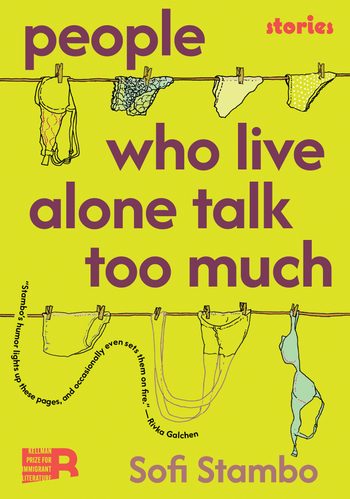
Radical repositioning toward memory and our past, toward the ordinary and the extraordinary, is at the heart of Sofi Stambo’s debut short story collection People Who Live Alone Talk Too Much. Stambo’s characters don’t act so much as they navigate—the city, their families, their communities, their nations—and the tension, and surprise of these stories, come from the subtle ways they need to adjust.
In the opening of the eponymous story, a group of workers stare out at the lido deck of a cruise ship as the ship sails past their office window. In another, the protagonist asks her boyfriend to keep track of a conversation she can’t witness, because of where she’s sitting. She playfully notes, “My boyfriend continues to be my rearview mirror, besides of course being the love of my life.” In another story, “Baba Borka” an outing to Coney Island transports the protagonist to a beach in Bulgaria where she and her siblings have memorized every tile in the sidewalk and make a barber shop disappear simply by not looking at it.
The collection is also very much about the political histories of both Bulgaria and the United States. Stambo details the deprivations both of living under communism and of life as an immigrant in New York City with clarity and a clear eye for the acute detail. There’s this lovely line, for example, describing the protagonist’s childhood in a communist era housing development: “We played a lot of elastic games.” The sentences that follow bring home the reality of the children’s situation: “Every girl purchased two and a half meters of underwear elastic, tied the ends together, and carried it in her pocket. In one game, two girls would stand across from each other and step through the circle of elastic as if putting on a giant pair of underwear.”
Stambo transforms the innocuous, the ignored, the dismissed with language that mines a slightly altered diction, original and surprising juxtapositions, and a masterful comic timing. The result is a book of compassion and joy and moments of original beauty in drawings by her daughter, Yana Mihaylova. The spare, delicate pen and ink illustrations are themselves meditations on memory and attention.
I talked to Sofi Stambo for over an hour recently over Zoom. This interview has been edited for clarity and length.
The Rumpus: People Who Live Alone Talk Too Much moves between New York City and Sofia, Bulgaria. But what really intrigued me about your stories is how they found a kind of liminal place between the two—a space filled with loss and sorrow, yes, but also, and more often, one of joy and possibility. To what extent do you agree with this reading and how much were you aware of this as you put together this collection?
Sofi Stambo: I think that’s right. When you have the upbringing I’ve had, when you come to the country in the way I did, you end up becoming a person of two countries and two languages. I arrived here first when I was twenty-seven. I left my husband and my five-year-old daughter behind. I think how mad it was that I did this. So, when you come to the country in this way, there’s this dual existence. Now, today, I feel as if I’m one person here in America and another in Bulgaria. “Am I me, Sofi, here? Am I me, Sofi, in Bulgaria?” I think the answer is yes… and no. And, of course, these are the questions driving my work. If I am both me and not me in any place, then where do I belong?
Rumpus: I noticed that your characters often grapple with that sense that they’re both part of New York City but also don’t ever fit in completely.
Stambo: Once you leave your homeland, you lose something. You arrive here. You don’t quite get the culture. You never become American—even though that’s a question in and of itself: Who and what is an American these days? And I return to Bulgaria and, well one of the ways Bulgarians find to insult someone who returns is to say, “Oh, you’re so Americanized.” You lose one sense of belonging, and at the same time, you also gain another. You start to find belonging everywhere, anywhere and with people that have nothing to do with you, but they’re suddenly more close to you because they’re lost like you.
So, there’s this struggle to always keep a sense of yourself. Returning to your question, I find myself most comfortable in these liminal, in-between spaces: airports, subways, the corridors running between buildings. I feel more whole in these spaces.
Rumpus: Along with liminality, another word I would apply to the concerns of these stories is slippage, particularly around how we use language. As a writer writing in a language that is not your first, can you reflect a bit on how mishearing and mistranslating provided both opportunities and potential obstacles for your writing?
Stambo: I still fight with the English language. When I write I sometimes make horrible mistakes and there are always typos. I still mispronounce words and mix up idiomatic phrases. I have stubbornly refused to learn the language, in some sense. There are immigrants who lose their original accents, completely assimilate. That’s not me. So, I rely on my daughter to read my work, and I’m always asking her if that’s how you’d say something. All this has made me very conscious about the language, and I listen extra carefully.
Rumpus: Yes! In the title story, the protagonist tries not to talk too much because of her accent. In another story, “In Charge of Gravesend” the protagonist notes an entire Brooklyn neighborhood is misidentified because of an error in pronunciation. I love that this is really being drawn from your life.
Stambo: I often, to amuse myself, translate words and phrases back into my original language and that makes me laugh because you know, often, when you translate it into your original language what was so clear in English no longer makes sense. And this is why we immigrants sound so funny because that’s what we’re doing. I have a friend who was telling me the other day that she’s a “lonely mother.” And I said to her, “You’re not a lonely mother. You’re a single mother.”
Rumpus: Do you think the form of the short story is ideal for exploring this kind of attention to language?
Stambo: My parents had three kids, which was considered a big family in Bulgaria during communism. My mom was a journalist and what she wrote was always measured strictly in lines. She might have only ten lines to detail an important piece of news. She became so used to thinking in lines, when my father poured her wine, she would say, “No, no, just two lines please,” instead of two fingers. Maybe you could argue with this and say that two fingers is very different from two lines of text but I don’t think so. What if we use two lines of text as our continual measure?
My point is that when I was growing up, no one had time for anything, so if I didn’t say what I needed to say quickly—in two lines—the person I was talking to would have moved on already. They would be in another room or another neighborhood attending to the next kid or emergency. I learned to speak rapid-fire fast and to the point. And if I could make someone laugh, that was a bonus. I would get what I wanted. This is my recipe for short stories.
Rumpus: The stories in People Who Live Alone Talk too Much often take surreal turns but the surrealism is quite gentle. It often hinges on subtle shifts in perception and absurdism rather than full out fabulism. From what sources do you draw, to create these moments in your work?
Stambo: Life is actually surreal more often than not. Things happen that are not from this reality and if you entertain the possibility that this is the norm you begin to find these odd moments naturally—in fact you realize these are the moments you most enjoy.
For example, you’re sitting in a park and suddenly a pigeon shows up next to you. You ask yourself, “Who is this pigeon?” You ask the pigeon, “Who are you?” Because this pigeon, she is someone you once knew. After my father died, before his funeral, my brother had a dream that he heard my father in a local park calling for his two dogs. My father cared for the dogs and, when they died, he buried them in the park. At my father’s funeral our family and friends talked about how much they loved my father. At the restaurant afterward, we ran into someone who told us, “You know I had a dream about your father last night. He was with these two dogs.” And I said to my brother, “See, he found them.” These things—they happen. They are surreal and they are also real to our lives.
Rumpus: I am enthralled by the artwork by your daughter, Yana Mihaylova. Her drawings appear throughout the collection and often receive pages of their own. I also want to note that the linework is exquisite. I could have stared at the drawings for hours. But I also deeply appreciated how the drawings worked in conversation with the stories and created a grammar and mysterious narrative of their own. Can you talk about the decision to pair text with drawings?
Stambo: My editor at Restless Books saw Yana’s work on my website and suggested that we pair the drawings with the stories. So, my daughter and I, we really welcomed the chance to collaborate.
My dad was an artist and told us stories while he drew. All of us kids drew all the time. When I was ready to apply for high school, I wanted to attend one of the two art schools in Sofia. My dad was like, “It is too competitive. I don’t have any connections.” Connections were everything during communism because we didn’t have money. He also told me that he thought it would be hard for me, as a woman, to be an artist. I listened to my father, I always did. I was a good kid and went to study languages. Three years later, when it was my sister’s turn, she didn’t listen, she just went and applied and became an artist.
My aunt, my dad’s sister, and her daughter are artists. My uncle and my father are artists. Genetically, my brain is wired that way. Words and drawings go together.
Rumpus: Can you talk a bit about the process of drawing and combining image with text? To what degree are the images meant to relate to the prose? Also, I imagine, since your daughter is an immigrant as well, and she’s gone through some of what you have, that her process relates to yours.
Stambo: As I mentioned before, my daughter was young when we left Bulgaria. When we returned for a visit when she was in high school, she sat and drew. I didn’t realize this but she was recording what happened. It was a bit of a preservation instinct for her. She was uncomfortable because she lost much of her ability to speak Bulgarian. Her sketchbook became a shield. It was a way of signaling that she wasn’t available to us for talking. But she used that time to draw the family, the city, Sofia, her friends, people on the street.
When we started the process of pairing the stories with images, she drew occasionally from snapshots, but, mostly, she drew from memory. The sketchbook becomes—what do you call it?—a camera obscura. She’s recorded what happened in her own way, maybe many years after the event itself.
I have a similar process. I’ll chase memories. For example, I’ll notice someone who reminds me of a family member, and I’ll follow that person through some side streets in Chinatown. I realize that my brain is playing games with me, but I also realize there’s a story there. I just want to see where my brain takes me and where the story goes. My daughter wants something similar. She just lets the line take her to the memory. There’s a freedom and I think both the stories and the drawings get at that freedom.
Rumpus: What intrigued me the most is that you include drawings of real objects and beings—planes, clotheslines, birds—that are inspired by the text. Other images, like the crickets, don’t appear in any of the stories. Do the crickets have a personal, or cultural significance?
Stambo: Well, with the crickets I wanted something wild in the collection. Eventually the crickets are pinned. What does that mean? I’ll leave that to the reader.
Rumpus: You’re referring here to that drawing on page 65 of the pinned insects in a specimen case. I’m glad that you’ve brought that drawing up because it makes me think about the ways that you utilize memory in these stories.
Stambo: For decades I spent two hours a day on the subway commuting to work. If you live on the outskirts of the city, you get an empty seat and, then, you are left alone for an hour. You can’t do much, so you just sit back and give in to being transported. More people get in. They keep quiet. Many sleep while standing. Others lean on your shoulder. It is intimate, a little childish.
You are completely and totally free to sleep or listen to your music or read or think. Passing over the cemetery in Brooklyn, then going underground, under the East River, or over the Manhattan Bridge, you pass through portals and your memory shifts, like when you go through a door you forget a thought but sometimes remember another. These stories started coming to me that way, in the tunnel, on the next stop, a sentence at a time, a joke, a song. “Stay clear of the closing doors,” the voice repeats and tucks us all in. And I see myself hanging out of the crowded tram’s door in Sofia, school uniform and hair flying everywhere also completely and totally free for a few stops.
Rumpus: I am thinking here of “After Bulgaria, I Love Only You,” and the riff that opens the story that provides a brief political history of Bulgaria as the protagonist contemplates her boyfriend’s beard. In another story, “Hope Number Six,” the protagonist remembers living under communism and the memories are both a kind of deprivation and resourcefulness. Do you see these stories as pinning these memories to the page?
Stambo: Yes and no. I don’t think pinning is the correct metaphor here. You know on that train ride, nostalgia starts to play tricks with my brain. I suddenly see my grandmother sitting across from me on the subway, pretending to sleep. She pretended like that because sleep is contagious like sneezing and by closing her eyes she tricked me, as a kid, to fall asleep faster. After I recover from being startled to see her, I realize she’s someone else. But my grandmother had already entered the train and is coming along.
Those are the doppelgangers of the family you left a world away. Some of them passed in the other world while you were commuting.
“We Colombians believe that when people are asleep in one part of the world, they can show up in another,” a coworker tells me. “I get you,” she says. At work she often says, “I got you.” And this is how we continue to earn a living with the spirits of our people all over the place. And if we have a quiet moment, we tell their short stories.