
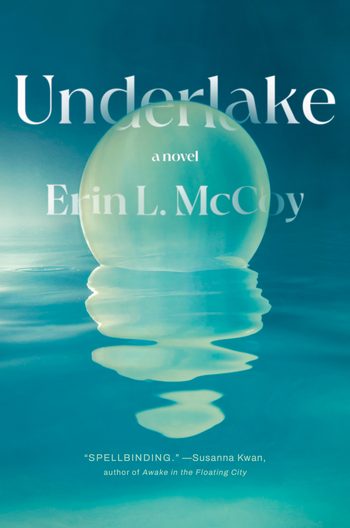
Imagine a world submerged under a lake, a missing daughter, a chance for redemption. Erin L. McCoy’s debut, Underlake conjures a dream-like world of communities struggling to maintain their homes, for better and worse, in a swiftly changing world, and fights into the depths of grief, hope, and forgiveness.
A government-made dam submerges the town of Paintsville. Years prior, residents refused to leave their homes, resulting in a mass drowning. The community still blames Otta Weber and her family for their alleged part in the drowning.
Then, Otta’s diving partner disappears undersea. Presumed dead, the loss brings Otta back to her hometown of Steels — and back to her estranged mother, succumbing to kidney disease. A high school history teacher, who acts as caretaker of the lead-polluted lake, makes an unexpected ask of Otta on behalf of her friend, May who insists she grew up under the lake: dive under the lake and find the missing daughter.
I caught up with Erin L. McCoy over email to talk about constructing worlds and narratives; our religious and political responses to crisis; and writing about the environment and colonialism.
The Rumpus: Through most of the book, we get alternating first-person chapters from Otta, who grew up in our familiar “overlake” world, and May, who claims to have grown up underlake. May’s voice reflects this world, with idioms like the swear “Lakes!,” but her grammar and cadence is different, too. How did you develop May’s voice?
Erin L. McCoy: It was largely intuitive. It sprang from those first few paragraphs of chapter two, from the long, uncoiling sentences and from the texture of her world. After I wrote those, I knew what to do.
Still, there were ways in which I laid the groundwork for May’s voice and ways I refined it. I wrote about ninety thousand words of prep for the novel before ever writing what I would consider to be a “chapter.” Through that work, I got to know each of my characters, their backstories, and their motivations—though of course, a lot of this would change in the writing of the book. I knew that this sunken town was located vaguely somewhere in the American South. And I was fascinated from the beginning by the impacts of isolation on a society—how the boundaries, artificial or physical, that we draw around our worlds create the condition for a particular set of beliefs, for the emergence of customs and rituals and even accents that are particular to the circumstance.
So May’s accent in the end contains seeds of the region’s history but is also singular, the result of a community that has spent thirty years in isolation, enveloped in a particular set of beliefs. In the Underlake, you can detect elements of 1970s slang and diction, since the lake “rose” in 1979. Also, in constructions such as saying that the lake “rose,” the Reverend’s belief system is manifest. Inside that, there is perhaps something more fundamental: the tendency to place oneself at the center of everything. It’s a lake- and Chimneys-centric worldview embodied in their vocabulary whenever possible, which I think is not unlike what we can see in any number of languages or regional dialects.
Finally, there were little see-saws and turns of phrase in May’s voice that I came to know as I wrote them and that I refined over time: the use of “come” instead of “came,” a Southern tendency, but only within particular grammatical constructions; and the misplacement of adverbs, which helped contribute to a sense of naïveté that is not May’s alone but also perhaps a symptom of the strict religious system imposed on the people of the Chimneys.
Rumpus: May and Otta mirror each other in many ways: both grieving, both fatherless, both alienated from their mothers. They’re also both outsiders, and as much as they suffer, they also find opportunities for–but not quite, escape. How can we build good lives as outsiders, or are we never really as outside as we think we are?
McCoy: It’s possible. I’ve been trying to answer this question all my life. The science shows that humans are fundamentally social creatures—our happiness and even our survival depends on it. But while our families and communities shape us in so many ways, we’re often born into communities that don’t nurture us, that don’t bring out the best in us, that suppress core elements of our personalities, invalidate our needs or desires.
I grew up in a place like this. And I think you can spend a lifetime searching for a community that complements your values and welcomes you for who you are, but so many people give up that search. Instead, they build a house around themselves and shut the door. The utter geographical immensity of the United States and our proud individualism have empowered so many people to close themselves off to a world that doesn’t suit them and to build a society around themselves, to suit themselves, without challenge. A narrow set of accepted beliefs and practices—and intolerance for everything else—is almost always the result.
I think the act of seeking your community, though, requires a willingness to be open, to absorb, to learn. At least in my case, when I started searching for a place I would feel welcome, it wasn’t because I knew exactly what that place would look like.
Everyone’s journey is going to be different. May’s and Otta’s experiences mirror each other because I also wanted to see those points of divergence. Their circumstances necessarily led them to address their loneliness in different ways. May, having lived in forced isolation all her life, starts to seek something outside those walls. Otta, having felt persecuted and shamed for who she was and who her mother was, drew an emotional wall around herself for many years that few people could penetrate—and that also blinded her to the nuance of others’ experiences, even her own mother’s. Every single one of us lives inside some kind of bubble. I think the point is to try, again and again, to see it.
Rumpus: Underlake has elements of science fiction, magical realism, and climate fiction, but there’s also something gothic about it, as the protagonists dive ever deeper into the earth, into ruins, into the past. How did you think about physical dimensions and time, and their relationship to how the reader moves through the story?
McCoy: It’s essential to remember that Underlake is in the first person, so each character’s personal beliefs and sense of what the world is and what’s possible shapes what they actually see and experience. That’s what metaphor is for, after all: to help us describe an unfamiliar thing in familiar terms. May is experiencing so much of the world for the first time over the course of this book, and she must interpret it in comparison with and in vocabulary inherited from the Chimneys. Otta, meanwhile, approaches her surroundings with a biologist’s mindset—but, little as she would like to admit it, this is a learned mindset, layered over underlying traumas that inevitably resurface over the course of the book.
So when it comes to genre, I didn’t approach this book with any other intention than to write a work of literary fiction—meaning that the quality of the writing itself was critical for me, and the exploration of foundational themes helped guide the plot and my understanding of the characters. I knew that elements of other genres were creeping in, and I’m particularly prone to incorporating elements of magical realism, since I studied Latin American and Spanish literature. But to think too much in terms of genre while I was writing would have been restrictive, because it would have attempted to wedge the story back into its lane despite where it actually wanted to go. Genre could be said to be another bubble—another set of laws that preclude us from participating in anything outside them. As I was writing the book, I did my best to pretend that there were no walls pinning me in—beyond the laws of this particular book, which I set for myself, which required that everything be rooted in the laws of physics and the history of underwater living and be technically possible. Anything truly magical—that lies in the eye of the character beholding it.
Rumpus: Otta takes real journeys above the lake and below, yet there’s also a persistent sense of unreality: not just May’s fantastic claims, or their visions–extraordinary or hopefully imagined–of their lost loved ones, but the disorientation divers experience under great pressure. The characters move in and out of intoxication. How did you balance questions of reality, the dreamy tone, and a grounded (sometimes quite technical!) environment and plot?
McCoy: I spent a great deal of time researching the effects of diving and pressure on the body, and also had to layer this with the impacts of long-term lead exposure on adults and children. At one point, I mapped these impacts by depth against the relative depths of each of the cottages, of the Chimneys and of the Factory, and used them to determine exactly how deep the Factory should be, before it strained the limits of what the human body might be able to tolerate long-term. That last bit was a judgment call on my part, and I’m certainly no expert, but on the other hand no one has ever succeeded in living at this depth for nearly the amount of time that the people of the Underlake do, so there’s a lot that we don’t know about what would happen in those circumstances.
The map of depths helped determine what type of experience Otta, May, and the residents might be having in any given cottage. Short- or long-term symptoms might impact how they’re feeling physically or how they interpret the people and the environment around them.
Rumpus: May’s community, and sense of self, is dominated by “fates,” or assigned purposes, which correspond to social status and opportunity. But purpose is just as meaningful above the lake. Otta’s mother, Eugenia, is kindest and happiest when she has a task ahead of her. Otta thinks taking on work of marine biologist and researcher will free her from her family legacy and hometown reputation. What does Underlake have to say about our roles, responsibilities, and purposes?
McCoy: I think (and maybe I assume too much) that most people want to feel useful in some way: that they’re making the world better, or at least driving toward some goal. Religious systems, social norms, class structures, so many of these have at their root the assignment of roles to individuals or groups of people, as flawed as many of these attempts may be. But to live in a society requires cooperation, requires relying on someone else to fulfill a role that you cannot: you farm the wheat; I bake. So we’ve perhaps been seeking methods for setting up successful social ecosystems for millennia. And each person wants to know where they fit in.
There are circumstances in which individuals and groups choose to withdraw. These are not always antisocial acts. But in the case of the Underlake, to withdraw in order to construct an artificial world that aligns with your beliefs alone—this can be dangerous. It shuts off avenues for learning, for being wrong, for growth. To have a real sense of purpose, I think, requires a sense that you are moving forward. I wonder if you can retain it in societies whose mission is to keep things exactly the same.
Rumpus: The people of Paintsville imagine their refusal to leave their doomed town as an act of resistance against the government; there’s a populist air to Eugenia’s alleged theft and the “People’s Council” fight. But these closed-off communities–including, perhaps, Otta’s overlake hometown, Steels–are also poisoned by reactionary impulses. What are the political dimensions to our responses when it comes to environmental crisis?
McCoy: Henry Weber takes on the mantle of a populist leader who sides with the “people” against the elitism of his own family. But this is more about his own personal dalliance with youthful rebellion and his nostalgia to (ironically) keep things exactly as they were when he was part of that elite family. As is so often the case, his populist rhetoric wasn’t really a reflection of his fundamental political beliefs, and over time in the Factory, there is a shift toward the type of strongman leadership of the U.S.S.R. under Stalin.
Far be it from me to claim expertise in this arena. All I’ll say is that, as I was writing Underlake, I took the view that our political beliefs are founded in what kind of world we want this to be. And for some, that is more of a personal than a social question. For Henry Weber, his political choices aim to construct an immediate world around himself that is favorable to him. The beliefs shift as his needs and desires shift. This, for him, is not inconsistent, because the aim remains the same: his personal satisfaction.
To address climate change and this very real environmental crisis, our political choices must look beyond our immediate surroundings and our personal needs. Climate change has been impacting millions of people, plants, animals, and ecosystems around the world for decades. We can choose to care even if it has not impacted us—if only because, someday, it might. Our approach to the environment reveals whether we treat the world as a shared inheritance or a stage set for our own lives.
Rumpus: How does the book explore the tension between preservation and stagnation?
McCoy: I’ll admit that I harbor a huge amount of suspicion in the face of nostalgia. I grew up in a place where preserving the past was a thinly veiled way to cling to white supremacist systems and Christian ideology. This isn’t uncommon. But a novel isn’t a treatise or a work of rhetoric. You don’t write a book with answers—you write it with questions. So while I wanted to explore the dangers of a certain type of nostalgia, I also knew there were characters who would gain real value and personal strength from it, and make something else of it entirely than I might be able to imagine.
Preservation can lead to stagnation—but it doesn’t have to. In fact, the antidote to stagnation is learning. We all live and act in the context of history, and when we don’t know our history, it’s easier to be blind to foundational systems of oppression. Nostalgia is the desire to return to an idealized past, but preservation is something else entirely. Writing this book helped me explore the distinctions.
Rumpus: One counterpart to the People’s Council is Reverend Jewell’s congregation. His religious vision of the world is repressive, but the religious impulse, and especially May and Daphne’s faith, can also be compassionate and creative, and ultimately necessary to survival. Can you tell us more about trust–in each other, and the unseen world–in the novel?
McCoy: I wouldn’t call the religious impulse necessary to survival, but trust in other human beings—most likely, yes. I think that what both May and Daphne find is that trust is earned. Even Daphne, who draws great strength from elements of the faith that the Reverend Jewell espouses, has learned to see the reverend’s flaws. Her faith is rooted in the goodness and potential she has seen in other people. May connects most with the natural world of the Overlake, that when she experienced it firsthand changed her sense of what was possible, and decentered her in the cosmos in a way that was freeing.
Rumpus: How does colonialism figure into your approach to environmental and climate writing?
McCoy: The colonial impulse is rooted in part in the scala naturae, the great chain of being, which places humans at the top (just below God and his angels) of a hierarchical system of “inferior” animals and plants and living things. “[L]et them have dominion over the fish of the sea, and over the fowl of the air,” [Genesis 1:26 in the Bible] et cetera. Such a system lays the groundwork to dehumanize other human beings, and thereby to claim the right to extort them like a resource, just as we do with other animals and with entire ecosystems, lakes and forests and continents. In Underlake, the Webers use lead in their paint until it’s expressly outlawed, although the dangers of lead have been known for years. They then commit one more act of extraction, selling the valley’s land to be converted into an artificial lake, which will more broadly disseminate the lead throughout the area. Any benefit to themselves outweighed harm to a natural world that lay below them on the ladder—and to any other human beings “below” them as well.
In writing the novel, I wanted to explore how this type of hierarchical thinking comes to bear on our day-to-day lives, how we relate to and interact with our world and the living beings in it. It feels so rooted in our culture that it can be both omnipresent and invisible. But I think some of the characters begin to imagine another way of living—inside real human connection, and in a natural world without that familiar god at the top of the chain.
Rumpus: As Otta befriends May and learns the truth of her own town and family, she observes, “That the singular picture I had of myself–of what I needed to become–was flaking away like paint.” But paint, we find, persists–at least, the lead in it does, polluting the lake that submerged the old paint factory. Is it possible to transform sin, poison, injury, or do we need to learn to live with it?
McCoy: A lot of times we live with that pain, exactly as it is, for most of our lives. But we have to try to transform it, right? Living with it can transform it. I don’t know that I have any answers here—I’m trying. And I know it’s work. All I can say is that one of the questions I started this book with was what you do next after complete failure. That’s part of where Otta’s story comes from. As a writer, I felt like I’d been working so hard for so long, and nothing had come from it. I was in full mourning. And this book came out of that. You bury the dead, water the ground, and hopefully something grows.
Rumpus: You’re either an experienced diver or an intensely gifted researcher–maybe both. What’s your background in diving and sea exploration, and why were you drawn to write about it?
McCoy: I’m a snorkeler but not a diver, and I’m a very nervous swimmer, afraid of open water. I wanted to be a marine biologist when I was a child, though, and I’ve always been a student of the natural world.
So my research for this book was extensive and led to major revisions as I learned about the history of underwater living, the rules of diving to various depths, and the physical and mental impacts of hydrostatic pressure. The science directly impacted the plot of the book and changed it entirely a few times. I did look into taking diving lessons, but between claustrophobia and some medical concerns, I ultimately had to commit to the research first and foremost.
Rumpus: This is your first novel, but you have also published the poetry collection Wrecks (Noemi Press, 2025), winner of the Florida Book Award and finalist for the Noemi Press Book Award. How does your poetry influence your approach to writing sentences? Shaping narratives?
McCoy: For me, the language always comes first. A good book has to have ambitions beyond transmitting information. How the sentence sounds, that it has a music to it, that it contains what Robert Frost called the “sound of sense”—embodying the “abstract vitality of our speech”—all of this is critical for me as a writer and as a reader. Certainly, plot and character-building have become much more important as I’ve moved into fiction, and I love exploring these elements of the craft. But my top priority has never changed.
Rumpus: Wrecks centers around the extinct sea-bird the great auk, and so also takes place in the exchange between land and sea. Did you write these two books at the same time? Did one grow out of the other? What fascinates you about this liminal landscape?
McCoy: I wrote Wrecks first, and realized only well into Underlake that I was writing another amphibious book. I mentioned earlier that I think the primary aim of a book should be to ask questions. I think both of these books find their purchase inside a space of unknowing—they sit there in the dark and feel around, squint, smell the air. Wrecks was inspired by a flightless seabird that was hunted to extinction for her feathers, eggs, and oil, but what I learned in my research was that many of the people who killed the last great auks first compared them to human beings: they “walked like a man;” they sighed; one was mistaken for a witch. The auk inhabited “uncanny valley,” that space of ambiguity where entities don’t fit into neat categories—and that makes us uncomfortable. But those categories rely on a hierarchical view of the world.
We know so little about the underwater world. We’re discovering new deep-sea creatures all the time, and even then only in glimpses; there’s still so much to learn. Maybe I’m drawn to the ocean as a space of possibility, where we have to grow comfortable with not knowing. Certainty doesn’t learn; it rarely changes. It so often creates categories of belonging and unbelonging. With each of these books, I’m just trying to figure out how to live as a human being inside of unknowing. “What a mystery is, is a story whose telling would drain it of all magic,” May says. I want to let the answer be, for a while, many things at once.