
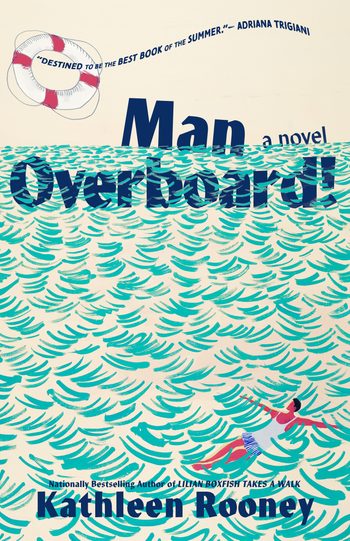
In Kathleen Rooney’s new novel Man Overboard!, the author immerses her protagonist—Patrick “Kick” Kilpatrick—in an uncommon setting for self-discovery: the open ocean, where he clings tenuously to life after a fall (or a jump?) from a Thanksgiving cruise with family. What follows is alternately a survival story, a dark comedy, and a poignant meditation on the beauty and abjection of life on Earth.
As Kick treads water and struggles to stay buoyant, his mind ranges freely—revisiting his childhood in Nebraska, parsing the complicated history of his nuclear family, and reckoning with the quieter, stealthier forces that have shaped his life.
Narrative voice propels Man Overboard! as much as the suspense of its plotting. Kick is a man in crisis, but also a keen observer of his own failings, his humor surfacing even in extremity. The resulting narrative balances tension with absurdity, asking how we endure not only physical peril but the emotional undertow of memory and self-doubt. In Rooney’s hands, the ocean is a crucible for transformation, a vital and vibrant space where the past presses in and the future remains uncertain.
In our interview, conducted primarily via email, the author discusses the challenge of sustaining narrative momentum within a circumscribed setting, the influence of writers who balance comedy with existential ennui, along with the deeper questions that animate Kick’s predicament: what keeps us afloat, and what, finally, compels us to keep going.
The Rumpus: Patrick “Kick” Kilpatrick fears the ocean, yet it becomes a place of catharsis for him, a setting where he confronts the choices he’s made, both personal and professional, along with his past and its challenges. Under such extreme circumstances, how did you develop his voice, and what drew you to Omaha and more generally to Nebraska as the place where he grew up and still resides?
Kathleen Rooney: What is up with men these days, you know? Don’t you wonder? I do. So I wanted to try to get inside the mindset of a sort of misguided but basically good-hearted 33-year-old gym bro trying to figure out his own deal. I grew up in Omaha for part of my childhood and both my parents are from Nebraska, and we spent a ton of time visiting there even after we moved away for good. I love Willa Cather and the way she depicts the state. Is this my My Ántonia? Maybe. I love how she loves her characters and I love Kick, too.
Rumpus: The cruise ship Kick has fallen (or jumped?) from adds a layer of absurdity before the crisis of Kick finding himself alone in the middle of the ocean without a life preserver. What drew you to the cruise vacation as a backdrop to Kick’s predicament?
Rooney: Doesn’t being alive right now feel kind of like being thrown on your own into the sea—a sea of woes of every kind? And isn’t it absurd that we have to live as we do in a country being governed (I use the term loosely) by a stinky, demented, and senile old Nazi? There’s something about cruise ships that is so vulgar and unappealing and yet millions of people worldwide willingly pay good money to go on them. Plus, Kick is (maybe? He’s too drunk to remember totally how he got in the water!) suicidal, and a cruise ship is a lethal weapon if one is so inclined.
Rumpus: What were the biggest challenges in creating a sense of forward momentum with your POV character stranded in a single setting, and how did you ensure the narrative maintained its propulsive energy?
Rooney: One of the challenges I wanted to tackle was how to make the story of a protagonist who is almost totally static in his physical position dynamic in his internal and external plots. The first novel I looked at to help me figure this out was Gerald’s Game by Stephen King in which the main character’s asshole husband, the titular Gerald, catastrophically dies during an ill-conceived sex game where he has handcuffed her to the bed in their remote lake cabin: This is not a spoiler but the book’s inciting incident. King does a phenomenal job propelling the book with a set of twin central questions: 1) How and why did a woman like her (a smart, well-employed feminist) end up in a ridiculous predicament like this? and 2) Is she going to get free? It’s riveting and he offers great answers to both over the course of the book.
I tried to give Kick a similar set of questions: 1) Did he fall or jump and either way, why? And 2) will he get rescued or will he die?
The second novel I looked at (a re-read) was Nicholson Baker’s The Mezzanine. I figured if he could hold our interest while all the main character does is take a short escalator ride, I could find a way to do the same while my dude was in the sea.
Additionally, I looked at such short, funny French thrillers as Command Performance by Jean Echenoz and Nada and others by Jean-Patrick Manchette to help me keep the pages turning.
Rumpus: Did you know when you started writing Man Overboard! that you’d be writing a survival narrative or did you have other ideas initially for Kick’s experience on this Thanksgiving cruise he’s taken with his family (of origin)?
Rooney: Oh yes, it was “write a survival story or GTFO” on this one. Like Kick, I have always been obsessed with stories of human survival against all odds and I wanted very badly to create one of my own.
For example, ever since I learned about the race to be the first person to reach the South Pole, I’ve been fixated on the differences between the expeditions of Roald Amundsen and Robert Falcon Scott. Both teams reached their objective within five weeks of each other from December of 1911 to January of 1912. But Amundsen not only got there first, he and his crew also made their return to their base camp with zero loss of life and in shockingly good shape. On the other hand, Scott barely made it there and he and all four of his companions died after suffering horribly on their ill-fated return journey.
I could go on and on about the strengths and weaknesses of each party, but in a nutshell it comes down to who was better prepared and why, which is another way of saying it comes down to character. Why is one person able to make it through an ordeal and another person isn’t?
I wanted to explore what kind of person Kick is by seeing how he handles this mind-bending and physically grueling ordeal of spending hours upon hours alone in the open water.
Rumpus: Were there scenes or sections you rearranged or revised considerably (or excised all together) in order to maintain the tone and the pacing?
Rooney: When it comes to novels, I’m a diehard outliner, so no. It took me a while up front to figure out the book’s ideal structure. But once I hit upon the organizing principle—that each chapter would represent one full hour in the water and that no chapter would be longer than 2000-ish words if I could help it—“I locked in,” as the kids say.
A note I wrote at the beginning when I was outlining is: “Short chapters, very short. Choppy like the waves, yet drifty like the ocean currents.” I stuck to that as I wrote it.
Rumpus: Kick is suffering from depression when he embarks on the cruise, but soon after he ends up in the ocean, he begins to understand how much he values his life, and how destructive long-held grudges are (in his case, a grudge that involves his mother). How did you decide where the novel should ultimately land—emotionally and narratively?
Rooney: My lovely spouse Martin Seay and I were hard at work on a screenplay together while I was working on Man Overboard! and learning how to write for the screen was enormously instructive in where I wanted to take Kick both physically and emotionally.
The brilliant writer Tinker Lindsay sent us Inside Story: The Power of the Transformational Arc by Dana Marks, in which Marks explains that the best stories have not only a plotty external arc, but an equally compelling inner one where the character’s emotional journey is just as important as his material one. This is not unique to Marks, obviously—dynamic characters who are capable of change have always been key to good storytelling. But working hard in this other genre concretized my understanding of that principle and gave me more tools to realize what would make Kick’s story riveting from a bodily perspective (Is he going to drown after all this effort???) but also from a personal one (Can he ever forgive his mom for what she did???).
Rumpus: What is your approach to writing comedically, especially in moments of fear or calamity, without undercutting the tension?
Rooney: Typically, the works of art that I find truly sad and profound are the ones that are also funny. A book I read recently that is a good example of this mix is The Lives of the Saints by Nancy Lemann, originally published in 1985 but reissued this year by New York Review of Books Classics. Some might dismiss humor as being light or easy, but when done properly, comedy can sound the depths.
For Kick’s story to be moving and for there to be enough tension for readers to get invested in his fate, I knew that I needed him to be a bit of a clown, hence his nascent interest in the art of clowning.
I always do a ton of research for every book that I write, and one of the gems I came across while researching this one is Rogan P. Taylor’s 1985 The Death and Resurrection Show: From Shaman to Superstar. In it, he writes, “Perhaps we forget that the absurd is the ground of all comedy, and that comedy is the only format yet discovered in which the tragic features of life can be truly resolved. Comedy includes the ‘last act’ of the human drama which rescues the tragedy of life from total despair. If the world and everything about it is simply the result of cosmic folly, then joy becomes our only worthy response” (78-79).
In a similar vein, in his 1988 book Acrobats of the Soul, Ron Jenkins writes that, “Clowns are kaleidoscopic emblems of human imperfection, and comedy is the chronicle of their struggle to survive. The simplest subject of farce is the man who falls down and gets up again. It wouldn’t be funny if he didn’t get up. We laugh, even as he lies flat on his face because something in the clumsy dignity of his demeanor tells us that he will persevere” (xi).
Kick is an acrobat of the soul! The comedic writing actually serves to build the tension—I want the reader to be unsure what will happen to him, but to be really rooting that he will not only have fallen, but will eventually get up.
Rumpus: Are there writers, filmmakers, or other artists who particularly influenced your blending of humor and existential urgency in Man Overboard!?
Rooney: Yes! Iris Murdoch’s The Sea, the Sea for how it shows Charles Arrowby’s need to confront his own vanity and self-deceptions, Barbara Pym’s Excellent Women for its depiction of the unmarried thirty-something Mildred Lathbury, and Norman Rush’s Mating for how its unnamed female graduate student in Botswana is a highly intelligent, extremely competent narrator in some regards, but who has some massive blind spots that facilitate the plot in a fascinating way.
For movies, a huge influence is Susan Seidelman’s Desperately Seeking Susan, which is a screwball comedy, but subtly subversive. It’s frothy on the surface, but is making some pretty deep points about identity and the choices we can make about how we want to live our most honest and free lives.
Rumpus: I loved the scenes with the different sea creatures Kick encounters while he’s stranded in the middle of the ocean. We meet a dolphin, an octopus, a sea turtle, along with a few other creatures. I think it’s safe to call them sages. They take the place of encounters with humans in real time. Would you discuss how you wrote these characters, which don’t come across as cartoonish?
Rooney: Thank you! And yes, they are absolutely sages. They are spiritual guides and Kick’s spirit needs guiding. I wrote my novel Cher Ami and Major Whittlesey (Penguin Books, 2020) half in the first-person perspective of a heroic World War I pigeon because I think animals have rich inner lives and much to teach us. It bugs me that in our culture, animal stories are typically relegated to being “just for kids,” a bias which underestimates both animals and kids.
Fiction is a form of magic that lets an author—and eventually a reader—inhabit any kind of consciousness, including consciousnesses that are very different from our own, including whale sharks and seahorses if we so desire.
So I tried to write the sea beasts with the same kind of complexity that I would write any other character. They hold their own in their conversations with Kick. My favorite to write was probably the dolphin, since Kick gets to talk with him not once, but twice, and he has to really contemplate the hard truths this ocean-going mammal has to share.
Rumpus: I see Man Overboard! as being in conversation with your most recent poetry collection, Where Are the Snows (Texas Review Press, 2022), which likewise looks at, with unblinking, heartsick clarity, how the most greedy and shortsighted people on earth are doing all they can to destroy it. Do you see your poetry and prose stylistically and thematically in conversation with each other, and do you alternate between the two or work more or less exclusively on one at a time?
Rooney: I’m so glad you see my poetry and prose resonating with each other in those ways, because I agree that they do. My poetry, like my prose, is funny, but funny from a similar gotta-laugh-to-keep-from-crying-all-the-time posture. I write poetry almost all of the time, but much of it is with Poems While You Wait, for which we do several events every month. When it comes to poetry that’s destined to be in a book, though, I alternate between it and my novel writing.
Lately, my non-PWYW poetry has been pretty hybrid, tiptoeing right up to the line of being prose. I recently learned about the Japanese fragmented essay form, the zuihitsu, and I think I’m kind of doing a version of those.
Rumpus: Kick surveys his past as he treads water, replaying certain scenes in his memory. He’s book smart too and brings up many facts as he tries not to drown. In a word, he’s compelling. Along with being a novelist, you’re a creative writing professor—what do you tell your students makes a convincing character? And who are a few of your favorite characters from others’ books?
Rooney: Character is my favorite part of reading fiction. As a curious/nosy person, I am attracted to the opportunity to get to know people extremely well, which is not super-common in life, but which is super-common in the best novels.
As a professor, I’m a fan of Janet Burroway’s excellent creative writing textbook Imaginative Writing. In it, she lays out the five categories or methods of characterization. The first four are direct: 1) image or appearance, 2) voice or speech, 3) action, and 4) thought. The fifth is indirect: 5) telling or authorial interpretation. I tend to teach my students that approach because it leads to a well-rounded result.
Evan S. Connell is my lodestar for all things writing, and the protagonists of his Mrs. Bridge and Mr. Bridge novels are indelible characters. Larry McMurtry’s Lonesome Dove is a trove of brilliant characters. I’m smitten with Gus, of course, but Po Campo, the Mexican cook, is one of my favorite minor characters of all time. And holy cow, every character in Rose Tremain’s novel Sacred Country feels as real as can be. I teach that in my intro to lit class at DePaul and it stuns me every time.