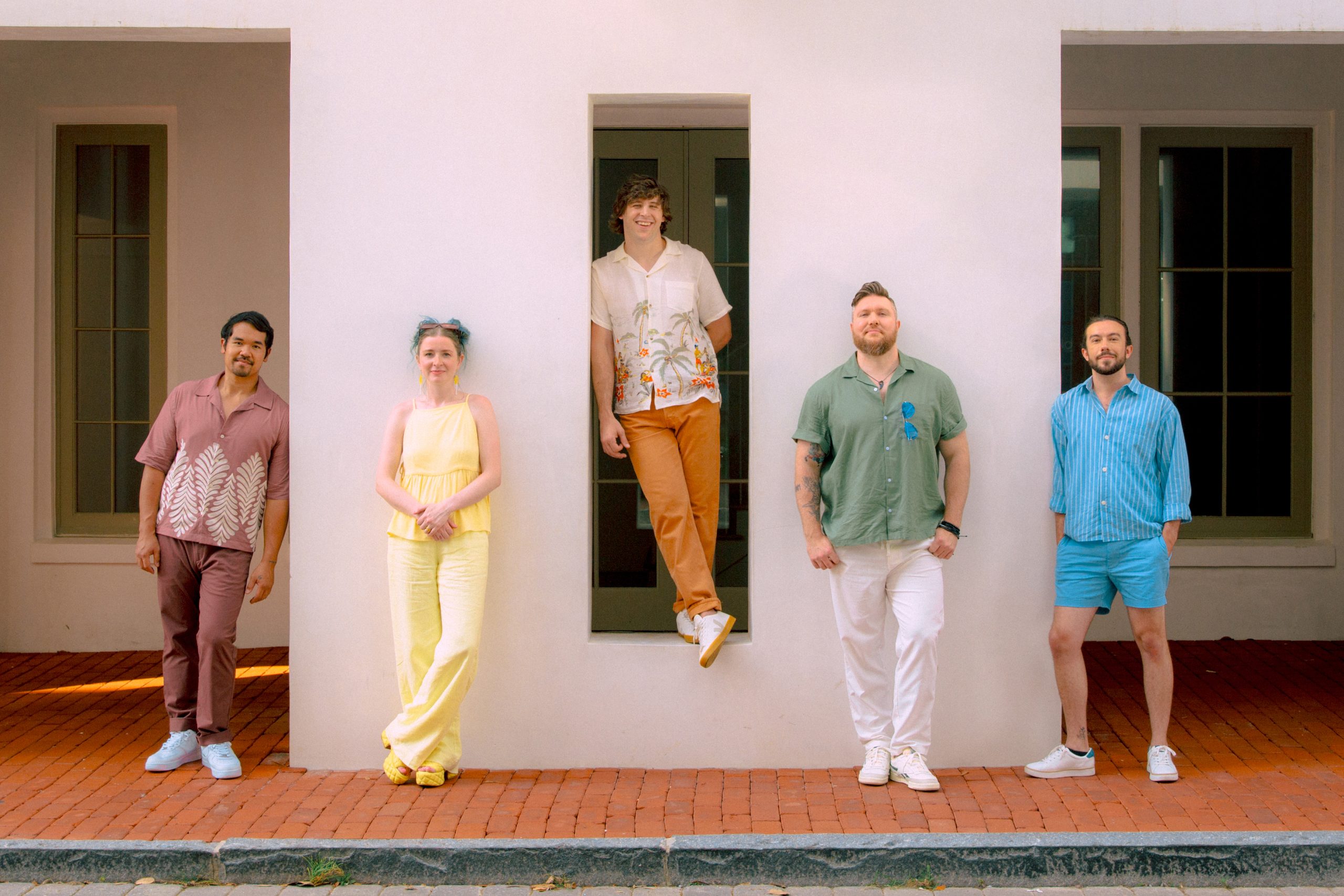
Eddie Isola, the lead singer of The 502s, enters the Zoom room looking like a young Ringo Starr. His mop-top of hair conveys a distinct Beatles look, his bangs drooping toward his eyebrows.
“Hey, how’s it going?” Eddie asks, balancing his phone against a water bottle. “Can you hear me all right?”
Crystal clear. It’s the same voice I’ve been singing along with for the past month since the release of The 502s’ Easy Street (Big Loud Records)—the beach folk band’s banjo- and horn-filled fourth full-length studio album. Listening to The 502s is like setting off fireworks at the lake on the Fourth of July. It’s sand volleyball with your pals. It’s swinging from the monkey bars at your old elementary school.
Which is to say: it’s the kind of music that makes you want to live life fully.
It’s no wonder they’re called “the happiest band on Earth.”
The phrase was a marketer’s dream, and it came to them from a fan.
“We randomly got a DM that was like, ‘I think y’all might be the happiest band on Earth,’” Isola says. “When we read that, we thought, ‘You know, that’s kind of perfect.’”
Yet in the time between receiving that direct message and today, Isola’s definition of happiness has evolved.
“Back then, I feel like the idea of happiness was just about joy and euphoria. These days—especially with [the release of Easy Street]—we’ve come to see other categories of happiness.”
Including expressing gratitude for time well spent with the people you love.
It’s a sentiment at the core of The 502s’ origin story. In 2015, Isola and a pair of cousins founded the band, and while they were searching for a name, Isola and one of the cousins (who happened to live across the street) felt that the Isola family’s home address, 502, might capture the essence of what the band hoped to embody: a celebration of connection.
“It was really unique to grow up across the street from your family and just be able to run back and forth and stuff,” Isola says. And his cousin wasn’t the only relative on the block. Isola’s grandparents lived just down the street, as did an uncle, while the rest of the extended family was within a five-minute drive. Over time, it began to feel less like a neighborhood and more like a family compound, especially with the addition of 13 grandchildren and a host of nephews and nieces, all of whom would descend upon Isola’s grandparents’ house for salami sandwiches on Sundays.
“Even at an early age, this solidified for me that family is super important,” Isola says. “And not everybody has that.”
With his marriage to Maggie in 2023, Isola’s happiness continued to multiply. When he’s not on tour, they live a seemingly normal life—part of their days spent in the garden (“My wife’s the real gardener; I’m mostly just moving around the rocks”) and evenings watching TV or walking the dog. It’s a kind of happiness that simmers rather than boils, which is fine by Isola.
For him, happiness is linked to gratitude for things both big and small. And to ensure he doesn’t forget, Isola has a daily alarm as a reminder on his phone. Every morning at 8:00 A.M., the alarm sounds, reminding him to dedicate a moment to listing off the things he’s grateful for: from family to fans to a little luck with lyrics. Isola’s entire musical journey seems so improbable (from college wrestler to self-taught banjo player, to The 502s’ winning the 2016 Okeechobee Music & Arts Festival) that for him, everything is gratitude.
“Every time I stop and think, ‘There’s a tour bus parked out there and we’re on it,’ I’m just like, “This is crazy!” Isola laughs.
Isola’s musical journey takes a new twist on the day we speak. In 2015, Isola, his brother, and a cousin saw Mumford and Sons live at the Ryman Auditorium in Nashville. It was a formative experience for Isola, empowering him to create similarly styled songs: narrative-driven, folksy anthems that entice listeners to sing along. A decade later, mere hours before we chat, Isola learned he is returning to The Ryman; only this time, he and the band will be performing as the newly named opening act for Old Crow Medicine Show.
“Which is like a dream come true,” Isola says. “But every day isn’t going to have some big, massive peak like that.”
Thankfully, happiness comes in both sizes. And, in fact, all sizes. Happiness is not a condition, Isola likes to say, but a practice.
Since the release of Easy Street, Isola has been mostly practicing happiness on the road. Today they’re in Raleigh, North Carolina, but soon they’ll head to Georgia, then Texas, and finally the western half of America before crossing the Atlantic to Germany and the United Kingdom.
While the breakneck pace of their tour may feel burdensome, Isola would never wish it away. When asked what makes the lead singer for the “happiest band on earth” the happiest, the first part of Isola’s answer is the tour itself.
“Every show is great, but there are shows where everyone’s on the same page,” Isola says. “The band is on the same page, and the crowd is on the same page, and like, we’re just really hitting all the gears. Musically, for me, that makes it all worth it.”
But the second part of his answer is the opposite.
“It’s just being home,” he says, shrugging. “Just spending time with my family.”
While The 502s’ repertoire of “happy” songs may make up most of the fan favorites, they’re hardly the only songs Isola writes. Sadness, too, has its place.
However, maintaining album space for both can prove a tricky proposition. Why, after all, would “the happiest band on Earth” grapple with any emotion that veers them farther from their brand?
In part, because life is both shadow and light, depicting one without the other loses the texture. But also, because Isola recognizes that catchall phrases like “happiness” and “sadness” fall woefully short of speaking to the spectrum of nuanced emotions in between.
“I think The 502s music is really great at letting people take a quick vacation from the hard stuff that’s going on [in their lives],” Isola says. But also, their music has a history of helping people proverbially “face the music” themselves. The band regularly receives comments expressing how their music has helped fans grapple with grief, disappointment, and other hurdles. Their songs, Isola says, try to create a kind of connectivity between listeners. In an era in which loneliness has reached epidemic proportions, Isola strives to build community one song at a time.
Isola was reminded of this at a recent show, when a young fan came backstage and shared a photo of her and her friend at a 502s concert the previous year.
“That’s so cool,” Isola says, smiling.
“Yeah, but she passed away six months ago,” the friend said. “Listening to ‘When I Get To Heaven’ is what got me through.” Though The 502s had never played the song live, they did that night. The experience proved so emotional that at least one band member was brought to tears on stage. The emotion was not only tied to the death of the young fan, but also in the band’s recognition of their ability to write music that might help a stranger heal.
Staring out at the crowd, Isola wondered, ‘Damn, why do we get to help?’”
In Easy Street’s opening song, Isola encourages listeners to say, “Sayonara to the bad times.”
Yet he understands, too, that sometimes you can’t.
Now more than ever, we need “the happiest band on Earth.”
If only to remind us that every shadow needs a light.