We humans seem hardwired to love dogs. I’ve seen even the most adamantly non-dog-identifying person soften at the sight of a dog’s tilted head, wagging tail, and the feel of that velvety nose nudging the palms of their hands. Though we know dogs are our closest companions in the animal kingdom, we can’t quite agree on how domestication happened over the course of millennia.
Thomas Wharton’s Wolf, Moon, Dog leans into all the what-ifs and transports readers to the Ice Age. Here, we meet Wolf, the first canine to approach and live among humans. Throughout this novel-in-fables, Wolf reincarnates as various dogs, both historical and mythological—like Laika, the first animal to orbit Earth, and Cerberus, the ancient Greek guardian of the underworld. Seeing the ages through Wolf’s eyes underscores how canine and human history are inherently bound.
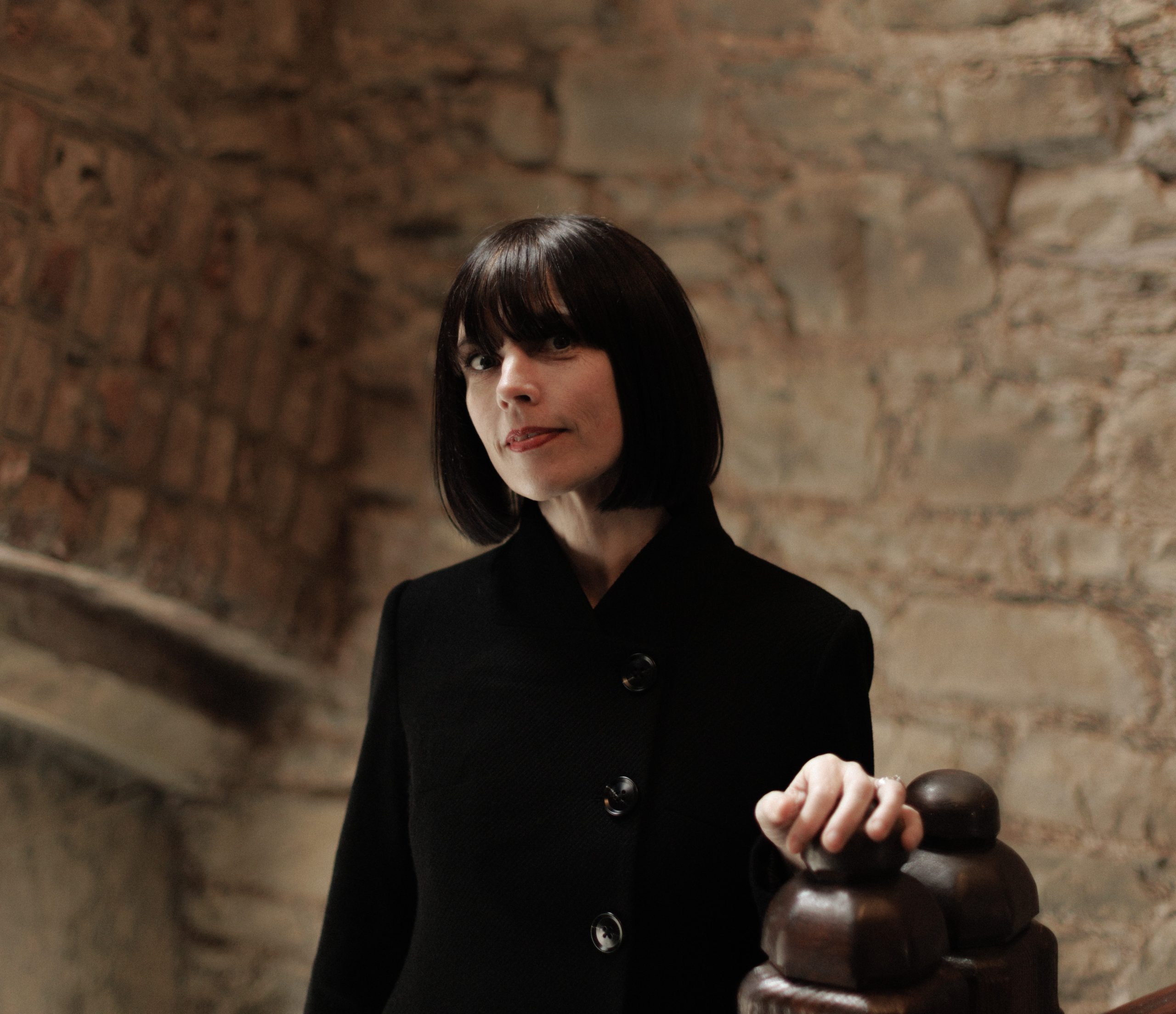
Based in Alberta, Canada, Wharton is no stranger to writing from the perspective of non-human animals surviving the Anthropocene. His last novel, The Book of Rain (Random House Canada, March 2023), features birds banding together to save humanity. In his Hazlitt essay, “Cat Fox Neutrino,” Wharton writes about the unique grief of the climate crisis and his craving for literature that decenters the human experience.
“That’s what I really wanted,” Wharton writes, “stories that would take me further out of my own skin.”
Wolf, Moon, Dog accomplishes that and more. By reimagining the genesis of the human-canine relationship, Wharton ensures that dogs are the main characters of their own stories, rather than simple companions and sidekicks.
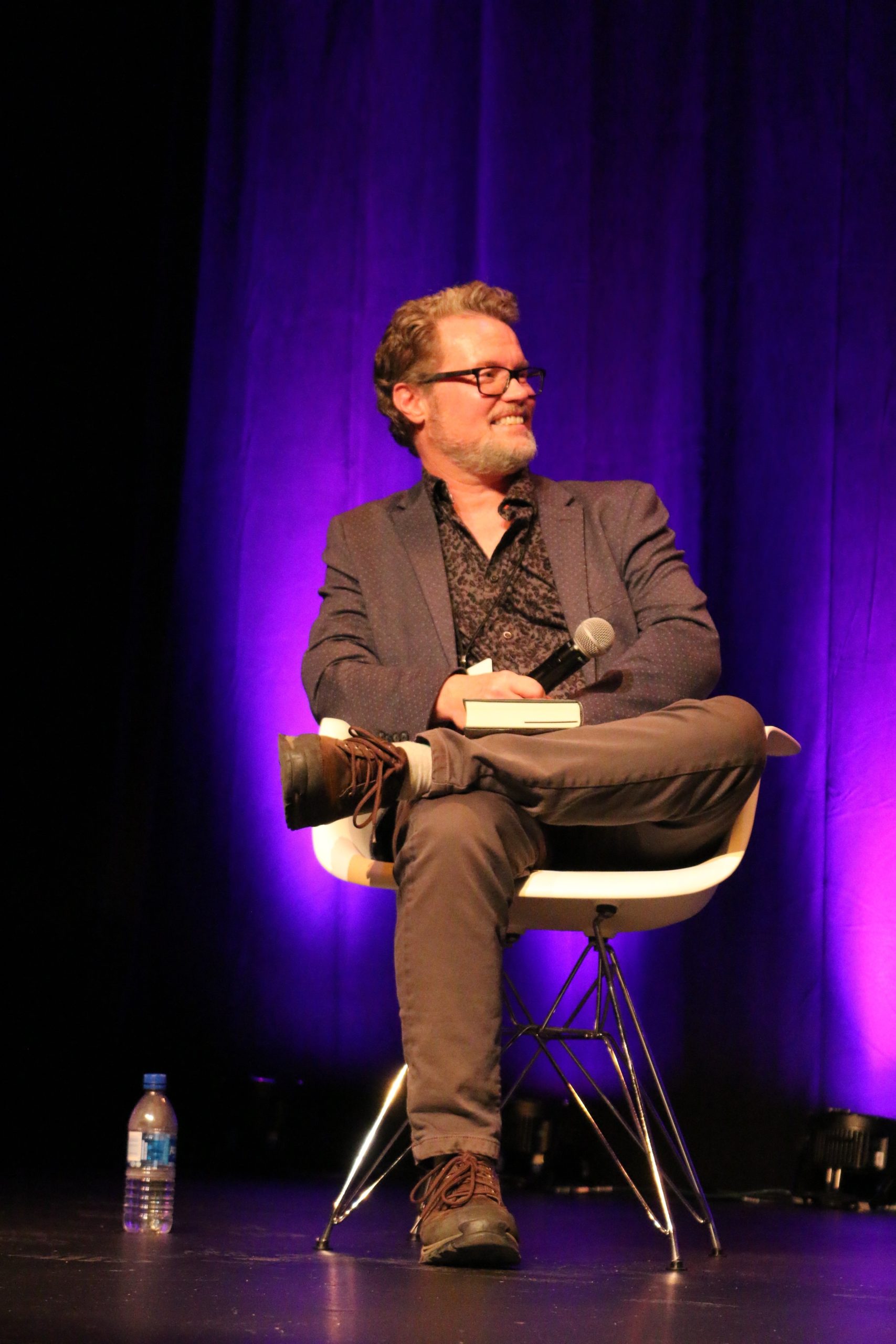
I had the opportunity to chat with Wharton over email and Zoom about capturing the voice of a non-human character, the importance of reclaiming the label “sentimental,” the endurance of fables, and so much more. Here are the best parts of our conversation, edited for clarity and brevity.

The Rumpus: What was your process for developing Wolf’s voice and keeping it consistent, or at least, consistently evolving, across this character’s many incarnations?
Thomas Wharton: There were two voices that I needed to figure out. The first was the narrator’s voice—what you could call my voice. When I decided the story would be told as a fable, I felt this great sense of relief and freedom: “I don’t have to be a fiction writer this time, I can just be a storyteller!” I can tell a story and have fun. When I gave myself permission to do it that way, the narrative voice came fairly easily. You could say I was channeling the voice of all the storytellers whose work I’ve known and loved over the years.
Wolf’s voice was another matter. I had to figure out how realistic this portrayal of a dog should be. In other words, do I let the dog talk or not? The only resistance was in my own mind. I imagined readers who would look at this and say, “You’re telling a story about a talking dog? Come on, this is children’s literature.” Then I thought, so what? I’m going to tell a story in the most traditional way, and I wanted to enjoy that.
Once I decided Wolf would talk and reason like a human, I drew on memories of the dogs I have known and loved and let Wolf talk and think as I imagined these dogs might if they could. Real dogs express themselves mostly through body language—it’s quite sophisticated and wonderful. So what I tried to do was to translate this wordless canine way of expressing oneself into dialogue and inner monologue. That was tricky, but also a lot of fun because it let me bring to life the dogs who have been important in my own life.
Rumpus: I read your afterword, so I know a special dog inspired this project. I would love to talk about your experience with that dog and other dogs you felt contributed to the story.
Wharton: In the afterword, I talk about Boo, our family’s previous dog. She was a total sweetheart. When we had to say goodbye to her, I said that was it—no more dogs. I thought I’d never want to have to go through that [pain of letting go] again. But I missed having a dog—that quiet presence at your side who doesn’t judge you.
So, I was playing with Sam—the dog we have now—in the yard one day, marveling at the thought that these funny, goofy little guys, creatures we’ve turned into pets, were once incredibly tough, scary wolves. And I wondered, “How the hell did that happen?” That was the spark of the book right there: just playing with my dog.
Rumpus: Writing a non-human character is challenging because you have to convince your readers that they’re experiencing the world through the eyes of another creature. Which decisions did you make to ensure Wolf would be doglike enough to convince readers that this is a dog’s story?
Wharton: It goes back to thinking about the dogs I’ve known, observing their behavior, and finding a way to translate that into human terms without getting too hung up on making it realistic—because the stories in the novel go all over the place in terms of whether they’re fantasy or not.
Smells are a major thing for a dog, way more than for us, so I had to keep that in mind. I had to keep reminding myself that dogs don’t see color the same way we do. For example, as I was writing, Wolf would notice certain colors, and then I had to stop myself and ask, “Wait a minute, dogs can’t see that color. They can’t see green.” It meant a lot of going back and trying to catch those human sensations.
I also believe in the idea of an “Eternal Dog.” Each dog is unique and has their own personality, but I just love how some of the same traits show up dog after dog. I wanted Wolf to portray “the Eternal Dog” in his many lives, so I simply gave him the traits I’ve loved most in the dogs I’ve known: Like curiosity, simplicity of heart, loyalty, love of food, goofiness. Sometimes, like people, dogs can act like complete idiots, and I love that about them, too. Depending on the chapter I was writing at the time, one or more of these canine traits would find their way to the fore, depending on what particular challenge Wolf was facing.
But in all of the chapters, I think sincerity is the key trait. Or maybe call it presentness. Wolf doesn’t understand humans and their strange ways, and so he’s often baffled, upset, or scared by what they do, but through it all, he holds nothing back, conceals nothing—a dog always wears its heart on its sleeve. And I’m sure that’s one of the reasons we love them so much.
Rumpus: That “Eternal Dog” is also present in the character, Alpha, the leader of Wolf’s pack. I get the feeling she’s the one guiding Wolf on this journey throughout human history.
Wharton: That’s true. She’s like the archetypal wolf that’s in every dog. Even in the smallest, cutest little dog, you sometimes glimpse that wild creature.
Rumpus: How did you decide when it was appropriate to lean into anthropomorphization?
Wharton: On one hand, we can’t help but anthropomorphize because that’s the way we see the world. We see it from a human perspective. So I didn’t worry about it too much in this book. Once I made the decision that this novel would be a fable, a non-realist tale, I knew I’d be doing some serious anthropomorphizing!
I’m aware that this is a way of thinking about animals that we need to be careful about. Most of our problems with dogs come from assuming they think like us—just ask Cesar Milan. As an expert on human-dog relations, he often says it’s the owner he has to train, not their dog.
By giving Wolf a human-like personality, I saw an opportunity to directly explore this very subject: how do we “humanize” dogs? Why do we do this? How have we imagined and portrayed them through history? What kinds of stories do we tell about them, and how do these stories reflect us? Take, “Beast,” the chapter set in medieval France as an example: dogs and other animals were actually put on trial in those days for their “crimes,” such as killing livestock. How did people think a dog would understand human concepts like crime and punishment? Trying to imagine my way inside Wolf’s head allowed me to ask questions like that.
I’ve also read that many scientists are moving away from the paradigm of trying to be absolutely objective about other living things, as if they have no interiority you could possibly understand. And [these scientists are] trying to cross that divide between human and animal in imaginative and compassionate ways. I think stories that try to imagine the inner life of an animal can also help with that. We have to be careful and aware that we’re trying to enter another animal’s interiority, but as long as we do so with care and attention, I think it’s worthwhile.
Rumpus: As a novel-in-fables, Wolf, Moon, Dog subverts traditional plot. Because Wolf keeps reincarnating, the overarching structure felt more like a spiral than a chronological line. Especially because the chapters aren’t numbered, but labeled like individual fables. Can you share about the decisions you made as you plotted Wolf’s story?
Wharton: I loved writing the opening and closing sections of the novel, in the Ice Age, where Wolf is still very much a wolf, on his way to becoming the first dog. He is, without a doubt, my favorite among my own characters, and at first I thought that this would be the entire novel: Wolf’s journey to doghood. But in the end, there were so many other topics I wanted to explore in the history of human-dog relationships that I kept coming up with more stories to tell. Dogs as sacrificial animals, dogs as tools of hunting and war, dogs as pampered pets, dogs as actors in movies, and so on.
I was recently diagnosed with ADHD, which was a real surprise at my age. It’s like, ”Are you kidding me?” But it helped me understand my creative process and why I’m always jumping around, thinking of other stories I could tell, and why none of my books ever seem to follow a single linear thread. I realized that’s the way my brain is built. So rather than try to resist that with this book, I thought, I’m going to lean into it.
Rumpus: Throughout Wolf’s journey, he or she reincarnates from the first wolf to live with humans, to Cerberus, the underworld guardian, to an Egyptian temple dog guiding a princess to the afterlife, to historical dogs like Laika, the first living being to orbit Earth. Why was it important for you that Wolf inhabited both myth and reality?
Wharton: I wanted to include mythic narratives primarily because I see this novel as a fable about fables—a story about stories. It explores not just the lives of dogs but also how humanity has imagined dogs.
We’ve put dogs to work in countless ways: as companions, guardians, weapons, experimental subjects, and so on, but they also play so many roles in our stories: as symbols, as heroes and villains, as figures of pathos. These roles for dogs in our picture of the universe have run the gamut, from dogs as deities to dogs as mindless automatons.
As I was writing “Escort,” the chapter set in ancient Egypt, I realized that the wheel has come all the way around, in the way dogs are currently so celebrated, loved, and almost worshipped in our culture—how they have become social media stars. There’s a little nod to that in this chapter. I don’t know if you noticed it, but it’s where the temple icon-makers place a relief image of Wolf on the walls of public spaces, and people can express their delight with their thumbprints. It’s like an ancient Egyptian version of thumbs up, liking somebody’s post. Wolf is the first dog media star.
Rumpus: Sometimes I wonder what someone in ancient Egypt would do if you could go back in time and give them a smartphone.
Wharton: I tend to think that people in earlier times would use the technology for much the same reasons we do: promoting ourselves, trying to improve our status, get noticed, all those usual things that people try to do. There’s an eternal human, too,just like there’s an eternal dog, there’s an eternal human.
Rumpus: What did your research process look like for gathering the historical details behind these fables?
Wharton: I read everything I can get my hands on with an eye looking for that one detail that’s going to snag my imagination, that’s going to make me go, “Oh, man, there’s a story in that.” In “Escort,” the ancient industry of dog-raising for sacrifice was one of those details. Ancient Egyptians worshiped these animals, but they also treated them like an assembly line of commodities to be sacrificed for someone’s funeral. So that weird irony was one of those moments that snagged my imagination.
Rumpus: One of the fable-chapters that stood out to me the most was “Good Dog.” It’s clearly about slavery, and I think the sparseness of language underscores this chapter’s inherent horror. Can you talk about your decisions to keep this fable particularly brief?
Wharton: I felt that this barbaric chapter in history wasn’t really my story to tell, but I still wanted to gesture toward it as an example of how we have sometimes put dogs to terrible use. Slavery dehumanized people and employed dogs to enforce that obscenity, and I thought that a novel about dogs shouldn’t shy away from the fact. Sometimes, though, when you’re writing, you discover that less is more. Originally, this chapter was longer, but in the end, I stripped it down to what it is now, to highlight just one brutal fact: that slave owners’ dogs were trained to treat people like prey.
Rumpus: On that note, many of these stories were absolute tear-jerkers. Like “Laika” and “Wandering Cloud.” Do you have a process for writing into the tragic without veering into the sentimental? Conversely, do you think it’s okay to be sentimental?
Wharton: In the “Unleashed” chapter, the dog actor’s agent says about dogs in movies: “You can shoot, impale, eviscerate, and blow up all the humans you like, but for God’s sake, don’t hurt the dog.” That’s me! When it comes to dogs, I have no emotional defenses at all. A lot of people clearly feel the same, and for sure, I had to address that in the novel.
We’ve inherited a mid-20th-century, male-centered view that authors must avoid sentiment, and I don’t think that’s true anymore. I think “sentimental” is a fine label, and an important aspect of fiction with a long pedigree of great art behind it. I admire the work of George Saunders, who has helped rehabilitate sentiment in fiction by boldly going where many writers fear to go—into highly emotional territory where sentimentality carries a real risk of being labeled schmaltzy or corny, as in his novel about Lincoln and his dead son. Saunders is skilled at slipping past a reader’s cynicism and detachment while avoiding maudlin or manipulative tendencies.
Do I have a process for tackling tragic scenes? Just to be honest and direct about what’s happening, and to avoid overwriting—that’s what moves me in the sentimental writing that I admire. If my own story makes me cry, that’s a good indicator that I’ve found the right words to convey a real feeling rather than trying to force the reader to have one.
Rumpus: There’s something hopeful about the way Wolf keeps reincarnating. Can you speak to that?
Wharton: That’s a beautiful way to think about it. Personally, I have no idea whether souls—or selves—come back. I don’t have any strong metaphysical belief about that, one way or the other. Bringing reincarnation into the novel was originally just a narrative device to get Wolf to all these various times and places, but clearly, it also let me avoid ever having to kill him off once and for all.
When I wrote Laika’s first chapter, in the space capsule, I planned to end her story where history says it did. But I couldn’t leave her like that. It was just too sad. So I gave her a special kind of “afterlife” in the future. And that future chapter, to my surprise, gave me a way to express what I find most wonderful about dogs. 30,000 years ago a brave species of canine linked their destiny with ours, and that whatever future we imagine for our own species, bright or dark, we can be sure dogs will be at our side, sharing it with us, still teaching us valuable lessons about love, loyalty, and resilience. That’s a thought that gives me hope.
Rumpus: What role do you hope fables will continue to play in literature? Why do you think it’s important that we humans keep telling stories from the perspectives of non-human animals?
Wharton: Traditional fables typically employed animals as stand-ins for our own human virtues and vices. So a crow or a fox or whatever was just a handy stand-in for something about humans, the way humans are. But in an almost accidental rather than deliberate way, fables also helped us imagine that other living creatures might have their own inner lives of deep feeling and purpose.
I like to think that fables will continue to be told, but in new ways, where it’s the animal who matters, not some human trait they’re made to represent. I hope people will continue to write and read fables, not for trite moral lessons, but to foster our compassionate understanding of dogs and the other creatures we share the planet with. That’s certainly what I hoped to accomplish with the story of Wolf.