One summer morning in 1976, Mom carried out a bamboo-woven box of chicks and called me, a seven-year-old, into the tiny yard. After scattering a handful of millet and releasing the chicks onto the ground, she said, “Yuwen, you stay here and guard them. Don’t let a single one run off!” Then, she hurried back to comb the hair of Yuxiu, who was barely five years old.
I seated myself on a wooden stool, spreading my legs around the cheerful, peeping chicks—fluffy balls already growing stiff feathers at the tips of their wings. I was proud to be a loyal helper to Mom. At five, I could sweep the floor to Mom’s dustless standard, while Dad’s sweeping, whenever he did it upon Mom’s request, was so flawed that Mom had to go over it, touching up and complaining the whole time. It was because I had used my heart—something I had learnt on my own before I could name it. Once at night, when I couldn’t sleep, Mom told me to count the numbers, so I voiced them roundly: “one, two, three…” But Mom stopped me and said, “Not like this. Use your heart.”
I didn’t understand.
As always, Mom modeled it to show me how. “One, two, three,” she murmured, so faintly it was almost inaudible. “Like this. Count in your heart, so only you can hear it.”
Mom explained it several times until I got it: All my inner monologues and dialogues lived in a place we called “heart,” a place that kept beating. Another big discovery was that no one could hear or know, as long as I kept them inside. I had been uncertain before, silencing my inner voice whenever someone came near. After that night’s lesson, I became fearless.
Now I counted the buttery heads from one to eight, then back down to one, wrapping each in the quiet, protective spell of my heart. The chicks pecked about, flapping their soft baby wings, in the safe little kingdom that I guarded. Never had I felt so puffed up, so exultant in my power. But a gray-and-black striped shadow jumped down from the eaves—who knew how long it had been watching from up there—and pounced into my petal-heart-soft kindergarten. Terrified by the demon face with long whiskers, a chick fluttered its barely feathered wings and narrowly escaped a furry kiss. The chick limped and almost toppled when landing on the ground, but it scrambled off, wiggling its little bottom.
The cat didn’t bother chasing the chick; it had too many other, dumber options. In a second, it pinned one under its paws—a chick that had been standing still on one leg, astounded by the mysterious intruder and forgetting even to set the other leg down. Holding the prey in its mouth, the cat cast a disdainful glance at me before leaping onto the wall via the persimmon tree and disappearing behind it. It took several seconds for tears to well in my eyes, and even longer for me to let out a cry. The chick that had narrowly escaped death bounced around, peeping like crazy.
Mom said it was an old cat—an old, female, Dragon-Li badass! Its striped coat was a badge of the top mouse-catcher, so local households welcomed it with plates of boiled minnows, calling it “Mimi.” With two vertical pupils in its amber, beady eyes, Mimi looked at me—a silly, presumptuous, milk-teeth thing—as less than an experienced hen. But am I not old? Whenever Yuxiu and I fought over something, Dad would say, “Let your sister have it. You’ve grown!” Every time Dad came home from work, Yuxiu and I would run to the door, but he always picked up Yuxiu and bounced her in the air, up and down. I waited off to the side for my turn, but in the end, Dad would get distracted by other things, and all I got was a sloppy pat on the head—if anything at all. I dearly missed Dad’s embrace, with its scent of metal shavings and machine oil, and the rough denim of his work uniform brushing against my cheeks.
My parents joked about the incident for days, until the Tangshan Earthquake took over the news and quickly pushed it from their minds. The chick that had slipped Mimi’s mouth turned out to be a rooster, growing a bright comb and a few upturned tail feathers. I could easily tell it apart because it was always spooked, jerking its neck as if living in a never-ending earthquake. Mimi strolled above the crowded lives of downtown Huaizhou, looking down and sneering at me. I was stuck in a thorny middle ground—older than Yuxiu, but smaller than an old cat.
I tried to scoop up the chicks with my hands as the ground trembled beneath me. Every time I picked one up, it slipped through my palms like water. Don’t let a single one… Mom’s voice came from behind. My family was escaping an earthquake and had sent me to gather the chicks. The only smart rooster chick hopped around my leg, desperate for my attention, but I was intent on rounding up the others first. Mom and Dad had left, taking Yuxiu with them. I could catch up. You’ve grown, Dad affirmed from afar. The ground split like a spider’s web, and through the cracks, a vertical pupil gleamed, whiskers pressing in. The little rooster flailed its wings, completely losing its mind.
I wailed and choked in the darkness. Two arms encircled me tightly, pulling me into a soft embrace. Gradually,
I became aware of my own sobbing and choking, and as the black and purple clouds that had obscured my vision parted, I saw Mom’s white cotton sleepwear dotted with red florals. Mom’s hand stroked my back, while Yuxiu slept soundly beside me.
“The cat, the cat—” I cried, trying to explain.
“Yes, yes!” Mom soothed.
Dad came in from their bedroom. “Don’t mention the Tangshan earthquake again!”
Mom hushed him. “Why are you shouting?”
“I’m not shouting. I’m telling you—don’t bring it up in front of the kids!”
“Sure, sure! You go back to sleep!” Mom urged.
“It’s the cat…” I insisted. I was always on Mom’s side.
“Mimi is a bad, bad cat!” Mom agreed. “But it won’t scare Yuwen anymore, because Yuwen is getting bigger! Does Yuwen want to grow up?”
With a glutinous “yes,” I was laid down on the bed. Mom cupped my head gently, hands on either side above my ears and softly rubbed downward—over my cheeks, shoulders, arms, waist, thighs, knees, and finally to the tips of my little feet.
“Grow, grow, grow, my baby girl—” Mom chanted as she caressed me again and again.
Two more chicks died, one after another, over the next few weeks in the bamboo-woven box. Mom said it was because of the cold. At this age, they should have been sleeping beneath a hen’s warm wings, not huddled together in an orphanage. I took special care of my sensitive, sulky rooster. I gently cupped its neck in my hands and stroked down its chest, back, and twig-like legs, murmuring, “Grow, grow, grow, my baby rooster.” Within another month, the chicks had fledged, and Mom let them linger longer in the sun. They strutted around, radiating the confidence of adolescence. Dad stacked boards and wire under the window, ready to build a coop and fence off an enclosure around it. However, one day, while I was babysitting Yuxiu in our bedroom, I heard a loud curse from Welder Liu—the husband of the Liu family with whom we shared the yard—followed by a chicken’s scream. I heard Mom’s trembling voice arguing with Liu, and the man shouting back before slamming his door. Coming out, I saw a chicken lying against the stone stairs, twitching its newly feathered wings as if calling for help, blood pooling beneath its beak. It’s not my rooster. I tried to accept the loss. Welder Liu came home earlier from work that day, and this poor chicken happened to get in his way. Without any hesitation, he kicked it aside, as forcefully as kicking a soccer ball into the gate. The chicken died after vomiting blood for hours.
Dad came home to find no dinner on the table, only a weeping wife. “I’ve never seen such an evil, brutal heart as his!” Mom rasped. “How could a chicken offend him so much?”
Dad sat down, lips pursed gloomily.
“It’s not about the chicken,” Mom sobbed. “He’s targeting us!”
Dad disapproved. “He’s just off work in a bad mood. I’ll have the coop and fence built tomorrow, and the chickens can stay there, out of everyone’s way.”
Mom shook her head. “I can’t live with this. I can’t.”
The Lius’ eaves cut into our eaves; the Lius’ windows beat against ours when pushed open. Their eldest son, a fifth grader, wobbled past on his bike and snagged our freshly washed sheet off the clothesline. The two smaller sons climbed the persimmon tree, shaking its leaves. Their mom, the most civil of the bunch, was a clerk at the state-owned store. When customers came clutching their precious money and ration coupons, she greeted them with a stony face across the counter, saying the kettle, fabric, or radio was the last one in stock—“Take it or walk!” Mom had offered the Lius slices of freshly cut watermelon or a plate of dumplings she had made. But the Lius never returned the goodwill. Instead, they tormented Mom, day after day.
“What do you expect me to do? Kick Liu in the stomach like he did the chicken?” Dad said.
“It was a hen,” Mom lamented. “She would’ve been laying eggs in a couple of months.” She sobbed for a while, then got up to cook.
In September, I started primary school, just a five-minute walk from home. For the first three days, Mom escorted me there, then she let me go on my own. She had also sewn a sling bag for my school supplies and washed my shirts meticulously, just as she did Dad’s work suit. Eating at the school canteen among the other pupils, I stretched my neck forward as far as possible, careful not to soil Mom’s work. “My daughter will appear clean and tidy at school,” Mom announced over a basin of clothes and foam, straightening the collar in the sunlight to check. In a few months at best, I could join the Young Pioneers and put on a red triangular scarf around my white collar, its bright point drooping over my chest. The scarf symbolized a corner of the national flag, dyed red with the blood of revolutionaries. The Lius’ boys wore it. Had I had it earlier, would Mimi dare to hunt right before my eyes? I was eager to leave Yuxiu alone in the seedling box and become not just the loom mechanic’s daughter, but also a red-scarved pupil—the future of the Republic.
But before that could happen, just in the second week of school, one late afternoon when some students had already snuck out, our young class teacher stepped in with a solemn face; her two little braids poked straight out from behind her ears. Requiring everyone to stand, she said, “Chairman Mao—” I expected it to be followed by “said,” then another wise line to guide our growth, but after a long pause, our teacher continued, “—passed away. That means he has left us forever.” Silence filled the room. Does she mean, I pondered in my heart, that Chairman Mao has died? The class was mixed, having three rows of red-scarved second graders and three rows of new recruits. I glanced to the veteran side but found only more blank faces. Suddenly, wailing burst from the next door—a mixed class of older students. At the deep, shuddering sound, we stood frozen, locked in a silent stare with our teacher. “Do any of you—” she forced out, struggling to enlighten us, “—have a grandparent who has passed?”
That night, I was awakened by tides of desperate screams from the chicken coop. When I reached the yard, Dad was heading back, holding a chicken in his hands. The others left in the coop were still exchanging jittery clucks.
“Did the cat come again?” I repeated nervously.
“No, it was a weasel.”
Liu grumbled from behind his window about the noise. Dad didn’t respond, simply pushed me inside and set down what he was carrying on the dining table. It was the rooster—my rooster! How much misfortune did it carry in this world? Had the cat leaked our address to the weasels? It lay on its side, head twisted unnaturally, its throat bloody and messy. Yet beneath the young, soft, flower-speckled feathers, its heart still pounded.
“It was bitten on the neck,” Dad said, parting the feathers around the wound.
Mom carried a kerosene lamp to the table, adding light to the dim glow of the soot-stained bulb overhead. “You didn’t chase off a weasel, did you? They’re deities!” she asked nervously, twisting the screw to adjust the light.
“Stop the superstitious nonsense!” Dad snapped.
“Superstitious or not, old sayings exist for a reason!” Mom hollered back. “Why must you be the one to test them? After all—” She stopped abruptly.
After all, even Chairman Mao can die. I finished the sentence in my heart. I suddenly hated him: How could he die? Leaving us—and the rooster—like this?
“It ran away before I got near,” Dad sighed, giving in.
Mom found some Terramycin pills in the drawer. I ground them in a stone mortar we usually used for mashing garlic, while Mom used thread scissors to clean the feathers around the wound. Then, Dad applied the powder and bandaged the rooster’s neck with gauze. When he finished, we stood around the table, looking down at the rooster, whose legs trembled and belly pulsed. “What’s left is up to itself,” Dad concluded. The rooster was placed back into the bamboo-woven box, on thick cotton pads, where it remained through the days of dirge and wailing. I fed it water and millet. With a black cloth tied around my arm and a white flower pinned to my chest, I hovered my hands over the rooster, chanting “grow, grow, grow” for it every day.
The next morning, we returned to school with some mature minds, ready to talk.
“My dad said no wonder there’s an earthquake in Tangshan! When a great star sways and falls, the ground will shake!” said a second-grade girl, widening her amazed eyes.
“My mom said Chairman Mao had a woman’s look,” I said.
“What do you mean?” Several turned to me.
I recalled how Mom had talked about him full of admiration with a neighborhood woman. Glancing at the portrait at the front of the classroom, next to Marx’s, I found the point obvious. But I simply explained, “That means he was the leader for all”—and everyone agreed.
“My dad says,” a boy interrupted with a running nose—Little Soldier, the youngest son of the Lius, “that oppression will come back, and child labor will come back!” He sounded more excited than worried. A few students wrinkled their faces, so Little Soldier quickly added, “But we’re safe. It won’t get so bad overnight! Only smaller kids—” He looked around, searching for an example, and saw me. Pointing at me, he announced, “Like your little sister, she’ll become a child laborer!”
Furious, I slapped my Chinese book on his head. He squawked and ran, and I chased him, hitting his back, until he darted into the boys’ bathroom.
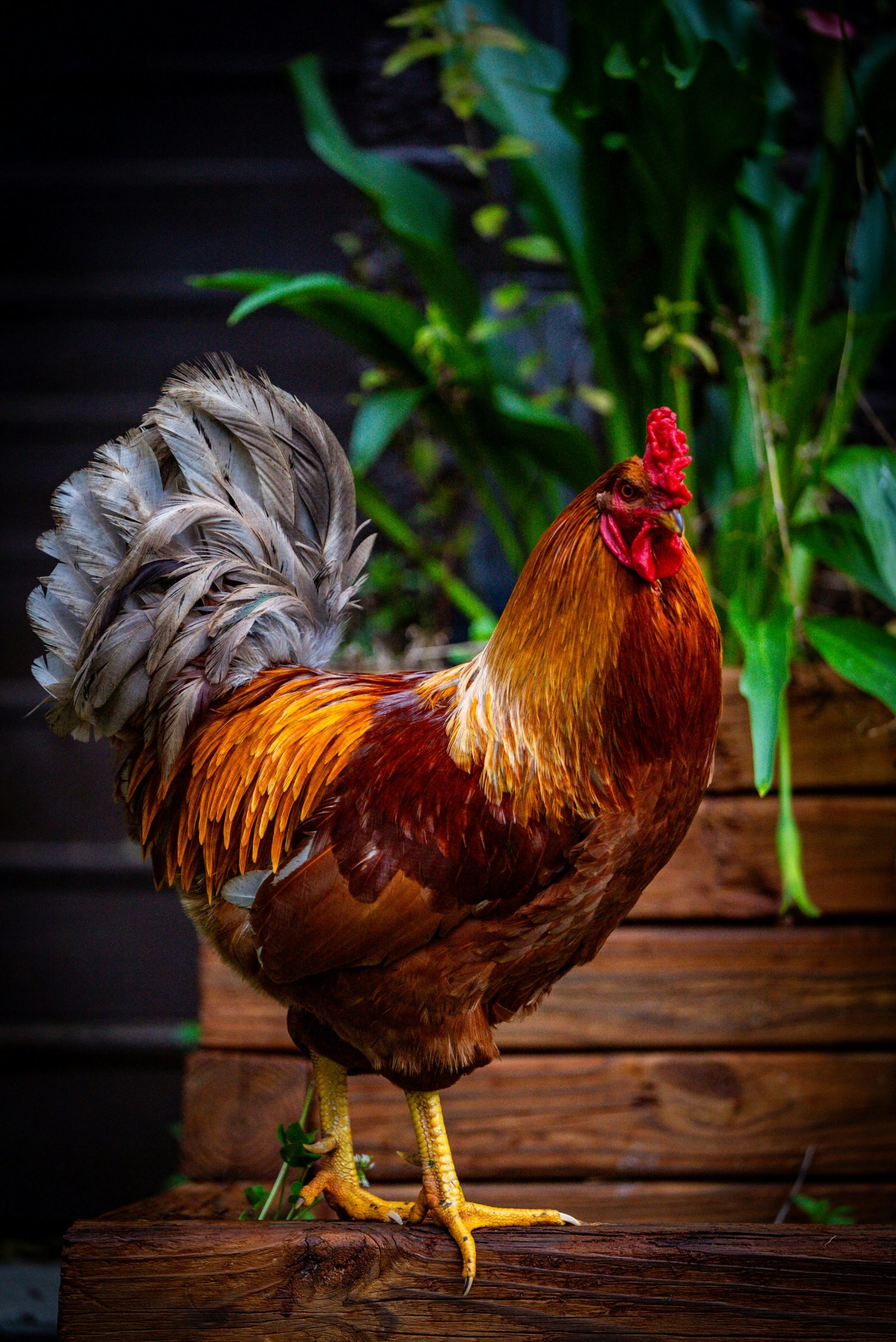
The rooster lived on; the wound healed, then it struggled to its feet. When it returned to the coop, it already looked bigger than the others. By the end of the year, it had grown to twice the size of a regular chicken. Was it a side effect of Terramycin or my “grow” ceremony overdone? Thick feathers covered its massive body, white down nestled beneath yellow, red, and brown shafts. Its long tail bore black quills with silky green gleams. The crest, once bitten by the weasel, had overgrown into a huge red sarcoma, under which were sharp black eyes. Its neck, forever tilted to one side, only made it look fiercer, much like a scar on a man’s face. It strutted around, head cocked, staring at people. I, eight-year-old and red-scarved, begged Dad to keep it, because roosters were either slaughtered for meat or exchanged for ration coupons—“sold” wasn’t a word to use, Mom warned. Dad made no promise, but on exchange day, he took only the other one. Afterwards, three of the original eight remained: the rooster and two laying hens.
Around the Spring Festival, the rooster suddenly learned to fly—first out of the wire fence, then onto the persimmon tree, up to the top of the wall, and finally to the eaves. The goose-sized, colorful bird against patches of snow on the roof became a striking sight in downtown Huaizhou. It also crowed punctually every morning before sunrise. Once, Mimi confronted the rooster perched on the wall. The bird jutted its twisted neck, fixing one eye on its old foe. After a short standoff, it spread its wings wide, feathers spiked, and Mimi retreated, jumping sideways down with a grumbling purr. A group of boys happened to witness this, and one of them, who had learned some history, said, “Isn’t that the Genghis Khan of the chickens?” The others cheered. If the sun rose each day to its confident crow, how wrong would it be to say that the rooster brought light to the world?
Mom left our basin in line outside the public bathhouse early on a chilly Saturday morning. A long queue had already formed on the women’s side. They brought all their dirty clothes to handwash inside—to make the most of the tickets—and dragged along their girls and boys who were not yet old enough to bathe themselves. When Mom, Yuxiu, and I came two hours later, each wearing plastic slippers over calico socks, ready for the shower, the basin had moved forward considerably, but a dozen heads were still ahead. Yuxiu, a useless thing, began whining soon after. Mom chided Yuxiu but still lifted Yuxiu into her arms, tucking Yuxiu’s little feet into the folds of her quilted coat. Then she took off her wool scarf and tossed it to me. “Wrap your feet in it!”
I said I wasn’t cold, but Mom didn’t answer. Mom was always like that: if one daughter got an egg, the other had to have one, too. Or she’d add extra sesame oil to the other bowl of noodles as compensation and make sure we both understood the deal. I held Mom’s white scarf, still steaming with her warmth and scent. I’d rather have chilblains on my feet than trample it.
Little Soldier ran past, steaming after a bath, wearing no gloves or hat. He first went to tug on his dad’s sleeve, but Welder Liu, absorbed in a roadside chess game, waved the boy away. Then he spotted me and rushed over. I quickly crumpled the scarf into a ball and pressed it against my chest. Losing his original target, the boy’s hand turned to my braids. He yanked one, shrank away, then sprang back and pulled it again. With my hands full, I was at a disadvantage—and Mom never got involved in the kids’ games. Irritated, I crossed my arms and slyly tucked the scarf ball under one armpit, pretending to be off guard. When Little Soldier lunged again, I seized the chance and gave him a hard push. The boy almost tripped over the curb. Stumbling back and balancing himself, he stepped on something soft. Mimi, who had been basking in the sunshine, leapt up with a painful meow and swiped its paw before dashing away. Little Soldier raised his hand and saw a long, sharp claw mark oozing blood. He cried out loudly.
Welder Liu strode towards us like a fierce hound, and Mom hurried to drag me behind her. He cursed furiously, jabbing his finger at Mom’s forehead. Mom tried to explain, but her words fell apart under the barrage of his insults and finally declined to silence. She stood there, eyes rheumy, lips trembling, as if she might shatter at any second. Yuxiu wailed in her arms. I had never heard Yuxiu wail like that before. Some wise voices urged Liu to take his son to the clinic. Leading Little Soldier away, Liu kept turning back, yelling over his shoulder. When the street finally fell quiet, still far from its usual bustle, his curse kept ringing in my head: “You watch out! All your cheap little chicks put together couldn’t make up for a single hair lost from my son!”
Before so many gazing eyes, Mom loosened her arms, and Yuxiu slipped down, clutching Mom’s leg. Mom buried her face in her hands, weeping quietly. The wooden basin lay unattended at her feet, overflowing with bathing supplies and dirty clothes. I wished some neighborhood aunt or granny would come up and say something to Mom, but nobody did. I reached out for her hand, whispering, “Mama,” but she pushed it away. I raised my hand again and again, and each time, she pushed it away.
Mom is angry at me. She stopped smiling, and the color dimmed from her face. Chairman Mao died, and before “oppression” or “child labor,” “discrimination against women” surfaced first. I decided to make a wish, using not only my heart, but also my voice, so the world could hear it. Lying on the bed at night, I stared at the wooden beam and whispered, “Chairman Mao, if you rise from the crystal coffin and lead a revolution against the Lius, I will—” I paused, searching for the right word. “Forgive you.”
“What did you say?” Yuxiu asked, suddenly opening her eyes.
“Nothing,” I replied, startled. Watch out. This little thing is growing a heart.
Summer returned, like a miracle, after the apocalyptic year of 1976. On Workers’ Day morning, I stepped out in the bright red dress the school had assigned me for a performance. Behind the wire fence, the rooster stood on a hen’s back, pressing its sharp claws down and pecking at her head. The hen trembled, clucking bitterly, her feathers scattering and streaked with blood. Another hen paced in frightened circles in a corner of the enclosure. Without thinking, I grabbed a bamboo broom and swept at the rooster. It leapt off the hen’s back, flew over the fence, and swooped toward me. I fended it off with the broom’s sharp, stiff head of bamboo twigs. We fought until Mom and Dad rushed out. Dad shooed the rooster away, and Mom told me to go to school immediately. The ruffles at the hem of my dress had come loose. Our class teacher scolded me, hastily sewed them while I stood on a stool, then pushed me onto the stage.
The fight had a more lasting impact on the rooster: It held a grudge against anything red ever since. Its first target was the scarlet sage that Mom grew. The rooster pecked and tore until all the blossoms were gone. Then, a wedding was held in the neighborhood. Instead of the usual army uniform, the bride led the fashion by wearing a bright red Dacron blouse she had made herself. When the newlyweds passed by our door, the rooster pounced at the bride, flapping its magnificent wings. A man caught the rooster before it could harass the bride, twisting its wings behind its back and locking them in his grip. “Whose rooster is this?” he shouted, waving the bird in the air. “It’s more eager than the groom!” The crowd burst into waves of hearty laughter.
Mom started keeping the rooster under the overturned bamboo-woven box. But whenever she forgot to place a brick on top, the rooster would knock it over and escape. Yet, since few people wore red or other bright colors daily, the rooster’s red fever remained largely unknown beyond our family door. One day, Liu’s wife came home from work wearing a fancy crimson flannel hat—the kind that was always out of stock in her store. It was already dark, and as she kicked down the bike stand, a black shadow lunged at her. Both she and the bike toppled. In the next second, the hat was gone. She insisted that someone had robbed her and made a big fuss around the neighborhood about going to the police, though she never actually did. Mom grew suspicious hearing about this and rummaged through the coop. Soon, she found the hat under the thatch, battered and covered in chicken droppings.
She wrapped it with layers of old newspapers. Putting the bundle in her cloth bag, she led Yuxiu and me towards a distant dumpster. Yuxiu started protesting half way there, and Mom gripped her bag with both hands, as if a crimson heart would leap out.
She hurried along, and I followed up, dragging Yuxiu forward mercilessly. Each time Mom glanced over her shoulder, I gave Yuxiu another tug, making sure both our sweaty little faces stayed in her view. Yuxiu gave up whining when she realized it was useless. Head drooping, she followed Mom and me on what felt like an endless journey.
I heard the rooster crow in the morning. A pair of hands tucked the quilt around my shoulders and smoothed away the hair on my forehead. Half asleep, my eyes glued shut, I murmured a question, and the answer fell with soft pats: “Mama is here. Grow, grow, grow, my baby girl—”
Mom told Dad about the hat, and they decided to slaughter the rooster before it got triggered by a red scarf and pecked out a school kid’s eye. Having bound the rooster’s legs and wings, Dad straightened its head, removed its neck feathers, and cut into the exposed, scarred skin. Blood streamed into the bowl placed underneath. When the bowl was almost full, Dad threw the rooster into the corner of the yard, where it fluttered for a while before going still. Mom put it in a clay basin and poured boiling water over it. Soon, she began plucking.
The rooster yielded plenty of meat, filling our large iron pot. Seeing a large bowl of stewed chicken on the table that evening, we sat silent for a while. It seemed that at any second, the rooster would rise from the bowl waving its wings and crow. “Okay. Let’s eat!” Dad suggested, picking up his chopsticks. Yuxiu followed Dad immediately, clipped off a large chunk, bit down hard, and soon abandoned her chopsticks to use her hands. When she reached out for more, I stopped her, eyeing the half-gnawed bone she had dropped on the table. “Finish it first!”
Never having heard of such a rule, Yuxiu shook her head firmly, so I kept her hands locked. She protested, calling Dad for help. Dad said, “Listen to your sister, Yuxiu! You’ve grown!” Yuxiu’s eyes widened in disbelief, tears welling up. Dad, on the other hand, added some nuggets into Mom’s bowl. Mom smiled and pulled his hand to her belly. In the moment, I saw color return to Mom’s face. Yuxiu was still glaring at me with her watery eyes, bitterly scraping the bone between her tiny teeth. I took the bone from her hands. “The cat’s better at it!”
That night, I didn’t know we would lose Mom forever in eight months, and after that we would never raise chickens again. Yuxiu and I snuck into the kitchen and added more meat to the plate of bones. Out in the yard, we called Mimi several times. The Dragon-Li soon trotted merrily toward us. We squatted down and tickled its neck as it leaned toward the plate. “Are we good now?” Mimi nuzzled my fingers and let out a flattering purr.
“What do you mean?” Yuxiu looked at me, confused.
Before I could answer, the cat gulped. The resilient, hard-fighting rooster that had escaped last year returned, plumper and cooked, to the same furry mouth.