

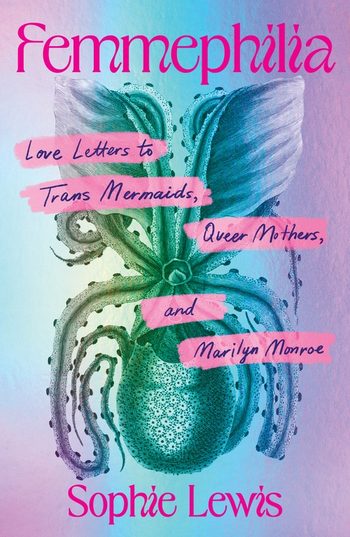
Tentacularly orchidaceous. Cotton-candy jawbreaker. Cunningly cutesy. Those were my first impressions of the cover of Sophie Lewis’ newest book, Femmephilia: Love Letters to Trans Mermaids, Queer Mothers, and Marilyn Monroe. No big surprise: lithely yet playfully, Lewis has written before on topics from Bridgerton dads to water-babies in bio-bags, reality TV to the shortcomings of the cis literati. Which is to say, she has critiqued all manner of cultural objects to forward her utopian vision of feminist communization. This most recent contribution to her oeuvre, trafficking in Greek myths, Disney films, feminist polemics, contemporary novels, and binge-worthy TV, proves that a poised and potent femmeness—a groovy, generative, and intentional gendering—can be gleaned just about anywhere, if you know what to look for.
Unified by the imperative to contour and celebrate this femmeness, Femmephilia draws together new and previously-published essays, combing through popular, canonical, and obscure texts alike in pursuit of tangled subterranean roots. Where has the femme been, where is she going, what work does she do? Femme, according to Lewis, is not antithetical to feminism (despite the say-so of certain macho or “gender critical” feminists), nor collapsable into femininity. It is instead a fashion of self-artifice with substantial liberatory—indeed, revolutionary—potential. This book is rigorous and citational while also managing to be accessible and relatable: calling all fans of Monique Wittig and Marilyn Monroe! With Femmephilia as our springboard, Lewis and I dove headlong into a discussion of how, why, and with whom to ally ourselves as feminists, where to look for signs of nurture, care, and mutual survivance.
Lewis and I had volleyed emails back and forth leading up to our interview. Shortly before we hopped on Zoom, she dropped a line to say she’d have her camera off, if it was all the same to me. My response: “Yes—no sweat! But please note: even off camera I am wearing my favorite shade of lipstick as glittering good luck. In femme solidarity, a.” Much to my surprise, I entered the meeting to see Lewis reclined casually on her sofa and gently smiling, auburn hair thrown and falling to one side, real chic. In femme solidarity indeed—she wanted to see my shade. (Black Honey, for those likewise piqued.) What followed was, as Nina Simone says of Marx, Lenin, and revolution, “real girls’ talk.”
This interview has been edited for length and clarity.
The Rumpus: In the spirit of your playful book, my first question can be taken totally at face value, or also as an opportunity to critically swivel into your work. My question is: fuck, marry, or befriend Marilyn Monroe, Ursula the sea witch from the 80s Little Mermaid, or the octopus from My Octopus Teacher.
Sophie Lewis: Fuck the octopus, marry Ursula, and befriend Marilyn.
Rumpus: You’re quite a prolific essayist and reviewer, prescient with your cultural pulse-taking and the breadth of your analyses. From gestational communism in Full Surrogacy Now (Verso, 2019) to family abolitionism in Abolish the Family (Verso, 2022). And then I see a similar tension between Enemy Feminisms (Haymarket Books, 2025) and Femmephilia. You say yourself that Enemy Feminisms is a different kind of love letter, whereas I have interpreted it as pseudo hate mail—
Lewis: A burn book!
Rumpus: Yes! Versus Femmephilia, which is very much a love letter. This responsiveness in your work, basically, between the texts that you’re publishing—I’m curious about how you track your trajectory in your writing.
Lewis: Without wanting to make things too neat, I think there is a continuity between projects insofar as maybe one could postulate the love letter is part negation of what kills us. To love someone is also perhaps to want to get the parasitic, destructive interloper off their back or something—or off their face. By which I mean: there are all these feminist ancestors, perhaps that are not framed as such, are not given to us or named as feminist at all, and in order to love them fiercely enough to clear a psychical space for a relationship to them, perhaps one has to fiercely shine a light on and reject passionately those standing where they should or could be.
And utopianism has that very central element of negation in it. It’s a method of saying: none of this is necessary, none of this is obligatory. This is not how things have to be. I’m not interested in the colonial utopianism of designing the cookshops of the future, or whatever the phrase is—the Thomas More thing of a post-problematic or post-conflictual, or post-bad-things society. That’s not really what I think is useful about utopianism. I think there’s this decolonial utopian tradition that’s about a different temporality, not just destination, linearity, telos, but time travel, cosmogenesis, like appreciating the hereness and nowness. […] But that requires, as I just said, a pretty intense negativity too. I think critique, when it’s at its best, is a negation in order to blossom. […] Perhaps I’m trying to insist to you that in this sense of abolition as positive supersession, the destruction is—I hate that I want to say—dialectical. It’s about realizing the unrealized promise at the heart of this ethically disappointing world.
Rumpus: In your [Shulamith] Firestone chapter, you talk about how a lot of the generative potential of Dialectic of Sex emerges in the ongoing problem.
Lewis: We need new pleasures and different dangers, to use the formula from the sex wars. You know, it’s not about a world with no danger—just different ones would be nice, perhaps. And different pleasures too—why not?
Rumpus: On a number of occasions in Femmephilia, you make this move to claim flawed kin. Sometimes that’s femme icons who’ve been dismissed as inconsequential or problematic— animated characters, non-human animals, or polarizing feminist theorists like [Andrea] Dworkin, like Firestone. In terms of leftist fragmentation, how should we, and why, incline ourselves towards unlikely or unlikable comrades?
Lewis: We’re toast if we can’t work with people it’s difficult to like or love.
Part of that is the vital importance of skillful disagreement—that is, about nondisposability. Enemy Feminisms is not just about saying let’s get more comfortable with drawing a line of enmity. What’s equally important is that vast space that is not enmity, that has to be a non-disposable relation, not just raining on people’s parades because your personal tastes differ, even if you want to dress that up as having nobler motives or higher stakes. The painfulness of coalition building in a time of overlapping genocides [necessitates] thinking about what people of different positionalities ask one another to tolerate. […] As soon as we start downgrading the importance of certain people’s basic survival, we’re lost.
But there’s this difficult question that Haraway posed in the “Cyborg Manifesto” about what kind of spell can hold together people long enough to—I think she says—disarm the state. And that’s clearly the question: what can hold us together long enough to disarm the state against us? I think probably the things we’ve been seeing in Minneapolis against ICE are the most everybody can see [of] these models of concrete neighborhood community building. That’s the solvent that both dissolves what is not enmity and clarifies what actually is. Perhaps we can only really know the difference in practice, in struggle. Although that sounds like a pretty handy leftist line as well, I recognize.
Rumpus: That was a little spell in itself. Femmephilia is also a sexy book, for many reasons, not least of which is the abundance of cross-species intimacy. It also examines and pushes against periodic waves of sex negativity which sometimes translate into individualism, femmephobia, or over-investment in victimhood, which all, in fact, rob us of connective and generative possibilities in sex.
Lewis: My God, yes. What a strange place we’re at, it seems, in terms of sexual history. I resisted for a long time the diagnosis of sex negativity among Gen Alpha, Gen Z; but I think there is something there. Especially when the Dworkin revival started happening and I started seeing a trend of self-described radical feminism—I would quibble, as a bit of a history nerd, that most of the people calling themselves radical feminists today are cultural feminists. But that said, the [rise of] self-described anti-pornography or Dworkinite trans feminists, in this moment, is a fascinating phenomenon. I’m fairly persuaded by Kate Wagner’s explanation that has to do with surveillance. [Wagner’s] is a sort of hopeful analysis that says we—“we,” gesturing wildly—are less afraid of eros than [we are] just over-surveilled. […] When [sex] is so surveilled, there’s no space in which to actually access the ineffability and mystery and opacity that is so crucial for good sex.
There’s a sort of apocalyptic tenor. There’s brokeness and overwork. Rent is too high. [That’s] always a reason why people don’t fuck. The spaces of public sexuality disappeared over the last decades in the West, which is why I think we have to also observe the extreme joyful enthusiasm for the slogan “make the golf course a public sex forest” out of Minneapolis, right? Not that many golf courses have been turned into public sex forests, as far as I know yet—Inshallah. But I think we also have to appreciate that appetite for communization projects, seizing infrastructures or lands for sensuousness. I think that’s important to stress, because it’s about people’s very core needs. And the erotic is, as Audre Lorde schooled us, very, very, very core, very, very, very elemental. You have to be unstressed about food and shelter in order to express your eroticism in the sphere of sexuality, right?
Is the sex negativity playing into reactionary trends? Sure. Would a neoliberal sex positivity play into it too? Yes, also, yes. Like most people, I’ve been staring at the developments in the manosphere or the anti-women’s suffrage, legalized rape kinds of elements, some of whom are in the administration of this country. […] There’s the model, in the decline and crumbling and flailing and drain-circling of American Empire, where you need your tradwife and anything you do with another man had better be at a 10-foot distance or something. But, if you notice, it’s kind of both. There’s the guys who say that there’s nothing gayer than eating pussy or whatever, right? At the same time you have the gooners that we all read that Harper’s piece about. Not to be contrarian, but it did seem to me there was an element of unnecessary disgust in that piece: this spectacle of the end of the world, tens of 1000s, it seemed in that piece, of men, just sort of lying behind closed doors, surrounded by screens, stroking themselves. […] I’m just very conscious that this is a Puritan settler colony that had extremely intense ideas in the 17th century about masturbation being degenerative of civilization. Perhaps I’m saying that I recognized an excessiveness in the response to that that reminded me of my Octopus tweets and people being like—
Rumpus: That’s exactly what I was just thinking! This reminds me of octopus-gate, in the sense that there’s something profoundly Foucauldian. It’s like we insist on sexuality to the point of obliterating it, or refuse to think about intimacy, dare we say, sexuality—in that case, between a human and octopus—to the point of insisting on it.
Lewis: And I think it’s interesting that 4B demonstrated the compatibility of a deformed lesbian separatism with late capitalist, neoliberal acceleration. I suppose that’s what I’m trying to say in that essay [in Femmephilia,“Hetero-Optimism, Where Are You?”], although I don’t think it’s the end of the story. Perhaps the gooners and the 4B girl bosses—who are shamelessly using their parents’ house as a restaurant—are parallel figures of maximal distrust of other people.
Rumpus: While historically, the imperative of femininity has been used to exploit labor from a certain class of persons, you also observe, through engagement with thinkers like Saidiya Hartman and Hortense Spillers, that femininity has been an imposition that excludes—on the basis of race, ability, class, sex, sexuality. It isn’t feminine labor or values, nor femmes themselves that must be repudiated, but the functionalization of femininity in service of sex privatization or social hierarchization. I’m curious about how we can cut through the fog and not only identify but proliferate what you call self-conscious, communized, and critical femmeness.
Lewis: It’s definitely tomorrow that we will be interdependent, dependent, and therefore even more indebted than we are now to the skillful arts of making life worth living. Observing and exalting those forms of femme femininity that are having to work extra hard because of their location outside of cissexual racial womanhood is part of that. There is perhaps something overly optimistic in the assessment I have been known to make that we’re in a golden age of feminism. This is partly an overstated corrective to a particular kind of boredom on a high literary sort of Western liberal level of feminism where the speaker, as I say at the end of Enemy Feminisms, is just not seeing herself in the estrogen undergrounds that are everywhere, in the harm reduction mutual-aid I see everywhere, or in the incredible work happening in disability liberation theory and in abolition feminism, in the work of people theorizing against cisness. But the femmes are out here, making people stay alive and making it look beautiful, which are both important parts of it.
[…] Emma Heaney is always really good at explaining this. When someone like Marjorie Taylor Greene denigrates someone like Jasmine Crockett, it is the masculine, macho, misogynist priority of cisness that is operative. And it’s happening in a feminist mode. You know, she’s making fun of Jasmine Crockett’s eyelashes, the excessiveness, the presumptuousness of her femininity coming from a Black positionality. What Marjorie Taylor Greene is saying is “your womanhood is fake—look how much work you have to do to access womanhood, and you’re still not in the club of womanhood.”
With cis feminist patriarchs, patriarchal feminism, feminists for patriarchy, and misogynist feminists, this is a way of illuminating the integument where some women have been architects of a system that benefits a small few of themselves in order to really shore up the machinery that ungenders and renders kinless many colonized and racialized female bodies, and casts a very handy shadow of withdrawable, contingent doubt over all kinds of other proletarians who might be sex working or contaminated by circuits of monetization that enables their [womanhood] to be withdrawn whether or not they’re nonwhite. It’s certainly femmephobic, because everything has to do with the contempt for women’s gender work—the work that is not trying to conceal itself, that is not working very hard at appearing not to be work at all, which is one definition of cis femaleness, right? The contempt for those who have the goal to make their gender labor visible and on top of that, to enjoy it—that’s what really incenses people like [Germaine] Greer, Dworkin, [Robin] Morgan.
Rumpus: You write about that so beautifully, too, in terms of foregrounding artifice as an element of femmeness. It’s something about the self-consciousness with which one may adorn oneself, or one may make a spectacle of oneself—that is the crux of femmeness. A supposedly innate position versus a very active enactment can be differentiated in embodiment but also theorization. This clarifies a reading of Wittig’s Across the Acheron where the staunch commitment to a macho feminism just circles back around, sometimes, to pure sexism. If you’re not going to liberate yourself, women, then you might as well just die, right?
Lewis: One hundred percent. The text that we’re often told is kind of the opening words of Western feminism has a slightly similar affect, because [Mary] Wollstonecraft writing The Vindication of the Rights of Women is animated so, so, so much by dislike for women. And of course, you don’t want to go too far and just simply flip this, a certain liberal feminist move, or a girl boss feminist move, saying everything any woman has ever done deserves to be on the feminist listicles of achievements. This is another form of dehumanization. Contra Dworkin, I insist that women have also made history, and that includes everything that is killing us systematically on a planetary scale. [There’s such] rage and fatigue in Dworkin and in Wollstonecraft for women who see a strategic benefit in seeking ecstasy on the battlefield pending the end of the battle, let alone for those who don’t necessarily see themselves in a Battle.
This is another thing I’ve been harping on: I think care and autonomy are too frequently accepted as antonyms in political discussion. We must uplift the voices of the abolition feminists who have been teaching us for decades, if not centuries, arguably, that autonomy is an effect of care, a quality that we generate through having quality care infrastructure. That’s what it means to be autonomous, to be so well held that you feel like you’re free to act. There’s never going to be freedom from other people—that’s not a material possibility for our species, and what a weird thing to want. Likewise, you can’t actually receive care unless your autonomy is being valorized, centered, uplifted, exalted.