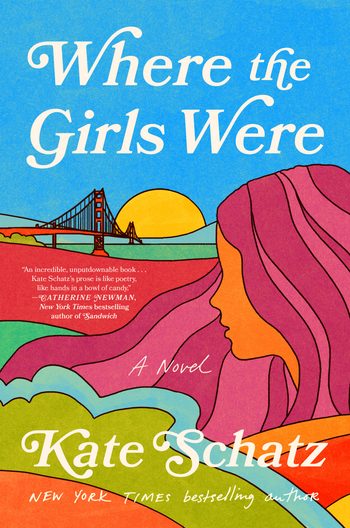
San Francisco, 1968: it conjures images of protests in streets, beautiful young people with long hair and tight pants, and vague ideas about radical activism and political turmoil and progressive ideals. Recent years have evoked 1968 as the public is again in the streets, particularly the protests inspired by George Floyd’s death in 2020. The comparisons from the late sixties to the present day run deeper than I realized; the extreme conservatism of both times served to both inspire and truncate progressive efforts. In both eras of our history, reproductive rights were one of the most contested topics. They are also at the center of Kate Schatz’s debut novel Where the Girls Were.
While Where the Girls Were begins with the radical 1968 San Francisco I imagined, it quickly reveals the dark underbelly of the time. Baker, a bright yet somewhat naive high-school senior who dreams of becoming a writer, meets a cute boy at a concert at the Fillmore and they begin to date. When she learns she’s pregnant, the bitter reality that she has no good options confronts her. Her mother arranges admittance to a home for unwed mothers, where Baker meets other girls in a similar predicament, each with their own story.
The pre-Roe world of Schatz’s novel reads now, since Roe was overturned in 2022, more like a dystopian future than our true past. Where the Girls Were makes a crucial contribution to this severely under-told piece of American history, the “Baby Scoop” era, just a generation or two removed from our own. With very limited sexual education and contraception, many young women found themselves pregnant like Baker; some of these girls ended up in homes that hosted them while they were pregnant, arranged for the baby to be adopted with questionable consent, never to be seen by the birth mother again. This practice has influenced uncountable numbers of families, whether or not we are even aware of it. Reading Schatz’s novel, I wondered, what secrets have my foremothers kept? What were they forced to hide, and what did they choose to keep private? What would I do if I were in their situation?
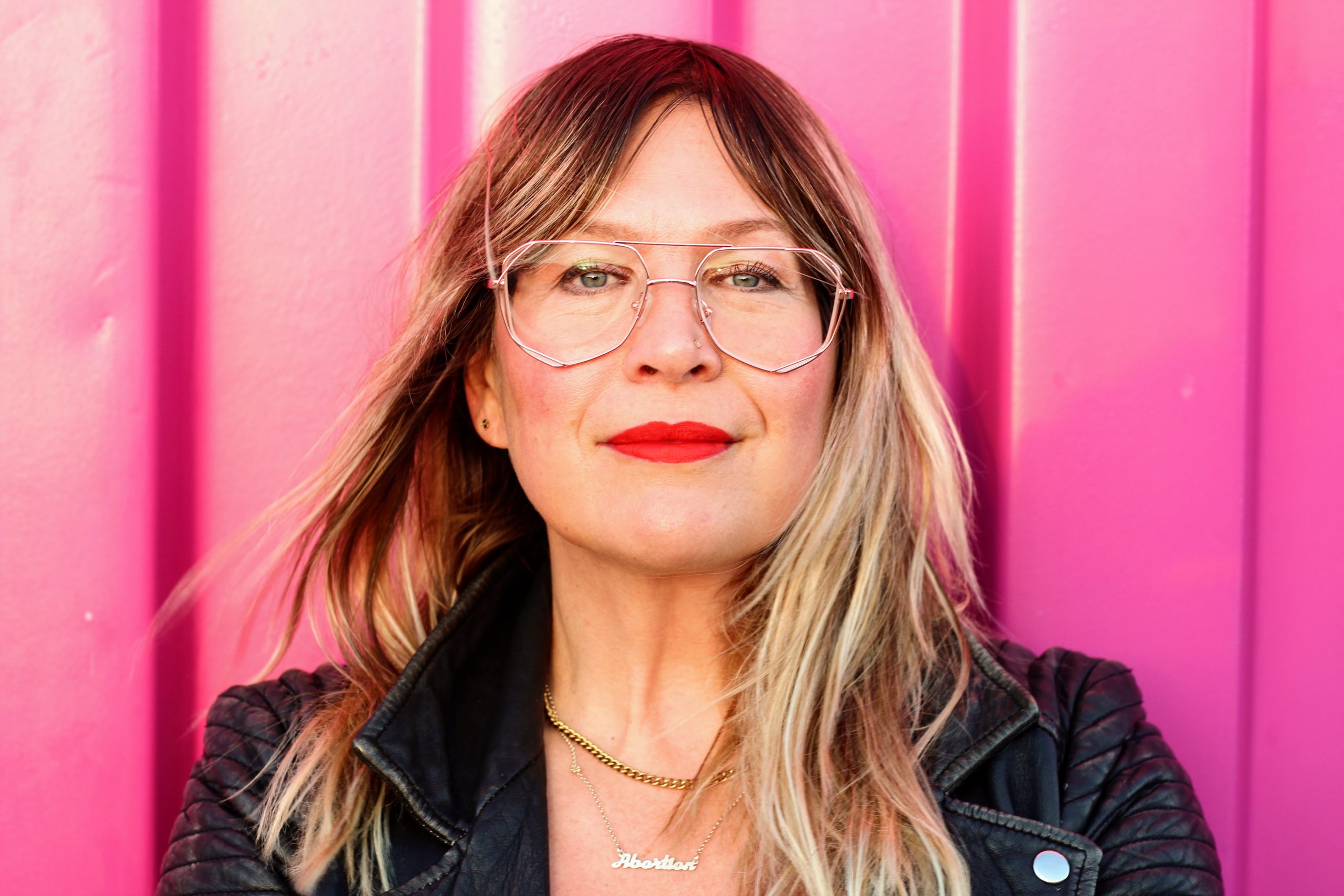
Schatz is returning to fiction, her first love, after many years of other genres. She’s the author of The New York Times bestselling children’s book Rad American Women A-Z, followed by others in the series. Along with W. Kamau Bell, she also authored Do the Work: An Anti-Racist Activity Book. Her writing has also appeared in CNN, Lithub, Buzzfeed, Oxford American, and the San Francisco Chronicle. Everything she gives her creative energy to is deeply political and highlighting injustice and histories of those whose stories are often not told. She currently lives in San Francisco with her wife and three children.
I conducted my interview with Schatz over several days in March on a shared Google doc, and we discussed her inspiration for the story, her research process, and how we carry on the labors of our foremothers.
The Rumpus: Where the Girls Were is your first novel, but you’ve written and published nonfiction and other genres before. Can you tell me about the decision to turn to fiction at this point in your life and career, and to historical fiction in particular?
Kate Schatz: Of course! It feels less of a turn to and more of a full circle, or maybe a return to—fiction is my first literary love, my earliest creative language. It’s the non-fiction, in particular the “Rad Women” book series, that felt like an unexpected detour, but it became what I’ve built my career on. Before those books, though, fiction is what I focused on as a young person, an undergrad, an MFA student, and then as a person in her twenties trying to figure out how to be an artist/grown-up/person in the world. I published a novella and a number of short stories, and was teaching Creative Writing, first at colleges and then at a public arts high school.
Then I became a mom! And for the first year of my daughter’s life I felt like I’d completely forgotten how to write fiction. My brain felt so different—stories just didn’t work, and it was so unsettling. Eventually I could feel myself coming back, and I started to envision a novel based on my mother, and my own new relationship to motherhood. It was slow-going, but seeds were planted. Then I got the idea to write a children’s book about cool women from history. That became Rad American Women A-Z (City Lights Books, 2015), the little book that could, and it took off and went viral and became a NYT bestseller and whoosh! It opened the door for my collaborator Miriam Klein Stahl and I to create more radical books for young readers, and we went for it! I’ve always loved history, especially the hidden radical histories that get suppressed and ignored, and I’ve been involved in social justice work for decades. The “Rad Women” books became a new form of activism for me, and they took priority, both career-wise and creativity-wise. Then in 2020, in the wake of the murder of George Floyd, I began working on Do the Work (Workman Publishing, 2022) with W. Kamau Bell—that book was an urgent response to an historical and political moment.
Through it all, the novel never left. It had taken shape, and was inspired by my mom’s experiences with unexpected pregnancies in the 1960s. I worked on it intermittently, in between other projects, and while I loved spending time with it, it just didn’t feel as urgent as the other books. That changed in 2022 when the Dobbs decision came down, and Roe was overturned. By that point I had learned so much about the power of historical storytelling, and empathy, and what can happen when artists remind us that the personal is always political. I knew it was time to shift gears and get this novel finished and out into the world. And here we are!
Rumpus: I’d love to hear more about the novel’s connection to your mother and your own relationship to motherhood. Can you say more about that? How did you decide when to stay true to your mother’s story, and when to fictionalize?
Schatz: Where the Girls Were is a fiction, but it’s directly inspired by my mom’s experiences with unplanned pregnancies in the 1960s, when she was a young woman living in the San Francisco Bay Area. She experienced two pregnancies, in 1966 and 1967, and like the protagonist and the young women in the book, my mom was sent away by her parents. She surrendered her babies for adoption, never got the chance to even hold them, and came back home where no one in her family really spoke of it again. She never forgot about it, of course, and she carried significant grief and shame for decades.
I had no idea about any of this until I was in my early twenties and one night she broke down and told me her story. I would describe us as very close, so this was really a shock to me. It was also fascinating. I’d never heard of this phenomenon—the “Baby Scoop” era, the world of maternity homes and secret adoptions, the 1.5 million young American women who surrendered babies for adoption in the decades between the end of WWII and the Roe decision in 1973. I fancied myself as a feminist who was well-versed in women’s histories, especially Second Wave feminism and reproductive rights. So my interest was two-pronged: the intensely personal story, as well as the urgently political. I dove into research about the history of maternity homes, and what emerged were the seeds of a novel.
It was never about telling my mom’s story, for many reasons. I wanted to explore the time and place without feeling constrained by the pressure of trying to tell her story exactly as it happened. That didn’t feel interesting to me, nor was it possible: there are many details she doesn’t recall, both because of the passage of time as well as the impact of trauma on memory wasn’t possible. By expanding beyond her story, I was able to broaden the scope and incorporate the experiences of other young women whose stories I encountered during my research. And finally: by creating a fictional world, I could give my protagonist experiences that my mom didn’t get to have. My protagonist gets to build community, find solidarity, and reclaim some agency—that wasn’t the case for my mother, at least not right away.
Rumpus: The precision of detail of the home for unwed pregnant girls and of San Francisco in 1968 is incredible. I felt a great sense of presence in every scene and trust in you as my guide through that time and place. Can you tell me about your research process? Were you able to learn intimate details of this kind of home in particular, and how much did you allow for creative license in the absence of satisfying description from trusted accounts?
Schatz: Thank you! That’s wonderful to hear. The setting details in the book come from research, from my own family’s homes, and from my imagination. I spent a lot of time immersing myself in imagery from the Bay Area and San Francisco in 1968—I pored over old magazines, Googled newspapers and advertisements, and looked through old photographs online, but also at my parents’ house, where my mom has box upon box of old family photos, and an extensive archive of… let’s just call it ephemera. May’s [Baker’s cool older cousin] penchant for knick-knacks and sentimental objects doesn’t come from nowhere My parents and my aunts and uncles were all there at that time, so I grew up on their stories, their music, and their images: of parties at my grandparents’ house in the ‘burbs, of city life, of wild concerts and “Be-Ins” and acid tests. I wore my mom’s old clothes and dressed as “a hippie” for Halloween multiple times as a child. It’s a place and time that has always felt incredibly vivid to me, despite being born a decade later.
The maternity home details come much more from my imagination, as it’s difficult to come by images of the interior of these homes. They were meant to be secret spaces, and the girls weren’t exactly snapping photos of their time inside. Most of the interior photos that are available online and in archives are staged (happy nurses caring for peaceful babies, et cetera), and were taken for promotional materials like brochures, or even magazines and newspapers that ran glowing profiles of the charitable work they were doing. I looked at many images of the exterior of homes, and when I could find interior images I tried to study the details as closely as possible, attempting to see beyond the photo shoot perfection.
Rumpus: The novel takes place five years before the Roe versus Wade decision legalized abortion, and of course the novel is coming out about four years after the decision was overturned. What was it like writing about a pre-Roe world now that we’re in a post-Roe world? Did you learn anything new about life in that era, and did it make you think any differently about our present moment and our possible futures?
Schatz: I’m part of a very specific generation of women who were born in the years right after Roe, and who came of age and experienced pregnancies, birth, and motherhood before Dobbs. My kids are teenagers now, and that is not their experience. My generation is a unique bridge between my mother’s,’ who didn’t have this access, and my children’s,’ whose access is also in peril. That perspective is sobering. At the same time, I’m someone who was not necessarily shocked when Roe was overturned. I was enraged and devastated and wanted to fucking burn it all down—but I wasn’t surprised. Because I’ve been paying attention to the attacks on reproductive freedom for decades, and I understood it was coming. It’s a stupid, helpless, hard feeling, and I suppose this book is part of my way of doing something.
As for what I’ve learned: so much! I went down all kinds of research rabbit holes: the history of abortion techniques! The “rabbit tests” that used to be used to determine pregnancy! Also: the fact that the idea of trimesters does not come from an ob/gyn or other kind of medical professional/midwife, but rather a Supreme Court judge who felt that Roe needed to impose some kind of framework on the pregnancy experience so that women’s bodies could still be controlled by the state. I did not know that. Did you?!
Rumpus: I didn’t! The more I learn about the history of reproductive rights and fertility treatments, the more horrified I am. I recommend American Baby: A Mother, a Child, and the Secret History of Adoption by Gabrielle Glaser and Hatching: Experiments in Motherhood and Technology by Jenni Quilter . I learned a lot from reading your novel as well. This book, like your others, is certainly a form of activism, yet it’s also a pleasure to read with very compelling, well-rounded characters. The novel most closely follows Baker, a high-school senior, and her journey with an unplanned pregnancy. Can you tell us a bit about Baker, and how you chose her as our guide through this world?
Schatz: First, let me add another title to that list: Relinquished: The Politics of Adoption and the Privilege of American Motherhood by Gretchen Sisson—a really important and thought-provoking book, for sure. As for Baker, our protagonist: she’s a book-smart 17-year-old who’s been told all her life how smart and exceptional she is, but she’s also very sheltered. She’s a people-pleaser who’s always done what’s expected of her, and she carries the pressure of high expectations, both for herself and her parents, who look to her as an ambassador of their own success and stature in their community. She’s valedictorian. She’s Stanford-bound., It’s 1968 and the country is exploding around her. She’s developing her own opinions about the war, about politics, and on New Year’s Eve she decides to finally let loose, to “live a little” and go to a concert with her wild hippie cousin. She meets a guy. She’s overcome with desire. She experiences sex and passion and a whirlwind romance—and then she experiences pregnancy, which she is not at all prepared for.
I chose Baker as our “guide” (I love that way of thinking about a protagonist) because I wanted to explore the tensions between our oft-romanticized notions of women in the late 60s and the political and social realities they faced. I grew up with ideas of gorgeous, free-spirited hippie women who seemed (in photos, films, songs, and the anecdotes I heard from my parents) so liberated. To me they seemed sexy and powerful, whether topless and covered in mud at Woodstock, or burning their bras and marching for their rights. But that was never the whole story, and I’m interested in what was happening in private—when “free love” clashed with the lack of readily available birth control, and little-to-zero abortion access. When women could feel “liberated” in some spaces, but still experience control, abuse, violence, and a lack of bodily autonomy. Baker is coming of age, and she’s stepping right into all of this in very personal, intimate ways—just as the country is exploding around her.
Rumpus: What you just said above, about the clash women felt between being liberated but also controlled and the idea of the country exploding feels as true today as it did in the 60s, and at many other times in our history as well—not to mention beyond the United States. It reminds me of the moment in the novel when Baker’s mother tells her, “There are no easy answers here… No perfect options. I don’t care how much the world has ‘changed’… This has been happening to women since the dawn of time.” I read that line a few times. I wondered if this idea came to you in writing this book, or if you’d always felt the truth of this—if it does feel true to you?
Schatz: It absolutely feels true for me, and it’s definitely something I wanted to communicate in the book. Women are constantly adapting to patriarchy, generation after generation. We adapt strategically, brilliantly, cunningly, boldly, quietly, deftly—but male domination and violence and control persist. It can absolutely feel Sisyphian, rolling the big dumb boulder of patriarchy up the hill yet again, like “Didn’t my mom do this already? Didn’t her mom do it?” And it’s true, they did. And it’s true, we’re doing it again. But if I’m gonna go with this metaphor, I’d argue that each generation changes the shape, size, and weight of the boulder; blazes new paths up the hill; and reshapes the experience of it all. We figure out how to do it together, in community. We can be strong and empowered and badass and experience more freedom and opportunity and choice than previous generations—and we can still be dealing with the bullshit boulder. Multiple truths, at once. Maybe my kids’ generation will be like “This boulder sucks, I’m just gonna let it roll and walk up the hill without it.”