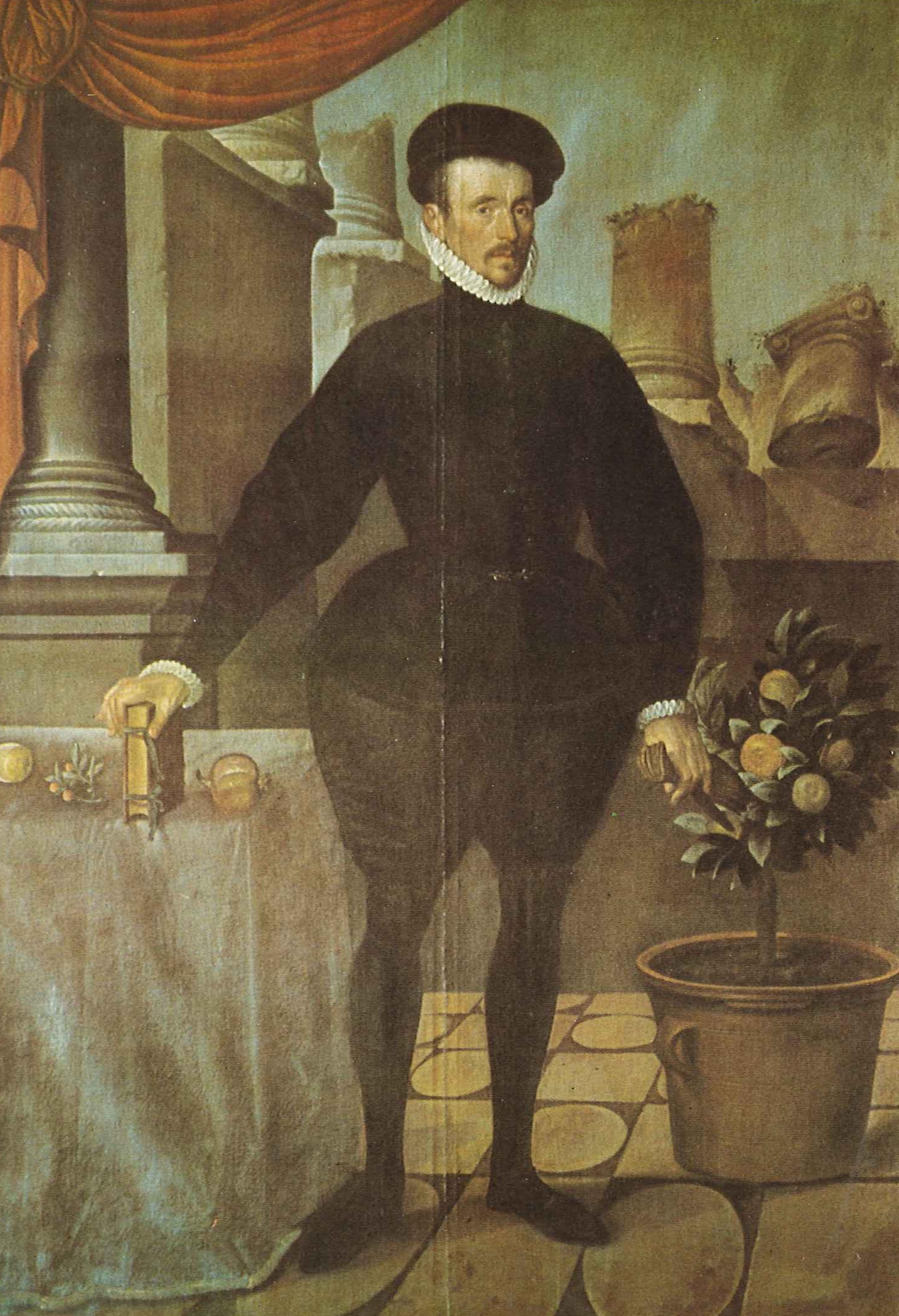
In October of 1552, sixteen-year-old Felix Platter set off from his home in Basel, Switzerland, with a few coins in his pocket and a few more sewn into his jacket. He travelled in the company of merchants and students to Montpellier, France, where he was to become a medical student at that town’s university. Lucky for us, he kept a detailed journal of these years, which later in life he polished to create a manuscript that McNally Editions has now reissued as Beloved Son Felix: Coming of Age in the Renaissance. It’s a wonderful book, in many ways reminiscent of medieval travelogues, yet instead of presenting us with fantastic and unlikely marvels in the way the old travelogues did, here we’re treated to the rich details of life in the years just prior to the French Wars of Religion. It’s a life that’s at times gruesomely macabre, yet not without a certain domestic charm.
Felix’s recollections are provided with surprisingly open emotional reactions—he frequently owns up to feelings of embarrassment, fear, homesickness, or a mischievous bent. Though his story doesn’t feature the same self-reflection that Samuel Pepys would display in his diary a hundred years later, or for that matter, the sheer sweep of history that can be found a few decades earlier in the Italian journals of Luca Landucci and Marino Sanudo, Felix Platter’s writing does possess two things that Pepys and the Italians lack: structure and stakes.
By confining his life story to his student years, and to the journeys that brought him to his distant university and back again, at a time when he was desperate to prove himself and when the threat of religious persecution was all around him, Felix’s journal has a narrative feel. Of course, Felix’s journal is not truly a novel, and part of the effect is due to the translation cutting some material from the beginning and end of Felix’s manuscript, but there is a forward momentum to keep you engaged as a reader, and like the best pre-modern travelogues, there’s a gem to be found on every page.
Felix was taking part in an informal network of student exchange, and ended up lodged in the house of Laurent Catalan, a pharmacist and Marrano Jew—that is, Catalan’s family were Jews who’d been exiled from Spain and at some point converted to Catholicism, though in private they retained some of their old customs and beliefs. Felix, a Protestant, enjoyed speaking about religious matters with Catalan, and you get the sense that the two of them smirked at Catholic superstition, though being outsiders, they also knew the importance of being discreet.
These were the years just before the Wars of Religion, and Felix witnessed a truly staggering number of executions, roughly half of them religious in nature, the persecution of Protestants and heretics. Body parts were cut off before or after the execution and hanged from olive trees.
As a guest in the country, Felix seems to have had a little more leeway in his religious leanings than his neighbours, though not much. Eating meat—or even eggs—during Lent became a capital offence, but Felix and the town’s German community persisted, in Felix’s case he found a way to cook eggs on a piece of paper held over burning charcoal. Unfortunately for him, a servant discovered his pile of accumulated eggshells and reported him to Laurent’s wife, who was quite annoyed but fortunately didn’t press the matter.
Not so fortunate was the peasant who pretended to be a devil, who “ejected fire from his mouth, his nose, and his ears. He had appeared in this fashion to several curés in a wood, but from a distance, and had replied in their conjurations by threats to carry them off in the night. Some people had been frightened out of their wits, and left sums of money for him, and then fled. Nobody dared to attack him; but one day some dogs belonging to peasants hurled themselves upon him, and would have torn him to pieces if he had not been rescued.” That the peasant was hanged instead of burned suggests it was treated as a criminal, not a religious, matter.
Perhaps the saddest execution Felix recorded involved a girl of fourteen who had previously served as a maid in Catalan’s household, who Felix fondly remembers as having once helped him remove his boots. Impregnated by a priest, she was found guilty of infanticide, hanged for throwing her unwanted child in a latrine. There’s no mention of what became of the priest.
Yet her story didn’t quite end there.
Felix was part of the first or second generation of medical students who gained their knowledge by dissecting bodies, and he reports that “her body was taken to the anatomy theatre, and it remained several days in the College. The womb was still swollen, for the birth of the child had occurred no more than eight days before.” Of another such dissection, we’re told: “the cranium and the envelope of the brain were opened, the brains burst out and ran over the face like thick starch.” Another involved a student who Felix had known in life, whose lungs were so decomposed that even sprinkling them with vinegar couldn’t cover up the smell. These autopsies were popular affairs, attended not just by students but by the nobles and bourgeoisie, and even––to Felix’s surprise––by monks and young girls. But even with all the executions, sourcing a body wasn’t easy. A typical excursion had Felix and his fellow students following a spy into a graveyard, swords at the ready, waiting around drinking until midnight, silently digging up the corpse (loose soil was a good sign that a corpse was “fresh”), and then smuggling the body back into town, which required either finding a hole in the town’s gate or distracting the night porter. When the local monastery caught wind of this, they set a monk with a crossbow in their cemetery to chase the graverobbers off.
And yet for all this death, life went on, and what makes the journal truly fascinating are the everyday details of the mid-16th century. On a day trip to Villeneuve, Felix notes that rosemary is so abundant that it’s collected and brought into town as a cheap fuel to burn in hearths. He has a charming story about becoming afraid of being left home alone on Christmas Eve (his Catholic roommates were off attending midnight mass), he passed the time reading Plautine comedies. He took part in massive food fights that left the town square covered in orange pulp.
In many ways, Felix’s life was typical of any young person’s. He learned to play the lute, took day trips to the countryside with his friends, snuck wine and dried grapes from Catalan’s cellar, letting him think there was an infestation of rats.
Thomas Platter—Felix’s father, a humanist scholar who ran a small school back in Switzerland—grew up in poverty, which we know because later in life Felix would encourage his father as well as his half-brother (younger than Felix by thirty-five years), to write their own accounts of their lives. Thomas junior, the half-brother, recorded seeing Shakespeare’s Julius Caesar performed at The Globe in London. During the years of Felix’s journal, his father continually lectures Felix by letter to be diligent with his money, to pay attention to his schooling, and to be on guard against the seductions of French women.
His father needn’t have worried. A common saying about French universities, which we’re given as “we take their money and send them back to Germany as ignorant as before,” would not hold true in Felix’s case. He was frugal and studious, often leading extracurricular student discussion groups. Admittedly, he took part in an armed student protest, but claims this was only under duress. The students elected a spokesman to take up their case, demanding to exercise an ancient right to withhold pay for professors who weren’t giving enough lectures. As for French seductions, Thomas appears to have been popular and well-liked, but also shy and clumsy around girls—the worst incident being at a dance when his spurs became tangled in a girl’s dress and they both fell to the floor.
Perhaps Thomas Platter worried for his son because Catalan’s son Gilbert, who Thomas was hosting in Basel, turned out to be a disappointment: he borrowed money on false promises involving his sister’s marriage; put his father back home on the hook to lodge strangers; brought a strange girl home from Spain who he claimed to some was his wife but bragged to others was merely a concubine; left lamps burning in his window at night to give the impression he was up late studying; and ultimately “quits Basel in dudgeon, because he had been refused a mastership.”
Felix leaves us many moments that have a cinematic quality: dealing with an extortionate ferrywoman who threatens to drown him mid-crossing (he throws stones at her once she drops him off on dry land); a night spent at an inn with swords drawn and the door barricaded against a group of drunks who mean to rob and, we later find out, murder Felix and friends; the crossbow-wielding monks chasing off the would-be graverobbers. But the real charm of the book comes from the simple fact that Felix lived a life that was only slightly out of the ordinary, and this allowed him to develop an eye that could see things that hadn’t previously been worth mentioning. By accumulating a plethora of customs and anecdotes about daily life on the road and in a city far from home, and providing this material with such honest emotion, Felix gives us a fascinating account of a life lived on the cusp of modernity, still vivid almost five whole centuries later.
Beloved Son Felix: Coming of Age in the Renaissance by Felix Platter, translated by Seán Jennett, with foreword by Stephen Greenblatt
McNally Editions, 2026; 176 pages.