The Riace Bronzes—two life-size Greek statues of bearded warriors from the fifth century BC—are among the most celebrated survivals in ancient art. Unlike most ancient bronze sculptures, which were melted down and recast as weapons or coins, they endure precisely because they were lost: probably sunk with the ship that was carrying them, then lying hidden on the floor of the Ionian Sea for over two millennia until they were pulled by an amateur diver in 1972.
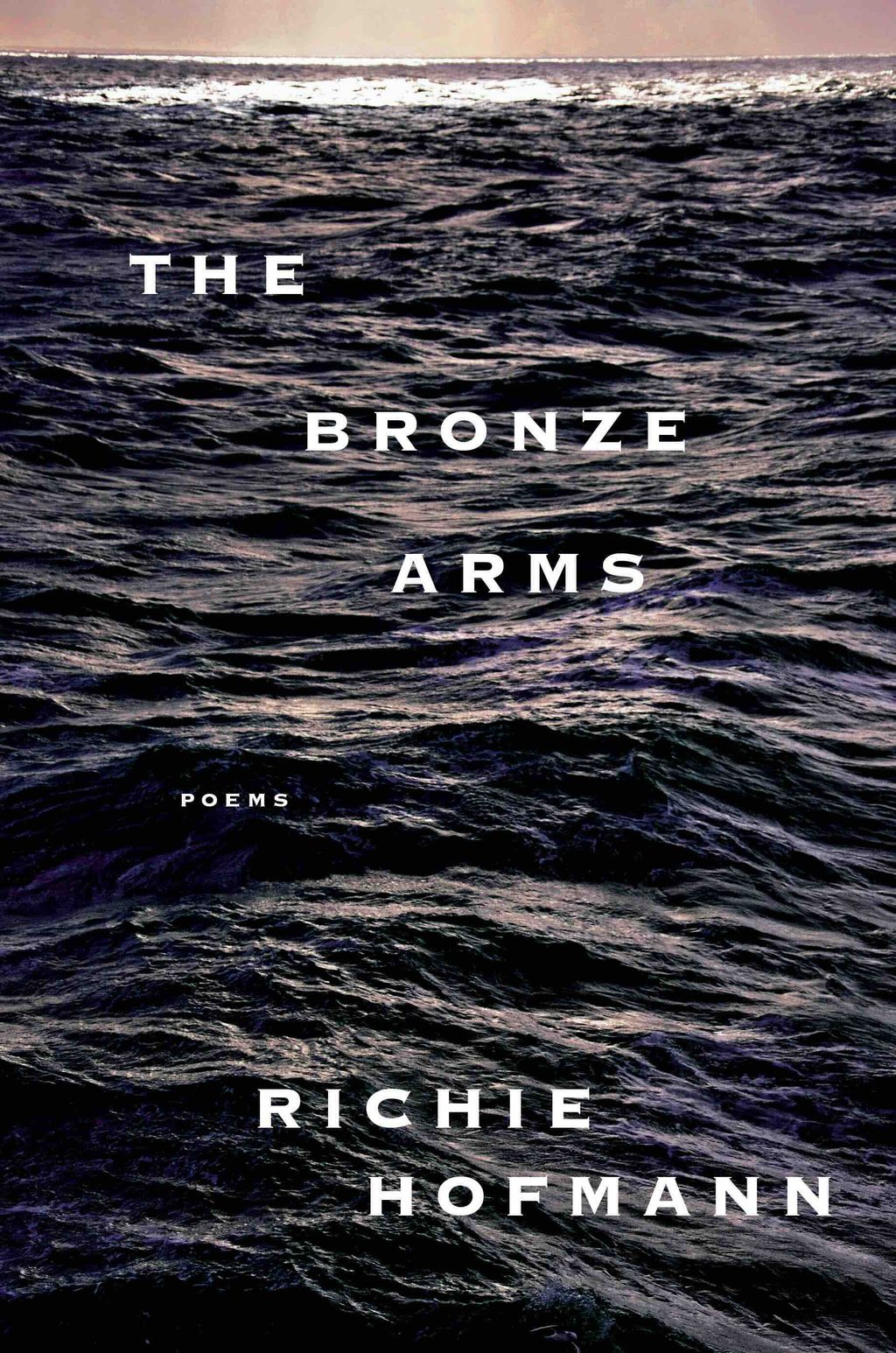
Survival through change, and survival through loss: the interplay between these two fates is the animating concern of Richie Hofmann’s third collection, encoded into the title itself: The Bronze Arms. Hofmann’s title nearly rhymes with itself. Bronze and Arms: identical vowels, the repeated r, the almost-identical consonants n and m, and then that same voiced z that ends both words. The two words are almost each other, but they are also almost each other’s, or their own, opposite.
This space between near-identity and divergence is where The Bronze Arms lives. “Arms” reaches in two directions at once: toward the body—arms as flesh, as embrace—and toward its negation: what covers the body as armor, what pierces it as weaponry. One poem calls attention to how, in French, amour contains armor—the way a bronze statue might “contain” the weapon it will be melted into. The Bronze Arms is ever alert to this drift of homophones and near homophones: the heroic dad who rescues the drowning young poet before he can be dead; the photograph that holds what it captures, captive; the stuffed lamb toy that is almost fused with the limb of the child poet. In a gesture that is emblematic of the book’s exploration of love and violence, the boy falls asleep with his finger in the toy’s eye-socket: toy and boy, eye and “I,” conjoined by tenderness and force.
Hoffman and I corresponded over email in March, about a month after the publication of The Bronze Arms. It was a pleasure to receive his thoughts about his “earnest and total” love of art, the evolution of his style across three books, and how poetry clears a space for the “almost-true.” This interview has been edited for clarity and length.
The Rumpus:
In The Bronze Arms, n The Bronze Arms, art is not exempt from time; it remains vulnerable to the same forces of accident, transformation, and loss as human life, just across a different timespan. Bronze statues are melted down and repurposed as weapons or coins, or survive only as marble copies. Even the contemporary photograph proves unstable: “There was sand in my camera lens. / It ruined the edges of every picture I have of you.”
It’s as though art here becomes not only a record of creation but also of destruction—something shaped by eros as much as by time and loss. How do you see The Bronze Arms in relation to your earlier books? Did your sense of what art preserves—or fails to preserve—change as you were writing this collection?
Richie Hofmann: I love art, in an earnest and total manner. People on Goodreads sometimes say I’m pretentious, but I’m really like that. I always have been. Art shapes how I see the world and myself in it. John Singer Sargent and Franz Schubert, for instance—these guys have at least as much meaning for me as friends from school do.
And when I began to write my first poems, I wanted to write something that paid homage to the art that I cared about. Like many first poems, they were horrible and misguided, I’m sure. I remember a villanelle inspired by Paradise Lost—a kind of ludicrous project, looking back, but of course I meant all of it sincerely. I wanted the poem to not be immediate—to be a sort of web of other texts and sources, like the modernist poets I loved—a web that could fit a whole world inside it, and whose strength was made robust or tensile by the endurance and beauty of its original fibers.
Naturally I became obsessed with ekphrastic poetry. What I didn’t fully comprehend was that the significance of my beloved objects didn’t make the resulting poem significant. I had to do more than describe a piece or refer to it. I like the evocation of certain aesthetic objects, but maybe not their invocation? My first book [Second Empire (Alice James, 2015)] has a “notes” section; the two that come after [A Hundred Lovers (Knopf, 2024) and The Bronze Arms] do not.
I think as I’ve written more and more poems, I’ve become less tolerant of ekphrasis as homage and more interested in ekphrasis as atmosphere. Art—especially very old art—has become a central metaphor in my work, not just for problems of representation, but for problems of durability. What is lasting? What is a body? What is the afterlife?
The Riace Bronzes are probably the most explicitly ekphrastic reference in the book, and I don’t think I ever call them that. I want to evoke their otherworldly beauty, their strange serenity, their effortless sexuality in my poem. But I don’t necessarily want the reader to run immediately to the library. I hope what I give in the poem suffices, at least for now.
I think you’re right to think of destruction and oblivion as a new focus for me. But in The Bronze Arms, I’m thinking about survival, too.
Every extant bronze from antiquity is a miracle of survival. I’m moved by the notion that the statues that come down to us often survive because they were lost, shipwrecked, hidden away. And then, discovered by an amateur scuba diver in the 1970s. They are resurrected into the uncanny afterlife of a museum. I wanted that miracle to be one atmosphere of the book—fragility, yes, vulnerability, yes, the threat of being melted down (for instruments of commerce and violence, no less), yes. But also the possibility of rescue. Life as a series of accidents, even the afterlife as contingent and mundane.
Rumpus: I’m also curious about your poetry’s formal evolution. Second Empire makes use of inherited forms like the sonnet, and A Hundred Lovers culminates in a long poem of rhyming couplets. In The Bronze Arms, the prosody feels more elusive but still very deliberate: the double-spaced, largely end-stopped lines of several poems; the dispersed tercets of the “Maze” sequence; the fragmented poem that recurs throughout the book. How did you arrive at these new formal contours?
Hofmann: I self-identify as a formalist poet. It’s how I came up, and how I think of my work. Probably formalists wouldn’t want to claim my poems. But the poems that seduced me seduced me because of their shapes and sounds—their complex formal programs. Rhyme, especially, has interested me from the beginning, in an intense way—like a worldview or a sexuality.
I went to the West Chester conference and all that—I felt instantly embraced and so inspired by so much of what I saw and heard there. The emphasis on verse-craft and the history of lyric, as well as the role of musical performance and print culture in poetry. Heaven! There were edges of that world that felt a little partisan in a way I was uncomfortable with, and a little paranoid, too. And, as with all forms of aesthetic partisanship, there was a valorization of mediocrity I couldn’t fully understand as a young student.
When I was starting to make my own poems, the poets and teachers that changed my life—Natasha Trethewey, Rosanna Warren, Henri Cole, Mary Jo Salter—they showed a way forward. I could do anything I wanted—and the poems could be metrical or not, nerdy or suave, emotional or icy. I remember encountering the poetry of Rachel Hadas and A. E. Stallings and Carl Phillips and Gjertrud Schnackenberg and feeling the walls in my mind crumbling to ash! I loved being young, when everything was new.
When I wrote the poems that became Second Empire, I was in that phase of experimentation—using all the old models to learn who I was or might become… Traces of [James] Merrill (our mutual hero) are all over that book, but I didn’t want to write poems that felt blah sub-him. I keep him in my mind, as an ideal reader, and fantasize about his approval and disapproval all the time. I wanted to be playful with sonnets, with rhyming couplets—even with some self-conscious experimental forms that maybe now I find a little gauche… I was young, and so I was learning and failing and showing off and learning again…
With A Hundred Lovers, I had the seamless composure and amorous posture of the sonnet in mind while also wanting to experiment with writing that felt more offhand and diaristic—those poems play at being casual when of course they aren’t, just as they play at being arch when I think they are hurting. Those tensions fueled me and excited me for those years of writing.
I love a book of poems that feels like an atmosphere—often I think some kind of formal pattern or unity throughout is useful for me in composing and putting the manuscript together. In The Bronze Arms, I wanted several kinds of poems to weave together. The double-spaced, largely end-stopped poems—I thought of them initially as like drums of marble stacked for a classical column. When I saw Chip Kidd’s design for the cover, I also realized those single-line stanzas were also like waves to me. Because I use enjambment rather sparingly, the line-breaks that do happen feel illicit or rapturous.
The fragmentary poems are inspired by fragments of Sappho. I was interested in their intensity of focus and roughness of texture. Their smallness and spareness make room for epigram. I’d always been interested in really, really short forms, and the fragments satisfied my curiosity about how they might texture the book as a whole. A poet is always tricking himself into new discoveries. I think because I didn’t feel they were really poems, I felt freer to experiment with different modes of sentence- and line-making. I’ve never read them out loud at a poetry reading, but I want to.
The weird shape of the mazes, with their quick turns and unwieldy indentations gave contours to their music. I felt free to be more musical, to be more repetitive, to cycle and cycle and bump into the walls of the poem as you move through it. It’s funny, I love music and song more than anything, but I’ve never written lyric poems in a very self-consciously song-like style… that’s what I’m hoping to work on next. I’m always curious to see what these new formal ambitions and challenges allow, what they limit, how they set me free.
I get asked all the time about philosophical and theoretical stances, and I have to admit to people (and to myself) that I mostly think about technique. My aspiration is the perfection of surfaces and it will be until I die or stop writing poetry.
Rumpus: Many moments in the book seem to take place in a kind of subjunctive or hypothetical space—somewhere between what happened and what almost happened.
For instance:
“I wished you loved me / Enough to kill me, / But not really.”
Or less overtly:
“Before I died, / I was pulled out of the water.”
In that final instance, the unusual syntax (“before I died” instead of “before I could die”) briefly allows for an impossible event—death, drowning—before quietly undoing it. There’s a feeling of suspended disbelief, as if the poems allow themselves to imagine catastrophe while also acknowledging its impossibility, or even its theatricality: “Let’s play that game where I’m the dead bird from The Hours.” The book’s final line—“I play dead in your arms”—feels like a culmination of that dynamic: an imagined death that is also clearly a kind of performance.
How conscious were you of writing in this kind of “almost” space, where the poem imagines something fully while simultaneously acknowledging that it isn’t quite real?
Hofmann: In some sense, I think that’s what poetry allows as an art form. The turning of the lines, the fractures and continuities of syntax that enjambment makes possible, these devices allow multiple realities to coexist, even if just for a moment. It’s why verse is such a higher form of art than prose—the artful, deliberate strategies and the interpretive accidents of meaning-making feel inexhaustible.
As a person, I think I’m somewhat evasive. I don’t want to commit to a narrative, certainly not to an identity. You can wade into desire, into risk, into darkness—and still come out alive. I’m actually thinking of a weird poem in the book called “Allegory of Love,” where Love (a very scary dom) tells the speaker: “I’m going to have you forever.” And the speaker says coyly, “You can have me for a while.” How deep can you dig? How dark can you go? I’m curious. But I’m holding on to ribbon so I can be rescued again.
If The Bronze Arms is especially interested in the almost-true, I think it’s because of the book’s terrain of memory and myth—two forms of narrative, of storytelling, that sit somewhere between reportage and fantasy, and which undermine (or uplift) (or pervert) our sense of what’s possible.
I don’t know, but I wonder if all lyric poems are interested in the “almost,” or the “not yet,” or the “maybe was.” Do poems build themselves up as they negate themselves? I think from my very first poems, I’ve been interested in the way a poem advances and retreats, conceals as it reveals; lies as it confesses. They perform total intimacy and even privacy, conceivable interiority, even as they are uttered, or written down, or printed in magazines, and read into microphones.
As readers (and as writers), we suspend our disbelief, I suppose. The lyrical speaker must seem, for the duration of the poem, plausible and convincing, while we’re reminded—at every turn—that the poem is art, elevation, fantasy, spectacle, song.