“Just this once, man, come and break mugs with me. Just this once,” says the narrator of “Karantina,” a short story in Hasan Dudar’s superb debut linked story collection Carryout. “Breaking mugs” refers to having a drink together, but the phrase suggests more than that. It conveys closeness and storytelling and community and survival. The narrator attempts to get his childhood friend from Beirut, Ziad Idilbi, to close his corner store, or “carryout,” as they’re called in Ohio, and reminisce with him for a little while. The fact that the two men left Lebanon at different times marks their friendship: Ziad before the war in the early 1970s and the narrator after.
While the story never leaves the store, over the course of eight pages, we’re transported from Toledo to Lebanon to Palestine and back to Toledo. By the end of the story, an ordinary night has become something sly and absurd and extraordinary. The political plays more of a role than just a backdrop in these stories; it’s deeply, unavoidably personal.
Carryout follows the Idilbi family, Ziad, his wife Salma, and their three children Mustafa, Nawal, and Walid, as they build a life in Toledo in the ’80s, ’90s, and aughts. We see each character prismatically: through their own eyes, through each other’s eyes, and through a range of characters who pass through the carryout and the community. Vivid characters and settings ground the collection where yearning sits next to ambition, and pain sits next to humor.
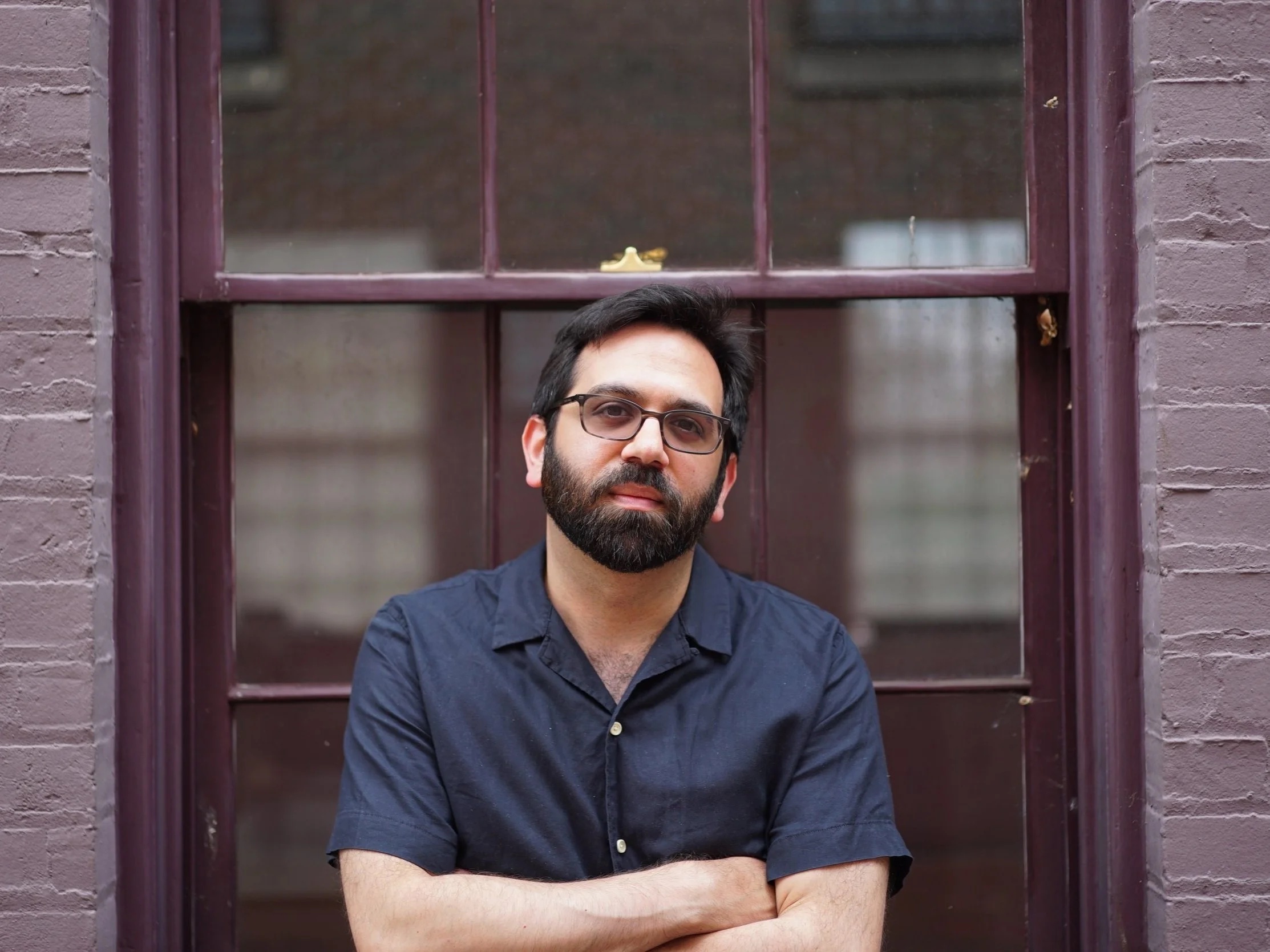
It was an honor to speak to Hasan Dudar over Zoom, him in Washington, D.C. and me in Roosevelt Island, New York. We talked about the nostalgia of a carryout at night, the importance of not editing out characters’ contradictions, the power of story collections, flag displays after 9/11, and the mystery of art making.
This interview has been condensed and edited for clarity.
The Rumpus: I read that your family owned a carryout in Toledo. You write about this experience with such specificity, care, and humor. Strange things happen in a general store! I saw the carryout as both a place of disappointment and a place of ambition and belonging. What was your process in creating fiction from this experience?
Hasan Dudar: I like that you said there’s disappointment in it. Often these stores are like lifelines in these neighborhoods, social lifelines as well as lifelines for basic things. These stores have a presence in the neighborhood. People rely on you and there’s a lot of power that comes with that. I also always saw it as a place of longing and like a bit of a melancholy because there’s only so much that you can do in a carryout. You open your door and you hope for the best in the morning. Anything can happen. No customers could come in, that’s a possibility, or you could be slammed with customers. But I didn’t want this place to be a metaphor. I wanted it to be a real place because it is animated with so much life.
You only really see these things when you’re looking back at what you put down on the page. I saw that the carryout spoke to something true in life. It’s filled with a lot of disappointment and you can only do so much. I felt that from my own family owning a carryout, that kind of frustration. My parents always seemed to be under great stress. I think some people might look at convenience stores as really lucrative businesses, but I didn’t see that from my parents’ experience. I saw carryouts as really precarious places and also places filled with life and stories and a community stage. I was always drawn to the place and it anchored me too while writing. Even though the stories don’t all take place in a carryout, I needed to think of these as carryout stories.
Rumpus: I fell in love with the Idilbis. Can you talk about how these characters developed? Who did you start writing about first? Which characters came later? Did any surprise you?
Dudar: Walid came first. I started writing these stories through his eyes, first person stories of this younger second-generation character observing the world around him and how people reveal themselves through actions and speech. Then I began to move from that character to inhabit other characters. After Walid came Mustafa, who is the narrator in “Wild Turkey.” Though [the characters in] the story that starts the collection, those characters came last. Ziad [Walid and Mustafa’s father] was obviously in other stories, but he was really in there through Walid’s eyes. But Ziad and Salma [Walid and Mustafa’s mother] as narrators arrived later on. I don’t know why that happened that way. I just trusted the way things were developing. The collection wasn’t written at all chronologically. Images would come to me or even just a feeling and I would go with it and see where it went. Then sometimes stories grew out of that. I really went one by one and didn’t know all the characters who would inhabit the collection until they appeared to me on the page.
Rumpus: I want to talk about the absurdity and the tricksters that are all over this collection, that are a joy to read about. How is absurdity connected to the immigrant experience, especially for a family like the Idilbis, who go through so many different kinds of migration and displacement, from Akka to Beirut as refugees, then to Toledo, NYC, and back to Toledo?
Dudar: I think the absurdity and eccentricities come from a place of disorientation. Especially when you have to start over again and again and again. As a family and as a people and even as an individual, you are constantly having to regroup. Are you the same after that? So many things may have changed and changed again. There’s some absurdity built into that experience. In this case, the family relocated once as a whole family, and then relocated again as a whole family. My question is, are you dealing with the same people? And how does that work out?
Absurdity was not something I aimed for while writing. But I did start to have absurd images and eccentric characters. I did know early on that these stories would be a bit off center, a bit of their own making, though so much comes after the fact. Editing the book is when I really learned—and seeing it through other people’s eyes, rereading it, whether it was the agent, publisher, et cetera—that’s where you learn a lot and start to make big decisions, which for me were to let things be. I saw the characters’ eccentricities and absurdity and I had to learn who these characters were. I can’t explain it for them, why they are the way that they are. It might be because you are displaced enough times that you have to just create life all for yourself. It may seem absurd or irrational to people who aren’t experiencing what you are experiencing, but it may make perfect sense to you. There’s some irrationality and I wanted to let that be in the collection.
Rumpus: You said in an Electric Literature interview with Bareerah Ghani that “the characters don’t apologize for their contradictions,” and this statement really spoke to me. I think it connects to the absurdity of displacement. Did you ever feel pressured to make these characters neater?
Dudar: I didn’t feel pressure externally but maybe some internally. You’re so close to the material as the writer. You get it but will other people get this? I do see these characters as a bit chaotic, and that’s where I had to be really careful when editing and moving things around. Something changes and you can lose a lot of what you were trying to do or what worked and you didn’t even know might work. So I try to tread very carefully in this process and really not interfere with the characters. I had to trust that they knew this book better than me. And then you start to think that it doesn’t have to be neat and rational. We’re irrational in so many ways. I think that when you’re dealing with material like this, especially as the immigration question is so politicized—and the questions of Palestine, xenophobia, it’s all very politicized—but that’s only one way it operates. The other way is [at] a very personal level, which can be loaded with all kinds of contradictions and irrationalities: at times, internal chaos, at times, inner peace. I didn’t want to see these characters as one or the other. When I was editing it, it would’ve been easy for me to see something in one story and try to line it up with this other one, but then I realized I didn’t need to see this collection as any one thing. Life very seldom lines up on one track. One day can go that way and another can go that other way. There are rhythms that don’t make sense to us.
Rumpus: Authors get pressured into writing a novel, and I love that Carryout remained a collection. Did the form of the short story help you keep the idiosyncrasies and the internal chaos?
Dudar: Absolutely. How you’ve characterized it is a lot of how I felt while writing and editing the book. A lot of people ask, “Did I consider a novel?” I saw these as stories, always. They came to me as images and bursts of feelings and moments that I was trying to capture and see where they might take me. They always ended up being stories. I knew that I wanted to link them, though not necessarily the way they are now. Early on I had one idea of how they’d be linked a lot more loosely. But then, I started to focus on this one family and went story by story and I did see the way an arc could come together. And again, I started to step back as much as I could and take every decision carefully and see what that kind of looser arc did for me and for the characters in the book. It allowed me to play with time as I went through my manuscript.
The story form allowed the work to be loose, fragmented, [to] come together at times, and clash at times in ways that may seem contradictory, but maybe that’s what makes sense for the characters’ lives. It allowed me to float between things and allowed the characters to float between things. That’s how they felt to me. I felt they were always floating between just about understanding their lives and having them completely upended again. The form allowed a lot of play and a lot of experimentation and allowed the contradictions to stand side by side.
Rumpus: You mentioned that you didn’t write these stories chronologically but then the structure in time ends up chronological, with big jumps. It feels like a very “lived in” approach. How did it come about?
Dudar: I think I instinctually just arranged them chronologically when I was done. It felt like the right move. I did want readers to understand where and when the characters are exactly, because there are a lot of jumps and it shifts from character to character, and it’s not so loosely linked that the characters aren’t related. I gravitated to chronology to maybe make it simpler for myself as I was editing and reading through it, but also maybe for readers, too, so they don’t have to jump around too much and so they know more or less where this character is at and where things stand in the general narrative of the book.
Rumpus: In this structure, 9/11 felt like a turning point, a shift in all the characters. Did you see it that way?
Dudar: I can see 9/11 as a turning point, for all the characters but certainly for the kids, who are aware of their identity as Palestinians, Lebanese, Muslims in the U.S., and what that means for their parents. And then, I think, that it would be a turning point for anybody.
Rumpus: Yeah, it was for all of us. The pressure to put up a flag—that really resonated with me.
Dudar: I think it’s in “Love Rose” that the flag is hinted at. The family doesn’t put it up at home and Walid notes that they put it up at the store. Then later on, in “Wild Turkey,” they put it up at the store. With Ziad [who decides to hang the flag], I felt that he was a character carrying a lot more than what his children might have been carrying as minorities in the U.S. 9/11 really brought up a lot of old fears and old things that haunted him. It’s an event that universally changed things, and I was aware of that when writing this. It’s one of those big moments in time that are difficult to write about because of how large they loom. That whole period of time was defined by uncertainty. So much was uncertain: our place in society, how people would view us. I think a character like Ziad has already been there. He’s already gone through something like this before. Sometimes I wonder if that makes him more resilient or if the uncertainty during an event like 9/11 feels even worse.
Rumpus: You talked about images as being very present in this book. There are so many strong images, from the love rose, the cars, to the carryout itself, the cover image, which we’ll talk about. And I know you’re a painter. Has painting influenced your writing?
Dudar: Painting has definitely influenced my writing. With the process of painting, so much of it is going with an image or working from an image, but it always comes out different, no matter what. What you bring to it is a feeling for the subject and material, whether those are subtle, like how you put the brush down or how long a stroke takes on the canvas. So much also comes from spontaneity that can’t be controlled. You can control how your brush goes down on the canvas, but there are 100 bristles on it and you have to assess how they made a mark on the canvas, then the next one and the next one. I think it taught me how to approach the work, not necessarily how to write, but how to approach your own output.
Though, definitely, looking at paintings helped me a lot. I really love impressionism and post-impressionism. Those painters really took shapes and colors and played with them and forced you as the reader to look in a different way. Where you stand changes how you see the painting. You can stand in a million different ways. Sometimes you may be standing up close and seeing it completely differently, which may be the way it was intended or maybe not. Or you’re just passing and you catch a glance, and it’s the way the artist wanted it to be seen.
Painting also just brings me a lot of joy. I find a lot of joy in applying colors to the canvas. You need that when you’re writing a book. The two art forms feed off each other. My writing, and the way I view the page and handle the material, feeds a lot off what I’ve learned from looking at paintings and trying to make them myself.
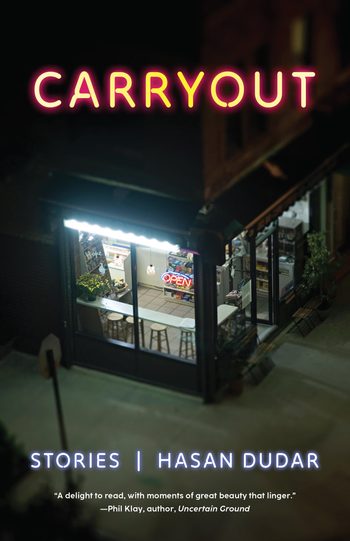
Rumpus: Did you have a hand in this incredible cover?
Dudar: They asked me for some input. I wanted it to have a real Toledo carryout feel. And if there was going to be a carryout there, I believe I did say something like I’d love a carryout at night with the door open, fluorescent sign, and they found it. I love the image because to me there are so many different things around carryouts, having grown up in one: the summers, winters, seasons. But there’s something about the nighttime, the door open, and people coming and going, and this languid feeling. I was really hoping to capture that, and I think they did a great job.