
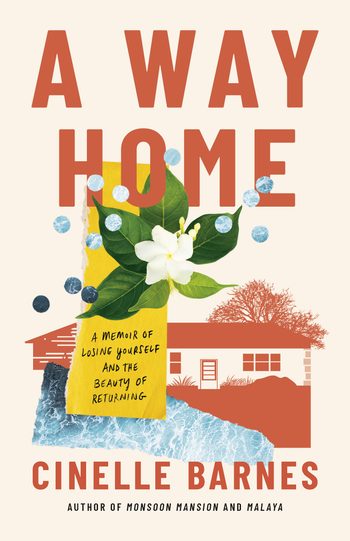
There is travel writing and there is transformation. I couldn’t help but feel like Cinelle Barnes modeled something about this nuance for the reader, seeking peace despite trauma and upheaval, past and present in her new memoir, A Way Home: A Memoir of Losing Yourself and the Beauty of Returning (Little A, June 3, 2026).
As she is preparing to start traveling again after years of being undocumented, she tells us:
“I became a balayage blond, then a brunette, then a blond again. I grew my hair out. I learned to crab. I took up space. I said to myself: Wish you were here. I said no when it didn’t immediately feel like a yes in my gut. I started divesting my time and energy from predominately white work and social spaces. I got a passport. I used it.”
This energy, this resilience, leads her through the whole story. She invokes calmness, while also offering a rebellion. She tells us right in the introduction, “There is so much peace in these pages, dear reader, and it is that peace they absolutely want none of us on the right side of history to have.”
A Way Home transports the reader on a journey of extremes: from waterfalls and sandy beaches in Puerto Rico and Jamaica, to the isolation of pandemic lockdown, and to the ICU and a world where she wonders, “If I’m in the wrong universe, or if I’m two seconds too late or two seconds too soon.”
Her return to her home country in the Philippines, braids with her journey to get back to herself and her life after a brain injury. For a reader of her earlier memoir, Monsoon Mansion (Little a, 2018), it is a gift to see her return to the country she left more than two decades earlier under difficult circumstances.
She wrote A Way Home to show us how complex travel is for people without privilege, to let us watch a woman finding herself in leisure, and to remind us that artmaking can be in pursuit of peace. It feels a little like an anthem.
I had the pleasure of interviewing Barnes over the phone about her new book.
The Rumpus: This book had a fascinating journey, in some ways your experience of writing the book becomes the story. You began it, you had a plan, and then you were interrupted by a brain injury, a brain aneurysm. It sounds as though you wrote the book twice. Writing part of it before the brain injury and the whole book after it, almost as if you collaborated on the book with yourself. Is that how it felt trying to finish this book?
Cinelle Barnes: Yes, that is very true to the experience. I wrote the book at least twice, once as a travelogue and once as a medical memoir. Life often tells me what I must write. The travelogue makes you want to root for the person who has such a dicey, compromised relationship with travel, and you want her to return to her homeland, and leisure, and intrepid joy. I think both narrative threads are fitting for right now because we all currently need to root for something.
I tell my daughter, if you root for others, you are rooting for yourself too. In the end someone else’s triumph is yours if you cheered them on. It felt like my former self was rooting for me to finish this book. When I wrote the medical memoir parts of the book, it felt like I was rooting for the traveler. It is not a book that has been afraid to plumb the depths of both joy and pain, and I was only able to do that because I felt like my two selves were companions, collaborating to complete this big question mark of a book.
Rumpus: Immediately when I started reading the book, I saw that braid and was so excited for that movement between these two times in your life. It is a satisfying read because the braid is working so well for these story lines.
Barnes: The braid and the vignette are so true to life with a brain injury. I feel like none of my sentences are punctuated or complete. My days can be a bunch of blips. Recovery is never linear. You take two steps forward and three back. You start again each day. I wanted the book to feel like that.
Rumpus: This book is a lot of things—it’s a memoir that seems to easily turn from travel writing, to medical journey, to the journey of an immigrant child and now woman in a time of surging political divide, to a mother mothering her daughter and herself, and even veering toward a craft book—sprinkled with anecdotal stories about how you write what you write. Do you see all that when you look at it now? Do you have any advice to someone who thinks their book might cover too much ground, or a secret to making it all seamless?
Barnes: I was very much inspired by travel books by Jamaica Kincaid and Anthony Bourdain who both write literature that is so layered, and the camera of their traveler’s eye is always panning out and zooming in. In Bourdain’s shows, he’s never just having a layover. He’s not just eating a meal. It’s about culture and politics and history. Jamaica Kincaid’s book Among Flowers: A Walk in the Himalaya is a hiking book that’s also a gardening book. But it has history and details on what it’s like to travel as a woman of color in this world, and flowers and their scientific names and what they mean to certain cultures and subcultures. It covers so much. Those two writers and their “traveler’s eye” guided me.
Outside books, music plays a big role in my writing. My brother is a musician and if you read Monsoon Mansion you know he basically raised me. His music choices, all the CDs and mixtapes he made helped develop my writing style and writing voice. But more recently, music by Bad Bunny, Young Miko, Helado Negro, Ruby Ibarra, XG, Imogen Heap, Maggie Rogers, Rosalía, Beyoncé— all these artists blurring the lines between genres and subgenres all understand that syncretism is a strength. The idea of many as one is very much a strength, and I didn’t want to shy away from wielding that power in writing this book.
Film is another influence. I was a media studies and journalism major, and I was inspired by Everything, Everywhere, All at Once, which is also my daughter’s favorite movie. It’s a speculative fiction story, a mother-daughter story, an immigrant story, a comedy, a drama, an action film. It has raccoons and hotdog fingers and talking rocks. We’re starting to see more of this kind of storytelling in cinema, and that’s because that’s how our lives really are. It’s only publishing that loves these silos and categories, because maybe it makes it easier for algorithms to streamline for sales. But I think it’s due time that we in literature embraced cultural and artistic multiplicity. The multi-narrative is the horizon of storytelling and art.
I guess the advice here is embrace your multiplicity of identities and find something that unites them, and that can be voice, or style, or a motif like travel, or a central question.
Rumpus: Your daughter plays a big role in this book. Reading this story, you are a mother, who is also an immigrant to the United States, and a transplant to South Carolina. As a mother myself, it felt like a guide: “There’s another way to do this.” It felt so different from your own upbringing, so uniquely you, and yet so relatable. For a project that starts out as travelogue, at what point did you know that motherhood was a part of this book?
Barnes: I think I knew that the mother-daughter relationship was going to be in the travelogue because my daughter was the one who posed the question: “When can we go to the Philippines?” It is so clear in my mind the moment she asked me. It was her idea to go back to the place that, no hyperbole here, almost killed me. I had two decades of physical, cultural, and spiritual migration. I was given a chance to see my country and the idea of travel anew. I was able to look at travel and this place with fresh eyes, because I had her set of eyes to borrow. It was a gift.
The other part of the motherhood story in this book is that there is another way to do this, and there is another way to parent and another way to be in this world. I think that’s just the millennial in me! I want this to be a millennial anthem of a book. It’s about how to make do with what we have been given. It’s about repairing the safety net that we thought was under us. Millennials just want better. Now that we are in midlife it’s easy to give into exhaustion and settle for less than what we dreamt of.
I hope this book is a reminder that we can still choose better, especially millennial mothers, that we can still choose better and do things our way and we can still make change happen. The caveat is: only if we do it together. I know that sounds corny, but isolation is killing us. The world is slowly killing us, and one of the ways it is doing so is by separating us from one another. A refrain in the book is “We have a good team.” That’s where the resilience in the book is rooted.
Rumpus: One of the themes that stayed with me throughout the book was a certain toughness, and a rebellious spirit. Your early childhood going hungry to school, nursing your daughter while reliving your own traumas, fighting to have a voice in the American South, or the very Southern family you married into. This toughness is juxtaposed with caring and being cared for, relaxation and leisure. There is something about the opposites, or extremes, that create a special synergy. Was it hard to write in those extreme modes?
Barnes: The extremes are my jam. If you know me, you know. I very much understand the extremes as a place where I can go into flow state. #flowstate! In my neuroscientific research, flow space is the place between two extremes: between hypo-arousal and hyper-arousal, the narrow window between too easy and too hard. I’ve always thrived in that space, and all of us thrive there, really. We all need these extremes. We find the space between them… that is where our best work lies.
I think the toughness you are talking about, that’s resilience. I think sometimes people miss that resilience is not about charging forward. Resilience is the ability to stay in the trough between two points: a high point and a low point.
Rumpus: I was often deeply moved during segments of the book you were traveling. You allowed yourself to find comfort and a found family to travel with. Watching you embrace leisure and new adventures like crabbing felt healing, like an antidote to the political, colonial, and capitalist backdrop that drains you/us. How did the original manuscript come about? Did you ever second-guess braiding in your life after the traumatic brain injury?
Barnes: I wanted to do something that I was familiar with, but also something that was so foreign to me. I was familiar with the uncertainty and hazards of travel as someone who was formerly undocumented. I knew how to look and not look in the TSA line. I knew the logistics of travel, and I wanted to become familiar with the joy of travel,especially after getting an American passport and having all the privileges that are tied to that passport—privileges we are slowly losing. I wanted to know what it was like to just be “at leisure.”
Did I ever second guess the braid? Not as much as I second guessed my ability to write at all. I had to do puzzles and crosswords, and spell my name repeatedly. I had to read letters off my OT’s and PT’s walls. I had aphasia and I couldn’t recall words. Words have been my bread and butter and suddenly I didn’t have them—my memory too. Suddenly it was gone. I questioned my ability to regain those skills. I questioned my ability to employ those skills.
But I’ve always been game to do something new. I’m led by curiosity and every book I’ve ever written has been the product of pursuit. I always want the next project to make me a better writer and a more versatile artist. Every project I take on is between something I know and something I don’t know, and for this book I didn’t know what it was like to travel and enjoy it, I didn’t know what it was like to write with a brain injury. There was something for me to gain and something for me to learn, a pursuit, and that’s the best place for a writer.
Rumpus: As a writer, that really does feel like the “ultimate challenge.”
Barnes: It really was. Having my manuscript on the kitchen counter was a gift from my past self. I had to learn my voice, my cadence, my tone and my style. I had to regain stamina. We don’t talk about stamina as writers, but it is such an important skill for a writer. What gave me that stamina was having this companion—my manuscript and my past self.
Rumpus: At times, this book feels like a craft book, maybe a companion to anyone who has struggled to find their story, get the whole book done, organize a memoir. You discuss teaching “audience” to your writing students, and I had to wonder if your audience was a constant when you were working on this book, or if it changed at some point?
Barnes: I promise you I had the same five groups of people in mind, which became helpful when the brain injury happened because it was the same people who were around me to help me live my life again: my daughter, my best-friend Jill, who is also Filipina American living in a third culture in Germany, my nieces in New York too. They were all born in NYC, which is a third or fourth culture to them.
My Filipina writer friends Aimee Nezhukumatathil, Grace Talusan, and Evelina Galang, are my other audience too. I’m always saying, “What would they say? What is a lesson I’ve learned from their works? How would they take care of themselves in this situation?”
Also, my longtime editor and friend Vivian Lee—she edited my first two books, so her voice is permanently in my head. Vivian consistently wrote to me in the hospital and then when I got home. She wrote me letters by hand. For someone with a brain injury, that was so special. I wrote back to her by hand. I have my ability to write because I was tasked with responding to her letters.
The last person in my audience is me. I tell people all the time, “Make sure you are writing to yourself.” I ended up writing the travelogue to myself and it would end up teaching me to write again later. At first, it was all theory: “You need to consider yourself as your audience.” But having the brain injury tested that theory. I had to become myself all over again through the writing process.
Rumpus: You open with an introduction about the difficult political times we are in. Political issues around immigration, race, travel and the movement of people, even wars, are all very much alive in the story you are telling. A Way Home is a great example of decolonizing travel writing, moving far beyond the superficial. Where do you look to find the writing you wanted to be doing?
Barnes: Apart from Kincaid and Bourdain, I look to food writers and writers who blend forms, and blend text and imagery, like Claudia Rankine in her book Citizen. Ligaya Mishan, a Filipino American writer for the food section of The New York Times, has such distinctive prose. Give her a read. The way Mishan describes food and incorporates history into her food writing is so inspiring. She has a delicate way of talking about history and politics without weighing down the food writing. Someone who experiments a lot with blending form and collage that I admire is Margot Jefferson.
I’m also inspired by TV personalities. I’m not afraid to say that! I love TV. I’m very much inspired by Padma Lakshmi. Nadiya Hussain, who was on the Great British Bake Off and a few spinoffs. I have the biggest girl crush on Kristen Kish, and there is something about the shows she is on that excite me. She has a show on National Geographic called Restaurants at the End of the World, where they meet chefs and restaurateurs and fishermen who are working in remote areas, or under extreme conditions. That storytelling inspired me when I was writing this book.
Rumpus: It’s so great to have these people to be inspired by and see them modeling that multiplicity.
Barnes: And it’s all women. The 1,001 big and small feats that women must perform everyday make us the best at multitasking. It’s a strength, why are we letting them use it against us?
Rumpus: It is so true. I want to visit each of the places you vacation in the book. Your return to the Philippines after twenty years away is engorged with meaning, and for those of us who read Monsoon Mansion, it is a real gift to get to take that trip with you. The tourist in me wants to visit this island, Palawan, that you describe with the gorgeous kayaking and the protected mango trees and the firefly boat tour. What do you want a traveler to know before taking that trip?
Barnes: Talking about travel to the Philippines is tough. There’s a part of me that wants to tell you to go because it’s gorgeous and you will meet the best people, and there’s a part of me that is very protective of this place and these people.
Right now, the Philippines is under an emergency declaration. They are the first country to declare an oil emergency because of the war in Iran. I read that we have about a month left of oil to literally fuel the economy. It is hard to talk about travel without talking about the limited resources these islands have, and a lot of these resources are reserved for tourists.
I think for anyone who wants to go to the Philippines it is important for people to know that much of what we have is reserved for tourists and the elite, and this is similar for Hawaii and Puerto Rico. All the places the United States colonized, what led to them becoming tourist destinations are war and violence. I hope that when people consider going to these places, they consider what afforded them the very real privilege of being there. I hope that when people fall in love with the Philippines—it’s impossible not to—I hope that they want to turn things right side up. Even acknowledging that there is a right side, that’s step one.
To writers, don’t shy away from telling the history of a place, the political story of a place. We are seeing more of that in travel writing and travel magazines. When there’s no acknowledgement of history and politics it feels like such an incomplete, undercooked piece of writing. And consider that there is a better way to travel. Going to Palawan, for example, we hired travel guides who were native to Palawan. The native caretakers for this “last frontier” led us through the places. They led our thinking about every place we visited. If you are going to get a travel guide in Charleston, get a Gullah/Geechee guide. Learn about the community practices where you are going. I’m going to be writing about Congaree, the only national park in South Carolina, and my brain, because everything I write now has to do with the brain. I’m going to be looking for those local guides and community practices.