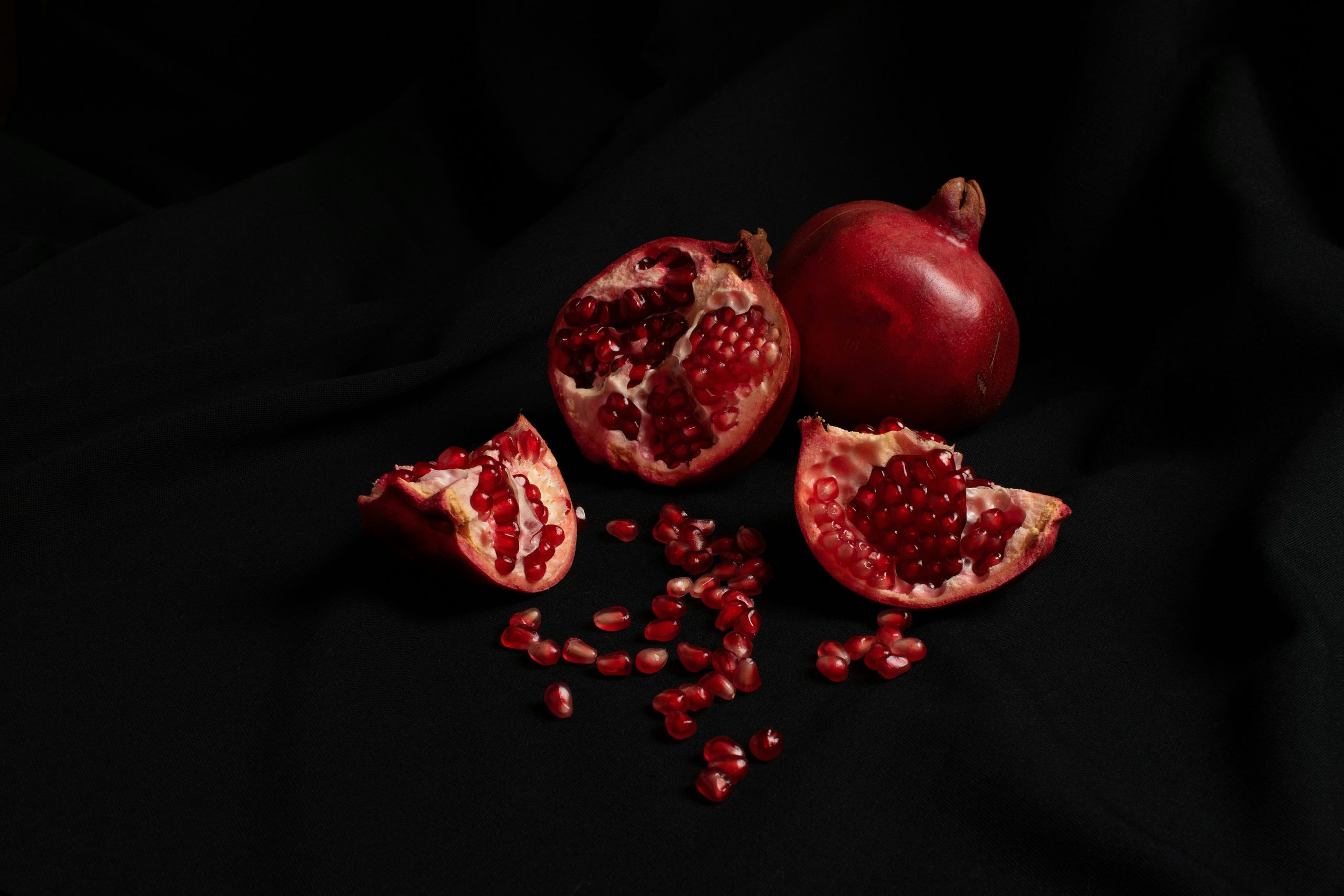
In the supermarket near my apartment in Vancouver, pomegranates live on a shelf just below the soft lighting that makes everything look a little holy. Each fruit is padded with mesh, crowned with a tiny sticker that says “Product of Elsewhere.” They are sold individually, not by the kilo, and cost almost as much as my hourly wage when I first arrived in this country.
I pick one up and turn it in my hand. The skin is polished, the blossom trimmed into a neat little crown. Somewhere in a marketing office, someone decided this was the right way to present a pomegranate to Western shoppers: smooth, contained, luxurious. On the days when I put one in my basket, I feel as though I am taking home not just a pomegranate but a précis of my own life: grown over there, consumed over here, translated into something that fits the aisles of a Western store. There is nothing here of the fruit’s ancient reputation, the way it has always meant sex and death and the space between, the seeds Persephone swallowed in the underworld, the way Persian poets used the fruit as shorthand for the beloved’s lips, for a heart cracked open.
Growing up, on Yalda night, the Central Asian/Persian celebration of the winter solstice, my mother spread newspapers across the living room floor. My grandparents, aunts, and cousins sat cross-legged, forming a small mountain range around the fruit. We cut the pomegranates open with whatever knife was closest; there was no photogenic symmetry. The skin resisted, then gave way. Inside, the seeds glistened like wet rubies in their white membrane chambers, and we went after them with our fingers. Sometimes the rind tore raggedly, and we had to search with our fingers, peeling back bitter white membranes, coaxing out reluctant clusters. The juice ran down our wrists. By night’s end, fingertips were stained red, newspapers blotched with juice, children’s clothes marked by splashes that would never quite wash out.
This is the difference I am trying to name. The pomegranate on the shelf and the pomegranate on the newspaper. The fruit polished for display, and the fruit cracked open in a living room. The version of a place that fits the Western imagination and the place itself, which is always messier, always more alive, always exceeding the frame.
***
In one of my university classes not long ago, our instructor shared a story about visiting a family member’s home country, a former Soviet republic in Central Asia. She had travelled with her children to meet extended family for the first time. They rented a house in the city, and relatives came from their village to stay with them. Nieces, nephews, the whole extended family gathered under one roof.
She described bringing gifts from Canada: coloring books, games for the children. Then her voice shifted, softer, wondering, as she told us about one moment that had stayed with her. The young niece, around the same age as her own daughter, had never seen a shower before. Back in their village, they bathed with buckets. When her niece discovered the shower in the rented house, she was amazed. The instructor described the niece’s delight as though she were describing something heartbreaking.
I sat there trying to understand why it unsettled me. It was, I realized, a story about plumbing. We were being moved by plumbing.
The former Soviet republics of Central Asia exist in a kind of limbo in the Western mind: not quite the Global South, not quite Europe—somewhere in between. They are imagined as places that were once on a path toward modernity and then fell off it, leaving populations stranded in a poverty that feels both historical and somehow their own fault. The Soviet Union, for all its violence, at least had plumbing. That the plumbing did not reach every village, that development was always uneven, that people found ways to live full lives regardless—none of this fits the narrative.
It was not that the instructor was unkind. She clearly cared about her family. But there was something in the framing, the assumption that the shower was the significant detail, that the children’s unfamiliarity with it was the thing worth noting. As if their lives, before that moment, had been defined by this absence. As if the bucket were not a way of living, but a failure to develop properly. As if no one had ever had a perfectly good bath with a bucket and a kettle and thought nothing of it.
I found myself thinking about all the things those children probably knew that the professor’s own children did not. How to move through a village where everyone knows your name. How to entertain themselves without screens. How to exist in extended family structures where dozens of people have claims on your attention. How to read the weather without any fancy apps, how to help with livestock, how to be part of a community that stretches back generations. Whether these forms of knowledge were burdensome or sustaining or both, the instructor’s story did not ask. It assumed the answer.
The shower became the organizing image because it confirmed what we already believe: that places are defined by what they do not have. I have come to understand this as the deficit gaze, a concept echoing scholar Eve Tuck’s critique of damage-centred narratives, a way of looking that sees only absence where there is also presence, only need where there is also abundance, only waiting where there is also living. It is not usually malicious. It is simply the water we swim in.
Or, I suppose, the water we shower in.
***
This deficit gaze is not confined to Central Asia. At an event I attended in Vancouver, hosted by writer Viet Thanh Nguyen, he spoke of Vietnam existing in the Western imagination primarily as a war. For Americans especially, the country has collapsed into conflict, its existence reduced to the years of American involvement. Thousands of years of history before, decades of rebuilding after, one hundred million people living ordinary lives today: None of this registers. As Nguyen writes in Nothing Ever Dies, the very name “Vietnam War” has become so normalized that “even if the name is abbreviated to Vietnam, as it so often is, many people still understand it to mean the war.”
This is what Nguyen calls the asymmetry of memory. America, with its Hollywood machine and its soft power infrastructure, has been able to globalize its version of the war: a story of American trauma, American heroism, American loss. Films like Apocalypse Now and Platoon circulate worldwide, while Vietnamese stories of the same conflict remain largely local. All wars are fought twice, Nguyen argues: “first on the battlefield, then in memory.” And in the memory war, America has resources Vietnam cannot match.
The photograph of Kim Phúc, the nine-year-old Vietnamese girl running naked from a napalm attack, has become perhaps the most reproduced image of the war, and of Vietnamese womanhood itself. Her pain circulates endlessly as evidence of war’s horror, yet this circulation rarely asks what Kim Phúc herself might want to say about her own image, her own life after that moment. But Kim Phúc refused to remain frozen. At a 2025 veterans’ dinner in Ohio, she asked the audience to see her differently: “When you see a little girl running up the road, try not to see her as she was then: wounded, suffering, and crying out in pain and fear. Try to see her as she is now: as a wife, a mother, a new grandmother, and a survivor calling out for peace.” Phúc built a foundation, became a UNESCO Goodwill Ambassador, a grandmother. But these dimensions of her life rarely appear in the Western imagination, which prefers to keep her running, forever nine years old, forever burning.
And so the pattern repeats: a complex place reduced to a single image of suffering, a people frozen in the frame of their worst moment.
***
I am Hazara, an ethnic group of Turkic and Mongolian ancestry from the Hazarajat—the land of the Hazaras—in the central highlands of Afghanistan. For centuries, the Hazarajat was autonomous. That independence was shattered in the 1880s, when Hazaras were forcibly brought under the control of the central power in Kabul. Like many Hazaras, my relationship with the word “Afghan” is complicated. Yet to be Hazara is not to stand outside Afghanistan but to sit at its complex heart. When I speak of the schools in western Kabul, I am speaking of a specific Hazara excellence, but I am also speaking of a broader Afghan desire.
To understand this desire, we must first look at the static image that has come to define us in the eyes of the world. You have seen the Afghan girl before. She appears in a blue burqa, or she appears beside a woman in a blue burqa—her mother, perhaps, or an older sister, or a future she is meant to dread. The scene is brown and dusty and vaguely menacing. The color grading alone could win an award for Most Ominous Beige. She is usually in the background, or she is the background: local color for a story about soldiers or journalists or aid workers finding themselves in a difficult land. If she speaks, it is to say something about oppression. If she is in school, she is in danger of not being in school. Her face, when you see it, is a face waiting to be saved.
This is the Afghan girl as she exists in the Western imagination. She populates stock photos, NGO campaigns, and documentaries that win awards at Sundance. In Whiskey Tango Foxtrot, the 2016 film starring Tina Fey as an American journalist in Afghanistan, Afghan women have no speaking roles. They drift through the frame in burqas, referred to at one point as “beautiful, mysterious Ikea bags.” Afghanistan itself is a “dusty, chaotic backdrop” for a white woman’s journey of self-discovery. Sad as it is, this is the genre rather than an exception.
In a 2022 interview, Afghan researcher Sahar Fetrat described her frustration with this imagery: “I was irritated by foreign scholars, journalists, and officials in Afghanistan who used imagery of Afghan women with burqa only. I thought they were not deeply engaged with the realities and changes in Afghan society.” The burqa became the only way to see Afghan women, which meant not seeing them at all.
And the oppression is real. I will not minimize it. Under Taliban rule today, girls are banned from secondary school and university. Women are banned from public parks, from gyms, and from working for NGOs. The United Nations has called it “gender apartheid,” a term Afghan women’s rights defenders have used since the Taliban’s first rule in the 1990s.
But the visual grammar of the “Afghan girl,” in which she is defined only by what she cannot do, where she cannot go, and what she cannot become, inflicts its own kind of harm. She is the deficit gaze made flesh, a lens that ignores the vibrant, internal world of the person behind the veil. To see that world, I must take you back to the winter of 2008.
I was eight years old, in grade three, wearing my blue dress shirt uniform paired with white pants and mandatory black boots. It was my first day at Marefat, a Hazara-run school in western Kabul. My father had decided it was time for me to switch schools, and I stepped into a world that defied every Western stereotype.
The founder, Aziz Royesh, had built the school on a simple premise: that education should teach you not what to think, but how to think. He had left school himself at the age of ten, during the Soviet invasion, and had educated himself in refugee camps. He opened schools wherever he went, in Pakistan and then in Kabul when the Taliban fell. The students could challenge the teachers. The teachers could admit they did not know.
I stayed at Marefat until grade nine. I joined the school music/choir team; hosted shows on the school radio, which broadcast across several provinces; wrote for the school magazine, though just once, but I remember the feeling of seeing my words printed and distributed, of being someone who could say something that others might read. These were not extraordinary accomplishments, but ordinary ones, which is precisely the point. Everyone around me was doing the same: joining programs, hosting shows, writing for the magazine, and planning futures as a matter of course.
After grade nine I left for Chicago, but Marefat continued and flourished. By the time the Taliban returned in 2021, the school had grown to more than four thousand students, nearly half of them girls. And Marefat was not alone. By 2021, more than one hundred and sixty private schools had opened in the Hazara districts of western Kabul alone, most of them modelled on what Marefat had built. Across the country, millions of girls were in school. This is what Hazaras and Afghans built when they had the chance: schools, curricula, intellectual communities, a generation of professionals and citizens.
But in Western coverage, there is little room for stories like Marefat’s. The media requires a simpler narrative arc: a failed state, a benighted people, a tragedy foretold. The deficit gaze does not know what to do with a girl in a blue uniform hosting a radio show, with classmates who debated literature, planned futures, and argued about politics between classes. Such stories complicate the frame.
***
If the deficit gaze is so limiting, why does this framing persist? Why do we continue to prefer the “Ominous Beige” of the Afghan girl in a burqa or the “heartbreaking” delight of a child discovering a shower?
I believe pomegranates play their own small, symbolic role in answering this. On restaurant walls in Vancouver, on magazine covers, and in the décor of boutique cafes, the fruit signifies a region imagined as both fertile and wounded, sensual and tragic. It becomes a way to aestheticize distance, to enjoy the idea of a place without reckoning with how that place was shaped by the political and economic decisions made right here in the West. We consume the “Product of Elsewhere” while remaining insulated from the “Elsewhere” itself.
This sanitization is what allows us to justify that a people can be intervened upon, restructured, and “liberated” into economic arrangements that benefit the liberators. This is the mechanism that the Palestinian-American scholar Edward Said identified in his landmark work, Orientalism. Said argued that the West does not simply observe the East; rather, it constructs it as a “theatrical stage” of exoticism and stagnation. By framing other nations as static, the observer creates a moral justification for dominance. When we reduce a complex society to a “single story” of victimhood, we strip them of their political agency. In the Western mind, they are no longer people with their own systems and solutions—like Marefat—but a blank canvas upon which the West can project its own “civilizing” missions.
The cost of this framing is not only political; it is intimate. It shapes how my former classmates are seen when they arrive in new countries, how their qualifications are assessed, how their stories are heard. It determines whether they are perceived as people with skills and histories and futures, or as grateful recipients of Western generosity. The deficit gaze follows you across borders.
But, to look without the deficit gaze is not to look away from suffering. It is to look more, not less. It is to see the suffering and the response to suffering, the loss and the survival, the wound and the healing. It is to recognize that people are always more than the worst thing that has happened to them, and more, too, than the worst thing their governments have done.
***
On Yalda night this year, I will buy a pomegranate. I will take it home and spread newspapers on the floor, and I will crack it open the old way, with my hands. The juice will run down my wrists. The seeds will scatter. By the time I finish, my fingers will be stained the colour of wine, of henna, of something secret, and for a moment at least, I will inhabit a reality that requires no sticker, no translation, no frame but my own.