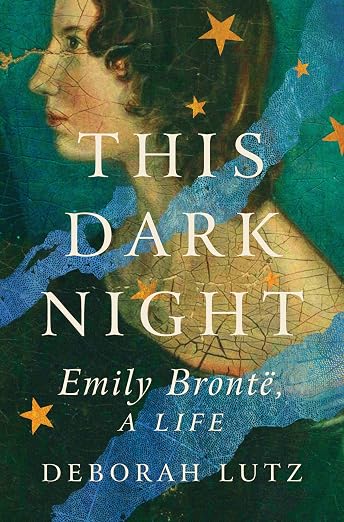
It’s inevitable that any review of an Emily Brontë biography arriving on the heels of Emerald Fennell’s bonkers adaptation of Wuthering Heights will reference the film (and most have). But I’m in the odd position of having also reviewed Fennell’s movie. This prompted an editor at W.W. Norton & Co. to send me an advance copy of Deborah Lutz’s This Dark Night: Emily Bronte, A Life, which was published in early May 2026. It arrived with a letter suggesting I might enjoy it after my “thrashing” of Wuthering Heights: “It’s not quite roaming the moors, but it’s close.”
A lifelong Brontë reader, I received the book eagerly, but did not take its editor’s words literally. Having read it, I realize she meant them that way. There are biographers desperate to know a life from the outside in and the inside out, and there are biographers aware that their subject is fundamentally unknowable. Lutz is the latter, and she works instead to produce a social and domestic history of those closest to Emily, a natural history of the West Yorkshire moors Brontë immortalized in Wuthering Heights, and a material history of Emily’s writing practice which, in the hands of Lutz’s meditative attention, approaches the mystical. “Expertise,” dry and academic, is the wrong word to characterize Lutz’s understanding of the Brontës. Victorianists tend to work exclusively with the established texts of their subjects, but Lutz spent several years immersed in Emily Brontë’s hand-written manuscripts (detailed photographs of these are included in the book) and inhabiting Brontë’s hometown of Haworth, West Yorkshire, and Brussels, where she studied alongside her older sister Charlotte at the Pensionnat Héger. Lutz pored over the local weather reports of Emily’s lifetime and learned the flora and fauna of the moors so integral to Brontë’s life and work (Emily could identify local birds by their song and kept a collection of their feathers she found on her daily walks). In This Dark Night, Lutz’s deep knowledge of Emily Brontë transcends biography and—appropriate for her subject, who wrote one of the most famous ghost stories in Western literature—approaches a haunting.
Written after a large cache of papers by the Brontës “that had been missing for over a hundred years” surfaced in 2018, This Dark Night gives readers a great deal of fresh information about Emily Brontë. Even with this new material, Emily remains the most elusive of the four Brontë siblings who survived into adulthood (the two oldest sisters, Maria and Elizabeth, died in childhood, events Lutz ties convincingly to Emily’s psyche and writing). Although Charlotte Brontë outlived Branwell, Emily, and Anne, she died at thirty-nine of complications from her first pregnancy, and Lutz posits that it was her widower who likely burned most of Emily’s correspondence and diaries.
Absent these sources, Lutz employs the candid letters, diaries, and various historiographical accounts of Emily’s father, Patrick, and her siblings to methodically illuminate Emily’s whereabouts and behaviors; these provide a comprehensive and intimate view into Emily’s place in the family pecking order. Despite being younger than Charlotte, Emily “exercised ‘a kind of unconscious tyranny’” over her elder sister, which Lutz says characterized most of their relationship. Its origins lay in their childhood rambles on the moors (even as very young children, they often walked several miles a day) where the physically implacable Emily relished in terrifying the timid Charlotte by “drawing her close to dangerous animals and cliffs.”
The animosity between them exceeded Emily’s death. Charlotte, by then a famous novelist and ashamed of what she viewed as Wuthering Heights’ ferocity and heresy, dramatically altered her younger sister’s only published novel, “correcting” the grammar and spelling Emily had deliberately constructed to evoke native West Yorkshire dialects. Charlotte reissued Wuthering Heights with her changes, including a condescending foreword that questioned Emily’s morality and claimed her younger sister was “not always master” of her “creative gifts.” This foreword had lasting cultural impact; Lutz spends parts of This Dark Night subtly disputing the now-famous idea that Emily was the unbridled genius to Charlotte’s controlled craftswoman. When the two studied together in Brussels, Charlotte fell in love with their married tutor, Monsieur Héger, and worked day and night to please him, events that inspired her novel The Professor. But Emily brushed off Héger’s advice about her own poetry and essays, assured of her talent and singular vision: “Emily was her own master,” Lutz writes.
Emily was much closer to her younger sister Anne, who was so bereft upon Emily’s sudden death at the age of 30 that she died five months later, “[like] a spouse who seems to die of a broken heart when their mate is lost.” But Emily was most at home with animals, with whom she was simultaneously tender and fearless. She once broke up a violent fight between her beloved dog Keeper and a stray by strong-arming Keeper and filling both dogs’ noses with black pepper. The men in town “‘[stood] there thunderstruck at the deed.’” Lutz makes Emily’s brute physicality (a quality she shares with her timeless anti-hero Heathcliff) a recurrent theme. When her father needed to train one of his children to shoot, he bypassed his only son for his daughter, Emily, whom he praised as “his brave and noble girl.” She was a crackshot.
This Dark Night effectively refutes the lasting image of the Brontës as isolated sad girls, stuck in the sticks with their abusive reverend father, which originated with Elizabeth Gaskell’s now-classic hagiography of her close friend, Charlotte Brontë. Lutz sketches a bustling, industrial Haworth where the Brontë siblings, as the children of the town cleric, were frequently at the center of social life, and Patrick bears no resemblance to the stereotypically restrictive Victorian father of legend. He gave his five daughters the same radical education he gave his only son, tutoring them in foreign languages and allowing unfettered access to the literature of the day (including the scandalous Lord Byron). He aided their travel to London and Brussels, and encouraged their creative writing, refusing to pressure them to marry. Online lit discourse likes to bat at the possibility that Emily Brontë was queer. Lutz won’t go so far as to guess, but she shows us a West Yorkshire where the Brontë siblings knew Anne Lister, the celebrated English diarist and lesbian, whose rarefied education and androgynous appearance modeled a different kind of life for Emily Brontë than the available standard for middle-class Victorian women–one Emily, who never married and devoted her life to art and her sisters, seems to have lived.
Emily’s living is at the heart of This Dark Night, which eschews the historically romantic notion of Brontë’s artistic genius that places Wuthering Heights as her singular accomplishment, with life a mere cipher for the novel. Lutz details how Emily created and maintained a writing practice alongside her brother and sisters from the earliest possible age. Many readers will be delighted to learn that for much of their lives, the Brontës’ primary form of writing was fantasy, the creation of elaborate worlds called Angria and Gondal. Angria belonged primarily to Charlotte and Branwell, and they abandoned it as adults, but Emily built Gondal with Anne, and it was a vital part of their writing into adulthood.
Together they wrote and rewrote the stories of this place, peopling it with angry queens, suicides, crypts, warfare, and illegitimate children. Emily was also an acclaimed poet (Emily Dickinson asked that one of Brontë’s poems be read at her funeral); many of her poems began in the voices of Gondalian characters and were later revised for a broad audience. Throughout their lives, the siblings staged dramatic readings of these stories; these readings evolved into the fiction workshop which birthed Wuthering Heights, Jane Eyre, and Agnes Grey, which the sisters read aloud to one another during the drafting process. Charlotte and Anne told Emily Wuthering Heights gave them nightmares; this made her laugh. Other extant manuscripts show Emily and Anne alternately filling the page with immediate observations of the household goings-on, what Lutz describes as an “avant-garde,” automatic writing practice, one she likens to the stream-of-consciousness writing that Virginia Woolf, herself a Brontë stan, helped to make famous in the twentieth century.
Although Wuthering Heights is her most famous work, Emily Brontë did not distinguish between “serious” work and her fantasy writing. This, Lutz argues, prepared her to write a novel firmly grounded in both fantasy and realism, one in which the protagonists’ longing for the impossible, or the long dead—for fantasies, in other words—are central to the story, if not the story itself. Brontë is most closely associated with the moors, the open expanse of uncultivated tracts of land surrounding the parsonage where she lived, with a few brief exceptions, for the whole of her life (and where she died). But Wuthering Heights (per Claire O’Callaghan, another Brontë scholar) is a novel of interiors, set inside the confines of two houses, in two or three rooms. It’s made up largely of dialogue between family members who possess the same or similar names—in many ways, a dark mirror of the domestic world Lutz describes in her book (Emily’s mother and sister, and father and brother and aunt, all shared versions of one another’s names).
A haunted world in which the living bear a resemblance to, and the names of, the dead was therefore a world Emily Brontë knew intimately. She daily inhabited its confined spaces, becoming obsessed with both the confinement and the inhabitants. Lutz locates the roots of this obsession in the crypt beneath the church Patrick Brontë ministered to. It opened upon her adored mother’s death when Emily was a small child, and would be reopened to receive her two elder sisters, Maria and Elizabeth, who died of consumption in quick succession four years after their mother’s death. These deaths and interments, Lutz writes, “became bottomless crypts lending shape to her art,” echoed in the cramped interiors of Wuthering Heights and responsible for the creative ethos Brontë went on to develop. With her mother (and maternal older sisters) all dead before she turned ten years old, she had to learn to care for herself, to be a singular voice. “Don’t look away from the pain, but stare at it unflinchingly, enter it and linger there,” Lutz writes. “Be haunted eternally.”
But if Brontë was eternally haunted by the bodies of her beloveds in the crypt, she was also liberated by the landscape just beyond it. The moors birthed and sustained her relationship with natural beauty, which Lutz argues Emily held closer than any Christian god. Brontë embodied this beauty and this haunting in her writing and, through it, created a lasting body of work. Lutz notes that in many of Brontë’s accomplished poems, “the point of view is that of a small animal or insect,” able to disappear into the vastness of the earth while gazing up at the vastness of the sky. She was equally concerned with both, but had a special interest in what lies beneath the earth, what Emily called “the undergloom” (and where, Lutz tantalizingly suggests, Brontë may have buried the manuscript of the second novel she was writing at the time of her death).
Far from reinforcing the gothic trope of Emily mooning over the rotting dead, Lutz investigates the ways Brontë’s close familiarity with the soil of the moors informed her domestic life as a gardener and cook and fueled her imagination. Brontë knew that what lay beneath us was as alive as we are and that the properties of peat bogs, common in West Yorkshire, were able to preserve bodies—Lutz describes the “bog men” discovered in the area, ancient bodies preserved by the peat soil. It’s this, she implies, that explains Wuthering Heights’ grimmest scene, when Heathcliff digs up Catherine’s body twenty years after her death. Heathcliff claims Cathy’s face is still her own, often read as proof of both his madness and undying, blinding love. Lutz asks us to consider the possibility that Catherine’s body really was preserved by the extraordinary properties of the land where she was buried, properties Emily knew so well.
This Dark Night is, therefore, literally a biography of the dirt beneath Emily’s feet which subverts the tired trope of Emily Brontë hitching up her skirts and running wild on the moors to instead give us a woman who was both a writer and a naturalist who also ran a household. Wuthering Heights is a book best remembered for the wilderness of its moors which nonetheless takes place almost entirely inside. We think of Cathy’s longing for that wilderness when she is trapped in confinement and the longing, the state of it, feels almost like the place itself. Lutz compels us to wonder if Emily Brontë felt that same longing—not for the moors, which were her literal backyard, but to break free of her human form, to seep into the “rocks and stones and trees” of the world she loved. It’s difficult to say for sure, especially since This Dark Night is so grounded in the physical—gardens, laundry, mending, cooking, dogs, cats, hawks. Yet Lutz captures Brontë’s ineffable desire to break free of her physical body, which is both a graver and braver thing than she might have done with this biography.
It’s possible—valuable, even—to reduce a figure like Emily Brontë to the questions that trouble our own gender politics. Emily Brontë might have often wished to be a man, or to love a woman, and these things may have limited her ability to lead the kind of life some of her contemporaries led. To write a book that addresses how Emily Brontë was limited by her gender is one thing. Lutz shows us instead that Emily Brontë’s real limitation was her human form, and how she paradoxically used that form to harness a mysticism and create some of the language’s most lasting works, works which nonetheless elucidate our own gender relations in ways rarely surpassed, even today. That is what a genius does, I suppose.
Near the close of the book, Lutz writes that, after Emily’s death, she became the “genius loci” for the remaining family members (only her father, Anne, and Charlotte remained, Branwell having died six months prior). She seemed to me the genius loci of This Dark Night, as well, if it’s possible for a subject to haunt its own book. Because the book is largely constructed of the words of those closest to Emily about Emily, rather than Emily’s own words, we see her in the periphery, or view her from afar. I felt pleasantly haunted throughout my reading of this biography, and was surprised to find myself weeping as it closed. I am a writer, and frequent reader, of biography. The death of the subject is pretty much the one thing you can count on in the genre, but Lutz paces her book so well that Emily’s sudden death seems to happen as quickly on the page as it did in life. The shock of it—Emily refused medical attention and insisted on keeping her eyes open to “meet” her end—took my breath away.
I learned more about Emily Brontë and her famous siblings from reading This Dark Night than I knew before. These facts stay with me and yet, the more I learned, the more distant Emily grew. It was as though the attempt to contain her or reduce her to acts or incidents or objects was to break up this person, who was always so evidently more than the sum of her parts, into her parts, and then watch the parts erase the whole. This is no fault of Lutz’s and is part of her book’s great success, since this seems to convey how her contemporaries felt about her. Emily Brontë is long dead. She can never be brought back to life, but we are haunted eternally by her, by the dictum she gave herself.
“There is no Emily in Time or on Earth now,” Charlotte is quoted as saying upon her sister’s death, and we feel that loss as keenly today as Charlotte did then—or fool ourselves that we do, or Lutz fools us that we do. If Emily can die like any other, we all can. We all will. This should have left me bereft, or at least a little grim, but instead I was comforted, and reminded of the feeling I have whenever I visit the Brontë Parsonage in Haworth, specifically, and the Calder Valley more broadly, which I try to do every few years. It took me a long time to characterize this feeling, which is a meditative ecstasy that leaves me with a profound sense of well-being. Eventually, I just said it aloud, so here I go: When I am there, in the land that birthed and received Emily Brontë, I feel immortal. Not because of some delusion that I will never die, but because, paradoxically, I am aware that I absolutely will. And life will go on beautifully beyond me. If I am lucky, any small thing I’ve done or said will reach out to the living; maybe they will have a conversation with the dead, like this one, like Lutz’s. Maybe I will talk back.