I rested my hand on my friend’s back, ready at any moment to hold her hair, as she dry-heaved into the movie theater hedges. When we decided to see The Substance on its opening night, before the hype and the media hullabaloo, neither of us expected such a nauseating display.
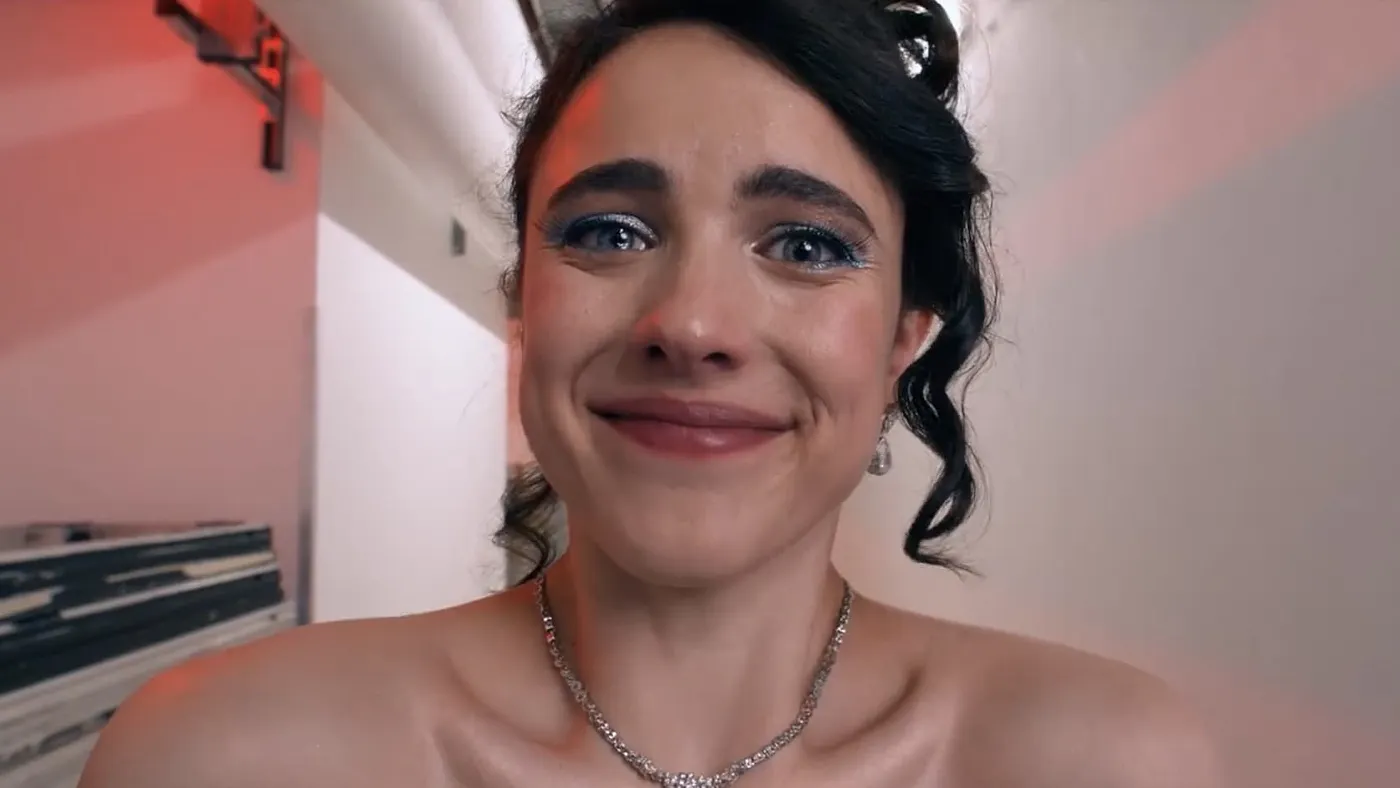
I spent half the film watching Demi Moore and Margaret Qualley through my fingers, and likely the other half with my eyes covered entirely, audibly gagging during the 140-minute trainwreck that seemed to be unfolding in front of me in extra-slow motion. The 2024 film centers Moore as the beautiful yet aging Hollywood star Elisabeth, who takes a mysterious black-market drug to revert back to a younger version of herself after she is fired from her long-running television show on her 50th birthday. The titular substance, a single-use bright green liquid, splits Elisabeth into two entities, her regular ol’ has-been self, and the new spritely starlet Sue (Qualley), who rips Elisabeth open from the inside and crawls out of her discarded body, plump as a baby and sexy as a Playboy. The two women are expected to “respect the balance”: Every week they must switch off consciousness in order to keep either body from deteriorating. But after obtaining overnight success as Elisabeth’s replacement, Sue’s bodily avarice festers uncontrollably, causing her to live far beyond her week-long means, all the while rapidly aging Elisabeth’s body into that of a terrifying, decrepit hag.
The film, by French filmmaker Coralie Fargeat, was nominated for and won several awards for its visual effects and makeup, and, at the expense of myself and my friend’s weak stomachs, for very good reason. Every shot of The Substance is viscerally disgusting and incredibly violent. After Sue murders Elisabeth (who, to be fair, was also trying to murder Sue), she begins to rapidly decompose just hours before she is set to host a Dick van Dyke-style New Year’s Eve broadcast. Her teeth wriggle out. Her nails break away from their beds. Her ears rot off the side of her head. But, when Sue tries to create an even younger, even more beautiful, even more perfect version of herself with the leftover serum, she mutates into a bullous monster with both her and Elisabeth’s rictus faces stuck in perpetual scream on its body.
Not a single fleshy detail was left to the viewer’s imagination, not even the film’s repugnant end, when the monster totters onto the live broadcast’s stage in a designer gown and a paper mask of Elisabeth’s face, babbling unintelligibly until she is decapitated, then explodes. I could not get out of the movie house fast enough.
***
I was born in the early aughts, the pinnacle of tabloid fat-shaming and “nothing tastes as good as skinny feels” mantras. I grew up in the bleach-blonde visual landscape of Scottsdale, Arizona, sometimes dubbed “Silicone Valley.” I hit puberty during the thin-spo era of Tumblr. Although my mother always modeled a good relationship with her body to me, my greatest fear as a child was growing up to be fat and ugly. I was never a “pretty girl” to the other kids my age and I was often ridiculed for being bigger, which, looking back, I never really was. In elementary school, with no understanding of human anatomy, I would dream of taking scissors and cutting off rolls from my stomach and legs. As I got older and developed curves, the fears only became worse when I realized all this wasn’t just playground politics and these things “mattered” in the real world. By age eleven I was getting monthly facial waxes to put an end to the Why do you have a mustache if you’re a girl? remarks. By the end of middle school, I was drinking five cups of green tea a day because I heard on Instagram that they helped you lose weight. I would have done unthinkable things for a blonde balayage. In high school, I would walk into doors and walls in unsuccessful attempts to break my nose (an excuse for a rhinoplasty); and I tried relentlessly to give myself anorexia (just for a month, I would think), but was far too undisciplined to succeed at it, which I hated myself for.
I look back at this younger version of myself and do not feel contempt or pity for her. I feel the same ache I felt for Elisabeth and Sue in the car ride back from the theater: sorrow. As a white child living in a conservative suburb, I experienced only a fraction of what others did, but it was enough for me to fantasize about bodily harm before I even understood what the beauty standard was. I still sometimes do. The message is that these insecurities, instilled in so many women like me from the moment we can walk and talk, are punishable by violence, mutilation, and death, is yet another piece of propaganda that women bring suffering unto themselves, instead of a longstanding patriarchal structure that hoists it upon them without regard.
I’ve long gravitated toward reading body horror in literature, as many of the modern stories in the genre are written by women, about women. It’s cathartic to read other women’s accounts—especially fictional accounts—of the terror that existing in a female body begets. I did not expect The Substance to reach the heights it did: It took the culturati hostage, earned several Oscar nods, and was the revelatory sign that body horror was back and better than ever. Move over Cronenberg, we have a new version of mutated monsters. And guess what? This time, they’re feminist. Or so we like to call them.
***
The Substance’s critical acclaim and box office frenzy was yet another clue that horror was beginning to be taken seriously by cinephiles, but also by the Academy. In the midst of the horrific reality we are entrenched in, it makes sense that horror is resonating with audiences more and more by the year. The genre has long been one of the most reliable forces to draw people to the theaters, and the industry is betting big on it to reinvigorate the box office. The low-budget slasher films of the New Hollywood era dominate the genre no more: Horror is mainstream and highbrow now. Only for those with thick skin and critical minds.
A slew of body horror movies succeeded The Substance’s release, from blockbusters like Dave Franco and Alison Brie’s Together (2025) to international indie films like Saccharine (2026), all with similarly graphic degenerations of the human body. While none generated the widespread hype of The Substance, their existence in its wake is a telling sign that modern cultural criticism is increasingly borne from the body, and meaningful, progressive messaging is more emphatic when it shocks rather than awes.
After my friend stopped gagging into the bushes and we took our separate Ubers home, I pulled out my phone and rated The Substance half a star on Letterboxd. “nightmare asmr,” I wrote, and left it at that. But the real reason my disliking of the film grew by the minute was not due to my squeamishness. It was born from the immense sorrow I felt toward Elisabeth and Sue. Although they are not real people, the brutality they underwent because of the aesthetic pressure they felt is undeniable, and also redundant. The Substance’s success was ultimately lauded for its commentary on ageism towards women, but any woman with half a brain and a lick of social awareness already knows this harsh reality. I felt consternation not for the film’s rife messaging, but for its intense violence and degradation towards Elizabeth and Sue for buckling under the pressure.
The film identifies sexism and ageism in a way that is intentionally palatable for male audiences: It provides shuddering violence toward women, coupled with a complete lack of responsibility from the men who push them to insanity (i.e. the male nurse who refers Elisabeth to The Substance’s practitioner; Elisabeth/Sue’s chauvinistic manager; the medical company’s phone operator who refuses to help the women during distress, and countless others).
Men identified the themes of the film with ease. Most had one of three reactions: They were either, for the first time, awoken to the harsh truth older women face daily (Peter Bradshaw of The Guardian called it “an awful reckoning”); found it boring, feminazi propaganda (Damon Wise’s Deadline review described the movie as “Demi Moore to make a hagsploitation body horror splatter movie”); or disputed the claim that beauty standards affect women more than men (a riotous MAHA-inspired Reddit thread called it “painfully similar” to testosterone replacement therapy, scrutinized the lack of a focus on a male character who has taken The Substance, and claimed men are just as affected socially by aging). So who, then, is The Substance actually for, when it overstates what half the planet already knows and the other half remains obstinately ignorant towards?
***
All of the “feminist” body horror media that followed The Substance begs the same question: Is all this violence toward women even necessary?
Female protagonists in recent body horror films are mainly characterized by their intense insecurities and their betrayal of their bodies in the pursuit of obtaining “perfect beauty,” whatever that may entail, depending on the specific angle the film is trying to explore. Last year’s The Ugly Stepsister looks at female intrasexual competition through a Victorian woman named Elvira who subjects herself to archaic plastic surgery in order to filch the love of a prince away from her more attractive stepsister. A female-centered adaptation of the racial politics of Jordan Peele’s Get Out, Slanted, which came out in April, follows a young Chinese American highschooler, Joan, who undergoes cosmetic surgery to look white in order to become prom queen. In The Beauty, a pair of FBI agents investigates a pharmaceutical executive who accidentally unleashes a deadly lab-grown STD that turns people so hot they combust, then markets the cure for an exorbitant price, in a critique of Big Pharma.
The female characters in these stories are vehemently tortured for their decisions to give into the societal oppression of whatever form of lookism they are obligated to inhabit. Despite breaking her nose, sewing fake eyelashes into her eyelids, consuming a tapeworm, cutting off her toes, and breaking all of her teeth, Elvira watches her stepsister get whisked away by the prince while she is stuck unmarried under the tyrannical rule of her evil mother. After Joan’s skin begins to melt on stage during her prom crowning, she rips her face off in the hopes of finding her prior self. The Beauty starts out with none other than Bella Hadid imploding, and ends with a young insecure woman intentionally catching a mutated strain of virus, then transforming into a creature that looks like a one-to-one replica of The Substance’s monster.
Through female body horror, audiences are told that sexism, ageism, racism, and corporate greed are bad, but the people who pay the price for society’s ills are the women who fall victim to them, not the perpetrators. Is the only way to discuss the chasmic anti-woman sentiments that pervade every form of oppression to change a woman’s physical appearance? To make her helpless to the joy of being “beautiful”—which I guess is now the same as belonging—until, poof!, she is destroyed due to her insatiable greed?
These rituals of punishment women face are not new nor exclusive to the body horror genre; they are repackaged from the conservative slashers of the 1970s and ’80s. In 1990, researchers Gloria Cowan and Margaret O’Brien found that, from an analysis of 474 victims in 56 films, slashers separated “good” women from “bad” women through their proclivity for survival. “Good” women were not promiscuous, and more likely to survive. But women who were sexual were deemed “bad” women, and therefore allowed to be punished by the deadly, ironic penetration of a blade from a male killer.
As seen in modern body horror, men are no longer the sole antagonists of the genre. But, although gender and film scholar Barbara Creed identified changing attitudes towards female anti-heroes in her foundational 1993 text The Monstrous-Feminine: Film, Feminism, and Psychoanalysis, she said, “I am not arguing that simply because the monstrous-feminine is constructed as an active rather than passive figure that this image is ‘liberated’ or ‘feminist.’”
The idea that the woman willingly turns herself into the monster through her ignorant obsequiousness to beauty, as Creed said over thirty years ago, is in no way progressive. Body horror recognizes the societal pressures that push their protagonists to seek out such extreme measures, but points the finger at the women who crack underneath these pressures. They are to blame; they have brought this fate upon themselves. Don’t crumble under the expectations that have been put upon you since you were a young girl, even if it costs you your job, your freedom, your life. And if you can’t handle it, your ultimate punishment is not your pain, it’s not even being turned into a fly or killed by a television frequency. It is being ugly—the worst thing a woman can be.
***
I want to be clear: In the Ozempic era and age of Instagram- and Mar-a-Lago-face, I am not advocating for women to modify their appearances endlessly without critique. Whether cosmetic surgery is feminist is above my paygrade at the moment, and fluctuation of “trendy” racial attributes is altogether confusing and dismaying. What I do mean to say is that there is actually a wealth of modern feminist body horror, it’s just not what we’re seeing on screen.
The recent body horror boom in literature predated The Substance, and has a bit more of it. While there is, of course, body horror literature that deals with changing one’s appearance, it’s only a fraction of the genre. For every novel like Ling Ling Huang’s Natural Beauty and Mona Awad’s Rogue, there are hundreds that take a critical lens to pressing issues without addressing them through a woman’s appearance. Chelsea G. Summers’s debut novel A Certain Hunger, about a food critic who kills and eats men after making love to them, is a visceral feast of discussions on the structural and social power imbalances between men and women; and Monika Kim’s The Eyes are the Best Part tackles conversations of racism and fetishization through a young woman who fantasizes about eating blue eyeballs.
The few literary adaptations that have made it to the silver screen seem to tame the original texts and are not representative of the diversity of the literature. The film adaptation of Rachel Yoder’s novel Nightbitch domesticated the story of a mother turning into a dog into a sappy “girlboss” drama, and Ryan Murphy’s adaptation of Danielle Rollins’ Delicate Condition, about an occult IVF treatment, rendered the original text unrecognizable, neutering its poignancy.
Hollywood has a very specific idea as to what female body horror is. It’s not to say that the creators of the individual films and series are anti-woman or even intentionally want to uplift violence towards women. I have no doubt in my mind that Fargeat and most other body horror filmmakers just want to point out these monstrous issues to a wide audience—and horror being, at the moment, the widest—but when Hollywood only greenlights shock and awe done unto women, it inadvertently creates a media landscape that is inherently anti-feminist.
***
After a front-running campaign ahead of the 2025 Academy Awards, Demi Moore lost the Oscar for Best Actress for her performance in The Substance to Mikey Madison. Many were quick to call out the irony of the situation: Madison’s raven hair and alabaster skin is reminiscent of Moore’s, a plausible younger version of herself. I guess it was true, netizens opined, The Substance fixed nothing! (Along with, Doesn’t Demi look reallllllly skinny and sickly?) But the comments, these attempts to pit Moore and Madison against each one another, are what The Substance actually highlights about our current culture. It is the real evil, the real mysterious lab and green goop. Pitting women against one another, humiliating them for their insecurities, punishing them for their flaws—it will never solve the underlying issues.
Perhaps I’ll take a break from these films until I see a man punished for his satyromania toward young women, or a director disintegrate the social structures upholding these values instead of the protagonist’s face. Perhaps I will never return. I don’t want to watch the women who resemble me and my friends tortured for a burden we did not create.