
Many disliked the blunt disregard for Homer’s epic poem in Christopher Nolan’s adaptation of The Odyssey, altering and even eliminating altogether some of its most famous passages. It is true that in Nolan’s adaptation, there is little of Odysseus’s hubris, his contradictory ways, his cunning survival, and even his love exploits with nymphs and goddesses. Instead, Nolan plays a trick on us: He makes the hero look inward, in deep and painful agony, far from Homer’s protagonist, presenting a guilt-ridden Odysseus with an anachronistic, Christian anti-war stance. He must reckon with the sack of Troy because it has precipitated a spreading horror.
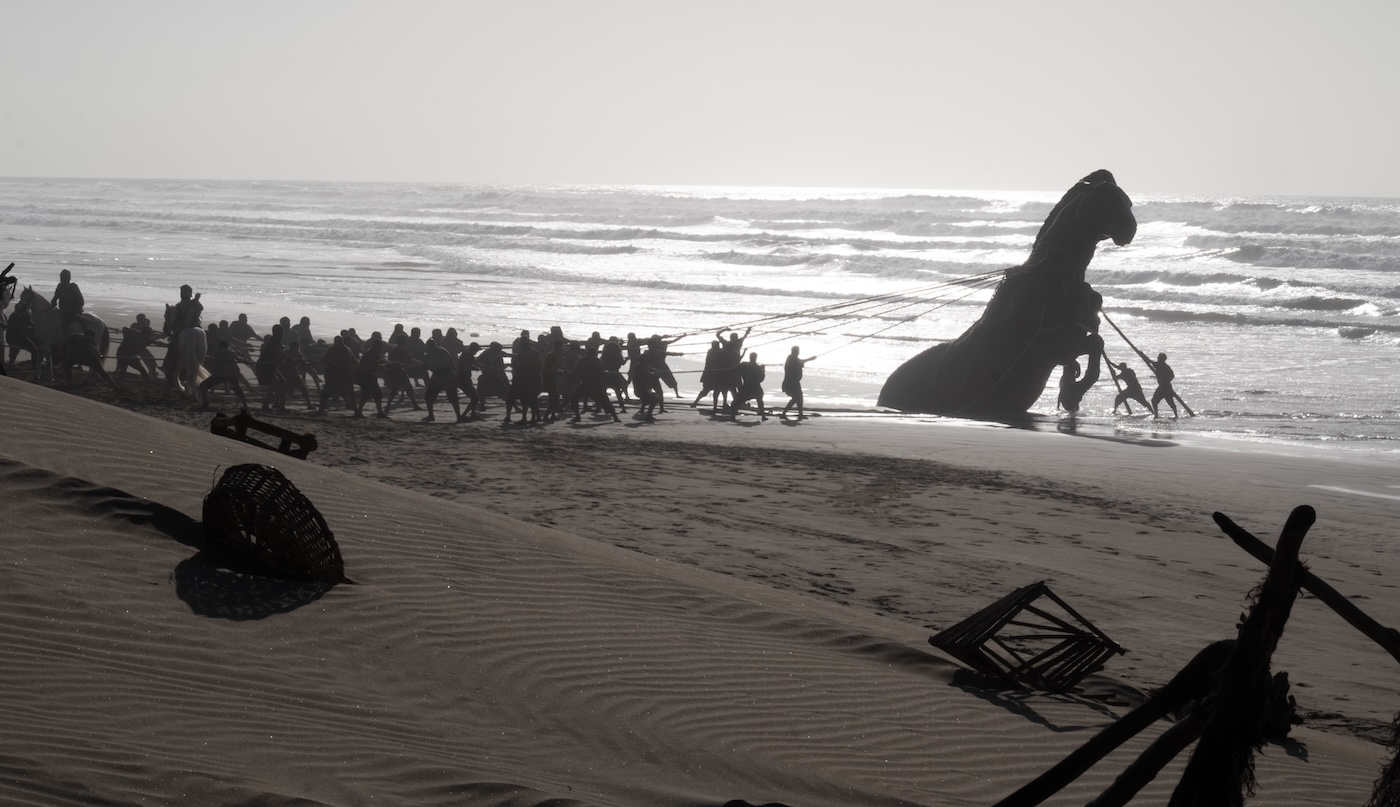
Famously, Homer’s Odysseus builds the wooden horse as a clever device to breach the otherwise impenetrable wall of Troy. It is a peace gift from the retreating Greeks, a sacred offering to appease the goddess Athena. A majestic scene in the film shows a gigantic, apparently harmless wooden horse half-sunk on the beach, recalling the ending of The Planet of the Apes (1968), when the Statue of Liberty sticks out of the sand on the beach of what used to be New York City. It echoes the sense of the apocalyptic. The wooden horse was a monstrous deception signaling the end of an era. It’s an unprecedented abomination, violating all conventions, disavowing the shared religion with the Trojans, and even betraying his own comrades to conduct collective punishment against innocents inside their own homes. The sequence of the soldiers enduring the heat, the rising tide, and their own bodily fluids as they wait inside the horse emphasizes the barbarity. An unforgivable war crime.
I will not be the first to notice the parallel between this version of the Trojan War and the forever war the United States has unleashed across the world. But I want to focus on one single perverse gift the US empire has offered its southern neighbor: the war on drugs. We may call it a Mexican Trojan Horse, as it was a ruse that caused—and keeps causing—death and destruction.
Implanting a War
It is often repeated that Felipe Calderón, then Mexico’s president, decided of his own accord to launch the now-infamous war on drugs in December of 2006, soon after winning a dubious, widely contested presidential election. As I argue in my book La guerra en las palabras, the idea was implanted in Calderón, who never campaigned on a drug security platform, but nevertheless called for a national antidrug militarization strategy days after taking office. Calderón underwent a process of inception—in Nolan’s sense of the word—through which the US persuaded him to escalate the drug war instigated with virulence for at least three decades.
Starting in 1975, the US pushed for a military campaign to attack poor peasants in Northern Mexico, spraying herbicides to defoliate poppy and marijuana crops, resulting in the exodus of thousands while failing to curb drug production. In 1989, the US forced Mexico to accept that drug organizations were a “national security” threat, even creating a new intelligence institution to repeat those false claims. In 2007, Calderón negotiated a cooperation agreement with then-President George W. Bush: the Mérida Initiative, which funded a national military campaign against so-called cartels.
President Calderón recalls how, to enhance the drug war in México, he personally asked President Bush for the “instruments” of Jack Bauer, the counterterrorist agent in the TV series 24. As US cultural productions shaped the Mexican president’s mind, the US also trained thousands of police officers and soldiers in the art of killing. The US government has since spent over $3.6 billion on military equipment and training through the Mérida Initiative, which has contributed to the killing of 460,000 people and more than 134,072 disappearances, a disproportionate number of them young, poor, brown men, in what at times appears to be a targeted social cleansing campaign.
The Mérida Initiative was modeled after Plan Colombia, a US-backed $10 billion aid package to instigate counternarcotics operations from 2000 to 2018. Journalist Dawn Paley calls the Latin American drug war a “neoliberal Trojan horse” with transnational military policies meant to bring peace and security, in reality, instrumentalizing violence to access resources and untapped markets. This type of binational agreement, Paley argues, “combines terror with policy making in a neoliberal mix, cracking open social worlds and territories previously unavailable to globalized capitalism.”
Kill the Narcos
The drug war has been told as an epic in which modern heroes—DEA agents, brave Mexican soldiers, even if only a few—have fought the barbarians, the Mexican narcos. In the 2018 Netflix series Narcos: Mexico, Walt Breslin is a persistent DEA agent who journeys into a land of many adventures and horrors, who fights his share of battles, and who mourns his friends killed in action. It is a story that transforms other men—frequently poor Mexican men—into rats and peasants into bloodthirsty armies, the lotus flower into valuable cocaine and marijuana shipments.
The plot is simple: In 1985, DEA agent Enrique Camarena is kidnapped and killed in Mexico by Mexican traffickers in retaliation for his investigative work, which led the authorities to one of the largest marijuana busts in history. At the end of season one, agent Breslin crosses the southern border posing as a tourist and drives an RV to smuggle a small arsenal of weapons. Once in Mexico, he gives a group of other agents—or perhaps mercenaries—a hit list of Mexican traffickers. “We knew we were in a war,” Breslin says. “Now it was our turn. Pretty soon, they were going to know they were in one too.”
Aligned with the official US narrative—a DEA agent directly intervened in the production, to the point of offering spoilers—the series distorts the events and naturalizes the killing of traffickers as a type of justified war.
Mexican viewers will point out that Breslin did not need to breach a wall to sneak into Mexico, as it is mostly defenseless against invasions from the north. The DEA agent comes from the country that built the only standing fortification, so it is hard to believe that he had to smuggle weapons when the US armed the Mexicans traffickers he now intends to kill.
The plot becomes even more distorted when you learn that, according to the DEA officer assigned to investigate the agent’s murder, the CIA tortured and killed Camarena after he learned that US covert agents used drug money and properties owned by Mexican traffickers to sponsor the Contra insurgency in Nicaragua. It is also documented that US-trained Mexican soldiers committed extrajudicial killings, and that the militarization has enabled lucrative gas, oil, and mining projects across Mexico, with transnational energy companies working undisturbed even in those regions most ridden with drug-related violence.
Narcos: Mexico omits all this, of course, and like its DEA protagonist, it smuggles back its distorted narrative, blaming the traffickers while erasing all the alleged CIA tracks in the crime. This Mexican Trojan Horse is not a trick to win one war: It is the fundamental mechanism of a forever war.
All the Trojan Horses
Barbarous tricks are found in most US interventions since World War II. We see it in the false evidence of weapons of mass destruction presented at the United Nations to justify the invasion of Iraq, and more recently, in the made-up drug cartel that the Department of Justice used to legitimize the kidnapping of Venezuelan President Nicolás Maduro.
Today, with the resurgence of right-wing governments across the region, the US has expanded its violent interventionism by creating the “Shield of the Americas,” a “counter-cartel” coalition of Trump sympathizers. They claim Latin American drug cartels are now popping up everywhere in the region, much like the faceless “people of the sea” in Nolan’s film.
As of now, nineteen countries have joined the alliance. With the political and financial backing of the US, Colombia’s right-wing President Abelardo de la Espriella—the newest member, a millionaire with dual US-Colombian citizenship—promised to bomb cocaine labs in the jungle and to build megaprisons in the style of those built by Salvadoran President Nayib Bukele. The Trump administration has dramatically intensified violence by designating drug cartels as terrorist organizations, justifying unilateral strikes in Latin America as part of a program the Pentagon calls “Operation Total Extermination.” It has already killed 223 people—many still unidentified—off the coasts of the Caribbean and the Pacific. Ecuador bombed a dairy farm that US intelligence identified as a “narco terrorist camp,” while the CIA is reportedly running another bombing operation against fishing boats near the Galápagos Islands, killing at least eight men.
If we pay attention to all this violence, we will soon see the identity of the “people of the sea.” They are the ones willing to kill their own citizens for “national security” reasons.
The Gift of Death
The Mexican Trojan Horse, however, inverts the premise of The Odyssey. As Helen explains in the film, the Greeks used her affair as a pretext to attack Troy and displace it as the region’s hegemon in control of all trading routes. Conversely, the US pretends to generously help Latin America to maintain its century-old political and economic dominance in the region.
The “war on drugs” is a double-edged sword gift that literally kills you twice. It ignites the conflict from a distance by flooding Mexico with the annual contraband of as many as 500,000 guns, many of which end up in traffickers’ hands. Then, it gifts money and training for the Mexican army to go after the criminals the US armed in the first place. As it pushes for antidrug militarization all over Latin America, the US takes 85% of the profits from illegal narcotics sales in the country, leads the world in money laundering schemes, and maintains the single largest drug market on the planet. The US is considered, in fact, the “drug capital of the world.”
The war—the killing—happens in Mexico. The drugs and the money remain in the US. There are no enemy walls to penetrate, but the US has built its own to curb undocumented migration fleeing the violence and the uninhabitable Latin American regions torched by the “war on drugs.” The US wall is breached daily, but the migrants are not foreign invaders—they make a cheap labor force that fuels the economy, pays taxes, yet is still criminalized, scapegoated, and marginalized. Unsatisfied, the US exploits Mexico’s precarious labor force on both sides of the wall.
It is true, as Grant Morgan writes in Jacobin, that Nolan makes a conservative turn as he imagines the empire repenting for its crimes without calling to subvert imperial politics. Odysseus finds forgiveness while allowing the next generation to inherit the throne and continue ruling.
The current state of politics in the US, however, is closer to Homer’s wicked poem than to Nolan’s wishful adaptation. It is led by a bragging king, ready to cause the demise of others because he cannot stop himself from mischief, from taunting the Cyclops, from hearing the Sirens’ song, from destroying the prosperous Troy over a man’s wounded pride.
There Is No Epic
In his poem “The Art of Poetry,” Jorge Luis Borges compares Odysseus’s island of Ithaca—and not his epic journey home—with the essence of art: “They say Ulysses, wearied of wonders, / wept with love on seeing Ithaca, / humble and green. Art is that Ithaca, / a green eternity, not wonders.” Like Borges, Nolan’s rewriting of The Odyssey does much more than present Odysseus as a sober old man ready to make amends: It interrupts the very logic of the epic, it robs the hero of his adventurous landscape, it uncomplicates the complicated hero, it even decapitates the gods. In sum, it relocates art in the green eternity of the land and the sea, away from the wonders of imperial killing. Stripped of its magnificent mythology, the film reduces Western culture to a society of murderous thieves craving the next bloody plundering, with only a few good men willing to admit that they are in desperate need of forgiveness.
For those of us on the outskirts of the Western tradition, watching the film from the perspective of the conquered, there was a certain relief in looking down on the gringo Odysseus accepting his mea culpa, even if it’s only done to allow the empire to wash away its sins the old Christian way.
Matt Damon’s Odysseus makes us realize who the real “people of the sea” are and what kind of destruction they are bringing to our city gates. The film’s leading cast is revealing in that sense: Damon played a CIA-trained assassin in the Bourne trilogy; Jon Bernthal, a police officer, mobster Johnny Soprano, a mercenary for a private army; Robert Pattinson, the resourceful time-travel agent in Nolan’s Tenet; and as Odysseus’ son Telemachus, Tom Holland, whose first installment of Spider-Man was titled Homecoming. They are all echoes and variations of the same motif: the brave man trying to return home or build a new one while ravaging other people’s land.
It is also very telling to look at the minorities in the film: Eumaeus, the blind and wise servant, is beautifully performed by John Leguizamo; Zendaya is the nameless, decapitated Trojan young woman who haunts Odysseus as a spectral Athena; both the disfigured Helen and Clytemnestra, killing Agamemnon to avenge the murder/sacrifice of her daughter, are played by Lupita Nyong’o; and Anne Hathaway, as Penelope, speaks for the abused and harassed woman married to a missing soldier. They all seek justice, but they do little to disrupt white masculine power relations.
Nolan’s film does not dare to speak truth to power to the fullest. In our cruel contemporary Odyssey, there is no epic, no homecoming, and no redemption. There is certainly no atonement. No one will pay. No one will be exiled. The wall will stand because it was built by those who conceived the Trojan Horses as tools to preserve an empire, not to destroy one.
Let us silence the muse and extract the tricksters from within the Trojan Horse of the drug war. Let us interrupt its epic tale of wonders. If the perpetrators don’t offer to atone for their sins, we should make them. We are weary of wonders.