
I first encountered Hannah Neeleman, the polarizing figure behind the social-media sensation Ballerina Farm, the way most people encounter Hannah Neeleman: accidentally.
A few years ago, her name came up on an episode of Sounds Like a Cult about tradwives. Mildly curious, I opened Instagram to look her up and found myself staring at a familiar internet dreamscape. A blonde woman with sun-kissed skin and effortlessly tousled hair kneaded bread in a linen dress. Her nine children, unfailingly cheerful and tidy, gathered eggs and worked their little arms through enormous bowls of batter. Sunlight spilled across a farmhouse kitchen so immaculate it looked staged, which, of course, it was. I scrolled for a few minutes and moved on.
But Neeleman and the domestic tableau she turned into a brand have a way of resurfacing.
A beauty pageant two weeks after giving birth to her eighth child. Health-code violations linked to raw milk. Endless speculation about invisible labor, inherited wealth, and whether the entire pastoral fantasy was subsidized by a billionaire family. Every few months she drifted back across my feed like a piece of cultural flotsam.
None of it felt particularly relevant to me. I’m a thirty-six-year-old tech lawyer in Seattle. Childless. Professionally ambitious. The world of tradwife influencers seemed as distant as the Oregon Trail.
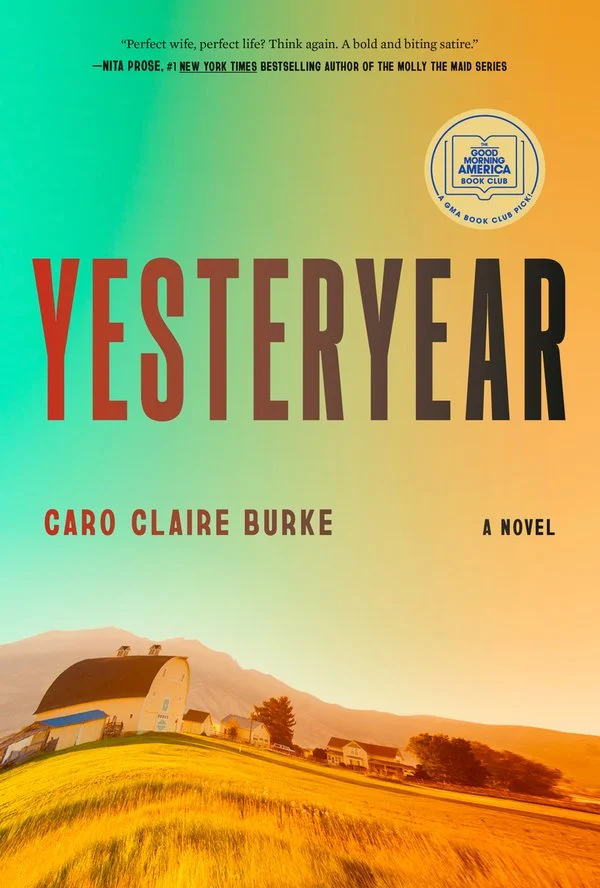
And yet when I picked up Caro Claire Burke’s debut novel Yesteryear, I found myself unable to look away.
The novel follows Natalie Heller Mills, a wildly successful tradwife influencer whose carefully curated life revolves around domesticity, motherhood, and conservative Christian womanhood. Then, abruptly, Natalie wakes freezing beneath an unfamiliar hand-stitched quilt seemingly transported to the mid-nineteenth century. Stuck in the past, she is forced to inhabit the historical reality she has spent years romanticizing online.
It’s an irresistible premise: What happens when a woman who monetizes nostalgia is made to live inside it?
The book flashes back to Natalie’s time at Harvard, before she goes full Little-House-on-the-Prairie-meets-late-stage-capitalism. At college, Natalie develops a contempt for the women around her so comprehensive it borders on theology. Through her eyes, Burke gives us a parade of liberal feminist failures: women who call themselves empowered but remain beholden to status, appearance, and male approval. Natalie directs most of her derision at her roommate, Reena, and her crew of nameless girls: They drink too much, chase careers, and have sex they later regret. Natalie watches the young women and sees only future loneliness.
Hearing that Reena landed a summer internship at a prestigious consulting firm, Natalie prophesizes: “From here on out, Reena’s life was going to be hard. She would have to work hard to get the job, and hard to keep it, and even harder to get promoted, and any promotion she received would lead only to more work… in the meantime she would have to squeeze out a few free hours a week to do everything else: date, stay fit, buy groceries, see friends.” Musing over Reena’s personal life, Natalie imagines her struggling with infertility only to discover that “when Reena finally gave birth, when she finally looked around and realized she’d made it—she was at the top of the mountain, she had it all!—the landscape would look like this: her husband no longer wanted to touch her, and her boss no longer wanted to promote her, and her childless friends no longer wanted to spend time with her, and her friends with children no longer had time to see her.”
Reading Natalie’s words, I winced. Not because I agreed with Natalie. Because I recognized the anxieties she was weaponizing.
I spent the first years of my legal career working the kind of job that quietly consumes a life. Seven-day weeks. Midnight emails. Entire weekends surrendered to people billing at a higher rate than me. I married at thirty-five. Like many women in my circle, I have spent years trying to ignore a low-grade hum of questions about aging, fertility, ambition, partnership, and whether any of the choices available to us actually add up to fulfillment.
Natalie’s judgments are cruel. Her barbs are also calibrated to hit my existing wounds as a woman who fought to make it in a demanding field.
I kept reading, reassuring myself that Burke was setting Natalie up for a fall. Surely the novel would eventually vindicate the women Natalie dismissed. Surely this was all heading toward a familiar moral: Tradwife fantasies are reactionary nonsense and professional women get the last laugh.
Instead, Burke does something stranger.
Natalie drops out of Harvard, marries into wealth, and reinvents herself as a popular lifestyle influencer on the aptly named Yesteryear Ranch. At this point in the book, the parallels to Hannah Neeleman are difficult to miss. Both women build public identities around motherhood, Christianity, and pastoral abundance. Both transform domestic labor into spectacle. Both invite viewers to imagine that fulfillment might be found in retreat rather than progress.
What makes Yesteryear unsettling is that Burke lures us into Natalie’s fantasy before she critiques it. She sells us on the possibility of rejecting mainstream professional success in favor of connection to the land, kinship, and spirituality. By the time Burke begins to expose the cracks, I had become newly aware of everything missing from my own life: communion, purpose, and a sense of belonging. Worse, the novel gave shape to a possibility I had tried not to entertain—that I might be an unwitting commodity in an invisible corporate supply chain.
Natalie’s life is beautiful. Not real, exactly, but beautiful. The images she produces offer relief from modernity’s constant demands. Natalie and her husband buy a farmhouse on an open stretch of Idaho, freckled with bluebonnets and alive with the sound of a river fed by mountain snow. The ranch seems untouched by modern disorder. Here, every chore offers a serene ritual. Growing food and preparing wholesome meals to be shared around a family table provides purpose. The appeal isn’t political so much as emotional. Natalie’s vision promises a life in which the rules are legible, the work is tangible, and the rewards are visible—a kind of certainty that can feel increasingly elusive at a time when higher education can mean years of debt, companies put profits before people, and knowledge workers wonder whether their jobs will survive the next wave of AI.
After finishing several chapters, I opened Instagram and found myself pulling up Hannah Neeleman’s account again. Children ran through fields. Bread emerged from ovens. Livestock grazed beneath impossible sunsets. I knew the images were curated. I knew they concealed as much as they revealed. But knowing did nothing to quiet my longing.
What startled me wasn’t that I believed the fantasy. It was that I wanted to.
Some ugly, frightened corner of my brain surfaced and offered a thought I would never say aloud in polite company: I’d rather be a subservient housewife than a barren old bitch.
The sentence arrived fully formed, carrying with it centuries of misogyny and shame. I rejected it immediately. Yet I couldn’t deny that it had appeared.
That, I think, is Burke’s real accomplishment.
A lesser novel would spend its energy debunking tradwife culture. Burke does something more disquieting. She allows the fantasy of the domestic sanctuary to work. She invites readers into its logic long enough to feel its seductions, and it is only then that Burke begins to expose the lifestyle’s costs.
Natalie’s eventual unhappiness doesn’t feel like a victory for feminism. The women Natalie dismisses never receive the triumphant counter-narrative I kept expecting. After going into consulting and enduring a layoff, Reena resurfaces only in the epilogue as an anchor at a regional Chicago station; the rest of her life remains largely offstage. The other Harvard women disappear altogether.
The omission of tidy resolutions begins to feel deliberate.
Again and again, Yesteryear presents womanhood as a series of impossible bargains. Natalie chooses motherhood and domesticity and finds herself trapped by the very identity she built. The professional women she condemns are haunted by different forms of dissatisfaction. No one emerges as proof that they chose correctly.
What interested me most was not the ideological conflict between these women but the vast, unexamined territory between them.
The majority of women that I know live somewhere in the middle. We may choose a job we like over one that pays more. Sometimes we leave work early to attend a child’s school play. Other times, we let the laundry pile up because we’re too busy grinding to meet a deadline. We compromise. We negotiate. We make room for ambition and family, work and pleasure, obligation and desire, accepting that it will never quite fit together. It is an imperfect, shifting way of making a life—and one that barely exists in Yesteryear.
The closest thing to an alternative to the novel’s competing visions of womanhood appears in Natalie’s daughter, Clementine, who resists her mother’s ideology while remaining fiercely devoted to her family. But Natalie’s parenting has left Clementine so intellectually isolated and emotionally stunted that she is hardly a convincing alternative. At age twelve, Clementine asks: “What’s an ocean?” Adapting to an environment where appearances can’t be trusted, Clementine learns to keep secrets and becomes hypervigilant of the adults around her. Clementine’s independence develops largely in opposition to her mother. While she may escape Natalie’s rigid vision of womanhood, she does so as its casualty, not as an exemplar.
At first I found the novel’s absence of an answer frustrating. Eventually, I began to suspect the absence was the point.
Yesteryear isn’t interested in identifying a correct form of womanhood because Burke seems unconvinced that one exists. The novel rejects the comforting fantasy that enough optimization can solve the problem. There is no perfect balance between ambition and care. No ideal arrangement of work, marriage, children, beauty, independence, and sacrifice waiting to be discovered.
There are only choices and consequences.
At one point, Natalie reflects that “America hates women. What a comfort to remember.”
The line landed differently than I expected. Not because it absolves Natalie of responsibility, but because it names something many women already understand. The standards are contradictory by design. Work too much and you’re selfish. Prioritize family and you’re unserious. Remain single and you’re deficient. Marry the wrong person and you’re foolish. Every path contains its own self-contained indictment.
Maybe that is why there is comfort in abandoning the fantasy that there was ever a correct answer.
Burke offers one consolation. However constrained contemporary womanhood may feel, it still contains choice. Modern Natalie chooses to attend college. Then she chooses to leave it. She chooses marriage, motherhood, and self-reinvention. When she is transported into the nineteenth century, those choices vanish. History strips away the illusion that women have always been free to determine their own lives.
If feminism has failed to deliver fulfillment, Burke suggests, it has nevertheless expanded the number of possible lives available to us.
What lingers after Yesteryear isn’t Natalie’s failure. It’s the persistence of the fantasy she embodies. Burke dismantles the tradwife dream, but not before allowing readers to experience its appeal. Long enough to feel the pull of certainty. Long enough to wonder what exactly we’re mourning when we reject it.
By the novel’s end, I wasn’t scrolling Hannah Neeleman’s Instagram because I believed it. I was scrolling because some part of me wanted to.
Ideology is easy to reject. The question of what women should want, and which path will deliver it, is harder to untangle, a problem that Burke, wisely, refuses to solve.


Click here to subscribe today and leave your comment, or log in if you’re already a paid subscriber.