

This year, amid celebrations of the country’s 250th anniversary, there have been countless opportunities to find community in our collective citizenship. The trouble with many of these celebrations, however, has been the willful denial of the complexities that constitute the breadth of the American populace. These developments, unironically, have clung to the grand myth-making that whitewashes American history without consideration for the transatlantic slave trade, the genocide of Native Nations, Jim Crow, internment camps, and other atrocities committed in fidelity to whiteness.
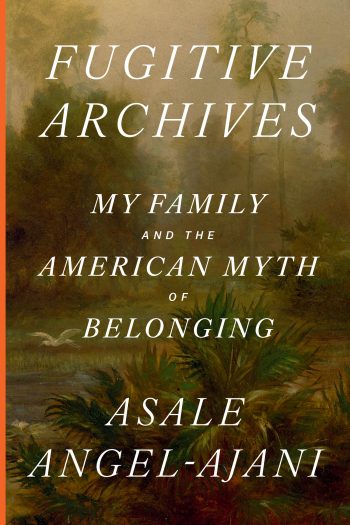
Asale Angel-Ajani addresses these inconsistencies in a sweeping memoir in essays, Fugitive Archives: My Family and the American Myth of Belonging (Algonquin Books, 2026), wherein she seeks to reveal “the intimacy of that horrible history we share.” Through exhaustive archival research and unflinching anecdotes of her life as a biracial woman raised in a white family and unforgiving country, she probes the archive to arrive at the crux of the American crisis: “The great American lie is not that we don’t know each other but that we never, ever stopped knowing each other—in violence, in intimacy, in the brutal, bloody, and sometimes beautiful entanglement of our fates.”
The entanglements she explores emerge as the book’s gems: her often benign relationship with a violent white supremacist who provides her shelter while simultaneously hating her existence; her ancestors involvement in the Klu Klux Klan; her distant ancestor’s enslavement in antebellum South Carolina; her white mother’s poorly veiled hatred for her Blackness although she herself had been a newspaper editor for her high school’s chapter of the Black Panther Party for Self-Defense; her white grandmother’s frequent, public denials of her Blackness although she later married a Black man. Each of these revelations encourages the reader to examine their own contradictory allegiances and beliefs that comprise the collective cognitive dissonance that most Americans experience. In August, we spoke about these contradictions imbued in the American consciousness and more.
This conversation has been edited for length and clarity.
The Rumpus: You don’t shy away from writing the hard parts of your story. How did you navigate this? There are some people, for example, that you only identify with initials. What were some of the decisions you made when sharing these stories? Is there anything that you were too apprehensive to share? How do you anticipate your loved ones reading this, and I’m thinking specifically about your twin sister, or your “shadow,” as you describe her. How did she and others influence your decisions?
Asale Angel-Ajani: There are several drafts of chapters or essays that focus on this person or that person, my feelings about this or that, but the truth is, I didn’t have permission to tell all these stories. So when I went back to revise and to really think about the structure of the book, I decided that I could do two things in terms of talking about difficult stories. I could talk about the stuff that was already in the public record, whether it was court documents, census data, et cetera, and things that could easily be verified or found when it didn’t necessarily pertain to my actual lived experience. I consulted with my sister a lot to make sure that she could verify my feelings or recollections about things, but I didn’t have permission to talk about her stories or experiences, nor my brother’s for that matter. So I was very clear that there were people in my life that I couldn’t write about. The people that I talk about in the book, with the exception of my mother, are all dead. I really tried to honor my ancestors and convey the truth about their stories from my own perspective. I know that people in my family will largely disagree with a lot of the things that I’ve decided about certain people in our family but in the places where I’ve revealed something that they might be unaware of, it’s all there in the archives.
Rumpus: There is a clear lyrical approach to many passages, and others are more researched and scholarly. How did you navigate your academic voice versus memoir? Many academics struggle with this balance. Why did you think it important to include both?
Angel-Ajani: I think that, especially for Black writers, writers of color, and queer writers, people will try to make your story a sort of singular phenomenon, like, “Wow, look at you, you did all these things, or you survived this.” I think that there’s a way that we become these unique vessels and not part of a broader, bigger community in history. And so, for me, I really wanted to drill down on, not necessarily the uniqueness of my experience or my family’s experience, but let me show you through history or through studies, or through whatever it might be, that this is not so unique. This is part of a broader dialogue. We live with these histories that we’re constantly engaging. So it was really important to counter the notion that some may have about our stories, that they aren’t valid or real, and lean into my scholarly training to make sure that I show the evidence and to provide context for this history. I also wanted to keep the history alive, because we’re also watching it literally disappear. There were certain files, for example, at the Library of Congress that I could access three years ago that I can’t access now.
In terms of thinking about craft and incorporating a different register to expand on the story, at times I would spiral and keep drilling down on the specificities of some details while taking the temperature of the story and feel my way through, like, “Okay the ground is getting a little too soft here, let me pull back and concretize this.” There’s one essay in particular that was painful to write because it was mostly grounded in history, and I’m not a historian, so I was trying to figure out where my story overlaps with the history, which I think for writers, is the most interesting part about writing a book when we’re thinking about all these intersections, all these puzzle pieces. There were moments when I would fall down the rabbit hole, and I would just be regurgitating all of this stuff, and my editor would say, “That’s really fascinating. I love all this information, but it’s not relevant to your story.” She was firm at times, and I was open to having pages cut by the hundreds. There were other times when the writing would become more experimental with seances, dream motifs, and me getting too lyrical and poetic. It got crazy.
Rumpus: I’ve had the unfortunate pleasure of meeting white supremacists, at least those that openly shared their bigotry, and in one of your opening chapters, you describe your relationship with a neo-Nazi who befriended you while also hating your existence. You describe this relationship as it pertains to the cognitive dissonance that most Americans experience consciously or subconsciously, which is the clear throughline of your book. Talk to me more about this American psychosis as it relates to where we are in this country.
Angel-Ajani: Loving versus Virginia reminds people that this country was built on the cornerstone of anti-Black racism. So when we start from that premise, we can have real conversations, but we haven’t. We tell ourselves these stories about our history coming together in all of these fanciful ways through terms like the “American project,” the “project for democracy,” and we use these terms in our day to day existence as if they actually mean something.
Going back to these histories, everything was about greed. And on the one hand you had these colonists who became landowners who actively needed populations to do their labor, and we haven’t moved out of that frame. We get the patina of the story where we’re post-racial, or we don’t know each other and will always have racism, but the practical reality is that we are just a utility.
We are expected to have these firm ideas about who we are, who our communities are, what our experiences are, and these positions aren’t true. We are always on these shifting grounds, especially in America where we’re in an abusive relationship with our government. I wish more poor white folks would understand that—they are just as much pawns, if not even bigger pawns, than anyone else.
Rumpus: Another thing that moved me was all the books that you reference that speak to belonging and not belonging. I just read an engaging novel called The Fervent Whites by De’Shawn Charles Winslow that centers on the death of a young Black man who was raised by a white family. There are other examples throughout literature that address the dislocation that you described feeling as you grew up. I’m thinking about Danzy Senna’s work but there are certainly more texts that you call “literary counter-narratives” wherein white mothers raise Black children. Can you talk about some of the works that inspired you and how Fugitive Archives fits within this milieu?
Angel-Ajani: I’ll go back to something that’s not actually in the book but was sort of the seed for all of this. When I was maybe nine or twelve, I had to write my first book report, and my mother is a hoarder of books even though she’s a working-class white woman. Books were really important in my household, and she would read a lot, anything and everything. At the time, we lived in the desert, far away from anything. My mother didn’t drive, so whenever I could get to a library, it had to be when I was either at school or somebody else was taking us. So I said to her, “I’ve got this book report, can I go see if you have any of the books on my list?” And my mother’s room was always off-limits but she let me go in there and said, “Oh, you got Wuthering Heights on this. It’s such a good book. I’ll show you where it is.” She didn’t have bookshelves, just books on the floor stacked up on each other. When she found it, she made me sit on the floor, and I started flipping through it as she walked out and thought, “This is so boring.” And then I scanned some of the other books and saw I Know Why the Caged Bird Sings, and I started reading it. Fifty pages in, I knew this was my book. That book became incredibly important to me because the whole story was about Dr. Angelou coming into her voice and being able to recognize her place as a human in the world. That book was the piece that set me off on my quest to discover who I was and allowed me to name myself, for me in my world.
When I was in college, there were all of these narratives that came about Black kids with white mothers. James McBride’s The Color of Water is a beautiful book, and I was like, “Wow, his mom is so cool unlike my mom.” There were all of these narratives of “radically” inclined white women, and I use radical in scare quotes, where these white women were much more invested in the rearing of their Black children and preparing them for the world as Black people.
Because one of these authors was one of my teachers, I was reading all of them but I couldn’t see myself in them, so my search continued. Having Dr. Angelou as sort of the kernel, she was able to bring out in me the sense that my voice and personhood were important. I’m always looking for that as sort of an affirmation in literature.
Rumpus: The abuse that you endured was difficult to read sometimes. I wonder how you read this current moment when there have been several high-profile cases wherein young Black people have been harmed while spending time with their supposed white friends. This was also painfully explored in the death of Brandon McClelland. How might understanding that we’re all more alike than different improve race relations?
Angel-Ajani: I was very conscious when rereading drafts of this to name the names of Black folks who were murdered by white people in any possible place that I could reference, find, name, and identify. Brandon’s story in particular was really hard for me. Even now when I talk about it, I get emotional about it. Brandon, of course, is not just one. He’s in a whole lineage of Black people who have, for the briefest moment, trusted white people and had that trust end in the loss of their life.
The problem is we don’t talk enough about how the foundation of our unity and togetherness has been rooted, not just in anti-Black racism, because I think that’s too nice of a way to frame it, but is rooted in this bloodthirst on the part of white folks to harm and abuse Black people. Part of the reason I wrote this book was because I was trying to understand my own relationship to white folks in my life who said that they loved me, who said that they cared for me, and in fact they did, in their own very limited ways. When I think about Black kids who are either adopted into white families, or Black kids whose families are entrusting their white neighbors to make sure that their children are not harmed, when I think about that, it’s like the level of cognitive dissonance that Black folks have to go through in order to put their children in the hands of other people and hope and pray that they’re not going to be harmed is a lot. We’re in a very toxic and abusive relationship with white supremacy, that actively has friends murder their friends, and because they’re friends, it is not considered a hate crime. Part of the reason why I talk about Brandon’s case is because it’s so instructive for all these other cases where what is going to end up happening, perhaps in the Nolan Wells case, is his death is going to be ruled an accident. We’ll see. We’ve lived through this before, and history tells us that we know what’s going to happen. It would be astonishing if anyone is found guilty for his murder. The intimacy that we have within this American racial framing means we rely on each other, and Black people rely on white people not to kill them. Unfortunately, our intimacies don’t buy us any protection or security.
Rumpus: One of my favorite takeaways was your insistence on a radical reframing of race. You write: “[T]o understand race not as destiny but as a living history of difference that can be individually claimed and communally honored. A space where complexity isn’t punished but lived. Where lineage doesn’t have to be hidden or conversely, elevated so that it becomes a gilded cage in service to white supremacy.” How do we move toward this reframing?
Angel-Ajani: I think that if there’s a way, that we can say: “I am attached to this community, I love these aspects of my community, I love these aspects of my history, I love these aspects of my lived experience, but that does not make mine better than yours.”
We are all mysteries to ourselves. But those mysteries are also in conversation with our communities, our histories, our history, our tradition, our lineage, our families. And we bring all of that with us when we enter a room, and that makes that room very crowded when we are trying to get to know other people.
We also need to realize that there are a billion different ways of being human in the world. And we can recognize and honor the violence and the terror that we, our people, have gone through often at the hands of white supremacy and by white supremacists whether they were white or not. If we can honor these histories and still walk into a room and allow ourselves to be as mysterious and complex and diverse as we are then we might be able to really have conversations and figure out where we need to go.
Some people are angry and some people are scared, but we still need to act. I would love it if white people were less afraid and owned up to their privileges without being coy about it, and I say that as someone who comes with her own privileges.
If we can say, “Look, I honor what you have gone through, and I honor your pain, and I honor the fact of my place and how I might have impacted you negatively, or how my ancestors might have negatively impacted and harmed you,” then we can progress. It all begins with taking responsibility. I need to take responsibility for the harm that I’ve engaged in in my lifetime just like everyone else.



Click here to subscribe today and leave your comment, or log in if you’re already a paid subscriber.