A woman in the booth of a moderately lit bar once told me that I look like someone who listens to Pavement. She told me this on a blind date, as I settled into the seat across from her, where she sat behind three empty glasses of varying sizes. To her, I looked like a certain kind of person. A man who was secretly not a man at all, someone hiding behind a veneer. Emotionally detached, maybe, clever and witty and a little obsessed with being so. If the body can look like a song, I appeared then as poorly arranged fridge poetry, desperate to say nothing with as many words as possible.
What hurts then is the truth. I did listen to Pavement. In the ’90s, as a teenager, I was more sad than angry. So tender that my spirit was threadbare. I read books and wrote shitty poetry, felt emotions with such ferocity, as if each time was the first. I was afraid of myself, afraid of how much I felt, and afraid of the person I wanted to be. This tender, easily hurt, wisp of a thing wanted so badly to be strong and confident, shielded by a clever wit and thick, weathered skin.
There is a before and after, a life before hearing “Unseen Power of the Picket Fence” on a ’90s AIDS-benefit compilation album called No Alternative. On it, wedged between the Smashing Pumpkins and the Goo Goo Dolls covering the Rolling Stones, Pavement frontman Stephen Malkmus name-checks all that he does and doesn’t love about R.E.M. over a lackadaisical guitar. All washed out with fuzz and reverb. His voice the tone of a generation of perceived slackers.
There is an alluring quality to Malkmus, who sounds both like he has just woken up and like he’s mad about something he will never explain. He is bold and confident. He is a liar. He is telling the truth. On “Unseen Power of the Picket Fence,” he talks about R.E.M., calls them southern boys just like you and me, although he is from California and we are not all southern.
Malkmus wants to tell you a secret, the way drunk people tell their secrets as loud whispers. He means everything he says, and he doesn’t believe a goddamn word of it. It’s all bullshit. It’s all hollow. These are lyrics used to kill time over guitar riffs that would not exist without words to give them purpose. Not that they are bad, but that they are eager for something. Desperate for a story to tell over their shambolic structures. And so Malkmus is a poet the way his longtime collaborator David Berman was a poet, and a poet will lie on their way to the truth. They tell slanted, enchanted truths. That’s just the way of things.
To reveal truths all at once can be a terrifying beast, so the poet is kind in their way, not to tell you everything all at once or maybe ever. It’s not manipulative or bitter, but rather self-preservation. It’s easier to trust your heart with slanted truth because if it breaks, it is nothing, and if it remains whole, it’s perfect. It’s more important that your heart might break than that it might never feel anything at all.
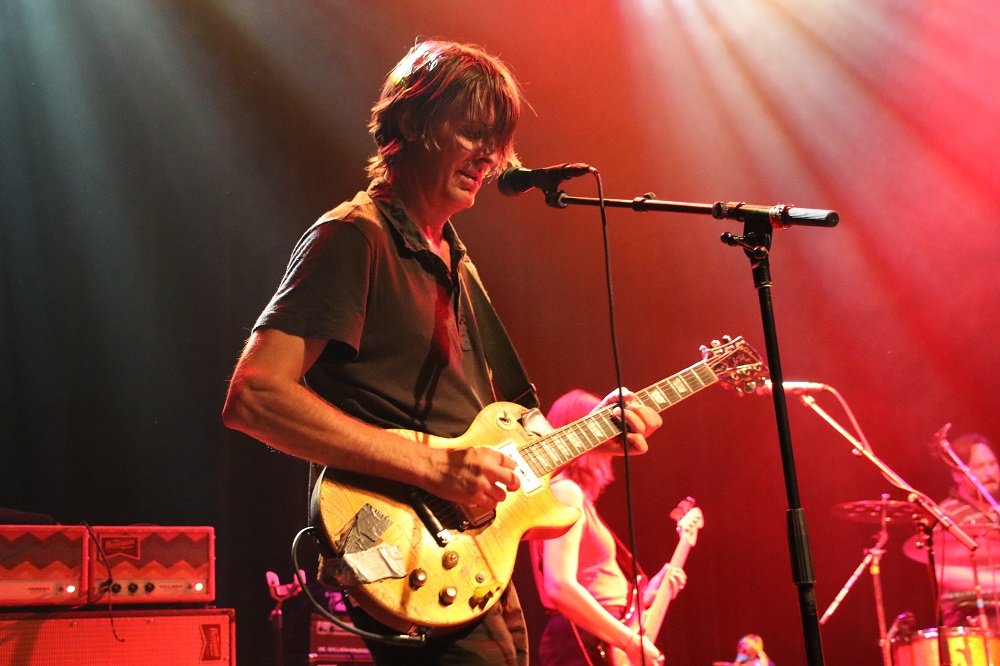
There is no way to write the word “cool” without feeling like a cop, but Stephen Malkmus seems cool. This man with his loosely arranged hair and emotional sleight of hand, never telling you the truth or announcing his feelings, hiding everything in poetic misdirections. He is telling you nothing; it’s all nonsense, he says, but there is so much of it. There is so much language here. So many words carefully gathered into verse and chorus by a man who clearly loves how malleable language can be. Malkmus’s deep, abiding love of poetry allows him to say so much while pretending to say nothing at all. His heart is not on display: It’s hidden below all these clever turns of phrase. Like a reverse Springsteen, holding the heart so gently under the sleeve you might barely see the outline of its beating center.
I wonder if Stephen Malkmus is afraid to be seen without the mask. I wonder when it slips if he even looks like a man who listens to Pavement. There are songs beautiful and saccharine in the Pavement catalogue, like “Grounded,” with its haunting opening riff. Those strings sound more plucked than strummed, as Malkmus ponders the base morality of the upper-middle class he grew up in. He sings about doctors with crystal ice picks, who live their days in comfort bought with casual wealth, their air-conditioned cars sitting languid in the parking lot, never outright telling you who he’s talking about, but choosing to illustrate their outline with delicate beauty, their lives made tall in short verses. “He foaled a swollen daughter in a sauna playing contract bridge,” he sings. Each little detail builds the world: A doctor helps a woman give birth while he sits in luxury, playing a card game that requires four players. These small vivid details delivered so effortlessly, as if they mean nothing, come together with such pathos to tell a story he’s trying to hide. Any possible message is masked by his laid-back charm. Then he wails, “boys are dying on these streets,” before a fuzzy, thunderous guitar solo builds a bridge between stories he has to tell.
Malkmus thrives in these mazes of poetic subterfuge. The second verse of “Grounded” begins, “I know the medical world could knock you out, to sell the coins that you jayed last Thursday, dine by candlelight, hold your savings tight,” which takes great pains to never speak directly to the heart of the matter, while walking great lengths around it. Malkmus presents thoughts and ideas as playful strings that build sentences and grand statements, which all easily read as nonsense if you never care to look beyond the veneer of it, the casual demeanour that begs you not to care.
Malkmus says his lyrics mean nothing, almost as a shield. As if by revealing the truth of them he is vulnerable, exposing weak points and vital organs that might be struck. They are a band born of a movement branded as slackers, lo-fi and blasé, who take a passive approach to daily life. Slackers are misrepresented as almost nihilistic, as if by not contributing with great fervor to the machines of the world, they care about and feel nothing. They would rather waste the day with idle conversation over coffee and dying cigarettes. As if by sitting and resting, they are not part of the world. They are empty and hollow shells at the perimeter of life, never participating, never getting much out of what little they put in.
This was the appeal as a young person who wanted to not have to care. To never have to feel. To be hurt by nothing. Let the world happen around you. But this isn’t really the slacker ethos, but a popular perception, a byproduct of bootleg merchandise where Bart Simpson proudly declares he’s an underachiever and proud of it. It’s a grand dance of being carefully perceived as so devoid of burden as to be weightless. The image of the slacker that is sold to us as a warning. That these are people who would rather be lazy than alive.
If Malkmus and Pavement are slackers, it’s only because the term means something different than how it is often deployed. It’s less that slackers don’t care, and more that they would rather sit in the moment and observe, choosing poetry to depict a drab world with color and rich texture. It’s possible the veneer of feeling nothing exists to protect them—their tender hearts—and if you pretend to feel nothing, you can only be hurt by the same.
Even the music is in on the distraction. Its riffs and chords work overtime to appear as if they’ve never been trying at all. That they are all good musicians doesn’t matter; what matters is that they would rather you think that they are amateurs. Malkmus’s voice stretches as fuzzed-out guitars do the same, sounding like they’re melting or bending with time. Bass and drums keep the rhythm steady, if not a little uneasy, and all of it works together but seems ready to fall apart at any moment.
Imagine a song could wink and let you know it doesn’t care if you don’t either. Not caring, not feeling, never letting anyone see. It’s lonely, but it feels safe. There’s no risk in letting everyone see that you can’t be bothered. A woman telling me in a bar that I look like I listen to Pavement is telling me I don’t give a shit about anything, that my face betrays a bitter heart worried about anyone seeing it. The ’90s are often told as an era of nihilistic slackers, but it was when I aged out of being young. It was when I felt every feeling in the book listening to R.E.M., those good southern boys just like you and me, when the things they taught me hurt so bad, and when every scattered emotion returned with a new scar.
Pavement offered a way out. You could care, but you could hide it. You could be cool about it. No one would ever have to see it again. All the scars heal over in time, numbing the spots where they once hurt so badly. I thought that Malkmus never had to care about anything, and so I resolved to follow suit.
I learned to hide how I felt, learned how language and poetry might fashion a wall to hide behind. I learned people liked when I was sarcastic and emotionless, and all the tender parts of me became easier to hide when I learned I could never be hurt if I refused to feel anything. People found the effortless way I didn’t care charming, and it made it easier to craft an identity as a cover. My clothes, my hair, my face, all conspired to hide the parts of me that hurt the most.
That night—years later, on a blind date with someone who saw the veneer so clearly—terrified me because I thought I had been so clever. I thought I had hidden it all away so neatly behind how I looked, and moved, and spoke. She could see that I was a lie, but she didn’t say as much. She used the same tools as “Grounded,” telling me the story of the world as she saw it in so few words. I was someone who looked like they listen to Pavement, because I looked like someone afraid to feel or care.
But this wasn’t really true. I believe Malkmus cares quite a bit. “Grounded” gets closer than most, outright screaming that this world is not okay. The way it hurts does, in fact, leave scars, but they are all under the skin where you might never see them, or perhaps delivered with a wink, as if to remind you that it’s not real. All of these words are just a distraction. He will tell you they came in the moment, that they’re gibberish, all just to serve the rhythm of the song, as if its plucked strings and steady drums were so perfect that he slapped lyrics on them so a song could be on the record.
It has become impossible not to care, and it has become painful to care so much. Where Pavement was once a way out, it offers a different kind of respite. It’s a reminder that we might see the world for what it is—all its sharp corners and bitter ironies—and we can write and speak at length about them without addressing them. It’s beautiful to find a thousand words to describe a simple, maddening problem. “Grounded” is mad at the state of the world that Malkmus can’t help but write poetically about their sinister contradictions. Perhaps this armor and this mask are still a shield, not protecting us from feeling but allowing us to feel so much while our words cast terrible things as beautiful. It’s not that he would prefer to hide the ugly parts of the world, but that he’d rather use a lifelong love of language to make them elegant. May they dazzle slowly on their way to the truth.