
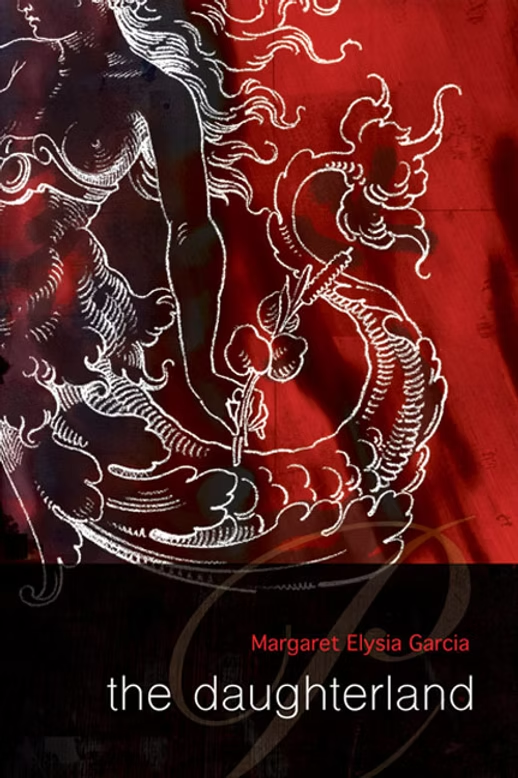
In her debut full-length collection of poetry, the daughterland, Margaret Elysia Garcia dissects and grounds the experiences of Chicanx girls and women. She interweaves the landscape of Southern California with her own Chicanx identity and experience as a brown woman in America. Her poetry asks: How can women of color protect their daughters from danger if love is not enough to stop racial attacks, sexual predators, and self-harm?
Garcia’s poems are set in the socio-political atmosphere inflated by the 2016 election and the incoming president’s racist and anti-immigrant rhetoric, heightened by the escalation of a global pandemic revealing systemic disparities impacting communities of color in America. Garcia sets up her poem, “History Lesson,” with the context in parentheses and italicized: “(The president said Lat-tee-nex aren’t getting vaccinated because we fear documentation and deportation. Demoralization. Department chair: don’t they realize they’re all from farm workers?)” This poetry collection is even more relevant today with the corrupt surge of ICE agents across the country, state violence against communities of color, and undisclosed rape and abuse against young Latinx women in detention centers, than when it was published in 2023. Her rich imagery of isolation and grief, vibrancy and hope, tolls truer today with a presence both haunting and embracing. Body, mind, family, femininity, and landscape unite in the speaker’s deep willingness to learn and understand survival: in persisting as a person of color through enforced assimilation; as a young girl in a world of predators who invade even the space of home; and living through psychological ghosts and demons manifesting as depression and self-harm.
Garcia uses the imagery of whiteness to illustrate the suppression of feeling and identity. In her poem, “Your Parents’ Intentions,” the speaker explains:
If we fell
apart
we’d do so quietly, whitely,
suffocating tears into stained pillows
and overworked livers.
In this line, the adverb “whitely” parallels the adverb “quietly,” highlighting Garcia’s portrayal of whiteness and order as suppressive. The speaker describes how she and her husband would quell their breakdowns and arguments, which she experienced firsthand from her own parents, to shield her daughter from their marital strife. However, this repression leads to “suffocating tears” and “overworked livers,” which can be interpreted as self-harm, and the internal pain shapes into discreet yet destructive behavior. By depicting the harm in suppressing internal emotion and sentimentality, Garcia highlights the importance of expressing intimacy, starting within the home. When parents conceal and repress their emotions, whether love or anger, they teach their children to isolate themselves and suffer alone. The resulting loneliness deepens depression in younger generations as a consequence of the tradition to appear stoic, familiar to immigrant parents and grandparents.
The concealment of intergenerational trauma and sexual violence simultaneously suppresses women while enabling men to take advantage of this forced silence and prey on young girls. Garcia writes in “White Cousin Rapist,” “The curiosity of power, / with that gun in his pants. / An army of one.” We see the weapon of manhood hidden, and his threat underestimated with an “army of one,” while his “curiosity of power” suggests that he is dangerous. By the end of her collection, Garcia writes:
[…] Me barricading
in front of her with my armor and
my shield, while the world crept up
behind us, taking her prisoner
and me by stupid surprise.
Garcia illustrates an external and concrete ambush on girlhood and identity aided by concealment, depicting the violence against women and young girls in militaristic terms. In “Rural Mountain Town,” Garcia describes, “The boys’ anger bubbles out of their babybird mouths, / angry with a world they’ve already won,” highlighting the privilege and inheritance engrained in manhood and an early harboring of anger transformed into violence directed toward girls and women. Despite the innocence evoked by the image of “babybird mouths,” such masculine hostility and violence is made tangible by Garcia, challenging how harmful behavior directed toward young girls and women is disguised and normalized by our culture.
Garcia’s portrayal of whiteness often mirrors the harm of silence, marking direct and physical self-harm. The repression of both positive and negative emotions leaves evident damage on both parents and their children, meaning no one is being protected by avoiding their feelings. The speaker addresses her daughter directly: “You grew up in this peaceful house: / with a quiet air so thick / You began to cut yourself with it.” The peace of the house is sustained by suppressing and silencing one’s own self. This practice normalizes the withholding of pain and concealing it from others and mirrors how the parents cope by crying secretly and consuming alcohol. From the surface, the house and family both appear peaceful, but left unsaid, and avoided due to fear of confrontation, is the visibility of self-harm. Subsequently, in “Rural Mountain Town,” the speaker notes, “The girls who leave town mark time in knife lines / The scar of this tranquility on their skin.” The word “tranquility” echoes the adjective “peaceful” in Garcia’s previous description of the speaker’s home life. The silence and non-confrontation painted as “peace” pervades these young children’s lives, resulting in the unresolved tension manifesting as bodily self-harm.
Even within the private sphere of their home and bedrooms, there is palpable discomfort and distrust in expressing one’s desires, needs, and sense of selfhood. The speaker recalls her childhood and the rooms lived in by her grandparents, which offer scarce hints about their personal lives and interests. The rooms in her grandparents’ house are portrayed as sterile and sacred, failing to reveal their internal character. In her poem, “Old Men’s Rooms,” Garcia notes, “We / leave their rooms of monastery air, where even there / they don’t feel free to offer clues.” These rooms of “monastery air” suggest a sacred and religious connotation, constructing an atmosphere instilling a quiet and deferential energy, as well as a practiced tradition of constraint and repression. In “Even the Kitchen Sink,” the speaker recollects, “My grandmother used to paint the kitchen / lead-paint white, sparse medical white, / free-of-the-clutter-of-children white.” Once again, we see the imagery of whiteness used to establish a sterile and visually clean atmosphere, despite the underlying toxicity implied. Exposure to white “lead-paint” is extremely harmful and poses a significant threat to health. Garcia suggests the tradition to repress emotions within a constrained space, often passed from parent to child, is dangerous and adverse to self-development. Ultimately, creating a home environment that presents itself as clean and orderly prevents children and parents from expanding their emotional health, well-being, and growth.
In the daughterland, whiteness has a double meaning, illustrating what is impersonal and detached as a result of repression, as well as alluding to the role of race. Whiteness is visible and accepted as the norm, in juxtaposition to the poet’s identity as Chicana and her daughter’s struggle with growing up as a young girl of color in a predominantly intolerant town. Garcia showcases both historical and contemporary conditions constraining Latinx individuals to assimilate into American culture and a culture of whiteness. In her poem, “Cultural Amnesia,” the speaker delineates her daughter’s crisis of identity: “I don’t know who I am.” Guided by Garcia’s sharp insight, the reader begins to recognize the profound isolation experienced by immigrant children who are ostracized and forced to assimilate, obfuscating their self-perception and self-worth. Garcia portrays the division between the children of Latinx immigrants who “wrestle with hyphens and allegiances,” and the “people called real Mexicans, / who want their American hyphenated / or not at all.” There is recognition and visibility in naming identities and creating labels for individuals, shaping their outward presentation and self-perception. For instance, the speaker observes how:
Two days on the team and the coach
gave her a nickname, two syllables
instead of my three—her given name is too full
of beauty, vowel, and nuance. Spanish.
She juxtaposes this with the next stanza:
New school, new name to serve
new identities. Spike the old ones.
Two syllables, something short and ugly. American.
We see, too, that this is not new to Chicanx Americans. For instance, in the same poem, the speaker recalls how her father had “his Mayan name cut in two. Making it / easier on everyone, easier to remember. / Like remembering one’s place.”
Countering the assimilation and ostracization faced by her family and herself, in “The Search,” Garcia writes, “The sweet white husband / comes with a white noise, mother-in-law, / always attempting to conquer.” Comparable to how Garcia describes the domestic life of the family as externally “peaceful,” the white husband is described as “sweet” and his mother is characterized as “white noise,” which is often used to sleep and meditate, presenting superficial tranquility. Garcia’s verb choice is central to challenging the normalized association of whiteness with peace, with her observation of whiteness “always attempting to conquer.” The visible whiteness of the speaker’s husband and mother-in-law is conditioned to be accepted as peaceful, while the word choice “conquer” contradicts this picturesque image of serenity and normalcy. The discreet and sinister intention to control and gentrify the space with whiteness excludes immigrant families and children of color, forced to assimilate, introducing a new struggle with identity, culture, and self-preservation.
Garcia’s imagery of whiteness represents a barrier in the daughterland, imposing borders onto the experiences of young women of color and disrupting their sense of belonging and visibility. In her poem, “Las Viejas (an elegy),” Garcia describes a “white wall / of aggressive politeness;” illustrating the illusion of politeness as solid and impenetrable, enforced early on children, particularly girls of color. Garcia emphasizes the overt politeness, or even “aggressive politeness,” expected, administering an ideal for children of color to be docile and subservient to the wishes of others. In her poem, “After the Fight,” Garcia writes, “We instruct our children to never hit back— / self-defense is not your defense when you’re brown,” suggesting survival for children of color is only found in their submission and passivity, affirming the inherited mindset of remaining unassertive, unseen, and unheard.
In the poem titled, “Vampires,” Garcia uses the metaphor of monsters to characterize the predatory behavior of men, attesting, “they blame their victims. / As if we weren’t raised to be hospitable,” demonstrating how women are faulted for practicing what they are taught as children: how to be polite and hospitable. This misogynistic mindset suggests women should constrict and conceal their visibility from the external world for their own survival and safety. In “Coming of Age,” Garcia writes, “Mama stays on the inside, / away from the doors and windows,” once again asserting how invisibility is expected from women of color. Women are taught to suppress their bodies and pain behind a “wall” of politeness and instilled hospitality, contextualizing the generational trauma and harm accumulated by portraying the female experience, especially for women of color, as taboo.
Garcia unmasks how children, especially young girls of color, face immense dangers threatening their survival, development, and success. She argues the necessity for parents to break their silence and confront the effects of intergenerational trauma and repression. Garcia effectively gives shape and form to the female and Chicanx experience with her poetry, as her portrayal shares visibility with a larger community, instead of remaining silenced and deferential. Her collection of poetry is an emblem of this message, enabling the Chicana experience to be more visible and recognized. Garcia harbors space for the Chicana experience to persist and belong. In her poem, “Right of Passage,” the speaker recognizes the intergenerational suffering and suppression of women in her family who have faced assault. A 2024 study from Rutgers University reports, “Children born to mothers who experienced CSA [Child Sexual Abuse] are 3.6 times more likely to also experience CSA.” Garcia writes “One out of every three of us women / Have been waiting here for you,” transforming an ambiguous statistic into what resonates as more personal, especially with the added pronoun “us” and the line’s turn to address her daughter. The poem’s speaker pledges, “I vow and I promise to tell you, to show you … of who you come / from,” breaking herself, the stories of her predecessors, and her daughter out of a cycle of silenced abuse and assault. Garcia’s verb choice of “tell” and “show” illustrates the harm of concealing and internalizing pain. By expressing intimacy, grief, and rage without constraint, we enable ourselves with the power to build community, family, and intimacy.
By weaving color and visibility in her imagery, Garcia highlights symbols of hope in juxtaposition to the spreading reach of repression in the figurative and literal form of whiteness. For instance, the speaker observes “New lime green growth on the trees, frogs and / crickets are back like / hope for a dying planet,” emphasizing how there is positive change in the surrounding environment itself. Similarly, the speaker addresses her “gold and glistening” hoop earrings, maintaining,
You make me that mama,
you know the one.
You shine on me and demand I
take the weight of you, the
weight of me.
The weight signifies the solidity of both the earrings and the speaker’s existence, the presence and space she occupies, demanding to be seen. Garcia’s portrayal of femininity as bold with her visual of gold hoops in association with strength, visibility, and confidence. The image of gold hoop earrings juxtaposes the whiteness established earlier as impenetrable, indicating the intersecting visibility and significance of culture and gender in understanding and presenting one’s identity with pride and self-love.
Belonging and visibility are intertwined in Garcia’s the daughterland, especially in defining which spaces create a foundation for survival and growth. In “Life 360,” the speaker’s daughter asks: “How come you love me so much? / As if she can’t believe it,” and the speaker responds: “I’ve loved you since before you were even born.” This characterization of unconditional love between a mother and daughter is powerful, uprooting expectations planted by the world on the shoulders of young girls of color, giving the freedom to exist and simply breathe. In “Diagnosis,” the speaker repeats
[…] I
believe you, my love.
I believe in you,
Always.
establishing her unconditional belief and love for her daughter in a world that automatically sets blame on women and expects their silence in return. In her poem, “Home,” Garcia searches for “that elusive place where we can be who we’ve / become,” speculating the existence of a space that provides belonging and unconditional acceptance for mothers and daughters of color. Garcia’s collection dares to imagine a landscape where young brown women are nurtured and able to grow and take up space without fear or self-doubt.
In her collection representing motherhood’s unconditional love, Garcia spotlights the significance of visibility and recognition, particularly for young women of color taught to suppress the body and self. Garcia creates a safe space to express grief, vulnerability, hope and rage, imbuing color in a world propelling borders of whiteness and assimilation. The images of gold represented by shining hoop earrings and the green growth of new life juxtapose the whiteness, indicating the importance of visibility of both culture and gender in finding and presenting one’s identity. Though the speaker is unable to protect her daughter solely with love, she breaks the cycle of intergenerational silence and abuse by actively creating space for young girls of color to find and express themselves with unconditional love instead of isolation and restraint.
Garcia expertly leverages her background as a muralist, educator, and arts advocate, upholding a diversity of mediums for artistic and lyrical expression as a poetry instructor with Community Literary Initiative and the cofounder of Pachuca Productions, a Latinx troupe upholding social justice in theatre and film. Her work celebrates Mexican, Indigenous, and Chicanx heritage and forms of storytelling. Garcia’s previous publications include: the audiobook, Mary of the Chance Encounters, an ebook titled Sad Girls & Other Stories, and Burn Scars, a memoir chapbook, detailing the Dixie Fire and its aftermath of locals coming together in the burned-out landscape. Her collection of Chicanx gothic and noir short stories, Graft, depicts the suburban landscape of Los Angeles and her most recent work, ¡Iconsistas!, published last year, is a poetry chapbook celebrating the Mexican Revolutionary Women, demonstrating Garcia’s versatility and her evolving vision as a masterful and deft artist. Her works of literary and artistic prowess unearth raw questions and epiphanies from the lived experience of a Chicanx woman navigating Southern California’s suburban and natural landscapes.
El Martillo Press published Garcia’s the daughterland in 2023, embodying the publication’s celebration of creating bridges and deconstructing walls in the literary and larger world. Garcia showcases an ambitious commitment to accessibility and clarity with intention. In her poem, “Bone,” Garcia strips motherhood to its skeleton of womanhood:
We are not
the ribcage, not pulled
from Adam,
just the heart.
Unprotected.
Broken.
Raw.
Gnawed.
The daughterland confronts heavy themes and content head-on, such as a daughter’s depression, self-harm, and multi-generational sexual assault and silence with compassion and vulnerability. Her collection layers the perspective of a mother willing to learn and understand her daughter’s trauma and pain out of unconditional love, alongside the experienced aspects of mourning the living and experiencing heartbreak as a parent.
Garcia navigates an impossible terrain that places an absurd magnitude of pressure on mothers for the survival of their children and the protection of their bodies and well-being. In “Gold Rush,” the speaker wishes her daughter and the girls on the mountain could
Escape to the rocks and the canyon floor,
where their hearts could stop beating, where the words,
and brute muscles of boys cannot sneak into their
rooms, beds, bodies.
Escape to where the valuable
has already been picked, and sifted clean,
and the minerals left are rare—impossible to reach.
Garcia laments how “Cautionary mothers, praying mothers, loving mothers” are unable to effectively protect their daughters from physical violence and mental harm.
Garcia’s collection, the daughterland, wrestles with the assorted connotations of survival for girls of color. In the last line of “Life 360,” Garcia writes: “Maybe, just maybe, we survive.” Tests to survive arrive in varied ensembles for young girls of color in this collection: survival with mental health, survival in a world of predators, survival after physical assault, survival in a world of whiteness, and survival in a world that aims to keep women invisible and silent. Even the contingency of survival being possible for both mother and daughter emits hope like a new breath. We are reminded to break down walls of whiteness and create a world of visibility and love for children of color and from immigrant families. Communication and unrestrained expression, from parents to children and children to parents, will be key in constructing a foundation of unconditional belonging and love.


Click here to subscribe today and leave your comment, or log in if you’re already a paid subscriber.