
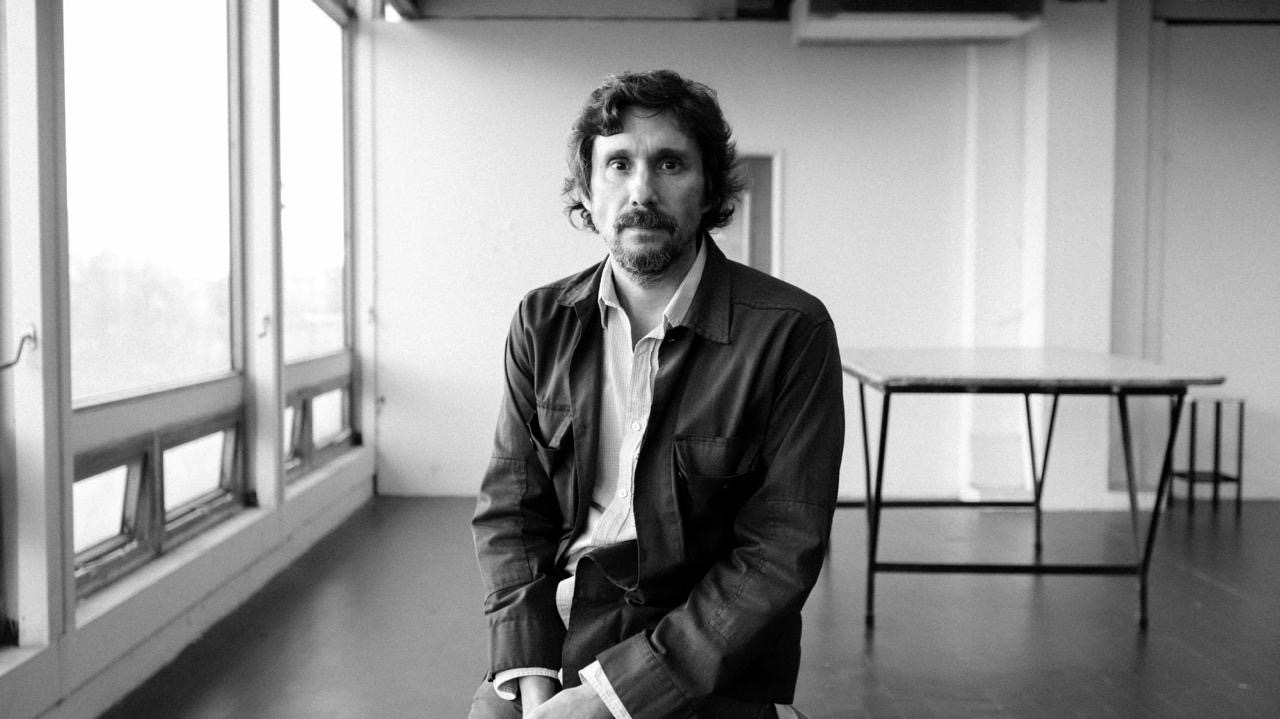
In 2001, a disillusioned drifter and film-school dropout from Buenos Aires, Lisandro Alonso ventured into a unique part of the Argentine pampas, where the vast, open grasslands gradually give way to a densely forested region, not far from where his family owns a ranch. There, he met a woodcutter named Misael Saavedra, who lived alone among the trees. Inspired in part by the meditative, philosophical style of Abbas Kiarostami’s Taste of Cherry, Alonso set out to make a film around the repetitive rhythms of a day in Misael’s life: cooking an armadillo over an open fire, squatting down in a hole to take a shit, chopping down a tree, stripping its bark and branches, selling the wood to a man in a truck. The resulting film, the simply titled La Libertad (Freedom, in English), not only launched Alonso’s career but became a landmark of the slow cinema boom of the early aughts. His subsequent features—Los Muertos, Fantasma, Liverpool, Jauja, and Eureka—would all go on to premiere at Cannes. Each has been part of an incremental thematic progression from what Alonso established when he first decided to shoot Misael’s routine: a commitment to diegetic time, a radical disregard for narrative expectation, and an observational mise-en-scène.
Twenty-five years and five features later, Alonso—51 years old, with wrinkles near his eyes and gray in his hair—has returned to the place where he made his name. La Libertad Doble—something between a sequel and a remake—opens, more or less, where we left off: Misael is still wearing his New York Mets cap, still living beneath the trees, and still making his living with an axe. Yet some things have changed. Misael is, of course, noticeably older. Flaps of fat fold over his chest, and he can’t chop as nimbly as he used to. But Misael is now faced with a responsibility outside himself: His sister, played by the Chilean actress Catalina Saavedra (no relation), returns from the mental asylum due to government cuts. For Misael, his sister’s introduction presents a new set of practical and moral obligations into his otherwise self-contained existence; on a structural level, this introduction of a professional actress (and a plot device) challenges La Libertad’s self-contained cinematic universe. If the original La Libertad asked whether Misael was truly free, questioning the nature of freedom itself, then its 25-year follow-up doubles down on Alonso’s artistic philosophy as it has emerged over the course of his oeuvre. More broadly, it becomes a self-reflexive query into the way things change, but paradoxically stay the same.
I spoke with Alonso following the New York Film Festival about returning to his debut a quarter-century later, the evolving meaning of freedom, and the (changing?) political realities that have come to inform his cinema.
This interview has been edited for length and clarity.
***
Samuel Brodsky: So why did you decide to return to La Libertad 25 years later, in 2026?
Lisandro Alonso: Well, there were a few factors. The most influential one, maybe, is that I was so tired from my last movie, where I was filming for three years all over Portugal, Spain, Mexico, and South Dakota. And with different crews, in different languages, and we were interrupted at least two or three times due to COVID. It all became very cumbersome. Since it was a more ambitious film, we had more co-producers, so communication between the financiers became increasingly tedious. When we screened it at Cannes, in 2023, I had such little energy left I couldn’t even enjoy the premiere.
Brodsky: And that was Eureka (2023)?
Alonso: Yes. I got to talking at a café in Cannes with my lifetime producer about the next step, the next project, and she told me that perhaps we should return to where we started: when we had less equipment and traveled lightly. So we got to thinking, well, how could we, and in what form could we do this. And in that moment in 2023, there was a breeding ground taking shape that culminated in a change of government…
Brodsky: You mean the inauguration of Javier Milei?
Alonso: Yes, a change that would have unfavorable results and consequences for the less protected, the less privileged, and I thought these circumstances were similar to what we were going through back in 2001. And I thought it would be interesting to return and show a little bit of the Argentine reality with this character, Misael Saavedra: how he had advanced or regressed over these past 25 years, if he had more options, if he could choose how he lived, or what the consequences were of this recent political moment—and I thought it would be good to use the character of Misael to not only tell the social, political, and economic health [change] Argentina is going through but also the cinematic one as well.
Brodsky: Did your methods of making La Libertad Doble change?
Alonso: We shot it in the same way we shot the first one: a crew of eight or ten people, [with very modest means]. It’s a co-production with Chile, which is the dominant producer, but we filmed 80-90 percent of it how we filmed the last one: the same place, locations, the same crew, the same actors, but we just added a professional actor, Catalina [Saavedra]. There are a lot of similarities today, cinematically speaking, to the resources we had in 2001. It was good to go back and film, not just for myself, but for students and people starting out, to show that you can go out and make things, that we are not state-dependent or European-dependent to finance our films. What I’m saying is that if there’s something to tell, we shouldn’t stop doing it with the tools we have, and I wanted to remind myself and others of that.
Brodsky: La Libertad, as a title, always had multiple meanings. One of those meanings was freedom in form: freedom from narrative, freedom from documentary. And here, with La Libertad Doble, it sounds like it was a way for you to be free again, to return to that cinematic freedom, no? To make a film your way, depending less on outside permission?
Alonso: Yes. But I’d also like to reaffirm the context of the title between the first and the second one. What does freedom mean today? Not just in Argentina but in other places, that word is used to accomplish things that run counter to my interpretation of freedom. When we shot La Libertad in 2001, some people said to me, “Wow, Misael has such freedom.” Well, I’m not sure if he’s so free. I see him burdened, marginalized by lack of choice. And choice, generally what we associate with freedom, Misael has none. In La Libertad Doble, he just asks that the system not burden him with more problems, and evidently that’s what happens—and it happens to him without him even being in the system. The only thing he asks is that they not fuck his life over even more, and that they help him take care of a family member he cannot take care of himself.
Brodsky: Right. The difference between the first and the second film, of course, is that Misael is now faced with a responsibility outside of himself, right?
Alonso: Time has passed, the demands have increased, he’s no longer twenty years old, and he has to take responsibility for things. As time passes and you step into becoming an adult, it’s usually a result of other people, say, children, but in this case it’s a sister. And he has to take responsibility. And Misael accepts it. It’s like he’s just accepted his life, like generations have accepted what’s been handed to them. Misael has worked with an axe since he was ten years old. I found him at twenty-eight. He’s always lived under the trees, cutting wood. He’s there as a local.
So that was good in terms of evening the playing field with Catalina [Saavedra], the professional actress [who played his sister]. Bringing her could have brought a certain nervousness to Misael, but because he was on his own turf, he was so sure of himself as a local that, even though the challenge was different, he could perform with naturalism.
Brodsky: Catalina Saavedra is amazing in this film. Did you get the idea to cast her because of their shared last name?
Alonso: That was just a beautiful coincidence. For a lot of people, the artifice of fiction disappears when they see the credits. Some people are disillusioned when I tell them they’re actually not related, so sometimes I leave them thinking that they are. Other times, people are relieved when they find out Catalina is acting, and that she doesn’t have that condition, and that her mental illness is just cinematic artifice.
Brodsky: Right. The ambiguity of them being related, I saw it as another instance of your style, of playing and blurring the boundaries between documentary and fiction, what’s real and what isn’t.
Alonso: When I was starting out twenty-five years ago, there were a ton of discussions that revolved around fiction and documentary, a lot of: Is this person an actor? Should we differentiate between professional and non-professional actors? A person in front of the camera is an actor. It doesn’t matter if they are making their living working a quotidian job, but at that moment, for that film, they are an actor.
Brodsky: Speaking of non-professional and professional actors. In your early films—La Libertad, Los Muertos, and Liverpool—you only cast non-professional actors, correct? I mean, people you found on the street, or in Misael’s case, near your family’s ranch.
Alonso: The films you mentioned, along with another one called Fantasma, I filmed over the course of ten years. In those ten years, I made four films with the same methodology, system, and criteria, more or less. I fell in love with a landscape, an area, a place. I travel to these places with a simple idea: How can I represent this place? And I have to find an excuse to film those places. Whether it’s La Paz, Las Corrientes, Usuaria, the sea, a ship. So I travel, and I begin to look at people. This takes some time. I was bonding with Misael for eight months before shooting anything. With Argentino [Vargas], I was visiting him for a year and a half. He lived on an island. I had to take an eight-hour bus, a two-hour boat, and walk for forty minutes. But that’s what I love most about cinema. I don’t like to say action or cut as much as I love travelling and discovery, finding something that could surprise me. And base the film around what I find.
Brodsky: Did you rewatch La Libertad before you started working on La Libertad Doble? How much did you actually study it?
Alonso: I studied it quite a bit. For starters, it’s a film that’s very dear to my heart. And since it’s a sequel—though it’s not exactly Fast & Furious, and I’m not sure how many people actually saw the first one—I had to provide some context: how Misael lives, his circumstances, his isolation. And then move on to the other conflict, the sister, which is the new element. I had to strike a certain balance. I wanted to be careful so as not to cross a certain line; otherwise, it would stop feeling like “the original.” But we also didn’t want to show Misael working as hard as he used to. He doesn’t work quite as much. He’s a bit more tired, a little heavier, too. He enjoys taking longer afternoon naps—you know, like anyone else. He’s fifty now, after all.
I wanted to show that he’s still working, still doing his thing, still living the same kind of life, but now he’s come to accept his lot. He’s at peace with it—content with having just one chair, a single set of cutlery, a bed—he even has a dog now, which he didn’t have before. He’s perfectly fine with cooking over an open fire every night, eating a piece of meat…
Brodsky: Still eating armadillo.
Alonso: The armadillo—well, we don’t kill them anymore; I got several complaints from PETA about killing animals. But now, there’s a different challenge: What to do about his sister? How does he manage her medication—making sure she gets her pills—and where is she supposed to sleep? And I think there’s something mutual there, something tacit, where both of them know that the situation is unfeasible.
Brodsky: I have to ask you about the element—the political aspect—that’s present in this film, which perhaps wasn’t as clearly defined in the first one.
Alonso: While I perfectly understand what you’re getting at, the political dimension in the first film is already there. The issue is that no one wants to see it. When I look at how Misael lives, there’s a state policy that isn’t reaching him. I don’t know—it felt a bit redundant to have to explicitly state: “Misael lives in poor conditions, he’s impoverished, he’s missing all his teeth, and he can’t see a doctor.”
It’s self-evident. At the same time, the Milei administration has dismantled the entire healthcare and social assistance system for people with disabilities. When something like this affects a specific segment of society, it obviously gets more media attention. But people like Misael have always existed throughout human history, especially here in South America. But because he didn’t complain, didn’t raise his voice, and didn’t cause trouble for anyone, he never made the news. Now, because this affects a much larger portion of the population, it carries more weight—and, consequently, has far more aggressive political implications. That’s why it’s so noticeable.
To be honest—and I’m not sure if I should even bring this up in the interview—it wasn’t a calculated decision based on the consequences of Milei’s policies. I have a brother who faces challenges similar to Catalina’s, and I know that, twenty years from now, the responsibility for his care will fall on me.
Brodsky: You seem to resist a political reading, then?
Alonso: No, no, I don’t resist it at all. I actually love it when people interpret it politically. I don’t agree with this government on anything, not at all, ever. But, unfortunately, I feel that the only thing I can really do is vote. I know the democratic system is the best one we have, but clearly, it’s not enough. It doesn’t seem to provide solutions to many of the global problems we face today. Honestly, I’m not very hopeful that politics can actually help.
Brodsky: And characters like Misael Saavedra and Argentino Vargas. Would they vote in elections?
Alonso: They don’t vote. When I was filming Los Muertos, I was scouting locations, traveling by boat with a tent, and I ended up staying for three or four days on an island at the mud-brick shack where Argentino Vargas lived. Argentino Vargas has twenty-four children with three different women. At the time, I counted eight of them living with him in that mud-brick shack. At one point, just to break the ice—this was right around the time of a corralito here, when the banks seized people’s savings—I asked him, in a very naive way: “Hey, Argentino, what do you think about what the banks did, taking people’s money?” And he just replied, “What’s a bank?”
When someone answers you like that, it completely upends your whole approach to the person you’re talking to. Misael only got his passport and ID three months ago, just to travel to Cannes. For them, it makes no difference who is in government, because they are so far removed from accessing any benefit, any outside help. They live off nature, off the little they can manage with an axe or by fishing. They have been deeply marginalized for generations. I find that quite interesting.
Brodsky: There’s a rumor—not exactly famous, but well-known—that when you delivered La Libertad to Cannes, they made you cut out a clip from the film where Misael laughs at the camera at the end.
Alonso: Exactly.
Brodsky: And now you’ve included it in La Libertad Doble. I wonder if that’s meant to be some kind of statement.
Alonso: I decided to treat myself and put it back in. It’s a kind of statement. It brings things together; you see the young man—well, you recognize him—looking into the camera, laughing for two or three minutes. It’s an incredibly infectious laugh. In the first film, that moment forced a radical shift in how you interpreted the film. Misael looked you in the eye, laughing—perhaps laughing at what you had just watched, given you’d assumed it was a documentary. It made you realize he was acting. I found that fascinating, but the folks at Cannes felt… that it was a bit too risky, not worth “turning anyone’s ear” in that way. So I took it out. But in this film, I included it at the end: the laughter of a young Misael, before all the problems that emerge in this second film. Back then, he could laugh like that precisely because he didn’t have to take responsibility for his sister. He was a freer character, with fewer responsibilities.
Brodsky: I found myself wondering: Are you parodying Hollywood in a sense by remaking your own movie?
Alonso: That interpretation is definitely there. I mean, who actually decides to remake a film that no one ever saw? We see reboots of Psycho, Rocky, or Rambo, heavily commercial films that were already successful. But it’s also a kind of statement, a way to remind my colleagues of the kinds of films I grew up watching—and I’m speaking to people of my own generation here. Those films we saw—Italian Neorealism, New Wave—didn’t cost 10 million dollars; they cost half a million, at most. Yet they possessed a poetry, a power, and a cinematic vitality I struggle to recognize in 80 percent of what I see today. So it’s partly about examining the kinds of films we make, and asking what kind of cinema is actually worth watching, thinking about, analyzing, producing, or directing.


Click here to subscribe today and leave your comment, or log in if you’re already a paid subscriber.