
economics
-

The Novel of Economics
Following her essay about the influence of Adam Smith’s economic theories in Jane Austen’s novels, writing at The Atlantic, Shannon Chamberlain gets back to the topic, this time debating what influence fiction had, and in particular the emerging genre of the novel,…
-
An Author’s Economics
How much does it cost to write a book? Kevin Sampsell, author of This is Between Us and A Common Pornography, opens up to The Portland Mercury about how much he actually earned from his books — or rather, how…
-
Cents and Sensibility
While readers today might think of Jane Austen novels as the equivalent of 18th century bodice rippers, money, wealth, and economics played a major role both in their creation and in their narrative. Austen wrote as much for financial benefit…
-
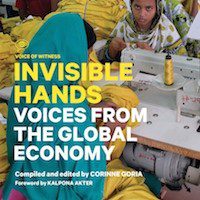
The Rumpus Interview with Corinne Goria
Author and veteran Voice of Witness editor Peter Orner sits down with Invisible Hands: Voices From the Global Economy editor Corinne Goria to talk about putting the book together, economic interdependency, and the complex human stories behind everyday items.
-

The Rumpus Interview with Astra Taylor
Driven by philosophical thought, Astra Taylor—documentary filmmaker, activist, and writer—looks at the way the Internet has affected social and economic change in her new book, The People’s Platform: Taking Back Power and Culture in the Digital Age.
-
Catawampus Uber Alles!: The Rumpus Interview with Peter Mountford
Writer Peter Mountford talks about his latest novel, the impossibility of altruism, the realities of the midlife crisis, and the “catawampus” that is economics.
-
Well, This Is Certainly One Way to Give Advice
On a blog for the Wall Street Journal (where else?), Emily Oster gives advice based on economic theory. For example: There is a model in economics called the “sS” model. It’s not often applied to relationships, but I think it should…
-
Economists Set Phasers on Stun
Nobel prize winning economist and NYT‘s columnist, Paul Krugman expresses his love for sci-fi and fantasy in an interview for Wired magazine. Krugman cites Isaac Asimov’s novel Foundation as his inspiration for becoming an economist, a damned responsible one at…
-
“What Isn’t for Sale?”
At The Atlantic, philosopher Michael J. Sandel breaks down the hidden (or not so hidden) costs of a culture in which almost everything is for sale, and articulates the key distinction between a market economy and a market society. “…Some…
-
Flexible Working
A British thinktank, the New Economics Foundation, is advocating for a shorter work week as a cure for Britain’s economic, social, and environmental woes. The economists argue that the solution to fewer jobs due to technological advances involves work-sharing, and…
-
Deconstructing Debt
In this interview economic anthropologist David Graeber disputes the standard theory that the monetary system replaces the barter system, arguing that credit and debt come before money. Graeber sheds light on the complex relationship between debt and morality, transitions from…
-
Economics for Kids
Children’s books are teaching all kinds of lessons and not just the morals-heavy, value-driven ones that are meant to stave off latent delinquency. Read between the lines of children’s lit and you can brush up on some conceptual economics. One…