
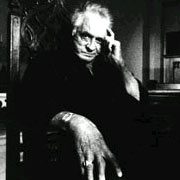
I’m stuck this morning in the Tea Lounge of Park Slope, Brooklyn, and it’s possible that the poor hipster who does the baby sing-along at the Tea Lounge is coming in any minute, God help me, and there are two-year-olds bouncing off the walls and smearing their H1N1 hands on every surface, and usually, under these circumstances, I just turn up the music in my earbuds to eleven, to tune it all out, but instead I’m listening to what’s playing on the Tea Lounge p.a., because it happens to be Johnny Cash’s recording of “One” by U2. In general, I pretend U2 is not happening—when I see Bono’s shades I try to avert my gaze—but I love Johnny Cash’s version of “One,” which, while not as good as his truly unsurpassed recording of Trent Reznor’s “Hurt,” or, for example, “The Beast In Me,” the Nick Lowe song he did under the same dark cloud, which is to say the American Recordings period  when Rick Rubin seemed to bring Cash back from the brink of annihilation by capturing the resignation and mortality in his voice, is nonetheless some of the finest folk music of the last twenty years. Without fail, Cash’s late covers are superior to their original recordings, and, with just a guitar and his unstable, uncertain intonation, he manages to say more emotionally than most singers say in their entire careers. I cannot, for example, hear “Hurt” without weeping. I was at a pizzeria in our neighborhood a month or so ago talking to a waitress friend when “Hurt” came on the stereo, and in the middle of the conversation I needed to excuse myself. And I don’t feel this way about the Nine Inch Nails recording. I admire it, and I think Trent Reznor has a great ear for sonic textures, but he doesn’t make me weep.
However: my certainty about the excellence of the late Johnny Cash (and this is not to exclude the early Johnny Cash, who is equally good but more rock and roll) leads to a related question, which is today’s question, the question I am brooding about now and have been recently: would I consider Johnny Cash’s American Recordings period somehow traditional?
 To answer the question, if indeed the question can be answered, you have to start with the folk revival of the late fifties and early sixties. Or, at least, this is always a useful place to begin any discussion of folk music. The folk revival is the music with which I became conscious of the world, in that I was in diapers, and then in elementary school, when some of that music was being released and popularized and talked about. Those were songs that we were taught to sing in music class, Pete Seeger songs, Joan Baez songs, Bob Dylan songs, Phil Ochs songs. In my house, The Clancy Brothers (Liam Clancy, rest in peace), were an affirmation of my mother’s Irish-Americanness, and to a child, the world that was spoken of in those old folk songs was (as I was also trying to say recently about Traffic’s recording of “John Barleycorn”) fascinating and exotic. It didn’t seem coincident with the world out the windows (the Connecticut suburbs), but it was just as real to me. When you are four or five you are permeable that way.
Still, did the folk revival genuinely summon the lost world, the world of Appalachian folk music the 19th century and early 20th century, or the English and Celtic folk traditions that preceded it by hundreds of years, did it revive the true spirit of folk music, the original spirit, or did it somehow just reproduce it? Is it enough if the folk revival photocopied the songs, if that is what it did? An example, for me, would be the Simon and Garfunkel recording of “Scarborough Fair.” This recording, according to people who know more about this history than I do, was cribbed from the excellent Martin Carthy, who taught it to Paul Simon when the latter was living in England in the early sixties. Carthy revived a version popular in the 19th century— although some version of the “Scarborough Fair” may go back much further (some people seem to think it’s about the Plague, so that’s how far back it may go). I can’t, however, shake the feeling that popularizing the song—though the Simon and Garfunkel version is lovely, with its sublime Art Garfunkel lead and its great descant melody—somehow conceals or smothers the original strangeness of the lyric. Or does it? Is it enough that the song in the main, is still there, still has the “Then she’ll be a true love of mine” refrain? I wouldn’t even know the names of most of the spices used in the kitchen if it weren’t for the Simon and Garfunkel recording. I thought parsley was something crammed into the chicken-shaped tray in my TV dinner in elementary school, something my mother heated up for me when my father wasn’t coming back from the office in time to see me and my brother and sister before we had to be in bed. The delicate loneliness of “Scarborough Fair” was my loneliness. But was that a contemporary feeling, a feeling of the 20th century suburbs, or a feeling that was coincident with the tradition in old folk music?
How quickly the folk revival became folk rock, which became acoustic music, which became something else entirely, Gram Parsons, the Pure Prairie Leagure, and then, ultimately, The Eagles. I guess that’s what happened, that traditional music became the Eagles, which is when it really ground to a halt. Because of the amounts of money and amounts of cocaine necessary to make an Eagles album, it seems self-evident that the Eagles are not traditional. (I am interested to hear from those who would argue oppositely.) Anyway, it was in the 1990s when Alan Lomax’s recordings of traditional music became available on CD and when Harry Smith’s Anthology of American Folk Music was rereleased that I went from being a guy who felt allegiance (mostly) to independent rock and roll (and some experimental music) to being again a guy who had a big sentimental streak for what was old and obscure and played on the fiddle or banjo or sung by Southern evangelical congregations who had no pipe organ. Swept up into this revival of a revival was the music that I loved as a kid, those Clancy Brothers albums, and quite a few things I hadn’t really known as much about as I should have: the acoustic blues of Son House, Skip James, Mississippi Fred MacDowell, the early John Fahey albums, Sacred Harp singing, Cajun music, anything coming out of New Orleans.
 But is a revival of a revival consonant with the original that it intends to celebrate? A recording of a recording of a recording? This is muffled historiography in the era of the cassette, this revival of a revival, because with each generation you lose fidelity. But what about in the era of the digital recording? In the digital age, a recording of a recording doesn’t lose sonic fidelity, doesn’t sound that much different, twenty generations later, but that is not to suggest that what you are hearing is not still in some way distant. Because when the news is reported by those who did not hear it firsthand, or even fifthhand, the news is changed. So does the digital question really alter the terms of the debate about tradition? Because back when T. S. Eliot, e.g., was writing about tradition, in his essay on the subject, tradition was something you could learn about, read about, be a part of, and, in the case of the music, if I can mix metaphors, you could be taught the songs, usually by some player who had been doing it a lot longer than you. When you borrowed from the tradition you borrowed it by living it, or living in it. Now when you borrow the tradition, you cut it and then you paste it using your laptop or your iPhone. And the question is whether any living has to take place in order for the cutting and pasting operation. When some deejay is making his beats, and he pastes in the guitar part from “Scarborough Fair,” into the far distant recesses of some collage of sonic effects, over which some guy then freestyles, what is the effect on “Scarborough Fair,” and what is the effect on this putative hip-hoppy track I’m formulating for the sake of the argument? Is there any effect at all, or does recorded life just proceed as though the shotgun marriage of the contemporary and traditional never took place?
 On the other hand, with computer recording comes the liberation from the recording studio and from the apparatus of the recording studio. So that any kid in his room can record himself with guitar or banjo or fiddle. I have been singing with John Wesley Harding recently, and Wes almost always demos songs on his iPhone. He just sets the iPhone on the table and touches record, because you don’t need to press buttons, and then we sing. Before I know it he has sent the result to me by e-mail. There’s no overdubbing, there’s no expensive microphone, there’s nothing but the phone. This is a supplemental technology (I’m using “supplement” here in the way Derrida uses it), a technology layered on top of some other technologies that somehow manages to change the entire tradition of the technologies on which it rests. Wes and I have not recorded “Scarborough Fair,” but we have sung similar songs, and we do them with a single acoustic guitar and two voices, and is that not something like the tradition? Even when recorded on iPhone?
Now, if I were to attempt to describe what I think makes the tradition traditional, I would say it has to have one of the following three qualities. It needs to feature either a) the compositions of the tradition (something in the public domain, let’s say, or something that is listing in that direction, like “The Lion Sleeps Tonight,” or “Turn, Turn, Turn”), b) the instrumentation of the tradition (which would lead us to a related thread, if I were talking about classical music here, namely, the question of “period instruments”), or c) it needs to have the soul of the tradition, which means, it needs to be played with that traditional intent. The third of these three items is obviously arguable, and permits much disputation. It’s a loophole big enough to drive a city bus through. But I suppose I require such a loophole, in order to permit in the electric guitar stylings of early Billy Bragg, or some of the recordings of Will Oldham, who manages to feel as though he is consonant with the tradition without being anything of the sort. Gillian Welch, I would observe, certainly has the soul, despite her L.A. upbringing, but then she also has the instrumentation, and, in some cases, the actual compositions. Oh, and I just realized what d) is! The fourth quality required for the tradition is time! Time has to pass! The song has to stand the test of repetition! As with religion! Q: what’s the difference between a religion and a cult? A: A thousand years!
A couple of years ago a friend of mine who lives upstate, in Saratoga Springs, sent me an album by a local band called the Kamikaze Hearts. They gigged around a lot in the Albany area, and, I suppose, if I had to describe them, I think I’d say that they are sort of a rootsy band. The whole “roots” concept is, if anything, more slippery and hard to describe than the traditional. Normally I think rootsy means not compositionally new, and featuring seventh chords, accidentals, and, on occasion, harmonica. Or: having pedal steel, but not in a two-step rhythm like country music. Or: country, without being redneck. The operative starting point, at least for the contemporary iteration for this kind of music is Uncle Tupelo, the band that spawned Wilco and Son Volt. The rootsy is No Depression music. Or else: it is the Steve Earle/Buddy Miller/John Hiatt/Lucinda Williams iteration, which means that you have to have a Southern accent, or you have to have Emmylou singing harmony vocals. Anyway, Kamikaze Hearts sounded like this, and they were really good players, but the compositions were a little bit on the light side. And I couldn’t quite get behind the singers. Even though I really wanted to like them because the sound was good, and earnest, and the band’s heart was in the right place. Anyway, I went to see them play, one of their last gigs, and everything was about how I expected it to be (amazing lead guitar player! one of those effortlessly good lead guitar players!), except for one thing. They had this mandolin player. The mandolin player was so young that he could have been the offspring of the others in the band, and he frequently played his mandolin through various effects pedals so that it sounded like an electric guitar, and he did these Hendrix-esque mandolin solos that were both funny and virtuosic, and basically stole the show.
 He turned out to be Matthew Loiacono, who for reasons of poverty worked a day job at a very busy café in Saratoga. It was amazing to me that he was just there, in the café, toasting bagels, and then going out at nights and playing this amazing mandolin. I bring all of this up because Matthew, I think, despite what you might think from the foregoing embodies the tradition now. In the following way: he totally knows and reveres all the traditional stuff, and he plays a very traditional instrument (though I have now sat around singing with him a few times, and apparently he can play anything with strings on it), and he has the soul of an Old Time music lover. But he describes his music as “new sounds on old instruments,” which means that he is also completely up-to-speed on all the contemporary new media approaches to things. For example, he now has a webmail project going where he sends new music to his friends every week (go to Matthew-Land at www.heartstack.org and subscribe). He also made a record recently—wrote, recorded, mixed, mastered, and jacketed—in one month, on a dare, and then, soon thereafter, made a record of songs that were all a minute long, and now he is making a song every week, usually just with materials at hand, some of which are software modules. He has some computer-based recording program, and he just builds up the compositions on his computer, playing all the instruments (most of them traditional) and layering voices, in a sort of low-fi way, in a way not at all unlike, e.g., Sebadoh’s Weed Forestin’, or those early Smog albums. He even sets lyrics by people he likes or by people who write in to him and suggest lyrics (me, for example), and so you can have some input on his output if that appeals to you, or you could just get to know him, as he is a warm and accessible and easy-to-like person. (He also, by the way, turned me onto a band from the Northwest that I have grown to love, Horse Feathers.)
 All of this, to me ears, is a lot more original than the rootsy music of Matthew’s defunct former band, but it also somehow feels consistent to me with the tradition, in part beecause Matthew learned the tradition first, but also because what is the tradition now?
I remember being in high school, and full of the testosterone, not to mention the cannibas and ethanol of that time, and I remember hating anything that smacked of tradition. I didn’t want to have Thanksgiving on Thanksgiving, I didn’t want to have to go to midnight mass on Christmas, I didn’t want to do anything because it had been done before. Tradition just seemed like enslavement, and an inability to come up with any new ideas. And I hate when the word is applied to stuff like traditional marriage, or traditional family, or traditional values, which to me is another way of saying resistant to history, or resistant to innovation, or what have you. But at the same time I understand that tradition refers to a certain ritual of affirmation, which is what music really is, a ritual of affirmation (even at its most nihilistic), and in this ritual what we do is, whether singly or in groups, make these very particular sounds, sounds that are encoded in this certain way, which delight in the very material of sound, which are, in effect, beautiful sounds, and when we do it in a way that has been done long before, we are delighting not only in the sound, but in the idea of using the sound this way we are close to the source, as Neil Young likes to say, and the source is a place of great power and great responsibility, because it is time-tested and true (as on Dock Bogg’s “Drunkard’s Love Child,” or “Devil Got My Woman,” by Skip James, or “John the Revelator,” by Blind Willie Johnson, or “John Hardy Was a Desperate Little Man,” by the Carter Family, or Buell Kazee’s “Butcher Boy,” or Davy Graham’s recording of “She Moved Through the Fair,” or in fact almost anyone’s recording of “She Moved Through the Fair,” or The Dubliners doing “The Auld Triangle,” or Woody Guthrie singing just about anything), and in this way you have cleared away all the distractions of the music, and most of the music these days is the distractions, and you are near to the idea of melody and lyrics and rhythm, and something in the heart rises up.
 Having said all this, however, I still believe that the folk revival is inherently postmodern. I believe that an ahistorical attempt to revive an earlier artistic methodology, no matter how thoughtful and sympathetic to that earlier tradition is somehow doomed to failure, and probably represents a kind of bad faith. Bob Dylan, that is, ripped off Woody Guthrie, and Eric Clapton ripped off Robert Johnson, and Roger McGuinn ripped off Bob Dylan, and everybody around ripped off The Carter Family, who ripped off a lot of traditional players and writers who preceded them at a time when these earlier artists didn’t know how to defend themselves or look after their publishing. In the same way, I suppose the Renaissance itself, in its attempt to revive ancient Greek culture, was postmodern, ahistorical, and somewhat full of shit, and given that this is the case, then a mandolin player who records at home on his computer, and who sends his lovely recordings around online, he is just as traditional, it seems to me, or can be, as some fiddle student who learns to play “Flop-Eared Mule” by rote. All of which means, additionally, that nothing could be closer to the tradition than Johnny Cash singing “Hurt.”


11 responses
My friend the composer Danny Felsenfeld sent a comment about the above, and he has acceded to my wish to have it posted: “Rick, I loved your essay about tradition, and I think I’m actually going to assign it to my Writing About Music class next semester. It says a LOT about a LOT from a flawless perspective–meaning that of someone who knows with hands and heart and head what they are talking about but is also not professionally invested in staking out a small patch of territory in same. I’m also glad you mentioned classical music without going in deep, because that is an entire other essay because even as a composer you are hardly ever taught to be daring, new, change the world, or if you are, it’s by increment–you learn about what Beethoven DID to the symphony, which made it impossible for others to write symphonies in the old ways, so Mahler came along and…It can get a little tiresome. And in the meantime, your technical schooling is all about baroque counterpoint, sonata form, and, maybe at the end, some “advanced harmonies” like Strauss, Mahler, Wagner, and Early Schoenberg. Then you learn about the Second Viennese School, those great tradition adherers/breakers and you are stuck with this idea that you have to start THERE and go forth, and that if you don’t somehow you’ll be doing it wrong. For example, a visit to the Cite de Musique in Paris leads you to the lone conclusion that music began with chant and worked its way up to Boulez. And if you are not part of this continuum, you are not part of the discussion.”
Have you seen Matthew Loiacono’s reaction to this article on his twitter feed?
“Writer Rick Moody explores “traditional music” on @The_Rumpus, and, somehow, mentions yours truly (??)”
http://twitter.com/m_carefully
@Isaac: If it wasn’t clear, I was actually being humble. I feel honored that Rick would think of me when writing on this topic. I’m not the biggest pro at communicating how I feel in 140 characters.
Sorry if that was misread!
Thanks, all!
@Matthew It was totally clear. I thought your response was humble and awesome, that’s why I posted it. Rick has introduced me to some of my favorite new music with this column, and I thought it was cool to see an artist featured be so pumped.
Oh, here’s another p.s. to the above. For those interested, Matthew’s new URL is http://matthew-land.com. The old one, heartstack.org, will work for a while, but he’s moving in a new direction. So interested parties can use the new address to check out what else he is up to.
And: I too know a lot about being misunderstood on Twitter.
Twitter miscommunication is practically its own genre at this point.
Rick,
I don’t think any discusiion on American music can be complete without mention of Jerry Garcia. (I know, I know. I can hear the groans all the way from Iraq.) Please. Let me explain…..
There’s a theory that argues that evolution isn’t a steady process, but the result of sudden, dramatic mutations, or miracles, if we’re thinking religiously. Rather than studying the through-line of tradition in American music, I find it helpful at times to consider, instead, the mysterious appearance of musical genius, which morphs the form into something strange and new. I don’t think this event can be rationally explained, as can tradition, but of course we all know it when we hear it. You could argue that it’s the tradition itself that gives the individual artist their power, but when you listen to Monk (Thelonius, not Meredith), or even Guthrie, what strikes me is how DIFFERENT they sound than the tradition, how completely unexpected and original. And we need to excuse ourselves at those moments, as you did in the cafe when Johnny Cash’s version of Hurt began to play. Cash was a true oddball, as you know, and was considered quite a freak in country music circles. Yet it’s the freakish tremble in that voice that gets you, that grating against the tradition. Watch Dylan shouting into the English chorus of booing at the Royal Albert Hall, his electric guitar slung over his shoulder like a weapon, and you get the same sense of isolation and irreverence. Which brings me back to Jerry…..
My Hurt moment came as I was driving to Rhode Island to visit a chef friend a few years back. My second wife was in the passenger seat and very close to asking for the divorce after listening to nothing, since our departure from New York City, but Dead. And then it happened….Comes A Time, from, as I recall, the Buffalo War Memorial in ’77. In Dead circles, somehow still active, there is always talk of the moment when you “got it”. I felt the tension melting between us in our rented car, and I finally turned to see a look of shock on her face begin to shake into weeping. I pulled over, and I’m not ashamed to say there were tears from both of us before that solo, a soaring, wrenching aria that can only be understood operatically, was over. Jerry is truly rooted in tradition (he even gigged with a jug band in his early career), but it’s how he departs from these traditions that makes it so interesting, and so easily returned to, again and again. “I never knew……” Hope told me later that weekend, still amazed.
Garcia doesn’t come to you steadily. It touches you suddenly, but somehow gently, a truly strange kind of talent in the rough world of rock and roll. Part of his spell can be explained pharmaceutically, I know, and his mid-career projects probably required more cocaine than an Eagle’s album. But that sound remains, the coolness and the sly humor of his playing still tricking the tradition.
Rick Gray
Sulaimani, Iraq
Rick, I have to say that I am very grateful and honored to get your notes from Iraq. Honored that my little column is something that merits attention from that part of the world. And maybe sometime on or off the comments page you can tell me a little bit what you’re doing. I would be interested to hear.
Striding into the question of Garcia requires so much preparation for me that I don’t know if I can do it just yet. I have such mixed feelings on the subject. As you know, there are and were Deadheads among my nearest and dearest, and I did, on occasion, see a gig or two by them, having been urged to do so by friends who’d waited in line for entire days to secure the tickets. Now that the dust is settling, I do think that Garcia was an old soul, if also one who punted on his talents rather spectacularly. Insofar as he bears on the subject at hand, the tradition, I agree entirely that he had one foot in traditional music throughout his career. I think his playing is unthinkable without bluegrass, and even at their most “psychedelic” (probably the period I like best, in fact, with Pig on organ) the Dead don’t make sense without reference to the kind of collective improvisation and community of bluegrass and Old Time. That is all true. And in this regard I will say that I was flipping by the Dead station on satellite radio not too long ago and I chanced to listen to a fascinating discussion of the provenance of the song known as “I Know You Rider,” which you probably recognize as a staple of later dead shows (usually paired, I think, with “China Cat Sunflower”). It’s “woman’s blues,” I think (and Janis Joplin covered it), or one source says as much, but despite the fact that there are a lot of early versions, it’s a little unclear where the original came from, I think, or that is my recollection. (This is always my favorite kind of song, the kind with no clear origin.) In a way, then, the Dead version of “I Know You Rider,” by a collection of MEN on electric instruments, really gets to the heart of the dialectical problem of tradition with respect to the march of history. It’s IMPOSSIBLE for the Dead to play a “traditional” version of this song. The only thing they have going for them is the song itself. And yet they plunge on, heedless of the contradictions, of the impossibilities, and, remarkably, they get to one of their rather soulful moments (on, e.g., EUROPE ’72), because the lyric is so amazing! “I wish I was a headlight on a northbound train,” indeed. One thing I give Garcia credit for is owning a lyric. When he committed to a song, he tried to make the lyric his own. He WAS the narrator. (I’m thinking of “Black Peter,” or “In the Attics of My Life,” or perhaps most tellingly “And We Bid You Goodnight,” from LIVE DEAD.) There is no reason, on paper, for me at least, why a song like this should be good. The rhythm section, especially later, is awful, excepting Lesh, the rhythm guitarist has his problems, the succession of keyboardists (excepting Pig or T.C.) really forgettable, the Donna Godchaux backing vocals weren’t so great, and the one guy in the band who was legitimately great as a player was normally so high that he was nearly a superfund site of poisons. And yet it’s an amazing song, and frequently very moving.
These, I guess, are just the kinds of paradoxes I’m trying to drive at here. The reverence for the traditional music is, for me, important, as is the recognition that you can never get there from here.
I could go on and on, but
Rick,
I don’t feel it’s the right forum here to get into Iraq, but I will have you know I’ve invited the Kurdish peshmerga guards who patrol the area outside my house to a Christmas dinner, when I plan to play them a China Cat/Rider sequence from the Europe ’72 tour. I’ve experimented with reaction to Garcia in a number of places overseas, mostly in Africa, and have seen reactions that ranged from instant, joyous recognition from a group of Kenyan secondary school students, who started dancing, to a serious young policeman in Nigeria who told me, kind of threateningly, that it sounded like the devil (I played him Dark Star, from the “Nightfall of Diamonds” show in New Jersey in ’91).
In thinking about tradition, I find I do catch myself feeling a little homesick, especially at this time of year. I keep thinking of Rockefeller Center. I don’t miss the tree as much as the fact that I will miss the sound of Phil Lesh’s bass around the corner in Radio City Music Hall on February 23 and 24th. Phil turns 70 on March 15th, and I worry I may be missing an important and moving event in American music.
Rick Gray
Sulaimani, Iraq
Hey Rick,
My name is Gaven, and I was one of the principal singer-songwriters for the Kamikaze Hearts. A friend of mine told me that I’d gotten slighted on the internet by a celebrated author. Being half French, I absolutely FEED on negative vibes so I came over here looking for red meat. To my disappointment you weren’t that harsh and I mostly agreed with your assessment of my old band.
My compositions might’ve been a “little on light side” as you say. Unlike Matt, I had a lot of trouble hearing past the Hee Haw-ness of our instrumentation. My songwriting for the Hearts frequently reverted to a parody/homage of the pop-country acts my Mom would play in the car when I was a kid like Eddie Rabbit and the Gatlin Brothers. I lack imagination. Fine.
I can understand not being able to “get behind” my singing. Objectively, I can hear that I sound quite a bit like Kermit the Frog on the verge of tears. No problem.
I agree that Bob is an amazing lead guitar player. By far he’s the most gifted natural musician I’ve ever played with.
And I agree that Matt on the mandolin always stole our shows. Even my own wife used to tell me that Matt was the only interesting thing to look at on our stage. If you think he’s good at stringed instruments, you should hear him play drums. When I met Matt he was drumming at pick-up gigs with the best jazz guys in town. I saw him trade fours using a fork and knife for sticks once and I fantasized about getting a band together with him before I could even pronounce his last name.
But there’s one thing you wrote that I just cannot let stand.
There’s NO! FUCKING! WAY! that Matt looks ANY younger than me. And so much younger that “he could have been the offspring of the others in the band”?!??!? How dare you?
How dare you? No, for this I’m afraid it has to be muskets at dawn my friend. I’ll take Ronnie Milsap as my second. For yours you can exhume the corpse of one of those traditional, frowny-faced, “I tend to speak-sing ’cause it makes me sound wicked tough”, daddy-figures you exalt.
Awaiting Satisfaction,
Gaven Richard
Gaven, I surely didn’t mean to slight, and I loved the band live that time up in the Adirondacks where Nina and I played first. There was a warmth and offhanded generosity to the set, for sure. And I will fall on my sword on the Matthew-looking-younger-than-the-rest-of-the band thing. If that will preserve the peace.
My best,
Rick M.
Click here to subscribe today and leave your comment, or log in if you’re already a paid subscriber.