<?xml version="1.0" encoding="UTF-8"?>
<rss version="2.0"
	xmlns:content="http://purl.org/rss/1.0/modules/content/"
	xmlns:wfw="http://wellformedweb.org/CommentAPI/"
	xmlns:dc="http://purl.org/dc/elements/1.1/"
	xmlns:atom="http://www.w3.org/2005/Atom"
	xmlns:sy="http://purl.org/rss/1.0/modules/syndication/"
	xmlns:slash="http://purl.org/rss/1.0/modules/slash/"
	>

<channel>
	<title>The Rumpus.net &#187; Andrew Field</title>
	<atom:link href="http://therumpus.net/author/andrew-field/feed/" rel="self" type="application/rss+xml" />
	<link>http://therumpus.net</link>
	<description>Books, Music, Movies, Art, Politics, Sex, Other</description>
	<lastBuildDate>Sun, 19 May 2013 16:54:02 +0000</lastBuildDate>
	<language>en-US</language>
	<sy:updatePeriod>hourly</sy:updatePeriod>
	<sy:updateFrequency>1</sy:updateFrequency>
	<generator>http://wordpress.org/?v=3.5.1</generator>
		<item>
		<title>Uncanny Valley by Jon Woodward</title>
		<link>http://therumpus.net/2013/04/uncanny-valley-by-jon-woodward/</link>
		<comments>http://therumpus.net/2013/04/uncanny-valley-by-jon-woodward/#comments</comments>
		<pubDate>Fri, 12 Apr 2013 14:00:32 +0000</pubDate>
		<dc:creator>Andrew Field</dc:creator>
				<category><![CDATA[books]]></category>
		<category><![CDATA[Poetry]]></category>
		<category><![CDATA[reviews]]></category>
		<category><![CDATA[Andrew Field]]></category>
		<category><![CDATA[Jon Woodward]]></category>
		<category><![CDATA[poetry]]></category>

		<guid isPermaLink="false">http://therumpus.net/?p=113227</guid>
		<description><![CDATA[Andrew Field reviews Jon Woodward's <em>Uncanny Valley</em> today in Rumpus Poetry.]]></description>
				<content:encoded><![CDATA[<p>What does it mean to understand poetry? There are poems written in the 19th century – by Clare, say, or Keats – that still compel new interpretations. These poems are, however, to a certain extent “representational,” a word I loathe, so use hesitantly, as I’m not sure poems represent anything at all besides other poems. Yet while the poetic texture of a Keats or Clare poem seems forever to allow for new, varied and vivid interpretations, the texture itself seems to gesture towards meaningful parts of lived experience.</p><p>In other words, Clare or Keats is not Gertrude Stein. While both are just as intensely interested in language, in what words do on a page, and in bathing the familiar world in an unfamiliar light, I am not sure any poetry before Stein is as autotelic, as disassociated from the world, and as autistically preoccupied with the sound and texture and form and stutter of its own valved voice going where no poem has gone before.</p><p><a href="http://www.spdbooks.org/Producte/9781880834992/uncanny-valley.aspx"><em>Uncanny Valley</em></a> by Jon Woodward, the winner of the 2011 Cleveland State University Poetry Center open competition, might be seen in the same light as Stein’s work. For Woodward is not interested in correspondence at all; or, if he is, he wants words to correspond to aspects of our experience that we haven’t thought about yet, or perhaps even imagined. Perhaps it is for this reason that his poems can be very musical, or at least sound-oriented – they have been composed and performed elsewhere along with music – a concert-length piano piece – and I can see why. Music itself is otherworldly, perhaps the strangest, the uncanniest of all the art forms. Occasionally, in <a href="http://www.spdbooks.org/Producte/9781880834992/uncanny-valley.aspx"><em>Uncanny Valley</em></a>, one is not sure if one is reading words so much as hearing sounds (what is the difference? Is there one?), an interesting reminder that, at least according to Hard Science Linguistics, what we are experiencing on the page is in fact just that: sound, phonetics, not semantics. Here is an excerpt from the first page of the poems proper, part of a longer poem called “Huge Dragonflies”:</p><p style="padding-left: 30px;">Huge dragonflies aim at your face.<br />Hope dwells eternally there.<br />Hope dwells eternally there.<br />Sound waves define characterist<br />istics of every interpersonal action<br />Hope dwells eternally there.<br />Hope dwells eternally there.<br />Hope dwells eternally there.<br />Hope dwells eternally there.<br />Hope dwells eternally<br />Enough food not enough food<br />Hope dwells eternally there<br />Hope dwells eternally there.<br />The sound of a calm fizz<br />breaks and dissipates<br />with a touch on the bl<br />ind girl’s shoulder to<br />congratulate her, her exhalation<br />tion Hope dwells eternally there<br />Hope dwells eternally there</p><p>The passage ranges from fascinating to boring to creepy to maddening to puzzling. And it raises the question of interpretation – specifically, what do we do with this? How do we talk about such an object? Do we excavate it for glimmers of meaning? Do we try to take it on its own terms, somehow, someway, without sounding horridly lame? Some combination of the two? Perhaps we simply take it line-by-line. So: “Huge dragonflies aim at your face.” Not the happiest predicament to be in, but even with the first line, we can see how a kind of surreal and sonic landscape opens out. Reading the first line, we might hear the buzzing of the dragonflies just as much as we see them “aiming” at our face. The poem, like the dragonflies, is an assault on our imaginations. When we next read the weirdly ironic, weirdly sincere, baffling “Hope dwells eternally there,” it seems almost like the phrase, in its repetition, is as meaningless, mindless, meaningful, mindful and inevitable as dragonflies flying at one’s face, as advertisements for laundry detergent, as poems interested less in sense and more in sound. One almost imagines a portrait of a face, progressively erased or blocked out by the phrase, “Hope dwells eternally there.” As if one were repeating a phrase over and over again, to experience how the phrase loses its meaning and becomes a sonic object. This interpretation is perhaps not too far-fetched, for we next read, in a line that stutters to hear itself said, “Sound waves define characterist / istics of every interpersonal action.” Yes, we want to say, that’s it! The poem, this poem, is more interested in sound than meaning. But why? Is it because meaning is just that: sound? What are the benefits of such an orientation, and what are the drawbacks?</p><p>I suppose the benefits are that you have more leeway to explore that sonic world. You have a new slant towards language, a new way of “making meaning” that is not constrained by semantics, that is only constrained by the acrobatics of the ear. You can be an Elliot Carter of poetry. But what are the drawbacks? These poems can be alienating in their autistic progressions, without supplying the pleasure, say, of an early Ashbery poem. For example, here is the entirety of “Salamander,” a poem that works as a metaphor for the experience of reading the whole collection:</p><p style="padding-left: 30px;">The janitor asked me<br />how to pronounce the creature’s name<br />&amp; I said salamander for him.</p><p style="padding-left: 30px;">He looked at it on the screen<br />and I looked at him.</p><p style="padding-left: 30px;">Slide your legs into its tail I said.<br />I can’t he said as he did.<br />Feed your guts there into its cavity</p><p style="padding-left: 30px;">of guts, I can’t he said (manifestly untrue<br />because he did). Mash the thing’s<br />name and yours I said together into</p><p style="padding-left: 30px;">that irreversible hole I know you keep<br />and he did &amp; it broke over his face</p><p style="padding-left: 30px;">&amp; flowed, water from the earth,<br />I can’t, I can’t, he said.</p><p><a href="http://therumpus.wpengine.netdna-cdn.com/wp-content/uploads/2013/04/Jon-Woodward.jpg"><img src="http://therumpus.wpengine.netdna-cdn.com/wp-content/uploads/2013/04/Jon-Woodward.jpg" alt="Jon Woodward" width="197" height="213" class="alignright size-full wp-image-113230" /></a>It does not seem too much of a stretch to argue that we, the readers, are the janitor in most of Woodward’s poems in <a href="http://www.spdbooks.org/Producte/9781880834992/uncanny-valley.aspx"><em>Uncanny Valley</em></a>. We are the ones who do not know how to pronounce the names. Woodward, the poet, is the one who feeds us the names, the one who says “salamander” for us, and then forces us to contort our understanding in various awkward ways to fit his poetic understanding of the poem, the name, the salamander. What’s unclear is why this serves as Woodward’s poetic template throughout the collection. For who likes to be assaulted with language, or forced into contortions – strict poetic yoga – that are occasionally not the least bit pleasurable, even upon re-reading?</p><p><a href="http://www.spdbooks.org/Producte/9781880834992/uncanny-valley.aspx"><em>Uncanny Valley</em></a> consists of twelve poems, five of which are fairly long, so let’s look at another example of a longer poem, from “The Half Horse,” parts of which I consider to be the most successful – the most disturbing yet somehow relatable – in the collection. Here is the first stanza:</p><p style="padding-left: 30px;">The transporter goes<br />Where the other half of the horse<br />Is hidden. Electric charge flows<br />Through the gateway<br />Keeping it closed through<br />The horse where this flank is.<br />It would be a remarkable thing to know<br />Where horse muscle does come from.<br />The gateway goes and goes.<br />Money (more money than you’ve ever seen)<br />Keeps it there, but closed<br />In a round, enclosed room<br />And nothing is seen through it.</p><p>The passage, like the excerpt from “Huge Dragonflies” is creepy, yet it’s hard to place the eeriness. One senses a kind of political diabolical activity going in, where a living creature is reduced to an experimental object that is then studied in inhumane ways. In a way, this does not seem too far-fetched from “Salamander,” where we are presented with Woodward’s fascination with another otherworldly creature, and a forced understanding that goes along with it. (The back of the book informs us that Woodward works at the Harvard Museum of Comparative Zoology, and the cover contains a strange ectoplasmic cell-like thing with an eyeball looking at us.) The form of the poem itself feels truncated, as if we are not looking at a poem about a devastatingly experimented-upon horse, so much as the still-slightly-breathing carcass of the horse itself. This is a disturbing and somewhat amazing achievement. But many of the poems in the book, while amazing in different ways, often feel too alienating, too interested in their own voices, even if these voices make no sense whatsoever. Rather than being open to varying interpretations, they seem like closed-off spaces, autistic structures, that do not lend themselves to interpretation easily, willfully, pleasurably, difficultly, or otherwise.<br /><h3 class='related_post_title'>Related Posts:</h3><ul class='related_post'><li><a href='http://therumpus.net/2013/02/orphan-hours-by-stanley-plumly/' title='Orphan Hours by Stanley Plumly'>Orphan Hours by Stanley Plumly</a></li><li><a href='http://therumpus.net/2013/01/in-beauty-bright-by-gerald-stern/' title='In Beauty Bright by Gerald Stern'>In Beauty Bright by Gerald Stern</a></li><li><a href='http://therumpus.net/2012/12/bewilderment-new-poems-and-translations-by-david-ferry/' title='&#8220;Bewilderment: New Poems and Translations&#8221; by David Ferry'>&#8220;Bewilderment: New Poems and Translations&#8221; by David Ferry</a></li><li><a href='http://therumpus.net/2013/05/rise-in-the-fall-by-ana-bozicevic/' title='&lt;em&gt;Rise in the Fall&lt;/em&gt; by Ana Božičević'><em>Rise in the Fall</em> by Ana Božičević</a></li><li><a href='http://therumpus.net/2013/05/desolation-souvenir-by-paul-hoover/' title='&lt;em&gt;Desolation: Souvenir&lt;/em&gt; by Paul Hoover'><em>Desolation: Souvenir</em> by Paul Hoover</a></li></ul>]]></content:encoded>
			<wfw:commentRss>http://therumpus.net/2013/04/uncanny-valley-by-jon-woodward/feed/</wfw:commentRss>
		<slash:comments>0</slash:comments>
		</item>
		<item>
		<title>Orphan Hours by Stanley Plumly</title>
		<link>http://therumpus.net/2013/02/orphan-hours-by-stanley-plumly/</link>
		<comments>http://therumpus.net/2013/02/orphan-hours-by-stanley-plumly/#comments</comments>
		<pubDate>Fri, 01 Feb 2013 15:00:53 +0000</pubDate>
		<dc:creator>Andrew Field</dc:creator>
				<category><![CDATA[books]]></category>
		<category><![CDATA[Poetry]]></category>
		<category><![CDATA[reviews]]></category>
		<category><![CDATA[Andrew Field]]></category>
		<category><![CDATA[poetry]]></category>
		<category><![CDATA[Stanley Plumly]]></category>

		<guid isPermaLink="false">http://therumpus.net/?p=110605</guid>
		<description><![CDATA[<p>Like a blue jay, thrush, or white-chested robin, darting in last light into leaves, twigs, or sky – after the rain, say, but before evening falls, when dark follows a darkening, Stanley Plumly’s <a href="http://www.powells.com/biblio/7-9780393076646-0"><em>Orphan Hours</em></a> shows us moments rife with a startling beauty, terrible with longing.</p>]]></description>
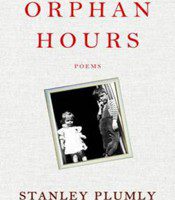
				<content:encoded><![CDATA[<p>Like a blue jay, thrush, or white-chested robin, darting in last light into leaves, twigs, or sky – after the rain, say, but before evening falls, when dark follows a darkening, Stanley Plumly’s <a href="http://www.powells.com/biblio/7-9780393076646-0"><em>Orphan Hours</em></a> shows us moments rife with a startling beauty, terrible with longing.<span id="more-110605"></span></p><p>His poems are aware of a cursedly blessed momentariness that, in their unfolding and passing, lead the heart down candle-lit passages of necessary pathos, and the mind (wandering purposely) through meditations of – and on – meaningful, exquisite meaning. “I remember,” he writes in the opening poem, “Lapsed Meadows,”</p><p style="padding-left: 30px;">in Ohio, fields of wastes of nature,<br />lost pasture, fallow clearings, buckwheat<br />and fireweed and broken sparrow nests,<br />especially in the summer, in the fading hilltop sun,<br />when you could lose yourself by simply lying down.</p><p>Although, like Keats and Wordsworth, his major themes are nature (birds, trees, wind, mountains, landscapes) and nurture (his family, including especially his mother and father), (he has two poems side-by-side entitled “Nature” and “Nurture,” and the title, “Orphan Hours,” from a fragment of Shelley’s revisions, connotes a kind of Romantic feral child quality), he is also, like any masterful poet, intoxicated by the elixir of words themselves. Thus this passage is a Whitmanesque commentary on the exhilaration of naming, the sublimity of incantatory cataloguing, the matin-like power of the hushed chant.</p><p>Plumly, like a soberer Keats or Whitman (he has written a book on Keats), he quietly intoxicates us with his own private mythologies. Boyish and manly, his head and heart hurts, then flutters, and you feel it. He finds compressed phrases and subtle effects that labor under cover of simplicity – “fading hilltop sun,” the slight natural rhyme of “sun” with “down,” the innocent tug of “especially,” the saddened, heart-stirring nostalgia of simply saying “I remember.”</p><p>Other times his poetry can be simply crushing. Here is “Sitting Alone in the Middle of the Night”:</p><p style="padding-left: 30px;">Maybe it was summer and I was back home for a while<br />working to pay off debts from school, painting white<br />barns and long field fences and on off-days baling hay.<br />It was hot then in Ohio and sometimes so dry the corn<br />or the soybeans would fail. I’d get up at two or three<br />in the morning to find my way to the kitchen for water<br />and he’d be sitting there in a kind of outline,<br />smoking and staring at something far, his eyes by now<br />long adjusted to the dark. Mine were just now opening.<br />Nothing would be said, since there was nothing to say.<br />He was dying, he was turning into stone. The little<br />I could see I could see already how much heavier<br />he made the air, heavy enough over the days that summer<br />you could feel in the house the pull of the earth.</p><p>Does the “pull of the earth” refer to gravity or the grave? Who is “sitting alone in the middle of the night” – the poet, writing this poem, or his father, refusing to speak? Imagine waking up in the heat of summer at two or three in the morning, stumbling through the house for a glass of water, only to see your father sitting in the kitchen by himself, the light failing, the room humid, not moving or speaking. The poem conveys this feeling of unspoken tension, trauma, and heartbreak very quietly, but more forcefully and forcibly because of its quiet. And the sadness in the line “He was dying, he was turning to stone” – reaching behind the coals of our feelings, setting them aflame. We feel what Plumly calls the heaviness of the moment, what Robert Hayden called “the chronic angers of that house.” Notice also the urgency with which Plumly begins his poem – he knows what’s on his mind, what’s weighing on him, as though he just asked himself, “What was going on with my father and me around this time? What stories do I remember?”</p><p>Many of Plumly’s poems located at the beginning of the book, like “The Crows at 3 A.M.”, “The Jay,” “My Lawrence,” (the latter a wonderfully chilling poem about Plumly’s love affair with D.H. Lawrence) proceed through the dance of thesis-antithesis-synthesis, whereby a problem or question is raised, explored in the next stanza or movement, and resolved, with greater complexity, in the resonating finality of the third stanza or movement.</p><p><a class="lightbox" title="Stanley Plumly author of Orphan Hours" href="http://therumpus.net/?attachment_id=110609"><img class="alignright size-full wp-image-110609" title="Stanley Plumly author of Orphan Hours" src="http://therumpus.wpengine.netdna-cdn.com/wp-content/uploads/2013/01/Stanley-Plumly.jpg" alt="" width="180" height="256" /></a>In one of my favorite poems, however, called “Lost Key,” which is sadly too long to quote in its entirety, this strategy towards moving into a greater synthesis is abandoned, for the sake of a kind of cultivated un-finality, whereby hints or clues as images, like lost keys, or a woman glimpsed through a window, or Plumly’s mother, continually surface and sink back into the rich texture of the poem. The poem’s own modus operandi is therefore a metaphor for the process of writing poetry over a lifetime – a kind of ocean, night, and mother unto itself. Thus we read, in the second stanza, “My mother would sit for hours inside silence,” (with echoes of the later “Sitting Alone in the Middle of the Night”), then of “my mother’s / half-moon scar” in the eighth stanza, and then, ending the eighth stanza and beginning the ninth:</p><p style="padding-left: 30px;">The night my mother died she held on to me<br />in order to keep her body upright over depths<br />above which lying down means falling.<br />Outside, the crystal skeletal snow was falling,<br />while in the wind that starts from the ground<br />it would suddenly rise. The sky was nothing,<br />but fifteen floors below carlights under the streetlights<br />slowed, the midnight into early morning passed,<br />and windows seemed so sheer they opened on the cold.</p><p>There is something marvelously haunting about this passage. It is as if the room in which Plumly sits, attending to his dying mother, has taken on the qualities of lucid austerity that attend his own mother’s consciousness during her final breaths. The rising and falling movements – between life and death, wind and snow, carlights and streetlights and sky, morning and midnight, inhalation and exhalation – echo masterfully the poem’s own movement and form of surfacing and sinking.</p><p>Then there are the poems that proceed by a kind of breathless desire to tell, to remember, to chronicle. We might end with the final poem of the book, a devastatingly inspired lyric, but I don’t want to give too much away. Therefore, let’s end with the third-to-last poem, called On the Beach at Duck,” short enough for a book review, long enough to stay with us:</p><p style="padding-left: 30px;">The almost gray brown pelicans flying in from nowhere,<br />and as far as the eye can see flying out to nowhere,<br />though they do it to perfection in formation<br />above the invisible lines drawn perfectly in sand<br />and in the inching blowback waves measuring the shore,<br />since once inside the wind they hardly move their wings,<br />except to readjust or sometimes change the leader,<br />until once inside the light they’re gone.</p><p>The poem is just short enough to document the brilliant image of a flock of pelicans, flying into and out of sight, over a twilit beach. Yet it also reminds us of what it is like to be inside one of Plumly’s soaring constructions. The description of “once inside the wind they hardly move their wings” is beautiful, and not less so because it is accurate. We might say the experience of reading Plumly is also often a breathlessly moving experience.<br /><h3 class='related_post_title'>Related Posts:</h3><ul class='related_post'><li><a href='http://therumpus.net/2013/04/uncanny-valley-by-jon-woodward/' title='Uncanny Valley by Jon Woodward'>Uncanny Valley by Jon Woodward</a></li><li><a href='http://therumpus.net/2013/01/in-beauty-bright-by-gerald-stern/' title='In Beauty Bright by Gerald Stern'>In Beauty Bright by Gerald Stern</a></li><li><a href='http://therumpus.net/2012/12/bewilderment-new-poems-and-translations-by-david-ferry/' title='&#8220;Bewilderment: New Poems and Translations&#8221; by David Ferry'>&#8220;Bewilderment: New Poems and Translations&#8221; by David Ferry</a></li><li><a href='http://therumpus.net/2013/05/rise-in-the-fall-by-ana-bozicevic/' title='&lt;em&gt;Rise in the Fall&lt;/em&gt; by Ana Božičević'><em>Rise in the Fall</em> by Ana Božičević</a></li><li><a href='http://therumpus.net/2013/05/desolation-souvenir-by-paul-hoover/' title='&lt;em&gt;Desolation: Souvenir&lt;/em&gt; by Paul Hoover'><em>Desolation: Souvenir</em> by Paul Hoover</a></li></ul>]]></content:encoded>
			<wfw:commentRss>http://therumpus.net/2013/02/orphan-hours-by-stanley-plumly/feed/</wfw:commentRss>
		<slash:comments>0</slash:comments>
		</item>
		<item>
		<title>In Beauty Bright by Gerald Stern</title>
		<link>http://therumpus.net/2013/01/in-beauty-bright-by-gerald-stern/</link>
		<comments>http://therumpus.net/2013/01/in-beauty-bright-by-gerald-stern/#comments</comments>
		<pubDate>Wed, 16 Jan 2013 15:00:26 +0000</pubDate>
		<dc:creator>Andrew Field</dc:creator>
				<category><![CDATA[books]]></category>
		<category><![CDATA[Poetry]]></category>
		<category><![CDATA[reviews]]></category>
		<category><![CDATA[Andrew Field]]></category>
		<category><![CDATA[Gerald Stern]]></category>
		<category><![CDATA[poetry]]></category>

		<guid isPermaLink="false">http://therumpus.net/?p=109922</guid>
		<description><![CDATA[<p>Having never read Gerald Stern’s poetry before, I took <em>This Time: New and Selected Poems</em> out from the library. The book won the National Book Award in 1998, and it deserves it; the poems are consistently charming, witty, disarmingly beautiful, and full of a kind of tongue-in-cheek, Eastern European wisdom and worldliness that seems part Isaac Bashevis Singer, and part Lenny Bruce.</p>]]></description>
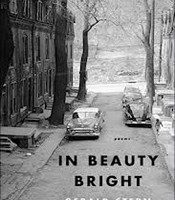
				<content:encoded><![CDATA[<p>Having never read Gerald Stern’s poetry before, I took <em>This Time: New and Selected Poems</em> out from the library. The book won the National Book Award in 1998, and it deserves it; the poems are consistently charming, witty, disarmingly beautiful, and full of a kind of tongue-in-cheek, Eastern European wisdom and worldliness that seems part Isaac Bashevis Singer, and part Lenny Bruce. Open the book up to any page, and you find lines with a wonderfully eclectic, intellectual-curmudgeonly, brutally wild music that brings to mind the marvelously manic antics of an intelligently bawdy grandfather or sophisticated, dirty-joke telling uncle. Perhaps the best compliment I can pay the book is that it motivated me to return to my own practice of writing poetry – one of the best tests I have found for the worth of a book of poems.<span id="more-109922"></span></p><p>I’m beginning this review with praise, because I found Stern’s latest book, <em><a href="http://www.powells.com/biblio/1-9780393086447-4">In Beauty Bright</a></em>, interesting as an experiment in form, but somewhat disappointing. The poems are much less punctuated than those in <em>This Time</em>; also, the majority of poems in <em><a href="http://www.powells.com/biblio/1-9780393086447-4">In Beauty Bright</a></em> comprise one breathlessly unwinding sentence. Yet it isn’t clear to me why Stern opted for this quirky formal challenge. The poems indeed feel breathless – one feels oneself working to catch up with the poem, to find oneself in the un-comma’d pauses, to locate one’s feet in the burrows of the meter – and yet it is not a breathlessness akin to W.S. Merwin’s whisper, where silence creeps into the pauses to lend much of his poems an eerie, Dickinsonian motionlessness.</p><p>Stern has been compared to Whitman, which I think is right, but these late poems do not feel exuberant so much as quietly nostalgic, and this at times jars disconcertingly with the breathless pace with which they introduce themselves and perform. Stern has a certain tender toughness that reminds me of Philip Levine, and his interest in surrealism also suggests some of Levine’s earlier work. Yet Levine, in his late work, deepens into a kind of urban Keats, without losing the toughness. Stern’s poems, at least here, do not suggest such a deepening, but rather casually shuffle across the page with their characteristic whimsy and celebration of human foibles. Yet sometimes they seem to err on the side of toughness, and other times on the side of tenderness.</p><p>At their best, they suggest a man on a bench, in coat and hat, feeding pigeons, who, upon entering into a conversation with you, regales you with fascinating, sad, moving and funny stories about his life. At their worst, they suggest the same man snoozing loudly and gutturally on the bench.</p><p>My favorite poem in the book was a longer poem called “Two Graces,” though still one breathless sentence, in which Stern re-imagines the two mythological graces as two very Stern-esque intellectuals, Emma Goldmans of 86th street or Eleanor Roosevelts of Central Park. It begins,</p><p style="padding-left: 30px;">There were three but two were all I knew<br />and one was at least a head taller and if<br />their writing was different they came from different sides<br />of the same mountain or for that matter a street,<br />and it was as if the one sang low and the other<br />shrieked almost but that wasn’t true they both<br />either hummed or sang soprano “Deep River” and ate<br />a fish soup there on the corner, and one of the two<br />grew up in the Bronx and one on 86th street<br />not far from Central Park, and one was a free-<br />thinker of the kind in Union Square<br />they stood on boxes with a flag protecting them<br />and one went to a progressive school and studied<br />Scotch-Irish songs by traveling through the mountains<br />on a bike and visiting schools and jails</p><p><a class="lightbox" title="Gerald Stern" href="http://therumpus.net/?attachment_id=109923"><img class="alignright size-full wp-image-109923" title="Gerald Stern" src="http://therumpus.wpengine.netdna-cdn.com/wp-content/uploads/2013/01/Gerald-Stern.jpeg" alt="" width="245" height="160" /></a>Notice the interesting jump between the eleventh and twelfth lines, where you’d expect a period after “Square.” I like this jump; it suggests a restlessness, a cranky need just to spit out the story, which fits well with Stern’s persona, as if he were saying, “Look, I’m 87 years old. What do you want from me? They ate fish soup, and that’s that.” One can be forgiven for wishing that this acclaimed octogenarian, however, might have invested more of his poems with such an urgency.</p><p>One more example. Here is “Rage,” a shorter poem, which, by its very title and form, would suggest a certain exigency – a needfulness to deliver, in its short time and term, a packed punch of pithiness, something to keep our attention pressed up against the poem, following its windings, moves, jolts, surprises. Here’s the poem:</p><p style="padding-left: 30px;">I lost my rage while helping a beetle recover<br />and stood there with precision, balancing<br />grass with stone and lifted my stick to show<br />how dirt holds us up and what is indifferent and what<br />their music could be and what the whistling train,<br />according to childhood and ecstatic age.</p><p>The poem conveys a certain insouciance, a cultivated laziness, which is risky – one wishes to be seen as freewheeling, perhaps, but obviously not as boring. Yet this poem is, sadly, boring.</p><p>It doesn’t matter if the moment upon which the poem is premised seems insignificant – a strong poem can make even the insignificant seem significant. For example, Williams:</p><p style="padding-left: 30px;">so much depends<br />upon</p><p style="padding-left: 30px;">a red wheel<br />barrow</p><p style="padding-left: 30px;">glazed with rain<br />water</p><p style="padding-left: 30px;">beside the white<br />chickens.</p><p>What “Rage” is missing is that “so much depends.” It’s missing that close investigative scrutiny of words that makes a poem a living object. Of course, I’m pretty much preaching to the choir, for Stern can be a marvelous poet. But too many times, in <em><a href="http://www.powells.com/biblio/1-9780393086447-4">In Beauty Bright</a></em>, he misses the mark.<br /><h3 class='related_post_title'>Related Posts:</h3><ul class='related_post'><li><a href='http://therumpus.net/2013/04/uncanny-valley-by-jon-woodward/' title='Uncanny Valley by Jon Woodward'>Uncanny Valley by Jon Woodward</a></li><li><a href='http://therumpus.net/2013/02/orphan-hours-by-stanley-plumly/' title='Orphan Hours by Stanley Plumly'>Orphan Hours by Stanley Plumly</a></li><li><a href='http://therumpus.net/2012/12/bewilderment-new-poems-and-translations-by-david-ferry/' title='&#8220;Bewilderment: New Poems and Translations&#8221; by David Ferry'>&#8220;Bewilderment: New Poems and Translations&#8221; by David Ferry</a></li><li><a href='http://therumpus.net/2013/05/rise-in-the-fall-by-ana-bozicevic/' title='&lt;em&gt;Rise in the Fall&lt;/em&gt; by Ana Božičević'><em>Rise in the Fall</em> by Ana Božičević</a></li><li><a href='http://therumpus.net/2013/05/desolation-souvenir-by-paul-hoover/' title='&lt;em&gt;Desolation: Souvenir&lt;/em&gt; by Paul Hoover'><em>Desolation: Souvenir</em> by Paul Hoover</a></li></ul>]]></content:encoded>
			<wfw:commentRss>http://therumpus.net/2013/01/in-beauty-bright-by-gerald-stern/feed/</wfw:commentRss>
		<slash:comments>0</slash:comments>
		</item>
		<item>
		<title>&#8220;Bewilderment: New Poems and Translations&#8221; by David Ferry</title>
		<link>http://therumpus.net/2012/12/bewilderment-new-poems-and-translations-by-david-ferry/</link>
		<comments>http://therumpus.net/2012/12/bewilderment-new-poems-and-translations-by-david-ferry/#comments</comments>
		<pubDate>Fri, 14 Dec 2012 15:00:17 +0000</pubDate>
		<dc:creator>Andrew Field</dc:creator>
				<category><![CDATA[Poetry]]></category>
		<category><![CDATA[Andrew Field]]></category>
		<category><![CDATA[books]]></category>
		<category><![CDATA[David Ferry]]></category>
		<category><![CDATA[poetry]]></category>
		<category><![CDATA[reviews]]></category>

		<guid isPermaLink="false">http://therumpus.net/?p=108832</guid>
		<description><![CDATA[<p>David Ferry’s <a href="http://www.powells.com/biblio/1-9780226244884-0"><em>Bewilderment: New Poems and Translations</em></a> is a necessary book. I was sad when I finished it, and hungry to return and re-read. Still, the phrase “poems and translations” seems unfortunate. In <a href="http://www.powells.com/biblio/1-9780226244884-0"><em>Bewilderment</em></a>, the two genres – the writing of poetry, and the writing of translations of poetry – are so seamlessly intertwined, thematically and stylistically, that one is compelled to ask the question, What is the difference between poetry and translation?</p>]]></description>
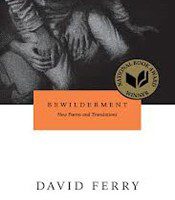
				<content:encoded><![CDATA[<p>David Ferry’s <a href="http://www.powells.com/biblio/1-9780226244884-0"><em>Bewilderment: New Poems and Translations</em></a> is a necessary book. I was sad when I finished it, and hungry to return and re-read. Still, the phrase “poems and translations” seems unfortunate. In <a href="http://www.powells.com/biblio/1-9780226244884-0"><em>Bewilderment</em></a>, the two genres – the writing of poetry, and the writing of translations of poetry – are so seamlessly intertwined, thematically and stylistically, that one is compelled to ask the question, What is the difference between poetry and translation?<span id="more-108832"></span></p><p>Aren’t poems just translations of commentary on other poems? And aren’t translations mostly forms of commentary on past translations, as well as upon the “original” poem (itself a translation)? If so, is there a difference between poetry and translation? In Ferry’s hands, the answer appears to be “no,” as his genres feel as permeable as “alterations in the light of the sun on the water.”</p><p>Translation is a central theme in <a href="http://www.powells.com/biblio/1-9780226244884-0"><em>Bewilderment</em></a> – the translation of text into text, or grief into text; text into bewilderment, or bewilderment into translation. The book proceeds through juxtaposition, itself a form of commentary, whereby lucid renderings of Horace, Virgil, Catullus, Rilke, Montale and Cavafy are set against more “personal” meditations, often woven together with thematic and stylistic content from the prior translation, “prior” in the sense of space and time – anterior to historically, and anterior in terms of the location in the book. In the process, the line between dream and wakefulness becomes blurred, as does the line between myth and reality. Ferry becomes a modern Orpheus, mourning his Eurydice, Anne Ferry, to whom the book is dedicated; a modern Abraham, bewildered by what God or fate can lead men and women to do, including the near-sacrifice of sons or prior poems; a modern Narcissus, faced with “the surface of a lonely pond iced over.”</p><p>How does Ferry achieve such compelling transfigurations, and what does translation have to do with the title of the book? We might start with the intriguing notion that “translation” and “bewilderment” share a common meaning – the former signifying, from the Online Etymology Dictionary, to “bring or carry over,” and the latter suggesting to “lure into the wilds.” Both words therefore connote an action involving a pulling into the unknown, whether that be death (an unreadable text) pulled into life, or the life of a person pulled by Death into non-being.</p><p><a href="http://www.powells.com/biblio/1-9780226244884-0"><em>Bewilderment</em></a> becomes automatically the preternatural and understandable reaction to the need for, achievement of, and process of translation. Thus we read the powerfully troubling, strangely humorous three sentences that comprise Ferry’s “Soul,”</p><p style="padding-left: 30px;">What am I doing inside this old man’s body?<br />I feel like I’m the insides of a lobster,<br />All thought, and all digestion, and pornographic<br />Inquiry, and getting about, and bewilderment,<br />And fear, avoidance of trouble, belief in what,<br />God knows, vague memories of friends, and what<br />They said last night, and seeing, outside of myself,<br />From here inside myself, my waving claws<br />Inconsequential, wavering, and my feelers<br />Preternatural, trembling, with their amazing<br />Troubling sensitivity to threat;<br />And I’m aware of and embarrassed by my ways<br />Of getting around, and my protective shell.<br />Where is it that she I loved has gone, as<br />This cold sea water’s washing over my back?</p><p>Aging, too, Ferry seems to be saying, like life and death, is a constant pull into the unknown.</p><p><a class="lightbox" title="David Ferry" href="http://therumpus.net/?attachment_id=108834"><img class="alignright size-full wp-image-108834" title="David Ferry" src="http://therumpus.wpengine.netdna-cdn.com/wp-content/uploads/2012/12/David-Ferry.jpeg" alt="" width="220" height="143" /></a>The strongest section of the book is part seven (the book has eight parts), in which Ferry’s mourning of the loss of his wife turns somewhat away from the humor of “Soul” (with a welcome detour in “The White Skunk”), to take on very serious, disturbing and heartbreaking implications in the opening two poems of that section, “Orpheus and Eurydice (From Virgil, Georgics IV)” and “Lake Water.” The translation of the Orpheus and Eurydice myth from Virgil is a tour de force, (I read it at 3am, working the midnight shift at a crisis center, though felt exhilarated rather than exhausted after finishing it), but “Lake Water” is even better. It begins with the poet commenting on strange weather (“It is a summer afternoon in October”). He is sitting on a wooden bench, looking “out across the plane of the lake, / Seeing the light shaking upon the water / As if it were a shimmering of heat.” These are very subtle lines, capturing a subtle perception, and the poem only improves from here, opening up beautifully to describe “Alterations in the light of the sun on the water, / Which becomes at once denser and more quietly / Excited, like a concentration of emotions”. The poem itself, in the third stanza, or “the surface of the page,” is compared to the lake water, “that takes back what is written on its surface.” Then we read, in the final six lines,</p><p style="padding-left: 30px;">When, moments after she died, I looked into her face,<br />It was as untelling as something natural,<br />A lake, say, the surface of it unreadable,<br />Its sources of meaning unfindable anymore.<br />Her mouth was open as if she had something to say;<br />But maybe my saying so is a figure of speech.</p><p>What a tremendous, terrible leap! Here Ferry’s themes of translation and bewilderment come marvelously, hauntingly together, in a climax of a poem that achieves an intensely calm apogee that is simultaneously a devastating anti-climax and nadir. Ferry does not need to tell us who “she” is; the careful reader will know he is referring to his Eurydice, his wife. Yet the moments after her death are “untelling,” a choice of word that is very telling, for it alludes instantly to trauma, the feeling of “I can’t tell anyone” or just “I’m not telling” that may follow a traumatic event. As Ferry reaches for a way to say somehow what he means, he translates his own bewilderment into speech, and the effect is shocking and heartbreaking.<br /><h3 class='related_post_title'>Related Posts:</h3><ul class='related_post'><li><a href='http://therumpus.net/2013/04/uncanny-valley-by-jon-woodward/' title='Uncanny Valley by Jon Woodward'>Uncanny Valley by Jon Woodward</a></li><li><a href='http://therumpus.net/2013/02/orphan-hours-by-stanley-plumly/' title='Orphan Hours by Stanley Plumly'>Orphan Hours by Stanley Plumly</a></li><li><a href='http://therumpus.net/2013/01/in-beauty-bright-by-gerald-stern/' title='In Beauty Bright by Gerald Stern'>In Beauty Bright by Gerald Stern</a></li><li><a href='http://therumpus.net/2013/05/rise-in-the-fall-by-ana-bozicevic/' title='&lt;em&gt;Rise in the Fall&lt;/em&gt; by Ana Božičević'><em>Rise in the Fall</em> by Ana Božičević</a></li><li><a href='http://therumpus.net/2013/05/desolation-souvenir-by-paul-hoover/' title='&lt;em&gt;Desolation: Souvenir&lt;/em&gt; by Paul Hoover'><em>Desolation: Souvenir</em> by Paul Hoover</a></li></ul>]]></content:encoded>
			<wfw:commentRss>http://therumpus.net/2012/12/bewilderment-new-poems-and-translations-by-david-ferry/feed/</wfw:commentRss>
		<slash:comments>0</slash:comments>
		</item>
	</channel>
</rss>