<?xml version="1.0" encoding="UTF-8"?>
<rss version="2.0"
	xmlns:content="http://purl.org/rss/1.0/modules/content/"
	xmlns:wfw="http://wellformedweb.org/CommentAPI/"
	xmlns:dc="http://purl.org/dc/elements/1.1/"
	xmlns:atom="http://www.w3.org/2005/Atom"
	xmlns:sy="http://purl.org/rss/1.0/modules/syndication/"
	xmlns:slash="http://purl.org/rss/1.0/modules/slash/"
	>

<channel>
	<title>The Rumpus.net &#187; Brian Beglin</title>
	<atom:link href="http://therumpus.net/author/brian-beglin/feed/" rel="self" type="application/rss+xml" />
	<link>http://therumpus.net</link>
	<description>Books, Music, Movies, Art, Politics, Sex, Other</description>
	<lastBuildDate>Wed, 19 Jun 2013 19:01:40 +0000</lastBuildDate>
	<language>en-US</language>
	<sy:updatePeriod>hourly</sy:updatePeriod>
	<sy:updateFrequency>1</sy:updateFrequency>
	<generator>http://wordpress.org/?v=3.5.1</generator>
		<item>
		<title>Less Is More</title>
		<link>http://therumpus.net/2010/08/59687/</link>
		<comments>http://therumpus.net/2010/08/59687/#comments</comments>
		<pubDate>Mon, 16 Aug 2010 14:00:13 +0000</pubDate>
		<dc:creator>Brian Beglin</dc:creator>
				<category><![CDATA[books]]></category>
		<category><![CDATA[reviews]]></category>
		<category><![CDATA[rumpus original]]></category>
		<category><![CDATA[Mary Hamilton]]></category>
		<category><![CDATA[microfiction]]></category>
		<category><![CDATA[Night Court]]></category>
		<category><![CDATA[ribbon]]></category>
		<category><![CDATA[Walt Whitman]]></category>
		<category><![CDATA[We Know What We Are]]></category>

		<guid isPermaLink="false">http://therumpus.net/?p=59687</guid>
		<description><![CDATA[<h4><a href="http://www.rosemetalpress.com/Catalog/whatweR.html"><img class="alignleft size-full wp-image-59688" title="Picture 1" src="http://therumpus.wpengine.netdna-cdn.com/wp-content/uploads/2010/08/Picture-14.png" alt="" width="90" height="106" /></a>The stories in Mary Hamilton’s very, <em>very</em> short collection are vivid, surreal, experimental, funny, and emotionally devastating.<span id="more-59687"></span></h4><p>Mary Hamilton’s stories read like the Facebook pages of people who share your name: noteworthy for their unifying principle but absorbing for their dissimilarity.</p>]]></description>
				<content:encoded><![CDATA[<h4><a href="http://www.rosemetalpress.com/Catalog/whatweR.html"><img class="alignleft size-full wp-image-59688" title="Picture 1" src="http://therumpus.wpengine.netdna-cdn.com/wp-content/uploads/2010/08/Picture-14.png" alt="" width="90" height="106" /></a>The stories in Mary Hamilton’s very, <em>very</em> short collection are vivid, surreal, experimental, funny, and emotionally devastating.<span id="more-59687"></span></h4><p>Mary Hamilton’s stories read like the Facebook pages of people who share your name: noteworthy for their unifying principle but absorbing for their dissimilarity. They are like a narrow crevice between boulders at the base of a mountain: When you pry open the fissure, you access an immense grotto of understanding. They are like a key party: When you reach into the fishbowl and draw one out, you might not be ready for where it takes you.</p><p>Not literally, of course. All that stuff might end up sucking.</p><p>A fundamental delight of Hamilton’s work is figuring out how to approach it. Impressive, considering that the thirteen stories in <em><a href="http://www.rosemetalpress.com/Catalog/whatweR.html">We Know What We Are</a></em>—winner of the Rose Metal Press Short Short Chapbook Contest—collectively span only thirty-five pages.</p><p>The author gets more done in those few pages than many writers could in a trilogy of novels. Hamilton’s work is genuinely, refreshingly experimental; it forgoes a polished sheen of innovation in order to take actual stylistic, structural, and cognitive risks. (I can’t quite bring myself to say Hamilton has incredible vision, but only because she works as an optician in Chicago and I hate having my metaphors so neatly teed up.) One story begins:</p><blockquote><p>More Walter always wanted more. Wanted to know how hot felt instead of how it was told. More Wanted to know how deep the river with his own eyes. More What was inside and underneath. More And now, with the sun and More with the alarm and More with the sound and More with the repetition of it and More with the familiarity of it and More with the desire and More the sound of it beating.</p></blockquote><p>The dogged use of one word trips up, bothers, and potentially alienates the reader—but then, that’s the point. When you want something badly, how long can you keep your mind on anything else? Insatiability is made vivid through language.</p><div id="attachment_59689" class="wp-caption alignright" style="width: 210px"><a href="http://therumpus.wpengine.netdna-cdn.com/wp-content/uploads/2010/08/AuthorPhotoMaryHamiltonRMP.jpg"><img class="size-medium wp-image-59689" title="AuthorPhotoMaryHamiltonRMP" src="http://therumpus.wpengine.netdna-cdn.com/wp-content/uploads/2010/08/AuthorPhotoMaryHamiltonRMP-225x300.jpg" alt="" width="200" height="267" /></a><p class="wp-caption-text">Mary Hamilton</p></div><p>Another story, about two lovers alone at a lighthouse, reveals important plot points in Morse Code—not to cruelly withhold information, but to reveal the truth that the characters are essentially speaking their own language. They’re flailing for meaningful contact, for aid, and can’t figure out why none is on its way.</p><p>Routinely, Hamilton bypasses fiction’s instinctual questions—<em>Why is this happening? How did we get here?</em>—in order to fully swell within the arterial framework of a moment. “Never Ever” is one page long, and its action consists merely of a ribbon being tied on a present, but it gives a sense of a couple’s entire emotional history—and a healthy suspicion about where they’ll end up—through the image of a finger turning purple and then blue in the ribbon’s knot. The story not only works in one page, it needs to work in one page. To know anything more would dilute the effect.</p><p>There’s a striking versatility in these stories, some of which offer traditional emotional arcs (an aging, married couple gets mired in routine), others functioning as associative prose poems that are equal parts “Song of Myself” and antagonistic Twitter feed: “I am the weather map. I am the swing in the park. I am blue sky. Yeah, I said blue sky.”</p><p>While Hamilton’s images are sometimes surreal—“There is nothing wrong with lanterns under your skin. The way they bump and quiver when you run”—her sentence constructions are consistently so. Paradoxically, her repeated use of fragments opens up these stories: “She crosses her legs. Holds one hand with the other. There is a hole. Where things fall. Things fall in. Hit bottom. Bounce back up.” It becomes a frenetic joy to map the thought chasms she leaps, the dams of logic she dynamites. The language is the collection’s true narrative thread, the thing we invest in over the course of these pages. Hamilton uses raw feeling as a foundation, then builds tangible structures with her sentences:</p><blockquote><p>There is no celebration of sunshine. No praise of blue sky or glory for light. Just gratitude for the rain. Flooding our streets and filling the sewers with fence posts and shoes. Leaves clogging drains and wind breaking trees. There is hope in these things. There is hope in our house washing away.</p></blockquote><p><em><a href="http://www.rosemetalpress.com/Catalog/whatweR.html">We Know What We Are</a></em> casts the body as an instrument of destruction, a connective force, a terrible promise, an embattled cathedral. People are surprised to count themselves as collateral damage in a war against nature (“The trees are assholes”), yet it’s their humanity that actually keeps them from connecting with others. The characters of the title story, passive-aggressive conjoined sisters who play piano on a cruise ship, may exude bravado, but they’re really propelled by hesitation and restlessness, crippling insecurity and the childlike need for connection, though they can only view each other through the telescoping lens of adult cynicism.</p><p>Hamilton’s stories are pretty goddamn funny, too. While rummaging through his attic, a man finds a bag with seventeen silver shirt buttons, but wonders, “Was he the type of man who could pull off a shirt with seventeen silver buttons? He wanted to be.” And her titles are labyrinthine gems. Four different stories share the subtitle “An Ode to Bull Shannon,” <em>Night Court</em>’s Frankensteinian bailiff; four others namecheck “Theodore,” which likely is a reference to Malcolm-Jamal Warner’s character on <em>The Cosby Show,</em> as she thanks Warner and the show’s creators in her acknowledgments. I defy you not to marvel at a title like “After a nuclear disaster the only survivors will be me and Theodore and Cockroach.”</p><p>If it’s been a while since you delved into the short short form, what will hit you here is how quickly you fall into Mary Hamilton’s world, how deeply her stories take root in your mind, and how fully they reward your attention. Do not approach them with caution—attack them with fervor. You’ll be better for the effort.<br /><h3 class='related_post_title'>Related Posts:</h3><ul class='related_post'><li><a href='http://therumpus.net/2013/03/david-biespiels-poetry-wire-identity-v-identification/' title='David Biespiel&#8217;s Poetry Wire: Identity v. Identification'>David Biespiel&#8217;s Poetry Wire: Identity v. Identification</a></li><li><a href='http://therumpus.net/2013/01/david-biespiels-poetry-wire-a-poet-and-a-president/' title='David Biespiel&#8217;s Poetry Wire: A Poet and a President'>David Biespiel&#8217;s Poetry Wire: A Poet and a President</a></li><li><a href='http://therumpus.net/2012/11/david-biespiels-poetry-wire-bruce-lees-advice-to-poets/' title='David Biespiel&#8217;s Poetry Wire: Bruce Lee&#8217;s Advice to Poets'>David Biespiel&#8217;s Poetry Wire: Bruce Lee&#8217;s Advice to Poets</a></li><li><a href='http://therumpus.net/2011/05/the-great-night/' title='The Great Night'>The Great Night</a></li><li><a href='http://therumpus.net/2010/09/the-blurb-19-the-complete-thing/' title='THE BLURB #19: The Complete Thing'>THE BLURB #19: The Complete Thing</a></li></ul>]]></content:encoded>
			<wfw:commentRss>http://therumpus.net/2010/08/59687/feed/</wfw:commentRss>
		<slash:comments>0</slash:comments>
		</item>
		<item>
		<title>The Duke of Discomfort</title>
		<link>http://therumpus.net/2010/05/the-duke-of-discomfort/</link>
		<comments>http://therumpus.net/2010/05/the-duke-of-discomfort/#comments</comments>
		<pubDate>Thu, 27 May 2010 21:00:39 +0000</pubDate>
		<dc:creator>Brian Beglin</dc:creator>
				<category><![CDATA[books]]></category>
		<category><![CDATA[reviews]]></category>
		<category><![CDATA[rumpus original]]></category>
		<category><![CDATA[david means]]></category>
		<category><![CDATA[fish]]></category>
		<category><![CDATA[gangsters]]></category>
		<category><![CDATA[Steven Millhauser]]></category>
		<category><![CDATA[The Spot]]></category>
		<category><![CDATA[tramps]]></category>

		<guid isPermaLink="false">http://therumpus.net/?p=53080</guid>
		<description><![CDATA[<h4><a href="http://therumpus.wpengine.netdna-cdn.com/wp-content/uploads/2010/05/9780865479128.jpg"><img class="alignleft size-medium wp-image-53081" title="9780865479128" src="http://therumpus.wpengine.netdna-cdn.com/wp-content/uploads/2010/05/9780865479128-201x300.jpg" alt="" width="90" height="135" /></a>David Means’s fictional worlds are ominous, pre-apocalyptic, the hiss after a match is struck but before it ignites.<span id="more-53080"></span></h4><p>A few of the universe’s hard truths: We all care what other people think of us. You will eventually become your parents. There is a point at which women are too old to wear toe rings and men are too old to wear their favorite quarterback’s jersey.</p>]]></description>
				<content:encoded><![CDATA[<h4><a href="http://therumpus.wpengine.netdna-cdn.com/wp-content/uploads/2010/05/9780865479128.jpg"><img class="alignleft size-medium wp-image-53081" title="9780865479128" src="http://therumpus.wpengine.netdna-cdn.com/wp-content/uploads/2010/05/9780865479128-201x300.jpg" alt="" width="90" height="135" /></a>David Means’s fictional worlds are ominous, pre-apocalyptic, the hiss after a match is struck but before it ignites.<span id="more-53080"></span></h4><p>A few of the universe’s hard truths: We all care what other people think of us. You will eventually become your parents. There is a point at which women are too old to wear toe rings and men are too old to wear their favorite quarterback’s jersey. And every reader—no matter how intellectually curious, emotionally receptive, or compulsively voyeuristic—has a comfort zone. When an author breaks that boundary, the reader is forced to come to terms with the limits of their own adventurous nature.</p><p>If it sounds as though David Means’s newest collection of short stories, <a href="http://www.booksmith.com/book/9780865479128"><em>The Spot</em></a>, forced me into my own literary panic room—if it sounds as though I’m fighting for some sense of ownership over these stories—well, it did, and I am. Means was put on earth to frustrate creative writing teachers and John Gardner evangelists: His characters don’t change. A lot of his action happens in flashback. His violence borders on the grotesque. He can take or leave paragraphs as structural units of composition. And he rarely, if ever, allows for immersion into fiction’s “vivid and continuous dream.”</p><p>Yet to read <em>The Spot</em> is to understand that these rules were made to be broken—or, in Means’s case, to be pistol whipped, dragged into a quarry, shot twice in the head, and set on fire.</p><p>Perhaps it’s too easy to say that these thirteen stories—his first collection since 2004’s <em>The Secret Goldfish</em>—are like compressed novels, but Means’s style is defined by tangents and parentheticals, a wandering narrative consciousness usually reserved for writers with three hundred pages to fill. Often, this omniscience works to the structural benefit of the story, as in “The Knocking,” where a man obsesses over the constant, rhythmic noise in his upstairs neighbor’s apartment. The knocking is so relentless that Means’s slippery narrative detours serve as the character’s only way to cope.</p><div id="attachment_53082" class="wp-caption alignright" style="width: 230px"><a href="http://therumpus.wpengine.netdna-cdn.com/wp-content/uploads/2010/05/means_pic2.png"><img class="size-medium wp-image-53082" title="means_pic2" src="http://therumpus.wpengine.netdna-cdn.com/wp-content/uploads/2010/05/means_pic2-300x225.png" alt="" width="220" height="165" /></a><p class="wp-caption-text">David Means</p></div><p>Unlike most novels, though, these stories lack a sense of cause and effect, forward progression; where we end up is usually right where we started. As a result, spontaneity and choice feel absent in the characters’ lives—and this stasis has the ring of truth. “The Actor’s House” explores the charisma of a Marlon Brando-esque figure in his late-life decline, the man reflected in his home and in the speculation of his community:</p><blockquote><p>Some imagined, passing, he had been helplessly buoyant upon the raging sea of his talents so that, in turn, he could only garner a sense of control over his life by not acting, or by taking bit roles that were far beneath his talents, forcing his so-called genius into small, ill-fitting characters the same way he now squeezed into his ill-fitting clothes.</p></blockquote><p>(Is Means knocking Brando’s turn as Jor-El in <em>Superman</em>? Let’s not go saying things we can’t take back…)</p><p>Means’s fictional worlds are ominous, pre-apocalyptic, the hiss after a match is struck but before it ignites. A typical hillside is, “silent and gritty, with condoms curled like snakeskins in the weeds, and the ash craters, and the used needles, glinting in the moonlight.” He’s a biographer of violence, interested in how blunt force trauma shapes human development as surely as technology or political elections—characters are beaten, shot, stabbed, drowned, tortured, crucified, and spontaneously combusted. And he has some curious signature obsessions: bank robbers, fire, hoboes. A previous collection, <em>Assorted Fire Events</em>, included a memorable story, “The Grip,” about a tramp whose essence lay in the way he clings to a cross-country train car. In <em>The Spot</em>, “The Blade” and “The Junction” both convey a sense of the almost religious importance of stories and performance in that singular community.</p><p>The collection’s best is “The Botch,” in which a Tommy gun wielding gangster pores over the details of a botched bank robbery, taking us from the elements of crowd control and the skillful dispersion of fear amongst the tellers to the mysterious appearance of a gorgeous woman who may (or may not) have derailed the whole operation. The issue of the man’s compulsion to rob in the first place is cast aside; instead, he obsesses over his failure to execute the plan, and what he would do if he saw the woman again:</p><blockquote><p>The idea was to let her know that she had been moving through life the way a fish moves through water, unable to see the fluid, unable to sort out the large picture. The idea would be to somehow shift the burden of the botch from my shoulders to her shoulders, heaving it like a duffle loaded with bones of the dead.</p></blockquote><p>We may not be able to find our way out of the darkness of these stories, but we always leave with a deep and sobering understanding of why the lights are out.</p><p>Most realist fiction aims to give readers access to the interior lives of characters. By contrast, Means’s cool, measured approach trains us to be exceptional observers of the world around us. Though he’s often compared to writers like Raymond Carver and Alice Munro and Tobias Wolff, I’d pair him with the fantastical Steven Millhauser, whose stories assume a level of scenic detail you might think impossible until you see it on the page. Though their subject matter and sensibilities differ wildly, both Means and Millhauser exert an iron will over the page. Consider Means’s paragraph-free, monolithic chunks of exposition that sometimes run seven pages long: As a reader, you’re not going to go anywhere he doesn’t want you to go. And if that makes you uncomfortable, then you’re starting to get the idea.<br /><h3 class='related_post_title'>Related Posts:</h3><ul class='related_post'><li><a href='http://therumpus.net/2010/07/the-rumpus-interview-with-david-means/' title='The Rumpus Interview With David Means'>The Rumpus Interview With David Means</a></li></ul>]]></content:encoded>
			<wfw:commentRss>http://therumpus.net/2010/05/the-duke-of-discomfort/feed/</wfw:commentRss>
		<slash:comments>0</slash:comments>
		</item>
		<item>
		<title>Stirring Coffee with a Feather</title>
		<link>http://therumpus.net/2010/01/stirring-coffee-with-a-feather/</link>
		<comments>http://therumpus.net/2010/01/stirring-coffee-with-a-feather/#comments</comments>
		<pubDate>Wed, 27 Jan 2010 22:00:55 +0000</pubDate>
		<dc:creator>Brian Beglin</dc:creator>
				<category><![CDATA[books]]></category>
		<category><![CDATA[reviews]]></category>
		<category><![CDATA[rumpus original]]></category>
		<category><![CDATA[Beautiful Soon Enough]]></category>
		<category><![CDATA[innovative fiction]]></category>
		<category><![CDATA[Margo Berdeshevsky]]></category>
		<category><![CDATA[Padgett Powell]]></category>
		<category><![CDATA[photography]]></category>
		<category><![CDATA[poetry]]></category>
		<category><![CDATA[Ronald Sukenick Prize]]></category>
		<category><![CDATA[tsunami]]></category>

		<guid isPermaLink="false">http://therumpus.net/?p=43800</guid>
		<description><![CDATA[<h4><a href="http://booksmith.com/book/9781573661492"><img class="alignleft size-full wp-image-43802" title="Beautiful Soon Enough" src="http://therumpus.wpengine.netdna-cdn.com/wp-content/uploads/2010/01/9781573661492.jpg" alt="" width="90" height="140" /></a>Margo Berdeshevsky’s work straddles the line between fiction and poetry. Her characters grieve, dream, punish themselves, and try to find harmony between who they are and who they might still be.<span id="more-43800"></span></h4><p><a href="http://booksmith.com/book/9781573661492" target="_self"><em>Beautiful Soon Enough</em></a> is the kind of book that, growing up, used to make me fearful of reading books.</p>]]></description>
				<content:encoded><![CDATA[<h4><a href="http://booksmith.com/book/9781573661492"><img class="alignleft size-full wp-image-43802" title="Beautiful Soon Enough" src="http://therumpus.wpengine.netdna-cdn.com/wp-content/uploads/2010/01/9781573661492.jpg" alt="" width="90" height="140" /></a>Margo Berdeshevsky’s work straddles the line between fiction and poetry. Her characters grieve, dream, punish themselves, and try to find harmony between who they are and who they might still be.<span id="more-43800"></span></h4><p><a href="http://booksmith.com/book/9781573661492" target="_self"><em>Beautiful Soon Enough</em></a> is the kind of book that, growing up, used to make me fearful of reading books. It’s intricate—I’d call a lot of the sentences “sentences” only because I’m not sure what else to call them—and not a whole helluva lot happens.</p><p>What’s important to consider is that, growing up, I was also stupid. I thought “unison” was a place, like Ithaca or Home Depot, because I’d always hear TV announcers say that crowds were “standing in unison.” I owned a pair of Zubaz pants and a jacket I made my mom sew fringe onto, because that’s how pro wrestlers dressed, and they seemed to have things pretty well figured out. When I hit middle school, you could’ve drained my hair for product and made drilling in ANWR a quaint little Plan B.</p><div id="attachment_43804" class="wp-caption alignright" style="width: 210px"><a href="http://therumpus.wpengine.netdna-cdn.com/wp-content/uploads/2010/01/Margo-Berdeshevsky.jpg"><img class="size-full wp-image-43804 " title="Margo Berdeshevsky" src="http://therumpus.wpengine.netdna-cdn.com/wp-content/uploads/2010/01/Margo-Berdeshevsky.jpg" alt="" width="200" height="243" /></a><p class="wp-caption-text">Margo Berdeshevsky</p></div><p>Which doesn’t mean Margo Berdeshevsky’s first book of fiction—winner of the FC2 American Book Review/Ronald Sukenick Innovative Fiction Prize—is a candy-coated peanut of a book that you can pick up with a few hours to kill and expect to fully absorb. Far from it. But to read <em>Beautiful Soon Enough</em> is to take part in the always-compelling conversation about the nature of fiction, what it can do, what it needs to do better, why it should bother, and what we readers can bring to it ourselves.</p><p>In twenty-three brief stories and twenty-eight interrelated photographs, Berdeshevsky’s women (always women) grieve, dream, punish themselves, feel the drag and drive of sex, and try to find harmony between who they are, who they could have been, and who they might still be.</p><p>Berdeshevsky is a poet (her previous book is the collection, <em>But a Passage in Wilderness</em>), actress (she toured the country as Ophelia), and photographer, who has lived or traveled extensively in New York, Hawaii, Cuba, Paris, and post-tsunami Sumatra, where she worked in a survivor’s clinic. Miraculously, she brings all those skills and all those miles to <em>Beautiful Soon Enough</em>; her photographic subjects, women never framed in full view, amplify the book’s themes of alienation, loss, and regret. She’s a wizard with written image, as well—“I sit in the stern and stare at the water. The water’s eyes are closed”—and has a wonderful knack for weaving the senses together for optimum visceral effect. She seems as comfortable wringing a few new drops from Shakespeare as she does relaying the scent of “homeless piss” in a hallway, and often does so in the same paragraph. It makes for a layered, loaded landscape, a world where all sense is hypersense, where emotion doesn’t just glow, it crackles like lightning.</p><p>By her own admission, Berdeshevsky is not a master plotter, and so small moments must bear the load, primarily through intense focus on language. And her language, while exotic and wily, can often consume the stories through sheer force. As a result it can be difficult to express what these stories are <em>about</em>, what <em>happens</em>, something that will be a turn-off for some readers.</p><p><a href="http://therumpus.wpengine.netdna-cdn.com/wp-content/uploads/2010/01/image-3.jpg"><img class="alignleft size-full wp-image-43969" title="image 3" src="http://therumpus.wpengine.netdna-cdn.com/wp-content/uploads/2010/01/image-3.jpg" alt="" width="258" height="244" /></a>A few common threads emerge. The tone throughout is that of a fable—timeless, yet infused with the detail-heavy sensibility of realist literature. Berdeshevsky writes killer last lines, cappers that give you not just chills but frostbite. A number of stories are about the inner lives of actresses—one of the standouts, “A Friday Desdemona,” tracks the relationship of a young drama student and a seasoned, ravenous Othello attempting to teach her to act more, feel less: “Be a warrior, woman,” he tells her. “Lovers do not last.”</p><p>When poets write fiction, it can sometimes read like a transfer student trying to navigate the unfamiliar hallways of a new school. Sometimes this works to brilliant effect, as the poet can put a fresh shine on the fiction writer’s familiar tools. In Simon Van Booy’s <em>The Secret Lives of People in Love</em>, the sentences feel brisk, bright, exact, like blocks of ice chiseled into smooth, brimming faces. Conversely, Berdeshevsky’s sentences seem to ache for line breaks, for the leaps and turns vital to a poem but often detrimental to fiction: “There’s a noise she is not waiting for. Scratching like—a light knocking—and again a scratching, as of unsheathed nails on her door.” Craft-wise, these bursts of language are fascinating; yet they have the net effect of poetry: they stop time with their beauty. They can bring a story—which relies on forward momentum, on cause and effect—to a halt.</p><p>Of course this begs the question: Does making such a stark distinction between poetry and prose really matter? For my money, it does. Fiction comes with expectations, just as poetry and hip-hop and meatball subs do. Some authors thwart those expectations to great effect: look at Padgett Powell’s newest, for instance. The paradox is that books like that thrive largely because they feel as though they must be fiction, as though the function demands the form. I’m not sure <em>Beautiful Soon Enough</em> works the same way. Consider a beat from “For Flame and Irresistible”: “She’s stirring coffee with a feather.” As an image in a poem, this is lovely. In a story, it upends the scene. Part of me couldn’t shake the feeling, while reading, that I hadn’t ingested a collection of stories so much as I’d been denied a phenomenal collection of poetry.</p><p><a href="http://therumpus.wpengine.netdna-cdn.com/wp-content/uploads/2010/01/image-4.jpg"><img class="alignright size-full wp-image-43970" title="image 4" src="http://therumpus.wpengine.netdna-cdn.com/wp-content/uploads/2010/01/image-4.jpg" alt="" width="260" height="269" /></a>It seems oddly fitting that I’m typing this review shortly after reading <em>The New York Times Magazine</em>’s <a href="http://www.nytimes.com/2010/01/24/magazine/24patterson-t.html">excellent piece on James Patterson</a>, whose business, it seems, is to make books as widely available—and as easily disposable—as candy bars. (And also, to make scratch. Lots and lots of scratch.) I’m not sure anyone could be farther at the other end of the spectrum than Margo Berdeshevsky, whose pages brim with crude tapped straight from the well of capital-A Art. Of course, this same quality can sometimes make her work impenetrable.</p><p>But that’s the thing about innovative fiction: You have to know going in that you’re going to alienate some people. Which is cool. Even if you <em>could</em> please everyone, if you were an artist with as many gifts as Berdeshevsky, why would you want to?</p><p>***</p><p>all photographic images c) margo berdeshevsky</p><p>Images from &#8220;Beautiful Soon Enough&#8221; by Margo Berdeshevsky<br />(University of Alabama Press/2009)<br />(c) margo berdeshevsky<br /><h3 class='related_post_title'>Related Posts:</h3><ul class='related_post'><li><a href='http://therumpus.net/2011/08/the-poet-as-pinup/' title='The Poet as Pinup'>The Poet as Pinup</a></li><li><a href='http://therumpus.net/2013/06/to-see-the-queen-by-allison-seay/' title='&lt;em&gt;To See the Queen&lt;/em&gt; by Allison Seay'><em>To See the Queen</em> by Allison Seay</a></li><li><a href='http://therumpus.net/2013/06/from-computer-geek-to-childrens-poet-laureate/' title='From Computer Geek to Children&#8217;s Poet Laureate '>From Computer Geek to Children&#8217;s Poet Laureate </a></li><li><a href='http://therumpus.net/2013/06/notable-new-york-0617-0623/' title='Notable New York: 06/17-06/23'>Notable New York: 06/17-06/23</a></li><li><a href='http://therumpus.net/2013/06/poems-retrieved-by-frank-ohara/' title='&lt;em&gt;Poems Retrieved&lt;/em&gt; by Frank O&#8217;Hara'><em>Poems Retrieved</em> by Frank O&#8217;Hara</a></li></ul>]]></content:encoded>
			<wfw:commentRss>http://therumpus.net/2010/01/stirring-coffee-with-a-feather/feed/</wfw:commentRss>
		<slash:comments>1</slash:comments>
		</item>
		<item>
		<title>Refresh, Refresh</title>
		<link>http://therumpus.net/2009/11/refresh-refresh/</link>
		<comments>http://therumpus.net/2009/11/refresh-refresh/#comments</comments>
		<pubDate>Mon, 30 Nov 2009 22:00:11 +0000</pubDate>
		<dc:creator>Brian Beglin</dc:creator>
				<category><![CDATA[books]]></category>
		<category><![CDATA[reviews]]></category>
		<category><![CDATA[rumpus original]]></category>
		<category><![CDATA[Benjamin Percy]]></category>
		<category><![CDATA[Danica Novgorodoff]]></category>
		<category><![CDATA[graphic novels]]></category>
		<category><![CDATA[Hilary Sycamore]]></category>
		<category><![CDATA[Iraq]]></category>
		<category><![CDATA[James Ponsoldt]]></category>
		<category><![CDATA[Oregon]]></category>
		<category><![CDATA[Refresh Refresh]]></category>

		<guid isPermaLink="false">http://therumpus.net/?p=39772</guid>
		<description><![CDATA[<h4><a href="http://www.powells.com/biblio/1596435224?&#38;PID=33625"><img class="alignleft size-full wp-image-39773" title="Refresh, Refresh" src="http://therumpus.wpengine.netdna-cdn.com/wp-content/uploads/2009/11/1596435224.01.MZZZZZZZ.jpg" alt="Refresh, Refresh" width="90" height="128" /></a>A new graphic novel translates Benjamin Percy’s short story about children of the Iraq war into brilliant color.<span id="more-39772"></span></h4><p>As I write this, a movie based on a series of young adult books about young adult vampires is on its way to having the third biggest box office opening of all time.</p>]]></description>
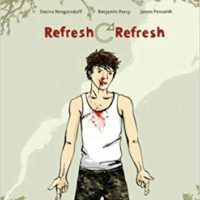
				<content:encoded><![CDATA[<h4><a href="http://www.powells.com/biblio/1596435224?&amp;PID=33625"><img class="alignleft size-full wp-image-39773" title="Refresh, Refresh" src="http://therumpus.wpengine.netdna-cdn.com/wp-content/uploads/2009/11/1596435224.01.MZZZZZZZ.jpg" alt="Refresh, Refresh" width="90" height="128" /></a>A new graphic novel translates Benjamin Percy’s short story about children of the Iraq war into brilliant color.<span id="more-39772"></span></h4><p>As I write this, a movie based on a series of young adult books about young adult vampires is on its way to having the third biggest box office opening of all time. (Um, the name of the film escapes me right now. If only they had a bigger PR budget…) The bulk of the ticket sales undoubtedly came from the books’ most avid readers; a friend of a friend—40 years old, by the by—went to see it twice on opening day, such was her fervor.</p><p>Nothing near the same readymade audience exists for a fantastically raw short story by Benjamin Percy called “Refresh, Refresh,” despite its inclusion in the <em>Best American Short Stories</em> and the Pushcart Prize anthologies. And, most likely, only a fraction of that audience is aware of the story’s transformation into a graphic novel from the pen of Danica Novgorodoff, the writer/artist of the underrated <em>Slow Storm</em>. Which is a shame, because Novgorodoff’s deferential and nuanced take on <a href="http://www.powells.com/biblio/1596435224?&amp;PID=33625"><em>Refresh, Refresh</em></a> deserves a readership as wide as the central Oregon valley in which it’s set.</p><p>Josh, Cody, and Gordon are high schoolers whose Marine reservist fathers have been in Iraq for far longer than any of them had anticipated. With tours extended and bills coming due, the boys become keenly aware of their social status, their poverty, their lack of options: “We didn’t understand the reason our fathers were fighting. We only understood that they had to fight.”</p><p>Left unsupervised—their mothers have remarried or are taking extra factory shifts to keep the lights on—they use a garden hose to form a backyard boxing ring and proceed to bloody each other after school. Unlike the empathy-starved bruisers of <em>Fight Club</em>, these boys don’t do it from some misrouted sense of honor or to promote anarchy. (Plus, Tyler Durden never swung a sockful of pennies.) They fight “to make each other tougher.” They fight because their fathers fight.</p><p><em> </em></p><p><em><img class="alignright size-full wp-image-39918" title="Danica Novgorodoff" src="http://therumpus.wpengine.netdna-cdn.com/wp-content/uploads/2009/11/danicaNovgorodoff.jpg" alt="Danica Novgorodoff" width="239" height="298" />Refresh, Refresh</em> thrives on character, not plot—past the absent fathers, there isn’t a sustained external conflict so much as a series of significant moments. The boys cross paths with a jockish bully and a military recruiter named Corey Lightener, who has a reputation for poaching the wives and girlfriends of deployed soldiers. (It’s also Lightener’s job to notify the families of the deceased; for whichever reason, it’s never good to see him on your doorstep.) But the novel’s power comes from how the three boys deal with absence. These boys are waiting: for their fathers, for their uncertain futures to take shape, for the sting of a right hook to affirm that they matter. They continually document their lives, filming their fights and their lonely walks through school hallways, posting heartbreaking messages through webcams; if they don’t put themselves on the record, who will? To avoid facing their post-graduation options, they spend hours in front of their computers waiting for word that their fathers are safe: “We could only cross our fingers and wish on stars and hit refresh, refresh, hoping they would return to us.”</p><p>Novgorodoff’s graphic novel is actually two steps removed from the original—she’s working from a film script by James Ponsoldt, who worked from the Percy story. The best dialogue is lifted verbatim from Percy, and occasionally Novgorodoff’s ear for boyhood speech lets her down. (These boys wouldn’t say “darn” and “sissy” when “damn” and “pussy” are available.) But she is a gifted visual storyteller who knows how to let silence do the talking: There are beautiful pages that pass without words, pine trees like stoic sentries behind empty houses, the town haunted by unsold cases of Coors and commercial planes overhead, flying toward somewhere more important. As the story builds momentum, it stockpiles an unnerving stillness, and abandonment becomes an almost tangible fact of these boys’ lives. Much credit must also go to colorist Hilary Sycamore for her lush Oregon greens, stark winter whites, and the unique color palettes for each character.</p><p>Novgorodoff renders the boys themselves sparsely, their faces wild with angst. She has a wonderful eye for body language—she nails the awkward gestures and restlessness that come with being teenaged and male, the urge for freedom that makes young bodies seem at once restrictive and indestructible. The lettering, a glossy afterthought in too many comics, suggests the speech of people unformed, in pain, wise but afraid of the world. Even the physical dimensions of the book seem well considered—it’s the size of a literary paperback, scaled down from a standard comic book as if to make the story more intimate.</p><p>The ultimate irony is that while solitude stunts the boys’ growth, it also gives them the wherewithal to become men. They move about their town with impunity, hitting up the local bars despite being years too young—the bars need the business, with the grown men all fighting abroad—and recklessly entangling themselves in matters of sex and violent revenge. “Just act like a man and you’ll get treated like one,” Cody says.</p><p>With this freedom, of course, comes understanding. Josh dreams of a bleak, featureless, yet unmistakable terror in Iraq, drawn by Novgorodoff in a stunning black-and-white watercolor sequence. It illustrates how much and how little these three understand about what the future holds for them.</p><p>If some readers find the beautiful playthings of <em>Twilight: New Moon</em> more easily digestible than these hardscrabble teenagers of the Pacific Northwest, I suppose I understand. We don’t like to put faces to the names of dead soldiers, much less consider the fallout their absence has on the people who wait for them, always, to come home. But I’m thankful Novgorodoff is asking the messy questions, even if the answers make us hurt.<br /><h3 class='related_post_title'>Related Posts:</h3><ul class='related_post'><li><a href='http://therumpus.net/2013/05/of-maus-and-men/' title='Of &lt;em&gt;Maus&lt;/em&gt; and Men'>Of <em>Maus</em> and Men</a></li><li><a href='http://therumpus.net/2013/02/congratulations-marinaomi/' title='CONGRATULATIONS, MARINAOMI!'>CONGRATULATIONS, MARINAOMI!</a></li><li><a href='http://therumpus.net/2012/07/black-wings-love-loss-and-life-as-a-humanitarian-aid-worker-in-iraq/' title='Black Wings: Love, Loss and Life as a Humanitarian Aid Worker in Iraq '>Black Wings: Love, Loss and Life as a Humanitarian Aid Worker in Iraq </a></li><li><a href='http://therumpus.net/2012/07/not-the-israel-my-parents-promised-me/' title='&lt;em&gt;Not the Israel My Parents Promised Me&lt;/em&gt;'><em>Not the Israel My Parents Promised Me</em></a></li><li><a href='http://therumpus.net/2012/02/goliath-excerpt/' title='&lt;em&gt;Goliath&lt;/em&gt; Excerpt'><em>Goliath</em> Excerpt</a></li></ul>]]></content:encoded>
			<wfw:commentRss>http://therumpus.net/2009/11/refresh-refresh/feed/</wfw:commentRss>
		<slash:comments>1</slash:comments>
		</item>
		<item>
		<title>The Camera Never Lies</title>
		<link>http://therumpus.net/2009/05/the-camera-never-lies/</link>
		<comments>http://therumpus.net/2009/05/the-camera-never-lies/#comments</comments>
		<pubDate>Sat, 23 May 2009 21:00:07 +0000</pubDate>
		<dc:creator>Brian Beglin</dc:creator>
				<category><![CDATA[books]]></category>
		<category><![CDATA[Original Content]]></category>
		<category><![CDATA[reviews]]></category>
		<category><![CDATA[rumpus original]]></category>
		<category><![CDATA[cartoons]]></category>
		<category><![CDATA[Nothing But a Smile]]></category>
		<category><![CDATA[photography]]></category>
		<category><![CDATA[pinups]]></category>
		<category><![CDATA[Steve Amick]]></category>
		<category><![CDATA[World War II]]></category>

		<guid isPermaLink="false">http://therumpus.net/?p=19288</guid>
		<description><![CDATA[<p><a href="http://www.powells.com/partner/33625/biblio/0307377369" target="_blank"><img class="alignleft size-medium wp-image-19289" src="http://therumpus.wpengine.netdna-cdn.com/wp-content/uploads/2009/05/nothing-but-a-smile-198x300.jpg" alt="" width="95" height="144" /></a></p><h4>In Steve Amick&#8217;s new novel, desire is most effectively stoked by what you can&#8217;t see.<span id="more-19288"></span></h4><p>What do you see when you look at a pinup girl?</p><p>As a kid who&#8217;d just been given my first <em>Playboy</em> by my brother-in-law, I would have answered that question in strictly anatomical fashion.</p>]]></description>
				<content:encoded><![CDATA[<p><a href="http://www.powells.com/partner/33625/biblio/0307377369" target="_blank"><img class="alignleft size-medium wp-image-19289" src="http://therumpus.wpengine.netdna-cdn.com/wp-content/uploads/2009/05/nothing-but-a-smile-198x300.jpg" alt="" width="95" height="144" /></a></p><h4>In Steve Amick&#8217;s new novel, desire is most effectively stoked by what you can&#8217;t see.<span id="more-19288"></span></h4><p>What do you see when you look at a pinup girl?</p><p>As a kid who&#8217;d just been given my first <em>Playboy</em> by my brother-in-law, I would have answered that question in strictly anatomical fashion. I remember being drawn to the promise of seeing things I hadn&#8217;t seen before. But oddly enough, the most alluring shot in that issue-the only one I remember now, honest-was a woman wearing a white dress shirt, a few buttons open at the top but revealing nothing, her hand on her head to keep a pile of blond curls from spilling down. Everything I thought I wanted to see was hidden. It could&#8217;ve been an ad for cologne in <em>Sports Illustrated</em>, a billboard for vodka in Times Square. Put a glass in her other hand, and it could&#8217;ve said &#8220;Got Milk?&#8221;</p><p>In <a href="http://www.powells.com/partner/33625/biblio/0307377369" target="_blank"><em>Nothing but a Smile</em></a>, his kinetic and clever slice of 1940s American cheesecake, Steve Amick operates on the guiding principle that desire is most effectively stoked by what you can&#8217;t see. Skillfully playing against wholesome tropes like Norman Rockwell and Rosie the Riveter, he tells us that everything we know is not wrong, but some of it is a little dirty.</p><p>During World War II, Army cartoonist Wink Dutton is discharged with a Purple Heart and a mangled hand, souvenirs of late-night drinking and a killer hangover. His career as an illustrator all but destroyed, he struggles to try to find his niche in the Chicago commercial art scene. As a personal favor, he swings through the Loop to check up on Sal Chesterton, the wife of one of his buddies still stuck in the Pacific. Sal&#8217;s in dire straits, too. The camera shop her family has owned and operated for twenty years has seen its wartime business plummet. She decides to take what she does have-ingenuity, photography know-how, and a busty figure-and produce a few pinup shots for quick cash. Soon, she shows him the pics for his professional opinion, surprised to find herself not embarrassed so much as intrigued by the possibility of combining her technical expertise with his artistic eye. They become friends, and Wink eventually rents a room in Sal&#8217;s apartment over her family&#8217;s camera shop, mores and neighbors be damned.</p><div id="attachment_19290" class="wp-caption alignright" style="width: 160px"><img class="size-full wp-image-19290" src="http://therumpus.wpengine.netdna-cdn.com/wp-content/uploads/2009/05/small_steve-amick.jpg" alt="Steve Amick" width="150" height="198" /><p class="wp-caption-text">Steve Amick</p></div><p>Amick is smart to keep Wink and Sal together, at work and at home and at play-their chemistry is undeniable. Sal is capable, charming, and so earnest in her business pursuit that it&#8217;s impossible to read her as objectified or hyper-sexualized. (In fact, she&#8217;s comforted by the thought that, thousands of miles away, her husband might take some pleasure in seeing a shot of her &#8220;playing it up for him, batting her eyes, sticking out her can, whatever.&#8221;) While Wink, frustrated by his injury, is sometimes driven to commit minor acts of property damage, he&#8217;s otherwise unflappable and as adept with a sarcastic crack as he is with a bottle of gin. Even when Sal catches him masturbating, he coolly says, &#8220;Obviously, I was waxing the dolphin.&#8221;</p><p>The novel&#8217;s chapters flip nimbly between Wink and Sal&#8217;s points of view, quick as an Argus shutter. The switches let Amick play the professional partnership for laughs-Wink critiques a girlie picture without knowing Sal is the girlie-but also give him control over the complexities of the relationship. The phantom presence of Sal&#8217;s husband starts to wear on them both, as does loneliness, and knowing what they can&#8217;t have only enhances their desire. &#8220;What,&#8221; Sal wonders, &#8220;did a person have to do around here to just smell a good-looking man once in a blue moon?&#8221;</p><p>Amick, author of 2005&#8242;s <em>The Lake, the River &amp; the Other Lake</em> and a former full-time advertising pro, is keenly tuned to our grainy mental pictures of the era, its perceived cuteness and spunk. While we get healthy rations of plucky period detail-gotta love the since-dated slang terms like &#8220;peachy&#8221; and &#8220;jake&#8221;-he also introduces some discord. Bizarre and potentially embarrassing military deaths go uninvestigated and unreported. The girlie pictures eventually catch the eye of more than just GIs, as local kids start recognizing Sal on the street and a crooked boxing promoter comes after the trademark. Wink rapidly picks up on the techniques Sal teaches him, and puts them to more traditional use: during one of his first &#8220;assignments,&#8221; he snaps a shot of a war veteran that warrants first publication in the <em>Chicago Tribune</em>, then an apology a few days later, and then regular visits from shadowy federal agents who stink of early McCarthyism. The most welcome complication comes from Sal&#8217;s friend Reenie, a ballbuster who catches Wink&#8217;s eye and becomes a co-conspirator in the pinup game.</p><p>But conspiracy and titillation are really just set dressing. At its heart, Amick&#8217;s novel is a playful, affecting love story. During a typically bawdy photo shoot, laughter rings, &#8220;through the camera shop, carrying out into the dark street, along with the music [Wink] found on the radio-delicious, brassy, pre-Army Harry James-and he wouldn&#8217;t have been anywhere else on a bet.&#8221; <a href="http://www.powells.com/partner/33625/biblio/0307377369" target="_blank"><em>Nothing but a Smile</em></a> is about people who specialize in revealing just enough, but there&#8217;s no covering up their hearts.<br /><h3 class='related_post_title'>Related Posts:</h3><ul class='related_post'><li><a href='http://therumpus.net/2013/06/the-danger-of-perspective/' title='The Danger of Perspective'>The Danger of Perspective</a></li><li><a href='http://therumpus.net/2013/06/a-former-nazi-tells-her-story/' title='A Former Nazi Tells Her Story'>A Former Nazi Tells Her Story</a></li><li><a href='http://therumpus.net/2013/05/album-5-audio-portraits-of-artists-and-writers-at-work-ariel-schrag/' title='ALBUM #5, AUDIO PORTRAITS OF ARTISTS AND WRITERS AT WORK: Ariel Schrag '>ALBUM #5, AUDIO PORTRAITS OF ARTISTS AND WRITERS AT WORK: Ariel Schrag </a></li><li><a href='http://therumpus.net/2013/05/attention-attention/' title='Attention, Attention'>Attention, Attention</a></li><li><a href='http://therumpus.net/2013/05/the-rumpus-interview-with-claire-rosen/' title='The Rumpus Interview with Claire Rosen'>The Rumpus Interview with Claire Rosen</a></li></ul>]]></content:encoded>
			<wfw:commentRss>http://therumpus.net/2009/05/the-camera-never-lies/feed/</wfw:commentRss>
		<slash:comments>0</slash:comments>
		</item>
	</channel>
</rss>