<?xml version="1.0" encoding="UTF-8"?>
<rss version="2.0"
	xmlns:content="http://purl.org/rss/1.0/modules/content/"
	xmlns:wfw="http://wellformedweb.org/CommentAPI/"
	xmlns:dc="http://purl.org/dc/elements/1.1/"
	xmlns:atom="http://www.w3.org/2005/Atom"
	xmlns:sy="http://purl.org/rss/1.0/modules/syndication/"
	xmlns:slash="http://purl.org/rss/1.0/modules/slash/"
	>

<channel>
	<title>The Rumpus.net &#187; Brynn Downing</title>
	<atom:link href="http://therumpus.net/author/brynn-downing/feed/" rel="self" type="application/rss+xml" />
	<link>http://therumpus.net</link>
	<description>Books, Music, Movies, Art, Politics, Sex, Other</description>
	<lastBuildDate>Sun, 19 May 2013 01:26:34 +0000</lastBuildDate>
	<language>en-US</language>
	<sy:updatePeriod>hourly</sy:updatePeriod>
	<sy:updateFrequency>1</sy:updateFrequency>
	<generator>http://wordpress.org/?v=3.5.1</generator>
		<item>
		<title>Punchline by Nick Courtright</title>
		<link>http://therumpus.net/2013/04/punchline-by-nick-courtright/</link>
		<comments>http://therumpus.net/2013/04/punchline-by-nick-courtright/#comments</comments>
		<pubDate>Fri, 26 Apr 2013 14:01:10 +0000</pubDate>
		<dc:creator>Brynn Downing</dc:creator>
				<category><![CDATA[books]]></category>
		<category><![CDATA[Poetry]]></category>
		<category><![CDATA[reviews]]></category>
		<category><![CDATA[Brynn Downing]]></category>
		<category><![CDATA[Nick Courtright]]></category>
		<category><![CDATA[poetry]]></category>

		<guid isPermaLink="false">http://therumpus.net/?p=113658</guid>
		<description><![CDATA[Brynn Downing reviews Nick Courtright's <em>Punchline</em> today in Rumpus Poetry.]]></description>
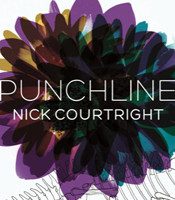
				<content:encoded><![CDATA[<p style="padding-left: 30px;">Humans<br />use sand to make glass,<br />through which we see to the other side,</p><p style="padding-left: 30px;">and to make computer chips,</p><p>So reads the third part of &#8220;The Despot&#8221;, the preface to Nick Courtright&#8217;s <em><a href="http://www.spdbooks.org/Producte/9780983700128/punchline.aspx">Punchline</a></em>. <em><a href="http://www.spdbooks.org/Producte/9780983700128/punchline.aspx">Punchline</a></em>, released in 2012 by Gold Wake Press, undulates around images of religion, place, modernization and science.</p><p>Courtright splits the collection into sections, prefacing each with a quote that leads into the following poem. For example, the first section, &#8220;&#8230;He does not throw the dice&#8221;, taken from a quote by Albert Einstein, is also the title of the first poem in that section. Courtright weaves repeating phrases and images (guitars, ghosts, octopi, wind) throughout the collection, as he juggles broader swaths of ideas. However, at the end of the poems, and upon revisiting, I don&#8217;t feel as if I know much about Nick Courtright; his poems do not cast strings with place names or dates. Much of the collection left me feeling as if I was staring into a zen garden, knowing the lines in the sand are beautiful and precise, not quite sure of their depth but able to acknowledge the mastery.</p><p>The poems that stayed with me were ones generous enough with details that I could see myself, or someone I might know. Like the poet, as a child I imagined a world under water I could reach if only I could hold my breath long enough. I always rose back from the Atlantic sputtering and coughing. But in &#8220;Journey to the Bottom of the Sea&#8221; Courtright takes us into the ocean, &#8220;alone for the first time, ocean on all sides of you/and it always had to be this way&#8221;. On the sea floor, where &#8220;the Lusitania and all the other great ships/mankind could not make unsinkable&#8221; wait, the poem plays cards with an octopus, swims the corridors and coral. It&#8217;s an idea that might seem better fit for a children&#8217;s book of rhyme, but Courtright turns the poem to a mediation on stillness, and the forgotten passages of history that wait within us&#8211; &#8220;the mistakes/ of the twentieth century and the nineteenth/century and this century and all the other centuries as well&#8221;&#8211; and around us, guiding us forward with their disasters and losses, in the search to answer what might be waiting in the darkness, or beyond the darkness.</p><p>At times, the poems are self aware, teasing their limits as words on a page, steps from one page to the next. &#8220;What We Know and What We Don&#8217;t&#8221; begins with a fan whirring in the ceiling but shifts suddenly to</p><p style="padding-left: 30px;">the litany of constellations</p><p style="padding-left: 30px;">whispering down to the hood of a car on which two teens lay&#8211;</p><p style="padding-left: 30px;">they are not as solid as you think they are,<br />and neither are you.</p><p><img src="http://therumpus.wpengine.netdna-cdn.com/wp-content/uploads/2013/04/Nick-Courtright_sm.jpg" alt="Nick Courtright_sm" width="200" height="240" class="alignright size-full wp-image-113659" />Courtright roots down his poems, and then throws them up, lets them lift on their own. What is the weight of a poem, even one you carry with you, whispering as you memorize it? What is the weight of the wind, he asks. What is the weight we carry with us, on us, and what does it mean? These are vast questions, left probed but unanswered, as they must be, like koans. It is as he says in “Punchline”:</p><p style="padding-left: 30px;">And<br />it’s in the punchline that is all our being and all our seeking—</p><p style="padding-left: 30px;">these are<br />the roadsigns of proof, the victory of one definition</p><p style="padding-left: 30px;">over others, the abstract<br />absurdity of living, here, wherever this is and why.</p><p>To try and give those questions answers belays their weight, and distracts form the purpose of questioning: to see yourself as part of a whole, and to wonder your place in it.<br /><h3 class='related_post_title'>Related Posts:</h3><ul class='related_post'><li><a href='http://therumpus.net/2012/10/the-girls-of-peculiar-by-catherine-pierce/' title='&#8220;The Girls of Peculiar&#8221; by Catherine Pierce'>&#8220;The Girls of Peculiar&#8221; by Catherine Pierce</a></li><li><a href='http://therumpus.net/2013/05/rise-in-the-fall-by-ana-bozicevic/' title='&lt;em&gt;Rise in the Fall&lt;/em&gt; by Ana Božičević'><em>Rise in the Fall</em> by Ana Božičević</a></li><li><a href='http://therumpus.net/2013/05/desolation-souvenir-by-paul-hoover/' title='&lt;em&gt;Desolation: Souvenir&lt;/em&gt; by Paul Hoover'><em>Desolation: Souvenir</em> by Paul Hoover</a></li><li><a href='http://therumpus.net/2013/05/forty-one-jane-does-by-carrie-olivia-adams/' title='&lt;em&gt;Forty-One Jane Doe&#8217;s&lt;/em&gt; by Carrie Olivia Adams'><em>Forty-One Jane Doe&#8217;s</em> by Carrie Olivia Adams</a></li><li><a href='http://therumpus.net/2013/05/easy-math-by-lauren-shapiro/' title='&lt;em&gt;Easy Math&lt;/em&gt; by Lauren Shapiro'><em>Easy Math</em> by Lauren Shapiro</a></li></ul>]]></content:encoded>
			<wfw:commentRss>http://therumpus.net/2013/04/punchline-by-nick-courtright/feed/</wfw:commentRss>
		<slash:comments>0</slash:comments>
		</item>
		<item>
		<title>Now Make an Altar by Amy Beeder</title>
		<link>http://therumpus.net/2013/01/now-make-an-altar-by-amy-beeder/</link>
		<comments>http://therumpus.net/2013/01/now-make-an-altar-by-amy-beeder/#comments</comments>
		<pubDate>Fri, 18 Jan 2013 15:00:46 +0000</pubDate>
		<dc:creator>Brynn Downing</dc:creator>
				<category><![CDATA[books]]></category>
		<category><![CDATA[Poetry]]></category>
		<category><![CDATA[reviews]]></category>

		<guid isPermaLink="false">http://therumpus.net/?p=109981</guid>
		<description><![CDATA[<p>In Amy Beeder’s poetry, we are surrounded by the refuse and remains of the past: memories and photos of lost generations, the bones and fur of animals used to adorn ourselves, the smell of fallow plants. Her second collection of poetry, <a href="http://www.powells.com/biblio/17-9780887485442-0"><em>Now Make An Altar</em><em></em></a>, explores those remains in verse both haunting and brutal.</p>]]></description>
				<content:encoded><![CDATA[<p>In Amy Beeder’s poetry, we are surrounded by the refuse and remains of the past: memories and photos of lost generations, the bones and fur of animals used to adorn ourselves, the smell of fallow plants. Her second collection of poetry, <a href="http://www.powells.com/biblio/17-9780887485442-0"><em>Now Make An Altar</em><em></em></a>, explores those remains in verse both haunting and brutal.<span id="more-109981"></span></p><p>Beeder creates a narrative that explores destruction imploring creation, suffering calling for beauty, such as when she writes “Yes, they liked your mother’s stark &amp; balding head/but also wanted ghosts: some charismatic/ ancestors conspiring in those hospice corners” in “I Liked the Poem About Your Mother Dying.” She impels the reader to join her loss, but also to recognize the moments of (fading) beauty that force themselves upon the mourning, as she begins the poem with, “gold leaves bunched in the gutter.” Beeder goes on to explore the isolation of loss, the inability to communicate the exactness felt in pain. She writes, “to sit at least and quantify, <em>expand</em> the parasite/clarify the tulip’s fluke, the turnip’s blight.” Her failure to declare her experience in the words of others leads her to draw a parallel between herself and “the wild boy of Aveyron/ who never learned to speak in any dialect but thicket.”</p><p>“Anatomy Lesson” turns to the bloody and public exploration of the human body in the name of science and knowledge. Have we surpassed our ancestors, who crowded anatomy halls? The guts of humanity are spilled out by Beeder’s pen, and I read as transfixed as if I was watching some ER-set soap, or crime scene investigation television. Despite the callowness of death, Beeder balances a child-like sense of wonder, describing the dissection as, “his frocked assistant fishing in that yawning slit/ from which blooms a mass of tubes.” While someone weeps for their loss, we are learning, finding answers to our own questions of limitations and possibility.</p><p><a class="lightbox" title="Amy Beeder" href="http://therumpus.net/?attachment_id=109982"><img class="alignright size-full wp-image-109982" title="Amy Beeder" src="http://therumpus.wpengine.netdna-cdn.com/wp-content/uploads/2013/01/Amy-Beeder.jpeg" alt="" width="194" height="260" /></a>Beeder explores the duality of pain and knowledge by focusing on historical footnotes in ekphastic verse, such as the poem “I Rightfully Curse the Author of so Pernicious a Machine,” which examines the legacy of Ambroise Pare, a barber surgeon and expert in battlefield medicine. Perhaps it’s Beeder’s work as a human rights observer in Haiti and Suriname that led her to recognize that the advances in medicine have contributed to advances in human cruelty and destruction.</p><p>“Jaguar in the Bullring” examines the desire to right the wrongs of history—but the acceptance of how such tragedy pushes life on, for art and the mundane. The jaguar in question has been skinned and its pelt mounted to a wall in a bar. Yet the image retains its power—and transits it to the poem. We’re still fascinated by “old gore,” still telling stories about bloody moments of power. If Beeder could return back to that fight, would she truly rescue that jaguar from the brute crowd/black bull’s dewslapped slab”? Or would she have stood and shouted in the stands, wanting her to win, and knowing that she couldn’t?</p><p>The poems in <a href="http://www.powells.com/biblio/17-9780887485442-0"><em>Now Make An Altar</em><em></em></a> seem to blend together. Beeder ends many of the poems on ‘em-stops’, leaving me to wonder where the boundaries lay. Perhaps that’s the root of this collection, as I could not just read one poem, but was led to the next, and the next, digging deeper into the past.<br /><h3 class='related_post_title'>Related Posts:</h3><ul class='related_post'><li>No related posts&#8230;</li></ul>]]></content:encoded>
			<wfw:commentRss>http://therumpus.net/2013/01/now-make-an-altar-by-amy-beeder/feed/</wfw:commentRss>
		<slash:comments>0</slash:comments>
		</item>
		<item>
		<title>&#8220;The Girls of Peculiar&#8221; by Catherine Pierce</title>
		<link>http://therumpus.net/2012/10/the-girls-of-peculiar-by-catherine-pierce/</link>
		<comments>http://therumpus.net/2012/10/the-girls-of-peculiar-by-catherine-pierce/#comments</comments>
		<pubDate>Fri, 26 Oct 2012 14:00:00 +0000</pubDate>
		<dc:creator>Brynn Downing</dc:creator>
				<category><![CDATA[books]]></category>
		<category><![CDATA[Poetry]]></category>
		<category><![CDATA[reviews]]></category>
		<category><![CDATA[Brynn Downing]]></category>
		<category><![CDATA[Catherine Pierce]]></category>
		<category><![CDATA[poetry]]></category>

		<guid isPermaLink="false">http://therumpus.net/?p=106995</guid>
		<description><![CDATA[<p>There is a canon of cinema that revolves around girls leaving girlhood, and finding themselves young and nubile, ready (so they think) to embrace their future as women. There’s the girl who seduces her teacher, only to realize she should have loved the boy next door, and there’s the girl who dreams of the city, only to appreciate too late the wisdom (and boys) of her humble town.</p>]]></description>
				<content:encoded><![CDATA[<p>There is a canon of cinema that revolves around girls leaving girlhood, and finding themselves young and nubile, ready (so they think) to embrace their future as women. There’s the girl who seduces her teacher, only to realize she should have loved the boy next door, and there’s the girl who dreams of the city, only to appreciate too late the wisdom (and boys) of her humble town. These girls rarely seem more than wisps of memory- poorly catalogued desires ambiguous enough to be recognized and claimed, without any of the sweat of honesty. When you are a girl, these stories read two ways: sometimes they are like lifeboats from the future- sometimes they are condescending, and the lack of grounding shows through. It might change depending on the day, or a phrase, as everything does when you’re 17.<span id="more-106995"></span></p><p>In Catherine Pierce’s third collection of poems, <a href="http://www.spdbooks.org/Producte/9780983368625/the-girls-of-peculiar.aspx"><em>The Girls of Peculiar</em></a>, she explores this dialogue between the past and present, and the weight of deciding who you are now against who you were. She walks the limits of identity, memory, and woman (girl) hood, casting herself back to adolescence and forward, to lives she might have lived. Ultimately, she surfaces determined to embrace life in this body, in this moment, but the possibilities of the past never lose their sweetness.</p><p>Pierce splits the book into thirds, the first section filled with recurring images and sounds, calls and responses like campfire games; book-ending the first section are “Poem to the Girls We Were” and “Poem from the Girls We Were”. In the former, the opening poem to the collection, Pierce picks apart the girls of memory with the venom of a queen bee clique: “….look at you/ Luxuriating in the bathwater of shame./ It’s lovely, isn’t it, to pity yourself”. Yet Pierce longs for the simple self-absorbed focus of adolescence, how rumors stung and “radiated, like a jelly fish binding/our organs in its poison strands”- such self-centered behavior in an adult is less accepted (oh the irony!). Then was a time when the world seemed to stop for a pretty girl who could “make the world dance any way/ your gorgeous, guilty selves want”.</p><p>The girls of the past respond, reminding Pierce “this is no romance”, that despite the melodrama of memory, for those living those highs and lows, it is deadly serious, as everything is when you’re breathing that moment:</p><p style="padding-left: 30px;">This is every house on your block<br />lit from within, each bedroom window<br />shining with safety and you outside<br />in the icing dusk, knowing nothing<br />will ever warm you. This is the gray<br />song you’ll hear forever. Your bones<br />will stay marrowed with dust.<br />The Future? This is The Future.<br />If you were here, you’d know that. (Poem from the Girls We Were)</p><p>By college, we’re expected to have identified ourselves. Adolescence was the time for dying our hair, to pulling on ripped t-shirts one day and Lacoste the next. Yet, this does not mean that we are content with our decisions. “Postcards from Her Alternative Lives”, published first in <em>Court Green</em>, and then later selected for <em>The Best American Poetry 2011</em>, explores the regrets and wants of choosing and settling into ourselves. At one point, we could have become desert shamans, where</p><p style="padding-left: 30px;">…on each<br />rock rests a bowl of water, a wooden flute, a lizard.<br />The clouds swoop into the shape of my fears, then<br />blow off into the next country.</p><p>Pierce acknowledges that selecting our identities, especially as women, is a political and social action on which we’re judged by our choice’s worth, and respectability in poems such as “Hare Lip” and “The Women From the 70s Are Beautiful”. In “The Guidance Counselor to the Girl”, Pierce writes the litany of acceptable professions that might also satisfy “an aptitude for solitary work” and a “proclivity for nature”. By the final line, Pierce resolves to pursue art, to “create the wind”.</p><p><a class="lightbox"  title ="Catherine Pierce" href="http://therumpus.net/?attachment_id=106997"><img src="http://therumpus.wpengine.netdna-cdn.com/wp-content/uploads/2012/10/Catherine-Pierce.jpeg" alt="" title="Catherine Pierce" width="225" height="150" class="alignright size-full wp-image-106997" /></a>She invites us into this inner monologue, switching between first person singular and third person plural, expecting that we too “howled. Oh yes./ Listen. Our throats still know how to find the rawest song” (“The Delinquent Girls”). Despite this attention to teenage sturm und drang, we’ve never given a taste of the roots of our angst. Is it our overbearing mother? A failed relationship? Did our parents divorce? Did our class douse us with paint during prom? There may have been insignificant reasons for us to lay in bed listening to the Smiths, but there were reasons- and they didn’t feel insignificant at the time. Pierce fails to root us in a place, or a where, as if stopping herself from truly embracing the wants and pains of girlhood.</p><p>I wanted to like <em><a href="http://www.spdbooks.org/Producte/9780983368625/the-girls-of-peculiar.aspx">The Girls of Peculiar</a></em>. I too, write poems rehashing the agonies of adolescence, and suburban upbringing. I bet Catherine Pierce hates herself for using ‘yay!’ in text messages, and prefers the Smiths to the Cure. Maybe she also realizes too late that she should have smiled at that strange boy. I know she allowed words to obsess her, and is still daydreaming about the woman, the girl she could have been, should have been. But I don’t feel as if I learned much else about her.</p><p><em><a href="http://wp.me/po1to-rPD">Read &#8220;The Tornado Collects the Animals,&#8221; a Rumpus Original Poem by Catherine Pierce.</a></em><br /><h3 class='related_post_title'>Related Posts:</h3><ul class='related_post'><li><a href='http://therumpus.net/2013/04/punchline-by-nick-courtright/' title='Punchline by Nick Courtright'>Punchline by Nick Courtright</a></li><li><a href='http://therumpus.net/2013/05/rise-in-the-fall-by-ana-bozicevic/' title='&lt;em&gt;Rise in the Fall&lt;/em&gt; by Ana Božičević'><em>Rise in the Fall</em> by Ana Božičević</a></li><li><a href='http://therumpus.net/2013/05/desolation-souvenir-by-paul-hoover/' title='&lt;em&gt;Desolation: Souvenir&lt;/em&gt; by Paul Hoover'><em>Desolation: Souvenir</em> by Paul Hoover</a></li><li><a href='http://therumpus.net/2013/05/forty-one-jane-does-by-carrie-olivia-adams/' title='&lt;em&gt;Forty-One Jane Doe&#8217;s&lt;/em&gt; by Carrie Olivia Adams'><em>Forty-One Jane Doe&#8217;s</em> by Carrie Olivia Adams</a></li><li><a href='http://therumpus.net/2013/05/easy-math-by-lauren-shapiro/' title='&lt;em&gt;Easy Math&lt;/em&gt; by Lauren Shapiro'><em>Easy Math</em> by Lauren Shapiro</a></li></ul>]]></content:encoded>
			<wfw:commentRss>http://therumpus.net/2012/10/the-girls-of-peculiar-by-catherine-pierce/feed/</wfw:commentRss>
		<slash:comments>0</slash:comments>
		</item>
	</channel>
</rss>