<?xml version="1.0" encoding="UTF-8"?>
<rss version="2.0"
	xmlns:content="http://purl.org/rss/1.0/modules/content/"
	xmlns:wfw="http://wellformedweb.org/CommentAPI/"
	xmlns:dc="http://purl.org/dc/elements/1.1/"
	xmlns:atom="http://www.w3.org/2005/Atom"
	xmlns:sy="http://purl.org/rss/1.0/modules/syndication/"
	xmlns:slash="http://purl.org/rss/1.0/modules/slash/"
	>

<channel>
	<title>The Rumpus.net &#187; Caleb Powell</title>
	<atom:link href="http://therumpus.net/author/caleb-powell/feed/" rel="self" type="application/rss+xml" />
	<link>http://therumpus.net</link>
	<description>Books, Music, Movies, Art, Politics, Sex, Other</description>
	<lastBuildDate>Fri, 25 May 2012 15:22:39 +0000</lastBuildDate>
	<language>en</language>
	<sy:updatePeriod>hourly</sy:updatePeriod>
	<sy:updateFrequency>1</sy:updateFrequency>
	<generator>http://wordpress.org/?v=3.3.2</generator>
		<item>
		<title>The Rumpus Interview with David Shields (Paperback Edition)</title>
		<link>http://therumpus.net/2011/02/the-rumpus-interview-with-david-shields-paperback-edition/</link>
		<comments>http://therumpus.net/2011/02/the-rumpus-interview-with-david-shields-paperback-edition/#comments</comments>
		<pubDate>Wed, 23 Feb 2011 08:00:28 +0000</pubDate>
		<dc:creator>Caleb Powell</dc:creator>
				<category><![CDATA[books]]></category>
		<category><![CDATA[rumpus original]]></category>
		<category><![CDATA[David Shields]]></category>
		<category><![CDATA[fiction]]></category>
		<category><![CDATA[Reality Hunger]]></category>
		<category><![CDATA[Reality Hunger paperback]]></category>
		<category><![CDATA[Reality Hunger: A Manifesto]]></category>
		<category><![CDATA[Reality Hunger: A Manifesto paperback]]></category>

		<guid isPermaLink="false">http://therumpus.net/?p=73583</guid>
		<description><![CDATA[The February 2010 publication of Reality Hunger: A Manifesto, by David Shields, generated an amazing amount of discussion from all sides.Shields traded contrarian ideas with Nicholson Baker, Stephen Colbert, and Rick Moody, among others, and provoked stalwarts Michiko Kakutani and James Woods. Such fiery debate rare for a work of literary criticism, leading to the [...]]]></description>
			<content:encoded><![CDATA[<p><img class="alignleft" src="http://farm6.static.flickr.com/5291/5471802649_2914a01c73_m.jpg" alt="" width="120" height="171" />The February 2010 publication of <em><a href="http://www.booksmith.com/book/9780307387974">Reality Hunger: A Manifesto</a></em>, by <a href="http://www.davidshields.com/">David Shields</a>, generated <a href="http://therumpus.net/2010/03/reality-boredom-why-david-shields-is-completely-right-and-totally-wrong/">an amazing amount of discussion</a> from all sides.</p><p><span id="more-73583"></span></p><p>Shields traded contrarian ideas with Nicholson Baker, Stephen Colbert, and Rick Moody, among others, and provoked stalwarts Michiko Kakutani and James Woods. Such fiery debate rare for a work of literary criticism, leading to the February 2011 release of the book in paperback. Within Shields argues for a certain aesthetic, a blurring of genre, a future without novel, a literature that penetrates “reality at ground level,” specifically: the lyric essay, collage, and other non-traditional forms. One cannot deny his manifesto has stimulated debate, and that the art he loves can be quite stunning. However, the underlying jeremiad against fiction has proven troubling, though attempts to persuade Shields of his follies prove futile. Christopher Hitchens might get better odds in convincing The Pope to renounce Catholicism. Nevertheless, I offer this salvo, not so much to dissuade Shields, but to promote the value, going forward, of the novel.</p><p style="text-align: center;">***</p><p><strong> </strong></p><p><strong>The Rumpus</strong>: A long time ago someone close to me told me she was raped, that she had been impregnated by her stepfather, and then had an abortion. When she told me I acted like she had a venereal disease. I avoided her. I lost contact. Years later I felt regret, and I wanted to understand her experience. I read <em>Bastard out of Carolina. </em>Through story, character, even setting and plot, through a novel, I learned about her reality at “ground level.” This reality obliterated something inside me. You&#8217;ve stopped reading novels&#8230;are you certain they can offer nothing?</p><p><strong>David Shields</strong>:  The question doesn’t really make sense. One idea is not connected to the other. What I think of is the novel Louise Erdrich wrote “about” Michael Dorris’s suicide. Everyone understood that the novel was a roman à clef, but it didn’t scrape to bone in the way that I wanted it to. I’m not sure what to say other than that for myself and other like-minded writers, I’m establishing an aesthetic of radical compression, naked discomfiture, etc. Louise Erdrich is a born novelist, and that is her métier, and she’s good at it, but what I found in that book, and what I find in 99.99% of novels is that the armature takes over – the impulse to keep the reader turning pages. What I want from work front and center is the writer struggling with nothing less than how he or she has or hasn’t solved the problem of being alive. A book should either allow us to escape existence or teach us how to endure it. Almost all novels do the former; I want the latter.</p><p><strong>Rumpus:</strong> How to escape? How to endure? Dorothy Allison&#8217;s novel asks: How can a 12 year-old child solve being raped by her stepfather? What can this child do when her mother does not believe her? How should she stay afloat when her mother ultimately chooses her stepfather? Thus specifically: “How can a child stay alive when she is raped and has no one to turn to?” The novel concludes with hardcore doubt. It&#8217;s a grueling lesson, and struggles mightily with how to endure, not escape. I question your certainty thus:</p><blockquote><p>A. David Shields is certain the novel does not solve being alive.</p><p>B. There are novels that struggle with the problem of how to be alive.</p><p>Therefore…</p><p>C. David Shields&#8217; certainty is called into question.</p></blockquote><p><img class="alignright" src="http://farm6.static.flickr.com/5140/5469564766_1198848b67_o.jpg" alt="" width="260" height="400" />I would say most novels are “entertainment.” You say “almost all.” You pull out your exceptions, and then label them anti-novels, but I&#8217;m trying to show, by one exception, that you may be wrong. That a novel, even if it&#8217;s a roman à clef, offers compelling art. I&#8217;d say that 99% of novels don&#8217;t do it, but this may also be the case with 99% of lyric essay/collage etc. The novel is equal to other forms in this respect.</p><p><strong>Shields:</strong> Sure. If you found the Dorothy Allison novel powerful, go for it. Not sure what to say. I&#8217;m just saying that for myself, I was looking at the <em>N</em><em>ew </em><em>Y</em><em>ork</em><em>er</em> last night. Thought I&#8217;d look at the first sentence of Tessa Hadley&#8217;s short story. It seemed to me a gesture made so many millions of times before that we can&#8217;t read it anymore. It&#8217;s played out. At least it is for me. I&#8217;m fifteen years older than you are. I&#8217;ve read a lot more. I&#8217;ve read all of these things. I&#8217;ve read all of these novels. Forms evolve. Art, like science, progresses. Why should a novel written in 2011 take very nearly the same form as a novel took in 1880, with minor variations? Is this true in music? In visual art? No. Then why should it be true in literary work? How can we not take full advantage of the digital materials now available to us? I can&#8217;t argue with your experience or anyone else&#8217;s. I&#8217;m just saying that for me I can&#8217;t read such works anymore. They feel hackneyed and predictable. I&#8217;m trying to develop an aesthetic flag to fly under for people who share this. Hundreds of people write me to say, “Thank you for writing this. I never knew what form I was trying to get to. This is it.”</p><p><strong>Rumpus:</strong> Hey, I’m as picky reader as you, I’ve got my eclectic mix of nonfiction and fiction, essay, journalism, cultural flotsam&#8230;I want art full of life, language, and I want to get into the mind of a fucking genius.</p><p><strong>Shields:</strong> That’s all I ever want to do, too – get into the mind of a genius. But I want the mind. Almost no novels major in mind. I love the exceptions: Sterne, Markson, Proust, etc.</p><p><strong>Rumpus:</strong> Fair enough. You’ve done tons of interviews, and pretty much everyone has come up with these so-called “exceptions”… I’ve got mine, Larry Watson’s <em>Montana 1948, </em>Toni Morrison’s <em>Song of Solomon,</em> Lionel Shriver&#8217;s <em>We Need to Talk about Kevin</em><em>…</em>man, that novel fucks with your brain. But I’ll stay with <em>Bastard out of Carolina</em>&#8230;the power comes from three hours of intense reading. A lyric essay could never match that. When you describe novels you aren’t describing this…unless you despise “real.” These are novels for the 21st century, for now, for the future, and they could not have been written in 1880.</p><p><strong>Shields</strong>: My goal was never to convince you or anyone else. It was just to write an ars poetica for myself, to figure out what it is I love and why, and if there are any like-minded individuals who find the argument useful, then I’m delighted. This probably sounds like an evasion on my part, but it’s the “truth.” One novel that I read fairly recently and loved, and that is utterly traditional, is Coetzee’s <em>Disgrace</em>. I haven’t read those novels you mention, but whenever I do read such novels that everybody else admires – e.g. Philip Roth’s <em>The Human Stain</em> – all of the armature inevitably defeats me.</p><p><strong>Rumpus:</strong> Who&#8217;s everybody else?</p><p><strong>Shields: </strong>Conventional wisdom, I suppose. The gate-keepers.</p><p><strong>Rumpus: </strong>I’d say you&#8217;ve developed an inveterate bias.</p><p><strong>Shields: </strong>No art without bias.</p><p><strong>Rumpus: </strong>The artist should embrace all forms.</p><p><strong>Shields: </strong>Nope. Gotta choose.</p><p><strong><img class="alignleft" src="http://farm6.static.flickr.com/5100/5468971221_152a3eb9b1_o.jpg" alt="" width="186" height="280" />Rumpus: </strong>I love what you love…fiction also. But I’ll admit…I’m concerned for the novel’s future. I see literature becoming less and less important.</p><p><strong>Shields: </strong>I’m trying to save it, I promise you.</p><p><strong>Rumpus: </strong>I think about David Foster Wallace&#8217;s take on poetry, that poetry is only written for poets, experimental writing is a lot of work with little reward&#8230;new forms capture the same landscape. I say the novel offers the best chance to avoid this.</p><p><strong>Shields: </strong>As I mention, there are definitely some novels that I like, but they aren’t novelly novels. They might have a somewhat fictive rubric, e.g. Coetzee’s <em>Elizabeth Costello</em>, but they are not sacrificing investigation for entertainment. They are all about the investigation.</p><p><strong>Rumpus: </strong>So I ask&#8230;do you think lyric essay and collage face the same danger as the poem? What about literature in general? Will there be a day when the only people reading literary art are those who create it? And how important is this to our future?</p><p><strong>Shields: </strong>I suppose that is a real concern, isn’t it? This is the elitist idea? I guess I don’t think in those terms. I just am trying to stay alive as a writer and reader and teacher. Almost all fiction writing bores me out of my mind. I’ve found, to my great relief and joy, work that thrills me and that I want to write. Many writers who are 55 are phoning in their SOP by now. I feel proud that I’m still completely confused, completely feeling my way in the dark through this new form, this nonfiction drawer labeled nonsocks. People will always read and write. It will take utterly new forms. And one of the main ways we’ll get there is by embracing new technologies and new modes rather than pretending “literature” consists of replaying the hits of 1908.</p><p>***</p><p><em>Read Caleb Powell&#8217;s first Rumpus Interview with Shields <a href="http://therumpus.net/2010/02/the-rumpus-interview-with-david-shields/">here</a>. </em><br /><h3 class='related_post_title'>Related Posts:</h3><ul class='related_post'><li><a href='http://therumpus.net/2010/05/52252/' title='What Should The New Novel Look Like?'>What Should The New Novel Look Like?</a></li><li><a href='http://therumpus.net/2010/03/notable-new-york-this-week-38-314/' title='Notable New York, This Week 3/8 &#8211; 3/14'>Notable New York, This Week 3/8 &#8211; 3/14</a></li><li><a href='http://therumpus.net/2012/01/late-bloomers/' title='For the Late Bloomers'>For the Late Bloomers</a></li><li><a href='http://therumpus.net/2011/11/following-the-rules/' title='Following The Rules'>Following The Rules</a></li><li><a href='http://therumpus.net/2011/08/tracking-our-literary-style/' title='Tracking Our Literary Style'>Tracking Our Literary Style</a></li></ul>]]></content:encoded>
			<wfw:commentRss>http://therumpus.net/2011/02/the-rumpus-interview-with-david-shields-paperback-edition/feed/</wfw:commentRss>
		<slash:comments>7</slash:comments>
		</item>
		<item>
		<title>Little Green</title>
		<link>http://therumpus.net/2010/06/little-green/</link>
		<comments>http://therumpus.net/2010/06/little-green/#comments</comments>
		<pubDate>Thu, 10 Jun 2010 14:00:55 +0000</pubDate>
		<dc:creator>Caleb Powell</dc:creator>
				<category><![CDATA[books]]></category>
		<category><![CDATA[reviews]]></category>
		<category><![CDATA[rumpus original]]></category>
		<category><![CDATA[crank]]></category>
		<category><![CDATA[Dorothy Allison]]></category>
		<category><![CDATA[Little Green]]></category>
		<category><![CDATA[Loretta Stinson]]></category>
		<category><![CDATA[mary gaitskill]]></category>
		<category><![CDATA[methamphetamine]]></category>
		<category><![CDATA[topless]]></category>

		<guid isPermaLink="false">http://therumpus.net/?p=54044</guid>
		<description><![CDATA[“If I ever caught you spun, we’d be over. Only one of us gets to be fucked up at a time.”What if all life choices are flawed? In her first novel, Little Green, Loretta Stinson, winner of the Oregon Literary Arts Fellowship in Fiction, introduces Janie Marek, a young girl with few options. Left an [...]]]></description>
			<content:encoded><![CDATA[<h4><a href="http://www.booksmith.com/book/9780979018817"><img class="alignleft size-full wp-image-54045" title="Picture 2" src="http://therumpus.wpengine.netdna-cdn.com/wp-content/uploads/2010/06/Picture-2.png" alt="" width="92" height="155" /></a>“If I ever caught you spun, we’d be over. Only one of us gets to be fucked up at a time.”<span id="more-54044"></span></h4><p>What if all life choices are flawed? In her first novel, <a href="http://www.booksmith.com/book/9780979018817" target="_self"><em>Little Green</em></a>, Loretta Stinson, winner of the Oregon Literary Arts Fellowship in Fiction, introduces Janie Marek, a young girl with few options. Left an orphan in care of an indifferent stepmother, heartbreak propels Janie to run away at the age of sixteen. On the road and needing money, she enters a topless bar; after displaying her wares and lying about her age she is hired. Janie’s life will become worse.</p><p>Novels about abuse, rape, domestic violence, and other hopeless situations often beg the reader to suffer along with seemingly helpless characters as they bump into and barely recognize better choices. The finest of these writers—Mary Gaitskill, Dorothy Alison—create realities many readers never experience: a girl has to decide whether to strip or become a prostitute or use drugs (Gaitskill); a bad situation worsens with no way out, as in Allison’s <em>Bastard out of Carolina</em>. So where will Stinson’s character go? Will Janie make a right choice?</p><p>Stinson’s prose propels the story, but her real strengths are dialogue and characterization. At the topless bar, the Habit, Janie meets Paul Jesse, an itinerant drug dealer; they have a moment, but she is not interested in pursuing the flirtation. After a couple months of saving up, she’s ready to head north, to Eugene; she thumbs it, accepts a ride, gets savagely raped, and returns to the bar beaten and in shock, where she sees more of Paul. He is ten-plus years her senior, an unshaven alcoholic roughneck and drug abuser with a history of domestic violence. Stinson creates a three dimensional character in Paul, who is able to recognize, when sober, some measure of his faults. He shows a soft and tender side to Janie and displays enough charm to convince Janie to move in with him—and then the proverbial downward spiral begins. All his redeeming qualities diminish, replaced by a pathologically self-centered, jealous, hypocritical, and insecure villain. Paul beats Janie, screws other drug-addled women without compunction, and when he takes Janie on one of his drug runs offers her as collateral: “As long as he didn’t rip off Bill and brought the money back in time, Janie would be fine. If he didn’t, Bill would get her strung out and sell her to a pimp he knew.”</p><div id="attachment_54046" class="wp-caption alignright" style="width: 140px"><a href="http://therumpus.wpengine.netdna-cdn.com/wp-content/uploads/2010/06/th__dsc1409-1.jpg"><img class="size-full wp-image-54046" title="th__dsc1409-1" src="http://therumpus.wpengine.netdna-cdn.com/wp-content/uploads/2010/06/th__dsc1409-1.jpg" alt="" width="130" height="192" /></a><p class="wp-caption-text">Loretta Stinson</p></div><p>Reading Janie’s misadventures can be frustrating, especially once the real Paul emerges. Her lack of experience fuels a naïve belief that she can make him change, but the source of this unexplained faith is never clear. Paul becomes enraged when she drinks or wants to use drugs: “If I ever caught you spun, we’d be over. Only one of us gets to be fucked up at a time.”</p><p>Then this: “Janie knew she stayed now because she was afraid to leave… He whispered in her ear, so close she could taste the crank on him, ‘If you ever left me I’d find you. I’d kill you before I let you leave me.’”</p><p>Janie finds support in unexpected places. One friend counsels, “if you ask a smoker they’ll say they know they have to quit but it means being uncomfortable. Until the smoker decides to live with discomfort there’s not much you can do.” Another, one of Paul’s coke whores, warns her, “Right now, I know more about you and Paul than you do. You think he’ll change and I know he won’t.”</p><p>Yet during Paul’s long absences Janie finds a job, other lifelines, and the reader begins to hope. Nevertheless, she keeps hoping against hope, giving Paul chance upon chance. When she serves up the Thanksgiving Day disaster of her home-cooked meal on a table made of an “old piece of plywood and two saw horses,” eaten by Paul’s meth-riddled friends as Paul is passed out, she seems more hurt and helpless than angry. Has she still not figured out that Paul is, well, not her best option?</p><p>Authentic narrations of drug use and abuse are not flashy and dramatic, but tempered by long periods of uncertainty, fear, and repeated mistakes. Victims are confused, scared, and rarely heroic. In seeking a better life, Janie’s passivity, her lack of agency in the cause of her own redemption, can be given a pass; the possibility that she might learn to recognize her choices and take action dawns only slowly. But Stinson’s admirable storytelling keeps the reader uncertain—and uncomfortable—until the very end.<br /><h3 class='related_post_title'>Related Posts:</h3><ul class='related_post'><li><a href='http://therumpus.net/2012/03/radar-productions-east-coast-benefit/' title='RADAR Productions’ East Coast Benefit'>RADAR Productions’ East Coast Benefit</a></li></ul>]]></content:encoded>
			<wfw:commentRss>http://therumpus.net/2010/06/little-green/feed/</wfw:commentRss>
		<slash:comments>1</slash:comments>
		</item>
		<item>
		<title>American History X-treme</title>
		<link>http://therumpus.net/2010/03/american-history-x-treme/</link>
		<comments>http://therumpus.net/2010/03/american-history-x-treme/#comments</comments>
		<pubDate>Tue, 16 Mar 2010 21:00:36 +0000</pubDate>
		<dc:creator>Caleb Powell</dc:creator>
				<category><![CDATA[books]]></category>
		<category><![CDATA[reviews]]></category>
		<category><![CDATA[rumpus original]]></category>
		<category><![CDATA[American History X]]></category>
		<category><![CDATA[Autobiography of a Recovering Skinhead]]></category>
		<category><![CDATA[Frank Meeink]]></category>
		<category><![CDATA[Jody M. Roy]]></category>
		<category><![CDATA[swastika]]></category>

		<guid isPermaLink="false">http://therumpus.net/?p=47400</guid>
		<description><![CDATA[A former neo-Nazi’s memoir describes a violent life in the white supremacist movement and his transformative experiences in prison.Frank Meeink is the most famous ex-skinhead in America, his life the basis for the character of Derek Vinyard, the neo-Nazi portrayed by Edward Norton in American History X. But Frank is not quite Derek; as he [...]]]></description>
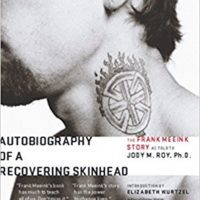
			<content:encoded><![CDATA[<h4><a href="http://booksmith.com/book/9780979018824"><img class="alignleft size-full wp-image-47401" title="Autobiography of a Recovering Skinhead" src="http://therumpus.wpengine.netdna-cdn.com/wp-content/uploads/2010/03/51EGe+hw0VL._SL160_.jpg" alt="" width="98" height="160" /></a>A former neo-Nazi’s memoir describes a violent life in the white supremacist movement and his transformative experiences in prison.<span id="more-47400"></span></h4><p>Frank Meeink is the most famous ex-skinhead in America, his life the basis for the character of Derek Vinyard, the neo-Nazi portrayed by Edward Norton in American History X. But Frank is not quite Derek; as he states in <a href="http://booksmith.com/book/9780979018824" target="_self"><em>Autobiography of a Recovering Skinhead</em></a>, “<em>American History X</em> isn’t my story. It’s every skinhead’s story to some extent… it was every other kid who ever got sucked up into the white supremacy movement.”</p><p>Frank’s tale, as told to Jody M. Roy, Ph.D., is a harrowing look at the white supremacist, neo-Nazi, and skinhead movements in the U.S., a graphic depiction of a broken home, drug abuse, addiction, and self-destruction. In South Philly, where “talking shit to somebody’s grandma can get you killed,” Frank is raised in and out of dysfunctional homes and streets infested by ethnic gangs. His only love and release is hockey, and he feels an atavistic pull toward violence, alcohol, and the notoriety offered by white supremacist gangs. Soon he starts beating the hell out of gays and blacks and homeless people. But the objects of his most intense hatred are Jews: “I felt alive when they bled. I craved the power I felt surging through my veins every time I slammed my boot into some dude’s face.”</p><p>Frank’s tattoo repertoire includes a swastika on his neck, a ten-inch portrait of Joseph Goebbels on his chest, S-K-I-N-H-E-A-D across his knuckles. When he gets busted after assaulting a gay man one of Frank’s comrades taunts the arresting officer, “I’m Charles Manson, and I’ve got the swastikas to prove it… on my dick. Come on, copper, suck my swastika!”</p><div id="attachment_47402" class="wp-caption alignright" style="width: 264px"><a href="http://therumpus.wpengine.netdna-cdn.com/wp-content/uploads/2010/03/862jw86o.jpg"><img class="size-full wp-image-47402" title="Frank Meeink" src="http://therumpus.wpengine.netdna-cdn.com/wp-content/uploads/2010/03/862jw86o.jpg" alt="" width="254" height="350" /></a><p class="wp-caption-text">Frank Meeink</p></div><p>The narrative borders on sensationalism: Meeink is beaten regularly by his stepfather, his mother lives on pills and alcohol, Frank roams the streets and whomps everyone’s ass, until he himself is raped at gunpoint. The author and editors of <em>Autobiography</em> were clearly concerned about the factual accuracy of these stories; they ran background checks and consulted Meeink’s friends, family, counselors, jailers, and social workers, until they were satisfied with the accuracy of Meeink’s memories.</p><p>Amazingly brutal and difficult to digest, <em>Autobiography</em> follows Frank from childhood through his involvement with the white supremacist movement, a felony conviction, and incarceration, introducing readers to the Aryan Nations, the National Alliance, the KKK, and other groups. They celebrate Hitler’s birthday, swap theories about the Zionist Occupational Government, debate the <em>Turner Diaries</em> (a book that influenced Timothy McVeigh), and revere the thugs in <em>A Clockwork Orange</em>. Frank claims to believe in God but accepts the white supremacist version of Christianity. He gushes when introduced to a neo-Nazi hero, describing him as an “Aryan warrior” and “the most hardcore white supremacist I’d met… The red laces in his Doc Martens dripped blood” before the two of them assault a homosexual outside a gay bar. “I felt proud, truly proud, for the first time,” Meeink recalls.</p><p>When he’s caught on film committing assault, Frank is arrested and pleads guilty, receiving a sentence of three to five years in prison. His girlfriend is pregnant, he’s an alcoholic, he’s suicidal. “You’re not a ‘race warrior,’” his girlfriend tells him. “You’re a thug.” In Illinois’ Stateville Correctional Center, he becomes a “skinhead celebrity.” But prison opens his eyes. Black inmates offer more support and solidarity than the other skinheads. He plays football on an all-black team. His best friends in prison are black and rather than descend to a deeper white supremacy he sees everyone as of one race.</p><p>The transformation continues after his release. He forms a friendship with a Jewish employer and starts speaking out against racism, though without breaking bonds of friendship with his skinhead brothers who eventually brand him a traitor to the race and subject him to the “Axis Stomp.” Addictions with alcohol, cocaine, pills, and heroin while fathering three children with three women add to his drama. However, he starts speaking publicly about the follies of white supremacy, achieves celebrity, and commands lecture fees of $2,000 or more. A life of relative stability begins as he founds Harmony through Hockey, marries, and reconnects with his family.</p><p>For all the focus on Meeink’s addictions and travails, <em>Autobiography of a Recovering Skinhead</em> doesn’t provide much introspection by its subject. As if to compensate, the book ends with an interview of both Meeink and Roy, in which he discusses religion, spirituality, and his newfound tolerance. “No matter the race or any other differences, we learn to walk at the same time, at about one year, we start to learn to talk at the same time… we’re all human, we all care about the growth of our children.” It would seem to be a tale of redemption, relevant to any reader who wants to understand hatred and take part in the process of forgiveness. But the book’s lasting impression is of the brutality of Meeink’s earlier incarnation, and one wonders if those drawn to white supremacy and hatred could take any lessons from it before their beliefs come to harm others.<br /><h3 class='related_post_title_no'>Related Posts:</h3><ul class='related_post_no'><li>No related posts&#8230;</li></ul>]]></content:encoded>
			<wfw:commentRss>http://therumpus.net/2010/03/american-history-x-treme/feed/</wfw:commentRss>
		<slash:comments>3</slash:comments>
		</item>
		<item>
		<title>The Rumpus Interview with David Shields</title>
		<link>http://therumpus.net/2010/02/the-rumpus-interview-with-david-shields/</link>
		<comments>http://therumpus.net/2010/02/the-rumpus-interview-with-david-shields/#comments</comments>
		<pubDate>Mon, 15 Feb 2010 08:01:26 +0000</pubDate>
		<dc:creator>Caleb Powell</dc:creator>
				<category><![CDATA[books]]></category>
		<category><![CDATA[rumpus original]]></category>

		<guid isPermaLink="false">http://therumpus.net/?p=45300</guid>
		<description><![CDATA[David Shields attempts to demolish the foundations of literature in his latest, "Reality Hunger: A Manifesto." His target: the culture.]]></description>
			<content:encoded><![CDATA[<p><img class="alignleft" src="http://farm3.static.flickr.com/2714/4357441755_7e745e0eeb_o.jpg" alt="" width="108" height="140" />David Shields, author of three novels and seven works of nonfiction, attempts to demolish the foundations of literature in his latest, <a href="http://www.booksmith.com/book/9780307273536"><em>Reality Hunger: A Manifesto</em></a><em>.</em> His target: the culture. He argues that there has been a dreadful trend in fiction, and not just genre<span id="more-45300"></span> fiction and the mass-market best seller, but within the entire literary spectrum.<!--more--> Stories using too much detail, too much description, stories within stories within stories deviating and dwelling in obscure tangents and conventional formula.</p><p>David took time off from his busy schedule to meet in Wallingford, a neighborhood just west of the University of Washington overlooking Lake Union and the Seattle skyline. He suggested a coffee shop but I convinced him to forego the lattes and chai teas and we went to a bar. He sipped water to my beer. I came armed with what I thought were sure-fire arguments to convince him that there is value in the story, and that the writer should pursue traditional fiction while perhaps evolving to a more precise, compressed, and minimal aesthetic. I’m not sure if I succeeded in making him budge, but he may have pulled me a couple inches closer to his line of reasoning…</p><p><strong>The Rumpus:</strong> You excoriate the traditional novel and fiction in <em><a href="http://www.booksmith.com/book/9780307273536">Reality Hunger</a>, </em>yet you began writing fiction. It turned out not to be your forte. Why the attack? Isn’t it like an impotent man vowing abstinence?</p><p><strong>David Shields: </strong>That’s a funny analogy. And I’d be a fool to think that type of criticism won’t emerge. I’m continually forced to reconsider and defend my views. I have a couple conversion areas in which I talk about impasse, my impotence <em>vis-a-vis</em> the novel. Zadie Smith, when she wrote about <em><a href="http://www.booksmith.com/book/9780307273536">Reality Hunger</a> </em>in <em>The Guardian, </em>brought this up as if I hadn’t thought of it. Of course I’m aware. The origin of this book is my response to my fascination, bafflement, and bewilderment at the fact the novel form has died on me. You could say, ‘Who cares. So the novel went dead for you…that’s your problem.’ But I don’t think it was a coincidence the novel went dead, nor do I think it’s just my problem. For those who buy my argument I’m the canary in the mineshaft. For those who don’t…well, they’ll just say, ‘That’s David Shields opinion. He’s foisting his own foibles onto the culture.’ It’s like the abortion argument: If you’re against abortion don’t have one. If you want to write the old-fashioned traditional novel…all the more power to you. No gun to your head. If you think traditional novels are exciting stuff, like those written by Ian McEwan and Jonathan Franzen…that they capture what it feels like to be alive in our mass media dominated culture, well, you have my permission to go on writing and reading those books. I’ll think you’re foolish, nostalgic, a dinosaur etcetera etcetera.</p><p><strong>Rumpus:</strong><strong> </strong>You dismiss fiction as entertainment.</p><p><strong>Shields: </strong>Too often it is.</p><p><strong>Rumpus:</strong><strong> </strong>Many fictional stories, though, are art, and the author is not concerned with entertainment per se.</p><p><strong>Shields: </strong>Give me an example.</p><p><strong>Rumpus:</strong><strong> </strong>Rohinton Mistry’s <em>A Fine Balance.</em> Nine hundred pages of traditional fiction.</p><p><strong>Shields: </strong>Haven’t read it, though I’ve heard it’s good.</p><p><strong>Rumpus:</strong><strong> </strong><em></em>You watch<em> Slumdog Millionaire</em>?</p><p><strong>Shields</strong>.  Yes.</p><p><strong>Rumpus:</strong><strong> </strong>It’s the polar opposite. After about page one hundred you realize everyone will die or wish they had. That’s difficult to achieve.</p><p><strong><img class="alignright" src="http://farm3.static.flickr.com/2694/4358161172_350f48a94b_o.jpg" alt="" width="268" height="400" /></strong><strong>Shields: </strong>Obviously there are exceptions. But what I find repeatedly is that a very intelligent writer will begin with a great idea, I know it’s an easy target, but I’ll use Jonathan Franzen<em>. </em>His idea is that we tend to overcorrect…on a personal level, a psychological, a familial, a geopolitical, an economic level…so he has this idea of writing <em>The Corrections.</em> And he wants to trace this over families and generations, and I’m really interested in that…but what does he do? He gives up way too much ground; he sacrifices too much on the altar of plot. He’s there, essentially, to hold the reader in his grip while the really interesting ideas he initially wanted to explore are barely scratched. Instead, he spends time trying to keep the middle-brow reader riveted. And I don’t think of myself as a middle-brow reader. I’m not held by plot, I’m held by thoughts…by ideas, by consciousness. We’re lonely. We’re existentially lonely. And the work I love the most shows you this for two hundred pages. What happens to me in book after book after book is the opposite, the most recent example is Louise Erdrich’s <em>roman</em><em> à </em><em>clef</em><strong> </strong>about her marriage with Michael Dorris…he committed suicide, their marriage ended blah blah blah. I haven’t read the book, just a review, but what I want from her is a searing excavation of the pain…not a story…not a novel, because a novel is basically a story telling mechanism that exists to hold the reader riveted…it’s there to sell a book.</p><p>I love ideas and contemplation. The energy of the word as the writer wrestles with some personal or cultural cataclysm. Take Maggie Nelson’s <em>Bluets, </em>a very short book composed of nothing but discreet paragraphs, ostensibly about her breaking up with this guy. Lots of memoirs and novels would just trace the relationship…but what she does in a series of beautifully far-ranging paragraphs is explore why the human animal is so melancholy…why are we so blue? And she explores…she flies all over, and for me that is a far richer meditation…whereas the traditional approach would be unending chapters about how this couple broke up. So many novels are hamstrung by the formulaic execution of scene, setting, dialogue, character development, back story, narrative, momentum, epiphany, closure…there are exceptions, but the books I love tend to be anti-novels. They foreground contemplation.</p><p><strong>Rumpus:</strong><strong> </strong>To write the traditional novel, though, you must become an authority. You want to write about prostitution in Thailand, so you need to know about AIDS, pregnancy, adoption, Thai culture…It’s like Hemingway’s tip of the iceberg, knowledge underlies a powerful story. Research may be boring, but to just reflect on your literary aesthetic, and explore your own problems, seems like a basketball player who only wants to scrimmage. No free throws, no laps, no weight room, just scrimmaging…or the musician who just wants to jam, no scales, no rehearsal. You write passionately about the panoply of your likes and dislikes…but once you’ve mastered craft and voice you’re just jamming. Where’s the exertion, the authority?</p><p><strong><img class="alignleft" src="http://farm3.static.flickr.com/2748/4357393465_4ecf392813.jpg" alt="" width="301" height="274" />Shields: </strong>That’s a brutal analogy. Hmmm, to say that the writers I like…are just scrimmaging or jamming. Brutal. If I felt that way…I’d be bummed out. I can see how, to a lot of readers, that the kind of writing I love might feel to the casual eye that it’s loose, it’s open-ended…</p><p><strong>Rumpus:</strong><strong> </strong>There’s a place for it, and you capture it well. It’s definitely not easy, you have strong voice; sensitivity to literary nuance…you must be fucking intelligent and talented. But still it’s…Here’s what I like and it’s good! Here’s what I hate and here’s why!</p><p><strong>Shields: </strong>You know, I’m definitely questioning what you say. I ask myself if I’m, maybe, shirking the big game because I’m not drawn to it…it’s the idea of boredom, I don’t want to bore or be bored as a reader or writer. Yet the work I love has this unfettered, naked, reformative, self-revealing and self-excavating quality, think…Amy Fusselman’s <em>The Pharmacist’s Mate,</em> Geoff Dyer’s <em>Out of Sheer Rage, </em>Cheever’s <em>Journals, </em>George Trow’s <em>Within the Context of No Context…</em>work that can go anywhere, that fluctuates between memoir, confession, stand-up comedy, cultural reportage, journalism, philosophy…And what I feel so often in the novel is the writer’s allegiance to a form. I can tell the writer’s terribly smart, but I don’t feel all this because they are straitjacketed in this well-established format. I don’t think I can remember the last time I was held, truly riveted, by a conventional novel or short story…I just felt like, you know, I don’t think I’m getting your best intelligence. I’m getting individual paragraphs. A glimmer…What happens in so many novels is furniture moving and throat clearing…just get to the fucking point. The work I love explodes in every paragraph.</p><p><strong>Rumpus:</strong><strong> </strong>I’d say the problem is too much description. It doesn’t matter if the characters are beautiful, all we need to know is A wants to seduce B…B is repulsed. Or…how many words does it take to describe a tropical beach? Two: tropical beach. But many writers spend paragraphs.</p><p><strong>Shields: </strong>That’s a good point. Exactly. Novels that persist in writing this way are ignoring the fact that cinema, TV, and the Internet have completely usurped this function. I agree emphatically…there was a recent story in <em>The New Yorker </em>by Ian McEwan…I guess I’m using him as a battering ram because he expends huge amounts of time, an endless investment, on verisimilitude. He builds a package of details to convince you the scene is real. Ninety percent of the story becomes cultural tidbits about the guy’s cufflink or what books he’s reading…</p><p><strong>Rumpus:</strong><strong> </strong>A little detail can be important&#8230;</p><p><strong>Shields: </strong>He’s not exploring anything but his own attempt to recreate this verisimilitude, it’s absolutely preposterous.</p><p><strong>Rumpus:</strong><strong> </strong>Right. You’re always talking about existential doubt…abstract art. But you say abstractness is existential, existential doubt is meaningful, the only true meaning is abstract and so on in circles. A story can produce doubt, but there is also a truth.</p><p><strong>Shields: </strong>Do you have an example?</p><p><strong>Rumpus:</strong><strong> </strong>You walk into a store and hand the clerk a twenty to pay for fifteen dollars of gas. The clerk hands you back three fives. You do not discover the mistake until you are driving off. What do you do?</p><p><strong>Shields: </strong>Did this happen to you?</p><p><strong>Rumpus:</strong><strong> </strong>Yeah, first time I kept the money. A couple years later, in college, I returned it. That’s what you do. You give it back. That’ s absolute. But as a young twit I justified it as sticking it to big business.</p><p><strong><img class="alignright" src="http://farm3.static.flickr.com/2681/4358206128_22bda5d889.jpg" alt="" width="264" height="400" />Shields: </strong>That’s a great example. I really love the story about whether or not to return the ten dollars. I could think about it forever, the pros and cons of giving the money back, and we’ve all acted incorrectly depending on our mood and our maturity. I mean, even a book like <em><a href="http://www.booksmith.com/book/9780307273536">Reality Hunger</a> </em>has plenty of stories. I mean, I love stories, but I want succinct. I just want the story, no details, and then I want to hear you thinking about it for ten pages. All of my work, even a book as relatively abstract as <em><a href="http://www.booksmith.com/book/9780307273536">Reality Hunger</a>, <a href="http://www.booksmith.com/book/9780307268044">The Thing About Life</a>, <a href="http://www.booksmith.com/book/9780299193645">Remote</a>, <a href="http://www.booksmith.com/book/9780609806661">Black Planet</a>, </em>they’re full of stories.</p><p><strong>Rumpus:</strong><strong> </strong>Ah! You love stories.</p><p><strong>Shields: </strong>But they’re lashed to an idea, a philosophical investigation. Those books are a foreground to exploring race, media, death, celebrity, art…the stories  are serving a larger investigation as opposed to taking a severe back seat to, say in your story, focusing on the gas station’s grease, or what the attendant’s playing on the radio, or if he has a mustache…who gives a shit? Just tell us one brief story and give me pages of Caleb worrying himself sick about whether or not he’s doing the right thing.</p><p><strong>Rumpus:</strong><strong> </strong>What I take is this: you’re not so much against story. You just want a new approach.</p><p><strong>Shields: </strong>Yes. I think of a couple lines…one is by Alain Robbe-Grillet, something like…we’re not against storytelling, but we’re against naïve storytelling. It’s the faux naïve crap. Alice Munro being an example. It’s like she’s writing in 1880, very innocent and not congruent with the 21<sup>st</sup> century. There’s a line by Borges I use in my book where he says if you can summarize a book in ten sentences then why not just say it in ten sentences? What happens in three hundred pages is that the writer starts with something like a failed marriage, nerves and guts, but ends up just cranking through this narrative with the in-laws and the children and the blah and the blah blah and who cares.</p><p>That’s just it. I’m not necessarily against story. I’m trying to change the culture, and so I wrote <a href="http://www.booksmith.com/book/9780307273536"><em>Reality Hunger</em></a>. Because we need to write compressed stories that produce a ton of thought rather than elaborate stories that produce none.<br /><h3 class='related_post_title_no'>Related Posts:</h3><ul class='related_post_no'><li>No related posts&#8230;</li></ul>]]></content:encoded>
			<wfw:commentRss>http://therumpus.net/2010/02/the-rumpus-interview-with-david-shields/feed/</wfw:commentRss>
		<slash:comments>41</slash:comments>
		</item>
	</channel>
</rss>