
All posts tagged Internet

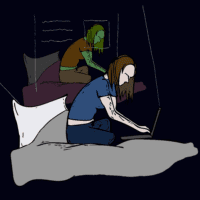
Blogging While Female

Lisa Dusenbery  ·  November 3rd, 2011

In an article at NewStatesman about sexist abuse online, nine bloggers reveal their experience with abusive, mysoginist comments, as well as rape and death threats.

Blogger digby added an interesting perspective on the subject, explaining that when people assumed her pseudonym “represented a male,” insults had a starkly different tone.

“My favorite all time comment has to be the fellow who complained, ‘You wrote a lot better before you came out as a woman.’”

A Internet-Based Literary Performance Piece

Sam Riley  ·  July 28th, 2011

Do you know about the Precession?

Judd Morrissey and Mark Jeffrey’s project is pioneering new digital landscape, making the act of writing into a visually-stimulating performance piece, combined with the personal act of reading work on the Internet. It is a collaborative performance piece, a social commentary and ready for you to experience at any time.

“The multiple elements of the duo’s practice — travel and experience, writing, programming, performance, and documentation (both of experiences and performances) — suggest the act of making art as a powerful analog for action in the world: civic action, exploration, and participation in the world, and the subsequent creation of community.”

Revolutionary Wikipedia

Sam Riley  ·  May 17th, 2011

All of us Wikipedia users are constantly reaping the benefits of massive information-based collaboration. This essay, published in the Awl, considers why this resource is so essential in our digital age. Anybody who has ever accidently cited Wikipedia on a college paper as a freshman can now liberate themselves from the shame–Wikipedia is deconstructing the personal ownership of ideas, transforming our material world and creating a new unity.

Real Life Honesty

Sam Riley  ·  May 10th, 2011

“‘One of the most important reasons to write, to make art, to make music, to be an artist of any sort, is to connect. To show others, ‘I too have felt this way, share it with me.’ If you try and connect with anyone in a way that is not earnest, it isn’t a connection. It’s a con. It’s a mask.’”

Our very own managing editor, Isaac Fitzgerald, offers some eloquent perspective on honesty, the internet and art in this KQED article about forging real life connections versus promoting our internet personas.

Digital Folk Art

Sam Riley  ·  April 19th, 2011

“Like quilting, archiving employs the obsessive stitching together of many small pieces into a larger vision, a personal attempt at ordering a chaotic world.”

This essay provides some edgy perspective on archiving, folk art and collectors as artists. Also, how the internet has intertwined the act of archiving and creating. (via Ubu Web)

Dan Weiss’s Morning Coffee

Walter Green  ·  November 8th, 2010

Some people wait a lifetime to find a website full of cool-looking old cassettes. (via John Gall)

This tumblr collects “funny tombstones from around the world.” (via Jason Arias)

To commemorate the Giants winning the World Series, McSweeney’s is selling a cool limited-edition poster of Giants-related Dave Eggers drawings.

The headline for this is, “Nicaragua Raids Costa Rica, Blames Google Maps.” What a world! Also, that website is called Search Engine Land. That’s where my family and I summer!

Should We All Commit Facebook Suicide?

Michael Berger  ·  May 20th, 2010

“But somewhere in that transition from a social site meant to deepen interpersonal relationships to a self promotional, commercial tool, Facebook lost its appeal.

“The various facets of my life merged into a web of connectivity where I could no longer clearly create distinct relationships with friends, foes, and fast food — either because I can’t figure out how or because Facebook is preventing me outright.

“For me, the overwhelming connectivity to everyone and everything, without much control over those ties, feels like I’m no longer connected to anything, and meanwhile, outside groups benefit.”

Laura McGann has deactivated her Facebook account and here’s why. (via Bookforum)

I’ve been hearing lots of arguments about how we should all quit Facebook. From countless privacy issues to F.B. hiring former Bush administration stooges, lots of well-intentioned folks have made strong cases for quitting while the next moment logging in to make a comment about their friend’s Youtube post. Facebook’s addictive nature is the strongest reason for deactivation, at least in my opinion.

But I still won’t do it. . . not until my friends do it. See, it all goes back to peer pressure, the only thing I really learned in grade school.

The Rumpus Sunday Book Blog Roundup

Seth Fischer  ·  February 28th, 2010

The author of the forthcoming My Life with the Lincolns asks what happens when you type Abraham Lincoln into Etsy. The answer is pretty awesome.

Anyone interested in fiction and the Internet should read this now.

Sappho and banjos! (via Bookslut)

Why does everyone hate the small bookstore?” (via Bookninja)

In the age old rivalry between Batman and Superman, Batman comes out on top by $75,500.

Dear Martin Amis, Just stop. And no more palling around with Hitchens. Someone’s gonna get hurt.

No Wi-Fi: A Very Short Q&A with Alan from Borderlands Cafe

Seth Fischer  ·  February 14th, 2010

A couple weeks back, I was in a bad way. I’d recently joined Twitter, was always on Facebook, and checked my email (and I don’t exaggerate) about 75 times a day. I couldn’t stand it, but I also couldn’t stop. I spent more than half my waking hours on a screen.

It’s not heroin. I should have been able to stop myself. But I couldn’t. Really. I wasn’t getting any writing done. I was ignoring my girlfriend and my friends. I was reading George Packer’s musings on how all this technology needs to stop and tearing up. I read this article about heavy web users being depressed. I agreed. I checked my email again.

And then, I found this essay at The Millions about a student who had to go to a corner of the Coop in Harvard Square where the wireless didn’t work  to get writing done, and, after chuckling at the irony, I decided to do what he did.  I had heard about a coffeeshop called Borderlands Cafe, affiliated with Borderlands Bookstore, that had opened just a couple months ago here in San Francisco.

Not only do they not have wireless, but they don’t have music, and everything is remarkably well lit.  …more

Ceasefire Liberia And The Promise of the Internet

Seth Fischer  ·  November 15th, 2009

Going through the book blogs every week, I read a lot  about how the Internet is ruining everything — from publishing to our attention spans to investigative journalism to our social lives. But every once in a while, I hear about an online project that’s so necessary and does so much good that I flash back to what it was like when all this technology was brand new and we thought it would turn the world into some sort of tech-happy utopia.

Today, I found one of these projects over at Galleycat’s Morning Media Menu. On Thursday, they featured an interview with Ruthie Ackerman, the founder of the hyperlocal web site Ceasefire Liberia.  The site is “a multimedia project which aims to document the Liberian experience on both sides of the ocean.” It is also an example of what writers and journalists can do with the Internet if they look beyond the assumption that they, by virtue of being professional writers or journalists, have a monopoly on writing about the communities they’re interested in. …more

Science Saturday

Brian Spears  ·  October 31st, 2009

Happy 40th birthday to the internet. Just don’t go buying a Harley to prove you’re still vibrant.

In what may be the most counter-intuitive finding in recent years, the internet might actually make people smarter, which frightens the hell out of me, considering what you can find online.

Bad drivers may be born that way, but that still doesn’t explain why they all wind up in south Florida.

Scientists are trying to synthesize spider glue for potential use as surgical adhesive.

MSNBC provides a slide-show of a steam-punk Haunted House.

And finally, check out Olivia Judson’s piece on how both language and facial gestures can affect your mood. Really interesting stuff.

You Caught Me

Steven Tagle  ·  October 13th, 2009

Shoplifting from American ApparelTao Lin’s characters are constantly connected, yet physically detached. The technology they live and breathe often seems less mechanical than its users. …more

Poems for the Gmail Generation

Steven Tagle  ·  September 10th, 2009

3139396473_62a51dc501_mBrandon Scott Gorrell’s debut collection, During My Nervous Breakdown I Want to Have a Biographer Present is an anxious, ambivalent ode to Internet culture. …more

The Rumpus Sunday Book Blog Roundup

Seth Fischer  ·  July 12th, 2009

It’s summertime. BookExpo is in the past. Writers have taken a little break from accosting critics. The book blogs finally have some free time.

And like most people, they are spending that time poking around the Internet and finding lots of things that are a little bit brilliant, from a homeless book club to a web site that asks gifted authors to write on slightly ridiculous objects to something called “possibilianism.” That, plus a “failed interview with Marilyn French,” giving up on vampires, and Middlesex on TV, all below the fold. …more

Harvard Study ‘Punctures Twitter Hype’

Jeremy Hatch  ·  June 10th, 2009

That’s the claim of a BBC News article which quotes the study’s lead researcher, Bill Heil, as follows: “Twitter is a broadcast medium rather than an intimate conversation with friends,” and “it looks like a few people are creating content for a few people to read and share.” That’s no great surprise, but there are a couple interesting items in the data. For example, men are much more likely to follow other men on Twitter than on other networking sites, where they tend to follow women instead. Heil has a hypothesis about that. …more

The Machine that Changed the World

Jeremy Hatch  ·  June 5th, 2009

Just in case you were looking for a compelling 5-part documentary series to watch for free over the weekend, consider The Machine that Changed the World, a history of computing jointly produced by WGBH Boston and the BBC in 1991. Last spring it was rescued from oblivion and made available online by Andy Baio, Simon Willison and Jesse Legg. The episodes are available as streaming Flash videos, but there’s also a torrent, if you’re into that.

Baio describes the series as “the longest, most comprehensive documentary about the history of computing ever produced …more

Is the Internet Ruining Our Lives?

The Blurb  ·  March 2nd, 2009

You are being watched.

by Marianne Rogoff

We’re distracted, our attention is shot, we are under surveillance, and we don’t care! We like being linked and friended by strangers who may or may not be who they say they are. …more

A Month Without Internet

Stephen Elliott  ·  December 13th, 2008

Two years before I founded The Rumpus.net I spent a month offline. I published the result in Poets and Writers but since it’s not available online we’re publishing it here as a Rumpus Reprint. …more

Jay Smooth on “The Big Moment”

Ainsley Drew  ·  December 3rd, 2008

Jay Smooth is the founder of WBAI’s Underground Railroad, New York’s longest running hip-hop radio show.  Like nearly all other bipeds, he has a blog. What differentiates Smooth from the pack is that his video posts on ill doctrine are amusing and articulate, blending intellectual commentary and blistering spoken word.  Even for those completely removed from hip-hop culture, Jay Smooth is likeable and relevant, almost like an upgrade of D.L. Hughley. This ill doctrine post about Barack Obama being elected serves as an extremely well-delivered, friendly reminder that we’re all responsible for translating the pull of a lever into a lasting legacy. Play to see Smooth point out that a functioning system isn’t solely one person, but the result of ongoing actions.

[via ill doctrine]