
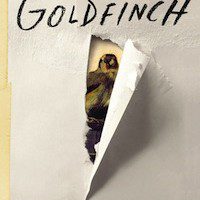
While I was reading The Goldfinch, I looked around the BART train one morning and my eyes lit upon a cryptic poster inviting me to discover the real truth about our greatest domestic catastrophe, courtesy of a group called Architects and Engineers for 9/11 Truth (AE911Truth, for short). The poster, which I keep seeing around the train, seemed a good corollary to the novel I had just started. In the aftermath of tragedies, people become obsessive, do strange things. As the tragedy recedes and is sewn up into the past, these strange things appear increasingly weird to casual observers.
In Donna Tartt’s new novel, a young boy named Theo is caught up in another New York catastrophe, the fictional bombing of the Metropolitan Museum of Art. A dying stranger (himself remembering an earlier catastrophe) instructs Theo to save Carel Fabritius’s 1654 painting of a goldfinch, which Theo then proceeds to lug around for the next decade, a beloved albatross threatening visits from Interpol at every moment. The parallels with the AE911Truth squad quickly run out, but I thought about them raising the money for their BART print campaign, watching the video footage for ten years, and I was reminded that we are none of us prepared to deal with tragedy.
In Tartt’s fictional tragedy, Theo gains a painting but loses a mother. He lives for a while with the wealthy family of a classmate, before his shitbag father and girlfriend Xandra appear from nowhere and squire him away to Las Vegas. In this hot, empty limbo, Theo meets another waif named Boris, also with a shitbag father, also damaged and lovable. The two boys adopt Xandra’s neglected white dog Popper; they take a lot of drugs and take care of the dog and love each other with the fierce romance that is only possible in adolescence. Although Theo spends the entirety of the novel pining for the mostly off-screen Pippa, a fellow survivor of the bombing, it is his relationship with Boris that forms the emotional core of the story.
Theo eventually leaves Las Vegas and finds himself in the furniture shop of the dying man from the Met. He finds himself back in the home of the patrician family of his classmate. He finds himself reunited with Boris after many years apart. For reasons concerning the goldfinch, he finally finds himself in Amsterdam with a pill problem and a gun in his hand. Things get very lofty at the end of Theo’s recollections, when he looks back at the wreckage of his still not-very-advanced years and issues a somewhat chaotic treatise on life and art and his own version of Non, je ne regrette rien. He narrates, “I add my own love to the history of people who have loved beautiful things, and looked out for them, and pulled them from the fire, and sought them when they were lost…”
I had never read Donna Tartt’s cult favorite, The Secret History (which prompted Alexander Nazaryan to write in a recent review for Newsweek, “there are two types of readers: those who know that Donna Tartt’s 1992 The Secret History is the finest debut in late 20th century American fiction and those whose opinion can be safely discounted”). Since my expectations for The Goldfinch were constructed entirely upon the enthusiasms of other people for Donna Tartt, I felt it necessary to read her first novel after I finished this, her third. And I enjoyed The Secret History. But there are some things, like Heathers or Star Wars, that need to be watched or read at precisely the right moment in your development or you are doomed not to really get them, and to forever get the side eye from those who do.
There is a moment in The Secret History when the young protagonist from modest origins tries to convince an effete classics professor to let him into an exclusive class by embellishing his California roots. He narrates: “I gave him the spiel. Orange groves, failed movie stars, lamplit cocktail hours by the swimming pool, cigarettes, ennui.” For whatever reason I have fixated upon this insignificant passage as being emblematic of my main problem with Donna Tartt, whom I find guilty, somehow, of simultaneously relying on shorthand, belaboring certain points, and generally being unconvincing. You can’t just say “cigarettes and ennui” and the Red Sea parts. By this method, The Secret History is “trust funds, spectral country mansion, incest, someone named Bunny, murder, suicide.” (It’s Dead Poets’ Society meets Cruel Intentions.) In The Secret History, a low-born fellow tries to run with the perverse high-born; both that novel and The Goldfinch reminded me of aspirational nineteenth-century novels that were written for regular ladies to experience the thrill of fancy life.
The Goldfinch is equally full of class markers, comical names (Kitten), kinds of antiques, and names of schools, so that the reader occasionally has the sense of being bludgeoned with a sledgehammer from some very tony shop. The nineteenth-century effect is somewhat exacerbated by elements of dialogue that are actually just bizarre. Why, why should the Albany-born Mr. Hobie, restorer of antique furniture, say things like “He was a bitter old sod” or “It takes some people that way, the sea”? (Perhaps this is where Theo learns some of his phrasing: “…I knew not a word of Dutch.”)
Paradoxically, while my main complaint about Donna Tartt is that her writing can feel like a class sledgehammer, I enjoyed the parts of the The Goldfinch where the sledgehammer came from below. Tartt perfectly capitalizes on the horror that the urban educated American has for the imagined American of the sprawl. When Theo’s father arrives in New York with Xandra in tow, with “her whiskey voice, her muscular arms; the Chinese character tattooed on her big toe; her long square fingernails with the white tips painted on; her earrings shaped like starfish,” we are outraged at the difference between his paramour and Theo’s mother, who was short on money but long on taste. For their last big meal in New York, Xandra and Mr. Decker take Theo to “a touristy restaurant I was surprised my dad had chosen.” During said dinner, Xandra returns from her smoke break, pulls her “massive, bright-red plate of manicotti towards her,” and enthuses: “Looks awesome!” Theo’s dad concurs, even though he’d been “known to complain about overly tomatoey, marinara-drenched pasta dishes exactly like the plate in front of him.”
Theo’s father and Xandra take Theo, who has never been outside of New York for longer than a week, to live in Las Vegas, in a housing development out of Arrested Development’s Sudden Valley: no trash collection, no pizza delivery, pool but no furniture, foreclosure signs, neighboring homes being reclaimed by the desert. When Theo arrives in Las Vegas he is faced, for the first time, with “loop after faceless loop of shopping plazas, Circuit City, Toys ‘R’ Us, supermarkets and drugstores…” He asks Xandra “ ‘Don’t you have public transportation out here?’ ‘Nope.’ ‘What do people do?’ Xandra cocked her head to the side. ‘They drive?’ she said, as if I was a retard who’d never heard of cars.”
Theo’s situation is horrible not just because his mother is dead and his father is a shitbag; his father has become a lowbrow suburban shitbag. Theo reports: “it seemed that they had celebrated their ‘anniversary’ not long before my mother died, with dinner at Delmonico Steakhouse and the Jon Bon Jovi concert at the MGM Grand. (Bon Jovi! Of all the many things I was dying to tell my mother…it seemed terrible that she would never know this hilarious fact.)” The Goldfinch invites you to revel in your own snobbishness, because Mr. Decker and Xandra are actually malign forces in the text; Theo’s dad is a legitimate villain, in addition to the baseline villainy of being sprawl-living, non-public-transportation-using, and bad-food-eating. The Goldfinch has been described everywhere as “Dickensian,” and it is; but Theo’s father and erstwhile stepmother reminded me of no one so much as the Thenardiers in Les Miserables.
Donna Tartt is catnip for educated people who want to read entertaining but not difficult things about lofty topics and cosmopolitan people. And despite my problems with this book–that it’s big and uneven and sometimes goofy–I’m basically on board. I loved Boris and Popper and the bad parenting and the sojourn in the desert. And the paintings. When I finished The Goldfinch I took a trip to Washington DC, and on a free afternoon I went to the National Gallery. I took a picture of the building and texted it to a long-lost friend, the one bona fide aesthete of my acquaintance, whom I know to be systematically visiting every great museum in the United States. “What should I see?” I typed. (Within seconds he replied: “Lavender Mist. Who is this?”) I wandered through the paintings, looking especially for animals and birds. I saw Hopper’s Cape Cod Evening and admired the glossy, obsequious hounds in J.G. Shaddick, The Celebrated Sportsman. I saw ladies strolling and odalisques lolling. The gentle eyes of Edward Hicks’ Bucks County cows. Dutch dogs and pheasants and fruit and be-ruffled sleeves. Singer Sargent’s serene Cairo Pavement. I imagined a catastrophe, and plucking one of these off the wall in my panic. And I couldn’t quite wrap my head around it. But I took pictures, and I took them home with me, a series of smaller thefts. What can I say–I’m a sucker for beautiful things.



19 responses
I think it misses the point to say that Boris and Theo are at the emotional core of the novel. What makes the novel particularly interesting, is that the emotional and moral center of the book is in constant flux. Mrs. Barbour, for example, in whose seeming coldness represent Theo’s longing for his dead, and therefore equally emotionally inaccessible mother, maintains an almost mystical presence throughout. For me, Boris is more Theo’s alter-ego than emotional center. And there is more irony than intended in stating that Theo “gains a painting” because the thread of possessiveness (and artifice) that runs unbridled throughout the novel is one of its more interesting motifs.
I really enjoyed this critique in spite of what feels like a tinge of typical San Francisco bias.
I’m going to assume this writer is very young. This is the first time I have read a review in which the thoughts and actions of the main characters are directly projected on to all readers, as though their thoughts are the same as the characters they are reading, which is just bizarre. I’m also going to assume that the phrase “Donna Tartt is catnip for educated people who want to read entertaining but not difficult things about lofty topics and cosmopolitan people” is what came first and then a flimsy argument to support it was made.
Readers love a good story, plain and simple. Experienced readers know how to critically read any fiction and learn something about how people work in the real world. It might just be possible that the examples given above are examples of how immature the main characters are, not manifestos for how people should live and think, how they should “revel in their snobishness.”
And what makes Tartt’s writing great, not just good, is that none of the characters are as simplistic as they are painted above – no one is ever all good or all evil. That’s eventually what Theo learns as well, particularly about himself.
This seems to be a prime example of a review being more illuminating about the author than of the material being discussed.
i loved the book. donna tartt writes a hell of a story. i was reading it all over the place, savoring the final pages, dreading coming to the end. it is, to me, a perfect union of literary and popular fiction.
I think the reviewer clearly enjoyed the book, and does a good job of investigating what this enjoyment says about her—and by extension what effect Donna Tartt’s books have on our lives.
I did not want this book to end. This novel has something for everyone..pop culture, art appreciation, intrigue and a large portion of humanity. Living outside of Albany NY, I found the Hobie tie to this area(home of the Shakers) most interesting as well as the wealth of information concerning furniture restoration. I have read all three of Donna Tarrt’s novels and I can’t wait for the next! This novel is intellectual good fun written by an author whose intellect is obvious……this is one ride the reader will enjoy taking…
I read The Secret History what seemed like 20 years ago and upon hearing The Goldfinch was to soon be released I re-read it in preparation. Funny, all I could remember was how I felt about the book, not the story itself. I knew I loved it, I knew it was a book I cherished and I was certain I had read a tale from an author who will one day be considered a treasure. After consuming The Goldfinch my feelings have been validated. Her nuanced descriptive writing had me living the part. I felt the anxiety of Theo and on several occasions had to pour my own stiff drink. Such a magnificent ride and I was there throughout. I can’t just pick up another book to read just yet. One needs to absorb what they’ve actually been taken through with a Donna Tartt book. She elicits a thoughtfulness from me like no other author I’ve read in ages. I think The Goldfinch is a masterpiece.
Finally, a review that at least glancingly mentions something that was making me crazy while reading this book (much as I loved it, and plowed through it in two days): “The nineteenth-century effect is somewhat exacerbated by elements of dialogue that are actually just bizarre.” I didn’t think “nineteenth-century”, but “bizarre,” yes for an American novel — that “old sod” the review quotes, and at least 30 other words and phrases I made note of until I gave up because they were so constant and recurring, are British (modern, not just nineteenth-century). I’ve been Googling my fingers off with things like “is Donna Tartt British,” “is the Kindle version of The Goldfinch British,” “Britishisms in The Goldfinch,” and I can’t remember what-all else, and I haven’t found any other references to it in any reviews or discussions. I finally realized that since words like “color” aren’t spelled “colour” and words that end in “-ize” aren’t spelled “-ise”, among other things (and also the audio matches the text, and the reader has an American accent) that it’s not an actual British-English “translation” I’ve read.
But good heavens: polo neck instead of turtleneck, bloody (as an adjective), crikey, meant to (where Americans would say supposed to), ring off (instead of hang up [the telephone]), lift instead of elevator, a taxi drove “round the corner,” and on and on. A few of them are when Boris is speaking, and since he was raised in Australia that would be understandable, but there are many more that are just in the narrative, or spoken by American characters.
Well, ok, not that it really matters, I guess, and I’m enough of an Anglophile that I understood them all (even use a lot of them myself sometimes) but as I read someplace in all my Googling (not about The Goldfinch but about British vs. American English), any technicality or device of the author’s that takes you out of the story is not a good thing. In this book it seems pretentious, I guess.
Another thing that bothered me was the timing. In the beginning when Theo’s looking back from Amsterdam he said it all took place 14 years ago. Yet there were references in the 14-years-ago part to kids his age having cell phones (his mother had taken his away as punishment, and shortly thereafter he and Boris and everyone at their school had them), which I know was not nearly as likely as it is now, and people using their cell phones to video the museum after the explosion (cell phones didn’t have cameras 14 years ago). And then no indication that the 14-years-later part takes place in the future. Well, ok, she wouldn’t have to actually indicate it in any particular way, but it really seems more likely that the adult Theo is living in the present, so the anachronisms during his teenage years are jarring. I was thinking for a long time that since there was not one single reference to 9/11 that the earlier part really was set 14 years ago (despite the cell phone mistakes), or in some completely fictional time, because you’d think that the bombing would have drawn all kinds of comparisons that would have cropped up in the narrative somehow, but no, finally, very near the end, there was an offhand reference to 9/11. So.
Well, whatever; as I said, none of that kept me from being completely immersed in this book for the better part of two days (thanks to the audio I didn’t have to put it aside while I cooked or ironed or anything). It’s an amazing story, amazingly well-written (despite my petty gripes above; I’m way too detail-oriented and obsessive about some things) (obviously), really really beautiful and thought-provoking. I cringed and held my breath a few times (at some of the scrapes Theo and Boris got into, not least in Amsterdam, of course), felt Theo’s constant anxiety, and laughed out loud in more than a few places. I loved the evocative comparisons of moody, cloudy skies to those of at least four different artists in the course of the book. (Mr. Barbour likes Maxfield Parrish’s, to his wife’s chagrin, it seems; not very highbrow for someone living on Park Avenue.) The descriptions of furniture restoration and sailing, among other things, are works of art in themselves. Definitely one of the best books I’ve ever read; I highly recommended it.
It’s bad enough writing a book and wondering if people will like it. But now we should wonder if they will like the review?
I loved the book and can not dare nit pick it or the reviewer.. Hat’s off to Donna Tartt for bringing that little creature to life to so many of us readers… This book has so moved me with the rich characters and absorbing tale. I was almost afraid to read the end, afraid it might spoil it….At first I thought it was too philosophicial. Now I am left with one of the best books I’ve read in a long time and the realization that after all these years that little goldfinch like so many wonderful things can still touch us in such a satisfying way..
This is a work by a master, not for persons who want quick action or a
compact style, even less such detailed and expansive descriptive power in a book of considerable length. That one reviewer above read it in two days invites disbelief, at least insofar as he or she could possibly have absorbed or savored such command of the language, or the compelling intellectual and emotional peon on life and what it means to be human that constitutes the lengthy coda, a reflection worthy of truly exalted poetry.
Ellen, I do believe there are references to 9/11 having occurred at some recent point before the explosion in the beginning of the book. So Theo is 13 at some point in the 2000’s not 14 years ago. I guess 14 years hence would put him in the near future when he is in Amsterdam. As you said, though, none of that is important when you realize the sheer brilliance of this novel.
Great read and I am savouring this novel;just two thirds of the way through. Has Donna inherited Tom Wolfe’s mantle? In the tradition of a comedy of manners finally with a dollop existentialism in the bleakest moments.
I finished reading “The Goldfinch” this morning. I had also been wondering about the ending, how could it be satisfactory? It was. The discussion about the role of art in society finished an absorbing book, that I enjoyed partly because it followed a single path and was the voice of one person, who I got to know well. What’s wrong with catnip? Natural, healthy & relaxing!
It’s been almost a week since I read The Goldfinch, and made my comment…I’m still savoring it and relish hearing other people’s comments
Finally got around to reading The Goldfinch and finished it over the weekend. I share some of my thoughts on the book’s themes, Art and Death here – http://guiltyfeat.com/2014/02/18/good-soldier-good-soldier/
I agree with the 19th Century effect. I thought it was a tribute to Dickens. http://daeandwrite.wordpress.com/2014/04/06/oh-donna-the-goldfinch/
This novel is very long and seemed to me to be a bunch of stories somehow lumped together.The momentous events,interesting escapades
and character studies made a good read and the fact that all the people, good or bad, had layers of both good and bad was encouraging.
The lengthy descriptions were poetic and really made you feel engaged but became tiresome and skippable as the book went on.
The “sermon” at the end with its improbable revelation that Theo had kept a sort of journal and the conclusion that while life may be better avoided in that it ends badly there are nice bits before the end that make it worthwhile and that Art somehow makes it possible to live forever.. The book was engrossing and – Oh so clever.
It seems to me that Donna tartt doesn’t give a fig about the prevailing pretentious and severely limited ideas about what comprises a great book. She just loves writing. Which is most likely how she has been able to write a great book. who made the rules anyway?
I knew people wouldn’t understand this novel from the moment I met Theo Decker. If you held a mirror of the soul up to my actual son, Theo would be looking back. And like the protagonist, he is a walking contradiction of emotion, logic, sensitivity and selfishness – humanity to the extreme. The issue that people have with the Goldfinch stems from their outright refusal to even acknowledge that people like this exist. I was dismayed to see one reviewer spend several ignorant sentences debating whether Theo was gay – demanding that the author out him in order to assuage her own nagging doubt that people may be many sexualities, at many different points in their life. Same with Theo’s class, or raw, addictive nature…apparently all too unrealistic for those who require precise characters to laude fiction. For what is good fiction if not for ambiguity? Why would I ever want an author to spell out (literally) the emotions and thoughts a novel requires of me? I won’t disagree that Donna Tartt is sloppy and incongruous in her chronology and candor, but I do actually know people who speak in anachronistic phrasing – they happen to love antiques, pine for ‘halcyon’ days, and they most definitely would recognize a homeless Pip, and the many caraciatures he assumes in order to cope with profound uncertainty and chaos. Some people do have it this bad, some people are hit over and over the head by life. To disregard these people – who remain afloat, if damaged – over notions of proper behavior, logic, class and even race – is to willfully disregard a part of humanity that the Goldfinch, painting and prose, conveys with such ironic simplicity.
Click here to subscribe today and leave your comment, or log in if you’re already a paid subscriber.