
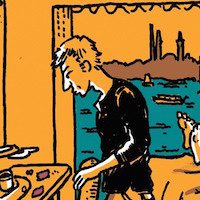
Both of the below true graphic stories created by my brother, Eric Orner, were rejected by two different online magazines for reasons, apparently, exclusively due to content. In the first instance—the work returned yesterday, the day of violence in Paris, though it had been scheduled to publish soon—apparently because of the scene involving the naked Muslim woman and her enraged husband in an Istanbul hotel. The second piece was rejected, after much back and forth with editors, because my brother refused to change a phrase used to describe an Israeli military response, “as unleashing the dogs of war.”
These are two human stories, and aren’t, as will be obvious, meant to be overt political statements. They are just stories of things that happen in a life lived among other human beings.
They aren’t without a point of view or an opinion, but clearly weren’t mean to be offensive, either. In the one case, my brother opened the wrong hotel room door. Who hasn’t done this? The people inside that room were, understandably, upset. In the second, he used a common phrase to describe the ugliness of war. Should he have said “the daisies of war” instead? In his Israel story, my brother was mostly upset, as you’ll see, that his 50th birthday party on the beach in Tel Aviv was wrecked. (I was, too; I’d been looking forward to it.)
If my brother is an offender, he’s an equal opportunity offender. We should be able to tell such stories without anybody looking over our shoulder, now more than ever. And yet, it seems we are moving in the other direction when publications steer clear of anything that might raise any issues whatsoever. In the spirit of telling human and humane stories, shouldn’t we risk offending Muslims, Jews, and everybody else in the universe? Or is, at the end of the day, all this ‘We Are Charlie’ stuff just the easy sloganeering of the moment?
I’m afraid that the events of yesterday will, in spite of much talk otherwise, result in more censorship, not less. The only true way to defend free speech is to exercise it—not just talk about it.
***


***
Eric Orner is the author of four books in the Mostly Unfabulous Life of Ethan Green series (St. Martins). A new Ethan Green compilation will be published this year. The alt-weekly comic strip was also adapted as a feature film. Orner’s work has been published in the Washington Post, the Boston Globe, Best American Comics, as well as in alternative and gay newspapers across the United States and Europe. A former staff counsel for Congressman Barney Frank, Orner currently works for the City of New York.



12 responses
Orner has a great point. Both of these cartoons are excellent and should not be in the least bit offensive–it’s scary how squeamish editors would reject them, afraid of offending the thin skinned. Slogans are great, but we need to live up the slogans or else they are nothing but empty words. Bravo to the Rumpus for publishing these.
Thanks for this article which points out how much self-censorship (or outright censorship happens on a daily basis in the MSM). Journalism should indeed be much, much more than purposely offending someone’s religion and participating in deliberate culture wars. There’s already enough Islamophobia. With all respect to the dead and to freedom of the press, what great, pressing need did Charlie Hebdo’s offensive cartoons fulfil?
What is it that Salman Rushdie said What is freedom of expression? Without the freedom to offend, it ceases to exist.†Something along those lines. It is precisely these kinds of nuanced, satirical, and human-all-too-human works of art that cause us to think more deeply about the human conditions in the various specificities in which it incarnates as conflict, as love, as suffering, as joy.
It is absurd, really in the extreme, that American publication venues would be frightened of Eric Orner’s delicate and equally hilarous meditation on the accidents and the collisions of life.
Frankly, I’m more offended at Peter Orner’s implied claim to speak la langue française. Can’t we censor that guy?
edit “What is freedom of expression? Without the freedom to offend, it ceases to exist.â€
I think you have to own it to make fun of it….like Monty Python’s “Life of Brian”. But a majority person making fun of minorities culture or religious beliefs, well that is O.K. ? Sure, the K.K.K. does it all the time, right? So is everyone good with that? If a Christian Caucasian pushes the buttons of an oppressed dark skinned minority, that is cool? I thought France had hate speech laws…I hope they are not only for Holocaust survivors…and yes, I believe in responsible freedom of expression.
Charlie Hebdo cartoons feature Muslims and Jews that wouldn’t have been out of place in Nazi Germany. Their cartoons are not especially clever. What about their content enlightens? It doesn’t soften the blow that they poked fun of the pope and Catholics since the pope and Christians are not drawn in a racist way. Nor are Catholics a group, unlike Arabs, that suffers from targeted racism.
Mocking marginalized people is at best a tacky thing to do, and nasty caricature has the power to dehumanize. We can recognize the great tragedy of what happened in Paris, and also dismiss bad political cartooning at the same time.
As a Muslim-American writer, I feel, but cannot prove, that publishers only want to hear certain points of view from people like me, any day of the year. So welcome to the club, or whatever.
Appreciate the thoughts: the problem here is clear on Harry’s thoughtful comment, that he supports responsible freedom of expression. But define responsible? More important: who should be the one defining it? The government? Freedom of speech is often a hard and ugly pill to swallow. And it seems to me that people too often support it in name only, with qualifications. I say you fight racist speech with equally free nonon-racist speech. But once you start going down the road of defining what is acceptable or responsible speech, I believe you call into question the very idea of freedom of expression and it becomes a slogan not a reality. To support free speech means to allow the right of other to express, via speech, the very things you most abhor.
Peter,
It is illustrative to look at other democratic countries. For example, in countries like Canada and Germany, hate speech is restricted. Germany in particular has historical reasons for observing this.
You are right to address the question of who determines what is, and isn’t, hateful. I wish I were more of a legal expert and could provide more details, but I don’t find Canada or Germany less of a thriving democracy than, say the USA, which often tolerates the KKK marching in parades and the right of a preacher to burn a Koran. I actually find the USA pretty hypocritical, since it is imposing mass surveillance and jails dissidents like Chelsea Manning.
In the U.S.A. the first amendment was put into effect to protect the rights of those not in the majority…to not be oppressed or prosecuted for opinions outside the accepted doctrines of that majority in Power. Within that is the idea of freedom of speech. When this freedom is inverted and abused I believe something different is going on, but that abuse should not result in killing, although the abuse may Provoke aggression (on both sides of the equation). Further along we may ask, what is responsible freedom of speech…is it child porn? snuff films? That is the question. I think the answer is always shifting in subtle ways as majority cultural norms change. I too am not a law expert, esp. international law, but once again, we in the U.S.A. should not continue to view the world as ours to make in our own image (Manifest Destiny).
Ahh, a classic example of intellectual self-loathing and hatred of life, liberal-liberalness choking itself to death on the coils of its own contradictions. I don’t mean Mr. Orner’s article- which is excellent- but rather the comments, of course. Clearly what things one may say out loud legally must be decided upon my a committee formed of three representatives each from the top ten ranked American liberal art schools. It shall meet at midnight on the equinoxes and solstices at Margaret Atwood’s house. There is a talking stick; please refrain from speaking until someone has passed it to you. If you would like to hold the talking stick and speak, please raise your hand. A violation of the talking stick rule may imperil your chances for tenure.
Aughh, a word from the spelling and grammar grinch: the word ITS as possessive pronoun (like MY, YOUR, HIS, HER, THEIR, etc.) does not use a blooming apostrophe!! (“It’s” means “It is” or “It has”.)
Click here to subscribe today and leave your comment, or log in if you’re already a paid subscriber.